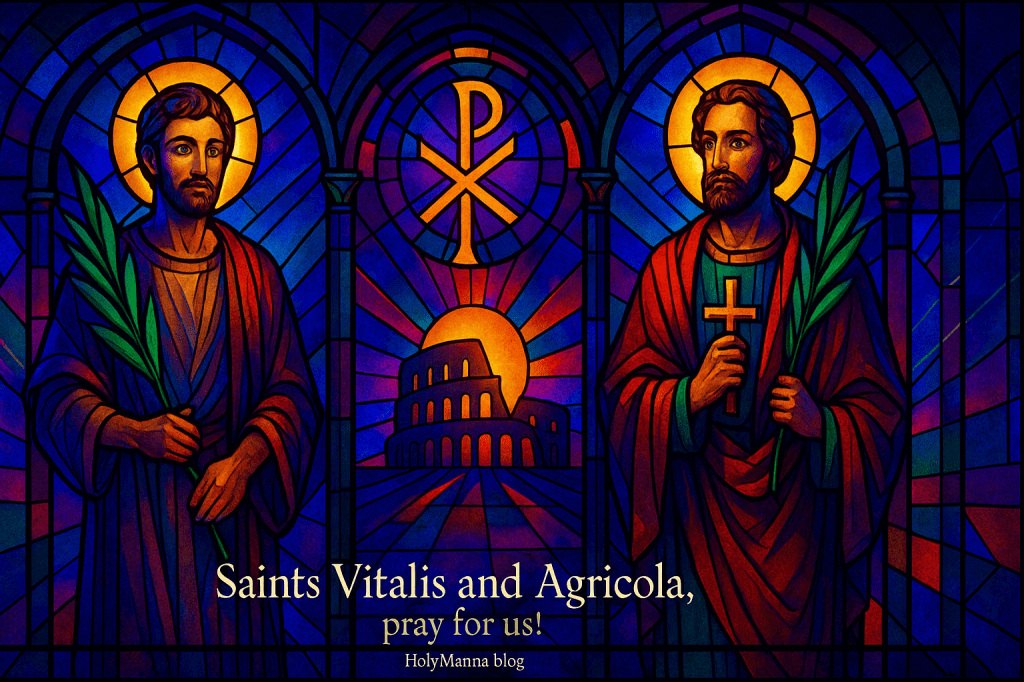
Friends Made Equals by Christ
Bologna still calls Vitalis and Agricola its first martyrs, and their story hits home because it is simple, stark, and beautiful. Agricola was a respected Christian layman. Vitalis was his slave who became his brother in the Lord. Their bond in Jesus turned the social order on its head and made their household a living proclamation that grace is stronger than status. The Church honors them as protomartyrs of Bologna and keeps their memory on November 4. Their witness is sober and bright: two ordinary believers who chose Christ when it cost everything. There are no preserved, verified sayings from Vitalis or Agricola in the ancient sources, which makes the eloquence of their actions all the more compelling. As the Catechism of the Catholic Church teaches, “Martyrdom is the supreme witness given to the truth of the faith… The martyr bears witness to Christ who died and rose… He endures death through an act of fortitude.” (CCC 2473)
From Master and Servant to Brothers
The earliest accounts do not give childhood details or family trees, but they are clear about the setting and the conversion. In Roman Bologna, a city threaded with trade and public games, Agricola embraced the Gospel and shared it with Vitalis in his own household. The grace of baptism remade their relationship from an arrangement of power into a communion of love and responsibility. What Saint Paul wrote became concrete in their friendship. “There is neither Jew nor Greek, there is neither slave nor free… for you are all one in Christ Jesus.” This was not pious talk. It became a pattern of life that others could see, a witness that drew more hearts to Christ. The Catechism expresses the same truth about human dignity: “Created in the image of the one God and equally endowed with rational souls, all men have the same nature and the same origin… With equal dignity the differences among persons belong to God’s plan.” (CCC 1934)
Quiet Faithfulness
The record preserves no spectacular signs worked by Vitalis and Agricola while they lived, and that actually teaches something vital. Holiness usually grows in the soil of ordinary days. Their charity within the home, their steady confession of Jesus in a suspicious culture, and their readiness to suffer rather than deny Him are the real miracles that prepared them for the final test. The Church calls every baptized person into this same path. “All Christians in any state or walk of life are called to the fullness of Christian life and to the perfection of charity.” (CCC 2013) The communion we share means the courage of some strengthens the rest. “Since all the faithful form one body, the good of each is communicated to the others.” (CCC 947) When their hour came, they were already living like saints long before they died like martyrs.
The Final Witness
Persecution under Diocletian swept across the empire in the early fourth century, and Bologna was not spared. Vitalis was taken first, dragged into the games arena, and tortured with a cruelty meant to terrify the Church. Accounts describe his body as covered with wounds, yet he stayed faithful until the end, praying to Christ who had first loved him. Officials then turned their efforts toward Agricola, hoping that a respected citizen might buckle under pressure and persuade others to fall away. Threats and flattery failed. Agricola confessed Jesus with calm resolve and was executed by crucifixion. Friends took their bodies and placed them in a nearby Jewish cemetery, a quiet act of reverence that kept their resting place from profanation. The meaning of their deaths is the same today as it was then. “The Church has painstakingly collected the records of those who persevered to the end in order to hand them on to the faithful.” (CCC 2474) Their crosses were not a tragic accident. They were a free yes to the Lord who first carried His Cross for them.
The Saints Keep Working
Some decades later, the tombs of Vitalis and Agricola were rediscovered. The faithful of Bologna honored their bodies with profound love, convinced that Christ’s victory shines through the members of His Body. Saint Ambrose, bishop of Milan, visited and verified what the Church already sensed in prayer: these were genuine martyrs whose relics the Lord used to encourage and heal His people. A portion of the relics was brought for veneration in other cities, and churches were dedicated in their honor, including the ancient church known as Santi Vitale e Agricola in Arena, linked by tradition with the place of their suffering. Christians told of conversions, deliverance from demonic oppression, and bodily healings granted through the intercession of these martyrs. The Church is careful here. It does not treat relics as talismans but as reminders that grace works through the whole Christ, Head and members. The Catechism explains this devotional instinct with balance and clarity. “From the very earliest days the Church has venerated the memory of the martyrs and other saints with great respect… She remains mindful that… the faithful should be taught to seek the saints’ intercession.” (CCC 1674, 957)
Why They Matter Now
Vitalis and Agricola show what Christian friendship can do. Love turned a relationship marked by rank into a communion marked by reverence. They prove that courage is born in hidden faithfulness long before anyone is watching. They call believers to honor the dead with hope, to treat every person with dignity no matter their status, and to stay close to Christ when pressure comes. A few simple practices keep their lesson alive. Pray for the grace to see Jesus in the people who depend on you. Offer inconveniences and misunderstandings for those who suffer for the name of Christ. Visit a church named for the martyrs or spend time before a reliquary and ask for their intercession for a specific need. Above all, cling to the Lord who never abandons His friends. “Christ is the principle of unity of the Church… In this wonderful exchange the holiness of one profits others.” (CCC 947)
Engage with Us!
Share your thoughts, prayers, or experiences connected to these holy martyrs in the comments.
- Where is the Lord inviting you to love someone across social lines, as Agricola loved Vitalis and as Vitalis loved Agricola in return?
- How can their courage help you respond to pressure or ridicule for living your faith this week?
- What is one practical way you can honor the communion of saints, such as visiting a church, praying before a relic with reverence, or asking for the martyrs’ intercession for someone who suffers?
- When you hear the word martyrdom, what fears or hopes arise in your heart, and how does Jesus want to meet you there today?
Go forward with confidence, live a life of faith, and do everything with the love and mercy that Jesus taught.
Saints Vitalis and Agricola, pray for us!
Follow us on Instagram and Facebook for more insights and reflections on living a faith-filled life.

 Holy Manna!
Leave a comment