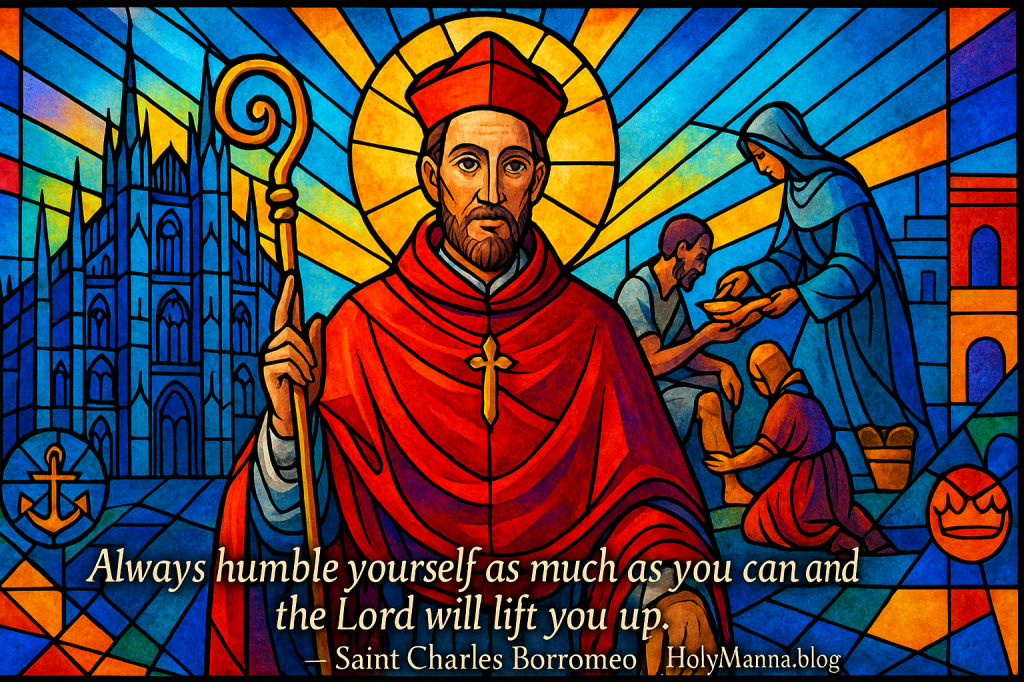
A Pastor After God’s Heart
Saint Charles Borromeo shines as a reforming bishop who turned the decrees of the Council of Trent into living parish life. He is celebrated for establishing seminaries to form holy priests, organizing systematic catechesis for children and adults, renewing sacred worship, and pouring himself out for the poor during famine and plague. His feast is November 4. The Church looks to him as a patron of bishops, catechists, and seminarians because his leadership was not academic only. It was deeply pastoral, relentlessly practical, and marked by humility. His family motto, Humilitas, was not decoration on a coat of arms. It was the way he led. “Always humble yourself as much as you can and the Lord will lift you up.”
From Arona to Reform
Charles was born on October 2, 1538, in Arona on Lake Maggiore into the noble Borromeo family. Educated in law at Pavia, he was drawn into Church service when his maternal uncle became Pope Pius IV. Called to Rome, Charles shouldered heavy responsibilities for the universal Church at a remarkably young age. He was named a cardinal and soon after received priestly and episcopal ordination. In 1564 he became Archbishop of Milan, a vast and complex diocese that had gone without a resident shepherd for years. His first move was not to centralize power but to convert hearts, starting with his own. He embraced a disciplined life of prayer, fasting, study, and works of mercy. The Council of Trent was still unfolding and he worked to reconvene and complete it. After Trent, he helped oversee the publication of the Roman Catechism, the standard for parish teaching, and he pushed for uniform liturgical books so that worship would be clear, reverent, and faithful. Charles did not simply sign documents. He traveled on foot and by mule into remote parishes, corrected abuses, reconciled enemies, and set up seminaries so that clergy would be formed in doctrine and virtue. “Are you in charge of a parish? Do not neglect the parish of your soul.” That line, preserved in his letters, shows the heart behind his reforms. Shepherds must be holy if the flock is to flourish.
Trent in the Streets
What Trent taught in its canons, Charles carried into kitchens, classrooms, and sanctuaries. He organized the Confraternity of Christian Doctrine so that children and busy workers received clear, regular teaching. He preached with clarity and demanded the same from his clergy. He insisted on beautiful, worthy celebration of the sacraments because he knew reverent worship shapes holy lives. He founded and endowed seminaries, colleges, and houses for religious so that learning and holiness would reinforce each other for generations. When famine hit in 1570, he opened his own purse and sold possessions to feed the hungry. During the plague of 1576 and 1577, he provided food, organized nursing care, and oversaw outdoor altars so people could assist at Mass from their windows while quarantine orders were observed. He walked in penitential processions barefoot with a rope around his neck, carrying the relic of the Holy Nail, and begged God’s mercy for his city. None of this was for show. He believed the Gospel touches bodies and souls together. “Be sure that you first preach by the way you live.” His daily choices made that counsel visible.
Signs That Strengthen Faith
Charles was known above all for reform and charity, yet God also confirmed his mission with signs. Accounts from his contemporaries describe healings after his prayers and blessings. Many families recorded recoveries from sudden illness, and there were stories of protection during his pastoral visits in dangerous regions. These were not spectacles. They were quiet mercies that accompanied a shepherd who trusted God and gave himself without reserve. “If a tiny spark of God’s love already burns within you, do not expose it to the wind, for it may get blown out.” He guarded that spark through prayer and penance, and God used it to warm the cold places of his diocese.
Trial by Fire
Real reform meets real resistance. Charles confronted entrenched abuses and laxity, and not everyone welcomed correction. In 1569, while he was praying in his chapel, an assassin fired at him. The shot wounded him but did not end his life. Many took his survival as a sign that God still had work for him to do in Milan. He also endured political pressure from civil authorities who pushed back against episcopal discipline and pastoral visitations. Fatigue, misunderstanding, and slander followed him, yet he kept going with patience and courage. “The cross is the gift of God to his friends.” He saw suffering as a path of union with Christ, not a reason to retreat, and he died worn out by love on November 3, 1584.
Intercession that Endures
Veneration for Charles spread quickly after his holy death. Miracles of healing and deliverance were recorded and studied in the processes that led to his beatification in 1602 and canonization in 1610. Pilgrims have long visited his shrine in the Scurolo of Saint Carlo within the Milan Cathedral to ask his intercession, to seek conversion, and to learn from the scenes of his life depicted around his relics. Parents pray there for the faith of their children. Priests and bishops kneel there to renew their pastoral promises. The poor and sick come to entrust their needs to a shepherd who once fed and nursed them himself. The Church continues to experience his help because charity never fails and the saints live to make intercession.
Why Charles Matters Now
Charles embodies what The Catechism of the Catholic Church teaches about pastors and charity. “The Good Shepherd ought to be the model and form of the bishop’s pastoral office.” He is also a living illustration of what the same book teaches about the works of mercy. “The works of mercy are charitable actions by which we come to the aid of our neighbor in his spiritual and bodily necessities.” His pastoral plan remains timely. Teach the truth clearly. Celebrate the sacraments reverently. Form disciples steadily in homes and parishes. Care for the poor concretely. Guard your soul through daily prayer and regular confession so that service flows from holiness. When discouragement sets in, his counsel still reads like a field manual for everyday sanctity. “Be patient with everyone, but above all with yourself.” Growth is slow, grace is sure, and humility keeps the door open to God.
Walking the Borromean Way
The path of Saint Charles is not complicated, but it asks for faithfulness. Choose substance over image. Place the Eucharist at the center of the week with Sunday Mass and a weekly holy hour when possible. Read a few paragraphs of The Catechism with a friend or spouse and talk about how to live it at home. Practice the works of mercy in small, steady ways by visiting a lonely neighbor, cooking for a struggling family, or offering a ride to someone who needs help getting to church. Keep learning the faith and keep bringing that learning to prayer so that love is what people notice first. “Be sure that you first preach by the way you live.” That line can shape an entire life.
Engage with Us!
Share your thoughts and graces from Saint Charles’s witness in the comments below.
- What part of Saint Charles’s life challenges you to change something concrete this week?
- Where is God inviting you to practice a specific work of mercy in your neighborhood right now?
- How can your home become a small school of faith, echoing his catechetical vision?
- When opposition or discouragement rises, which moment from his story strengthens your hope?
May the zeal of Saint Charles Borromeo ignite courageous love in every heart. Live the faith boldly, serve the suffering generously, and do everything with the love and mercy Jesus taught us.
Saint Charles Borromeo, pray for us!
Follow us on Instagram and Facebook for more insights and reflections on living a faith-filled life.

 Holy Manna!
Leave a comment