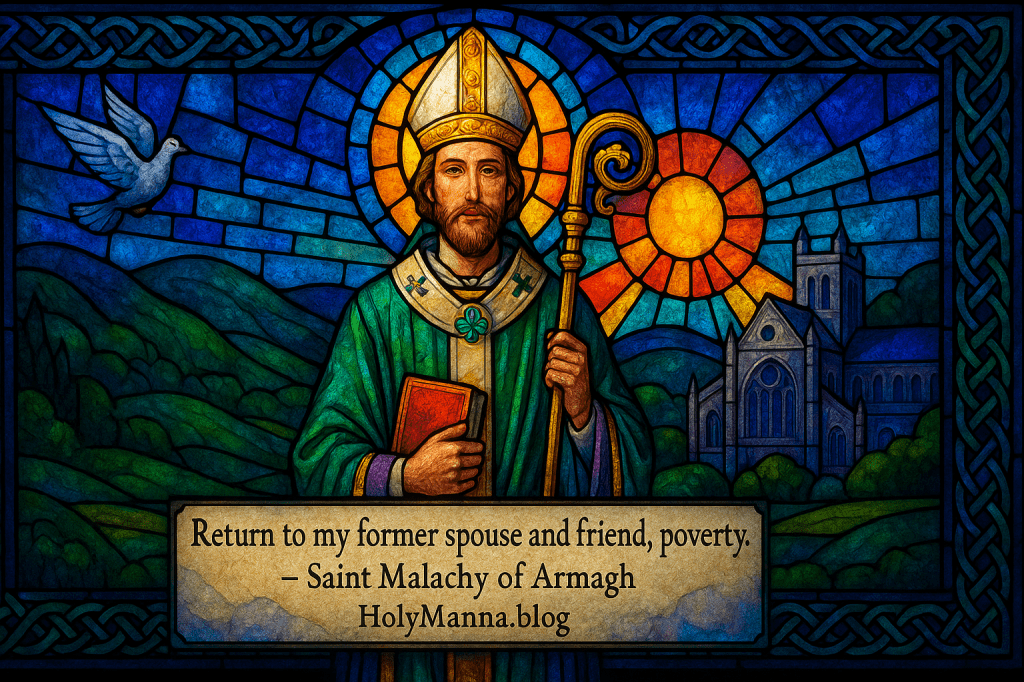
A Shepherd Who Brought Ireland Home to Rome
Saint Malachy of Armagh shines as the tireless twelfth century bishop who helped bring the Irish Church into deeper unity with Rome in worship, law, and pastoral life. He is remembered for firm love of the liturgy, contagious humility, a gift for reconciliation, and a warm friendship with Saint Bernard of Clairvaux that helped spark monastic renewal across Ireland. Malachy made long journeys to preach and to heal, to regularize Church discipline, and to ask the pope for the pallia that would confirm the Irish metropolitan sees in full communion with the Apostolic See. He died at Clairvaux on November 2, 1148, and because that is All Souls’ Day, his feast is kept on November 3. Pope Clement III canonized him on July 6, 1190, making him the first native born Irish saint to be formally canonized in the Church’s juridical process. His whole life is a living illustration of what the Catechism of the Catholic Church teaches about bishops as successors of the apostles: “In order that the full and living Gospel might always be preserved in the Church, the apostles left bishops as their successors.” (CCC 861)
From Armagh’s Schools to a Burning Zeal
Malachy was born around 1094 in or near Armagh into a family known for learning and service to the Church. As a boy he was placed under the guidance of a holy anchorite who formed him in prayer, Scripture, and ascetic discipline. Under Bishop Cellach of Armagh he learned the art of pastoral reform and the importance of right worship. Ordained a priest in 1119, he was soon entrusted with heavy responsibilities in Armagh. He pursued further formation at Lismore, where he absorbed a strong monastic spirit, and then returned to restore the ancient monastery at Bangor, drawing young men into a life centered on the Divine Office and the sacraments. By 1124 he was consecrated Bishop of Down and Connor, leading with a simple style that made room for the poor and the penitent. In 1132 he was called to Armagh to face down the hereditary control that had gripped the primatial see for generations. With patience and courage he restored order, then returned to Bangor in 1137 to live as a bishop monk who held authority with a strikingly light hand. His reputation spread as a pastor who could preach to the heart and mend what had been broken in communities and families.
Reformer on the Road
Malachy’s reform was concrete. He reestablished Roman liturgical practice, regularized the celebration of the sacraments, strengthened marriage discipline, and called clergy and laity to holiness that flowed from the altar into daily life. In 1139 he set out for Rome to seek pallia for Armagh and Cashel. On the way he stopped at Clairvaux and forged a holy friendship with Bernard. That friendship became a channel of grace for Ireland. Through their collaboration, the first Cistercian monastery in Ireland, Mellifont, rose in 1142, bringing a fresh current of prayer, penance, and study to the island. Malachy’s spirituality stayed intentionally poor and free. Saint Bernard remembered him with a line that captures his heartbeat for evangelical poverty: “Return to my former spouse and friend, poverty.” That love for simplicity gave credibility to his corrections and warmth to his preaching. The Catechism explains why this matters for all of us: “The Church…proposes them to the faithful as examples of imitation.” (CCC 828)
Signs That Followed
Miracles accompanied Malachy’s ministry, not as spectacles but as signs of God caring for his people. Saint Bernard recounts dramatic deliverance when Malachy prayed over two women in Coleraine who had been tormented by alternating demonic assaults. He tells of the sick who were restored, of a woman long afflicted with hemorrhage who was healed, and of moments when Malachy’s blessing provided exactly what was needed for the journey. In one beloved story, a poor, stubborn mule became a steady and surefooted palfrey after Malachy laid hands on it, allowing him to continue his relentless circuit of visits to scattered flocks. These signs underlined the Gospel he preached and the sacraments he guarded. The Catechism situates such wonders clearly: “The signs worked by Jesus attest that the Father has sent him…they invite belief in him who does the works of his Father.” (CCC 548) In the saints, those signs continue Christ’s own compassion for his Church.
White Martyrdom in a Time of Upheaval
Malachy’s era was not gentle. The most painful obstacle he faced was the entrenched custom of hereditary control over Church offices, which blurred the line between spiritual authority and clan power. Reform touched nerves. He was resisted, misunderstood, and sometimes slandered. Travel in twelfth century Ireland was exhausting and dangerous, yet he kept moving so that the Eucharist would be reverently celebrated, marriages properly blessed, the dying anointed, and the poor consoled. Though he never shed blood for Christ, his life shows what the tradition calls a white martyrdom: a steady pouring out of self for the unity and sanctity of the Church. On a second journey toward Rome in 1148, he fell ill in France and asked to be taken to Clairvaux. There, surrounded by Bernard and the monks, he surrendered his soul to God on November 2. His passing on the Commemoration of All the Faithful Departed became a final catechesis on hope in the resurrection. The Catechism reminds the faithful that the bishop’s pastoral governance is real spiritual fatherhood: “Bishops, as vicars and legates of Christ, govern the particular Churches assigned to them.” (CCC 894) Malachy bore that fatherhood with courage and tenderness.
After the Homecoming
Veneration of Saint Malachy blossomed quickly. Clairvaux treasured his tomb beside the monks he loved, and portions of his relics were later translated to Mellifont and other Irish Cistercian houses, where devotion deepened the bond between monastic prayer and diocesan renewal. Pilgrims came seeking healing and reconciliation, and stories spread of favors granted through his intercession. His memory traveled in the chants, annals, and homilies of the Cistercian world, so that across Europe the name of the Irish reforming bishop became a shorthand for pastoral zeal joined to gentle humility. The Church explains why this devotion is more than nostalgia: “Being more closely united to Christ, those who dwell in heaven…do not cease to intercede for us.” (CCC 956) To ask Saint Malachy’s prayers is to bring Irish courage and Cistercian calm into the storms of the present day.
The So-Called Prophecy of the Popes
Centuries after Malachy’s death, a list of brief Latin mottoes for future popes was published and attributed to him. Serious historians point out that the collection first appeared in the late sixteenth century, fits earlier popes with suspicious neatness, and becomes vague precisely where foreknowledge would have been required. The Church has never treated those lines as authoritative or as genuine works of Saint Malachy. What truly belongs to him is far better and far more beautiful: a life poured out for unity with Rome, a friendship that launched monasteries, and a generosity that healed wounds in the Body of Christ. Keeping focus on those verifiable gifts protects devotion and strengthens faith.
How Saint Malachy Trains the Heart Today
Saint Malachy’s life reads like a map for renewal in any age. He guards the liturgy because he knows worship forms souls. He embraces poverty because freedom makes love agile. He seeks communion with Rome because unity is a gift and a guardrail. He cultivates holy friendships because grace often travels along trusted human bonds. The Catechism calls the liturgy “the work of Christ and the action of his Church,” and it urges the faithful to participate fully and consciously in it (CCC 1071). Malachy spent himself to make that participation real in the parishes he served. A simple way to honor him is to pray daily for the local bishop and priests by name, to frequent Confession and the Eucharist with expectant faith, and to choose one concrete act of simplicity this week that opens space for charity. Let his remembered plea guide the tone of the whole effort: “Return to my former spouse and friend, poverty.”
Engage with Us!
Share your thoughts and graces connected to Saint Malachy in the comments below.
- Where might God be inviting a simpler, freer way of living so that charity can grow in your home and parish?
- How can prayer for your bishop and priests become a steady habit, not just an occasional impulse?
- What one practice could help you participate more fully and consciously in the liturgy this week?
- Which holy friendship in your life helps you persevere in the faith, and how can you nurture it?
Keep pressing on in faith. Live each day with the love and mercy Jesus taught, caring for the poor, cherishing the sacraments, and building up the unity of the Church that Saint Malachy served so well.
Saint Malachy of Armagh, pray for us!
Follow us on Instagram and Facebook for more insights and reflections on living a faith-filled life.

 Holy Manna!
Leave a comment