Monday of the Thirty-first Week in Ordinary Time – Lectionary: 485
A Table Set by Mercy
Step into a feast where everything is gift, and the only entry requirement is need. Today’s readings reveal a single thread woven through salvation history: God pours out gratuitous mercy and asks disciples to mirror that mercy with gratuitous generosity. Romans 11:29-36 proclaims that “the gifts and the call of God are irrevocable”, and that God has “delivered all to disobedience” so that “he might have mercy upon all”. The psalmist in Psalm 69:30-31, 33-34, 36 sings from affliction yet trusts the Lord who “hears the poor” and rebuilds Zion. In Luke 14:12-14, Jesus shatters the normal rules of reciprocity by commanding hosts to invite “the poor, the crippled, the lame, the blind”, promising repayment not now but “at the resurrection of the righteous”.
A little background sharpens the picture. In the Roman world and within many Second Temple Jewish settings, meals created social bonds, honored patrons, and expected returns. Invitations often moved along a ladder of status. Jesus speaks directly into that economy and replaces calculation with compassion. Paul’s doxology in Romans 11 stands in a section where the mystery of Israel and the Gentiles is unfolding. The point is not human strategy but divine initiative that starts, sustains, and completes the story. The lament of Psalm 69 belongs to the voice of the righteous sufferer, a prayer tradition that shaped early Christian understanding of the Messiah and the poor who cling to God when no one else will.
Taken together, the Church reads these texts as a call to receive grace as gift and then to give like God gives. Grace is a free and undeserved help that draws souls into divine life, as taught in CCC 1996–2001. Works of mercy flow from that grace and reveal the heart of the Gospel, as taught in CCC 2443–2449 and CCC 2447. The Eucharist binds believers to the poorest and impels real charity, as taught in CCC 1397. Jesus promises that what love cannot recover in this life, the Father will repay in the age to come. This is not philanthropy for prestige but imitation of the Father whose mercy is limitless.
Who can be invited to the table today who cannot repay, and how might that choice become a living homily on God’s irrevocable mercy?
First Reading: Romans 11:29-36
Mercy That Cannot Be Revoked
Paul brings the community in Rome to the summit of his reflection on Israel and the Gentiles, showing how God’s plan has room for every sinner and every nation. Written to a mixed Church in the mid first century, Romans draws from Israel’s Scriptures to reveal a divine strategy that does not collapse under human failure. The covenant remains God’s initiative. The Gentiles have been grafted in by mercy and Israel is not forgotten. Paul closes this section with a doxology that sounds like temple worship, reminding readers that all of salvation history moves from God, through God, and for God. This passage fits today’s theme by grounding works of mercy in the prior gift of mercy. What happens at the table in Luke 14:12-14 flows from what happens in salvation history in Romans 11. God gives first, and disciples learn to give like he gives.
Romans 11:29-36
New American Bible (Revised Edition)
29 For the gifts and the call of God are irrevocable.
Triumph of God’s Mercy. 30 Just as you once disobeyed God but have now received mercy because of their disobedience, 31 so they have now disobeyed in order that, by virtue of the mercy shown to you, they too may [now] receive mercy. 32 For God delivered all to disobedience, that he might have mercy upon all.
33 Oh, the depth of the riches and wisdom and knowledge of God! How inscrutable are his judgments and how unsearchable his ways!
34 “For who has known the mind of the Lord
or who has been his counselor?”
35 “Or who has given him anything
that he may be repaid?”
36 For from him and through him and for him are all things. To him be glory forever. Amen.
Detailed Exegesis
Verse 29 – “For the gifts and the call of God are irrevocable.”
Paul declares that God does not revoke his covenantal purposes. Israel’s election stands, and the Gentiles’ calling stands. Grace is not a bait and switch. The permanence of God’s call anchors Christian hope, guards against arrogance, and frames the Church’s posture toward Israel with humility and prayerful expectation.
Verse 30 – “Just as you once disobeyed God but have now received mercy because of their disobedience,”
Paul reminds Gentile believers of their past disobedience. Their present mercy came through a mysterious sequence in salvation history where Israel’s stumbling opened a door for the nations. The point is not superiority but gratitude that breeds compassion.
Verse 31 – “so they have now disobeyed in order that, by virtue of the mercy shown to you, they too may now receive mercy.”
The mercy that reached the Gentiles is meant to become an instrument for Israel’s restoration. The Church’s holiness and charity should make Israel jealous for the Messiah’s blessings. Divine mercy is centrifugal. It moves outward to gather all.
Verse 32 – “For God delivered all to disobedience, that he might have mercy upon all.”
This is the thesis line. God permits the universal reality of sin so that salvation will be recognized as pure gift. No group boasts. All receive. This verse safeguards the universality of both the problem and the remedy. It also frames Christian ethics as a grateful response to mercy, not a strategy to earn it.
Verse 33 – “Oh, the depth of the riches and wisdom and knowledge of God! How inscrutable are his judgments and how unsearchable his ways!”
Theology becomes doxology. When faced with the mystery of God’s plan, Paul worships. The words confess that God’s wisdom surpasses calculation. The proper response to revelation is adoration, trust, and wonder.
Verse 34 – “For who has known the mind of the Lord or who has been his counselor?”
Quoting Isaiah 40:13, Paul reminds the Church that no one advises God. Salvation is not a human project. The verse corrects pride and invites reverent submission to the revealed plan.
Verse 35 – “Or who has given him anything that he may be repaid?”
Echoing Job 41:11, Paul shuts the door on any notion of divine indebtedness. God owes nothing. Everything given is mercy. This disarms spiritual accounting and prepares hearts for gratuitous generosity toward others.
Verse 36 – “For from him and through him and for him are all things. To him be glory forever. Amen.”
The final doxology names God as source, sustainer, and goal of reality. Creation, redemption, and the Church’s mission all find their origin and end in God’s glory. This line is the foundation for Christian stewardship and worship.
Teachings
At the heart of this reading stands the Church’s teaching on grace and mercy. CCC 1996 states, “Our justification comes from the grace of God. Grace is favor, the free and undeserved help that God gives us to respond to his call to become children of God, adoptive sons, partakers of the divine nature and of eternal life.” Paul’s insistence that mercy is God’s initiative echoes this definition. The mercy that rescues both Jew and Gentile is given before it is earned and precisely because it cannot be earned.
Because mercy precedes merit, the Christian life overflows into works of mercy. CCC 2447 defines them with precision: “The works of mercy are charitable actions by which we come to the aid of our neighbor in his spiritual and bodily necessities.” This aligns naturally with the Gospel’s call to invite those who cannot repay. The Eucharist strengthens this ethic. CCC 1397 teaches, “The Eucharist commits us to the poor. To receive in truth the Body and Blood of Christ given up for us, we must recognize Christ in the poorest, his brethren.” The doxology of Romans 11:36 becomes concrete at the altar and then at the table shared with the poor.
The saints echo Paul’s wonder before the divine plan. Saint Augustine opens the Confessions with a line that fits Paul’s doxology: “You have made us for yourself, O Lord, and our heart is restless until it rests in you.” God’s wisdom is the rest of the human heart. When believers live from mercy, restlessness finds direction in worship, gratitude, and sacrificial love.
Reflection
Mercy changes how people see God, themselves, and others. The reading invites a habit of daily gratitude that names specific gifts and calls them irrevocable. It invites repentance without despair, since God’s plan anticipates human weakness and turns it into a place of encounter. It calls for concrete generosity that does not expect a return. Choose one person who cannot repay and serve that person quietly this week. Pray the doxology of verse 36 slowly and let it reorder priorities. Let Sunday worship become the wellspring of weekday mercy.
Where has God’s mercy been unmistakable in the past month, and how can that memory soften the heart toward someone who feels hard to love today? What step of generosity can be taken that no one will notice except the Father who sees in secret? How might the doxology of verse 36 become a short prayer repeated throughout the day to keep attention on God’s glory rather than personal success?
Responsorial Psalm: Psalm 69:30-31, 33-34, 36
A Lament That Becomes Thanksgiving
This psalm rises from the voice of an afflicted servant who trusts that God hears the cry of the poor. In Israel’s worship, laments like Psalm 69 taught the people to bring pain into the sanctuary and expect real help from the Lord. It carries both personal and communal tones, moving from a single sufferer to the hope of Zion’s rebuilding. That movement matches today’s theme perfectly. God’s mercy is not abstract. Mercy meets misery, lifts the lowly, and then sends the healed to sing thanksgiving. The psalm opens a path from helplessness to praise and from private distress to public restoration, which prepares hearts to recognize God’s irrevocable gifts in Romans 11 and to practice gratuitous generosity in Luke 14.
Psalm 69:30-31, 33-34, 36
New American Bible (Revised Edition)
30 But here I am miserable and in pain;
let your saving help protect me, God,
31 That I may praise God’s name in song
and glorify it with thanksgiving.
33 “See, you lowly ones, and be glad;
you who seek God, take heart!
34 For the Lord hears the poor,
and does not spurn those in bondage.
36 For God will rescue Zion,
and rebuild the cities of Judah.
They will dwell there and possess it;
Detailed Exegesis
Verse 30 – “But here I am miserable and in pain; let your saving help protect me, God,”
The prayer begins with unfiltered honesty. Suffering is named, not hidden. In biblical faith, truth telling before God is itself an act of trust. The plea for “saving help” asks for more than relief. It seeks God’s active intervention that guards life and faith.
Verse 31 – “That I may praise God’s name in song and glorify it with thanksgiving.”
Rescue is ordered to worship. The psalm envisions deliverance that bursts into liturgical praise. Gratitude becomes a public testimony that strengthens others who suffer. Salvation and thanksgiving belong together, because mercy naturally bears the fruit of praise.
Verse 33 – “See, you lowly ones, and be glad; you who seek God, take heart!”
The afflicted worshiper turns to encourage the community. Those who are “lowly” are invited to joy, not because circumstances have changed yet, but because God is near. Seeking God is not a vague spirituality. It is a concrete choice to hope in the covenant Lord when alternatives promise quick fixes.
Verse 34 – “For the Lord hears the poor, and does not spurn those in bondage.”
Here the psalm speaks God’s character. The Lord’s attention bends toward the poor and the imprisoned. This is the biblical root of the Church’s preferential love for the poor. God’s listening is not passive. Hearing implies acting, freeing, and restoring dignity.
Verse 36 – “For God will rescue Zion, and rebuild the cities of Judah. They will dwell there and possess it;”
Personal deliverance opens into communal renewal. The vision widens to the rebuilding of a people and a place. Salvation is never only private. God gathers the rescued into a restored society where justice and worship flourish.
Teachings
This psalm’s arc from lament to praise aligns with the Church’s doctrine on grace and mercy. CCC 1996 teaches, “Our justification comes from the grace of God. Grace is favor, the free and undeserved help that God gives us to respond to his call to become children of God, adoptive sons, partakers of the divine nature and of eternal life.” The sufferer’s cry meets this undeserved help, which then flowers into thanksgiving.
The psalm also grounds the Church’s commitment to the poor. CCC 2443 states, “God blesses those who come to the aid of the poor and rebukes those who turn away from them.” Mercy is not optional. It is the recognizable mark of God’s people. CCC 2447 clarifies the shape of that mercy: “The works of mercy are charitable actions by which we come to the aid of our neighbor in his spiritual and bodily necessities.” The Eucharist strengthens this mission. CCC 1397 teaches, “The Eucharist commits us to the poor. To receive in truth the Body and Blood of Christ given up for us, we must recognize Christ in the poorest, his brethren.” The psalm’s promise that God “hears the poor” becomes a Eucharistic commission to hear and serve them as well.
Reflection
This psalm invites a habit of honest prayer that moves from raw need to grateful praise and then to concrete mercy. Begin prayers by naming actual pains and fears before God. After naming them, speak a word of trust based on God’s character. Then choose one act of hidden charity for someone who cannot repay. Let gratitude become a daily discipline, perhaps by ending each day with a brief list of gifts received and a plan to pass a gift on to someone in need.
Where is the heart tempted to hide pain from God, and what would it sound like to bring that truth into prayer today? Who is the “lowly one” nearby that needs encouragement, a meal, or a visit this week? How could Sunday thanksgiving at Mass become Monday mercy for a neighbor in quiet bondage to loneliness or debt?
Holy Gospel: Luke 14:12-14
A Banquet With No Payback
Jesus speaks into a culture where meals forged alliances, honored patrons, and expected returns. In both the wider Greco Roman world and many Second Temple Jewish settings, hospitality often climbed a ladder of status. Invitations moved upward to secure favors and to protect reputation. Into that economy of reciprocity, Jesus places a disruptive word that reveals the heart of the Father. He redirects honor toward those who cannot repay and ties generosity to the hope of resurrection. This teaching fits today’s theme by translating God’s irrevocable mercy from Romans 11 and the promise that God “hears the poor” in Psalm 69 into concrete, table shaped love. Disciples do not host for leverage. Disciples host because they have first been hosted by divine mercy.
Luke 14:12-14
New American Bible (Revised Edition)
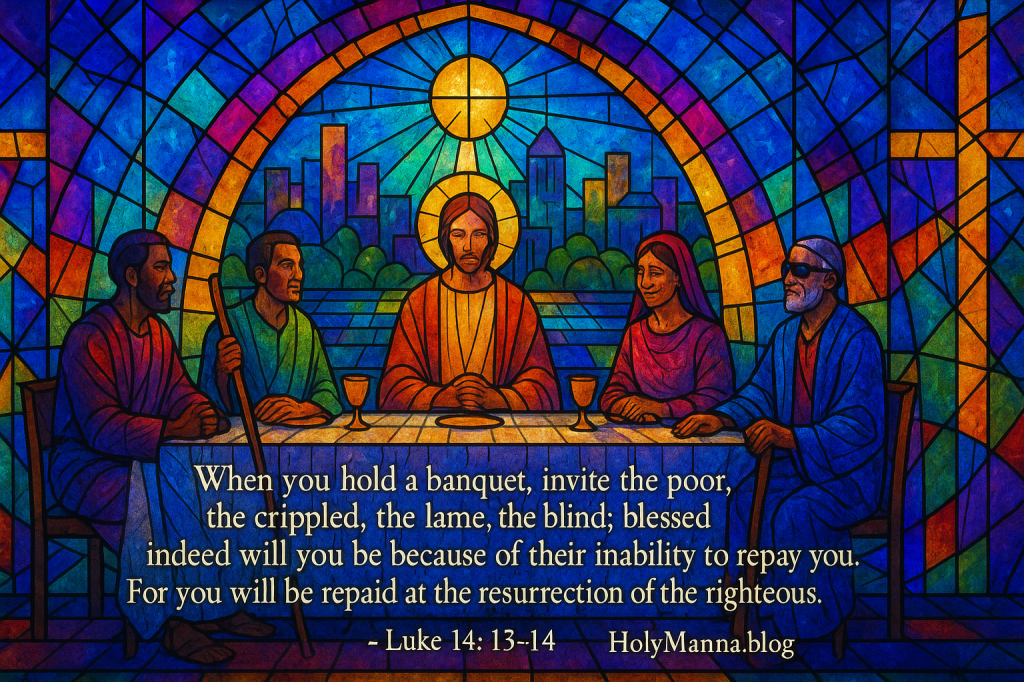
12 Then he said to the host who invited him, “When you hold a lunch or a dinner, do not invite your friends or your brothers or your relatives or your wealthy neighbors, in case they may invite you back and you have repayment. 13 Rather, when you hold a banquet, invite the poor, the crippled, the lame, the blind; 14 blessed indeed will you be because of their inability to repay you. For you will be repaid at the resurrection of the righteous.”
Detailed Exegesis
Verse 12 – “Then he said to the host who invited him, ‘When you hold a lunch or a dinner, do not invite your friends or your brothers or your relatives or your wealthy neighbors, in case they may invite you back and you have repayment.’”
Jesus is not outlawing family meals. He is exposing the hidden calculus that turns hospitality into a transaction. The warning about “repayment” unmasks a spiritual danger. Charity can be corrupted by the desire for social gain. The kingdom reframes the guest list so that love is purified of payback.
Verse 13 – “Rather, when you hold a banquet, invite the poor, the crippled, the lame, the blind;”
The command is specific. Jesus names those most likely excluded from honor based dining. The list echoes the messianic signs in Isaiah and anticipates Jesus’s own works of healing and inclusion. The instruction directs attention to those who cannot return the favor. This is the shape of divine generosity. It is mercy that moves first.
Verse 14 – “blessed indeed will you be because of their inability to repay you. For you will be repaid at the resurrection of the righteous.”
Here Jesus relocates reward into God’s hands and God’s timeline. Blessing does not vanish. It is secured in the age to come. The reference to “the resurrection of the righteous” anchors works of mercy in eschatological hope. Charity becomes an act of faith in the Father who sees and repays beyond the limits of this life.
Teachings
The Catechism names the Eucharistic heart of this command. CCC 1397 teaches, “The Eucharist commits us to the poor. To receive in truth the Body and Blood of Christ given up for us, we must recognize Christ in the poorest, his brethren.” The altar forms a people who set different kinds of tables. What is received as pure gift becomes a way of life that gives without calculating return.
The Church also articulates the moral claim of the poor upon believers. CCC 2443 states, “God blesses those who come to the aid of the poor and rebukes those who turn away from them: ‘Give to him who begs from you, do not refuse him who would borrow from you’; ‘you received without pay, give without pay.’ It is by what they have done for the poor that Jesus Christ will recognize his chosen ones.” This clarifies that preferential love for the poor flows from the Gospel itself, not from a passing social program.
The Catechism defines the concrete shape of this love. CCC 2447 teaches, “The works of mercy are charitable actions by which we come to the aid of our neighbor in his spiritual and bodily necessities. Instructing, advising, consoling, comforting are spiritual works of mercy, as are forgiving and bearing wrongs patiently. The corporal works of mercy consist especially in feeding the hungry, sheltering the homeless, clothing the naked, visiting the sick and imprisoned, and burying the dead. Among all these, giving alms to the poor is one of the chief witnesses to fraternal charity; it is also a work of justice pleasing to God.” The banquet Jesus describes naturally includes and empowers these works.
The saints speak with searing clarity. Saint John Chrysostom pleads, “Do you wish to honor the Body of Christ? Do not ignore him when he is naked. Do not honor him here in the church with silken garments while neglecting him outside where he is cold and naked.” Saint Basil the Great presses the conscience, “The bread in your cupboard belongs to the hungry; the coat unused in your closet belongs to the one who needs it; the shoes rotting in your closet belong to the one who has no shoes.” Saint Thomas Aquinas explains the primacy of mercy, “Of all the virtues, mercy is the greatest, since it properly belongs to God to have mercy, in which his omnipotence is chiefly manifested.” The Gospel command to invite those who cannot repay is the school where these truths are learned and lived.
Reflection
This passage invites a deliberate reorientation of daily hospitality. Consider setting one meal this week for someone who cannot pay it back, like a neighbor who struggles, a single parent, or a refugee family. Plan for presence as much as food. Ask for nothing in return. Let the table become a quiet liturgy where Christ is welcomed in the least of his brethren. Examine the heart for the subtle desire to be noticed and surrender that desire to the Father who sees in secret. Align generosity with Sunday worship by choosing a concrete work of mercy after receiving the Eucharist. Pray for eyes to recognize Christ at the door and courage to open the door wide.
Who is being invited primarily because of what they can offer, and who needs to be invited because they cannot repay at all? What habit at the table could be changed this month so that the poor, the elderly, or the outsider are welcomed with dignity and joy? How might hope in the resurrection of the righteous free decisions from fear and open a path to generous love today?
Go Forth From the Banquet of Mercy
Today’s Word gathers every heart around one table. Romans 11:29-36 reveals that God’s plan rests on mercy that cannot be revoked, and the doxology reminds everyone that “from him and through him and for him are all things”. Psalm 69 teaches the sound of that mercy in action as the Lord bends low to hear the poor and rebuild a people. Luke 14:12-14 then brings the mystery home, because Jesus tells disciples to set real tables for those who cannot repay and to trust the Father’s reward in the resurrection. The flow is simple and beautiful. Received mercy becomes offered mercy. Gift becomes banquet. Worship becomes justice.
Here is the invitation. Let grace define the plan for the week, because CCC 1996 teaches that “grace is favor, the free and undeserved help that God gives us”. Let the Eucharist shape the guest list, because CCC 1397 teaches that “The Eucharist commits us to the poor”. Let love take a definite form, because CCC 2447 defines works of mercy as concrete help for the bodily and spiritual needs of a neighbor. Pray the doxology of Romans 11:36 every morning. Offer one hidden work of mercy every day. Choose one meal to share with someone who cannot repay. Ask the Lord for eyes to recognize Christ where the world sees only inconvenience.
Who is waiting for an invitation that only you can extend this week? How can Sunday thanksgiving at Mass become Monday generosity at the table and Tuesday courage in conversation? What would change if every plan began with the quiet confession, “To him be glory forever”?
Engage with Us!
Share reflections in the comments below and help build a conversation that strengthens faith and sparks concrete mercy in daily life.
- First Reading — Romans 11:29-36: Where have God’s irrevocable gifts shown up in your life recently, and how does that memory change the way you see someone who is difficult to love today? How does the truth that “all have been consigned to disobedience” so that mercy may abound reshape attitudes about worthiness and favoritism? What would it look like to carry “To him be glory forever” from Romans 11:36 as a short prayer through the day, especially in stressful moments?
- Responsorial Psalm — Psalm 69:30-31, 33-34, 36: What pain or fear needs to be spoken honestly to God so that lament can begin its journey toward thanksgiving? Who nearby fits the psalm’s “lowly ones,” and how can encouragement move from words to a concrete act of help this week? Where is God inviting gratitude to become service so that personal rescue overflows into the rebuilding of a neighbor’s life?
- Holy Gospel — Luke 14:12-14: Which names would appear on a guest list if generosity were guided only by who cannot repay, and what simple step can make that meal happen this month? How does hope in “the resurrection of the righteous” free decisions from fear, status, or calculation about being noticed? What regular habit of hospitality could be adjusted so that the poor, the elderly, or the outsider are welcomed with dignity and joy?
Choose faith with courage, live mercy with creativity, and do everything with the love Jesus taught, trusting that the Father sees in secret and will repay in the life to come.
Sacred Heart of Jesus, we trust in You!
Immaculate Heart of Mary, pray for us!
Saint Michael the Archangel, defend us in battle!
Follow us on Instagram and Facebook for more insights and reflections on living a faith-filled life.

 Holy Manna!
Leave a comment