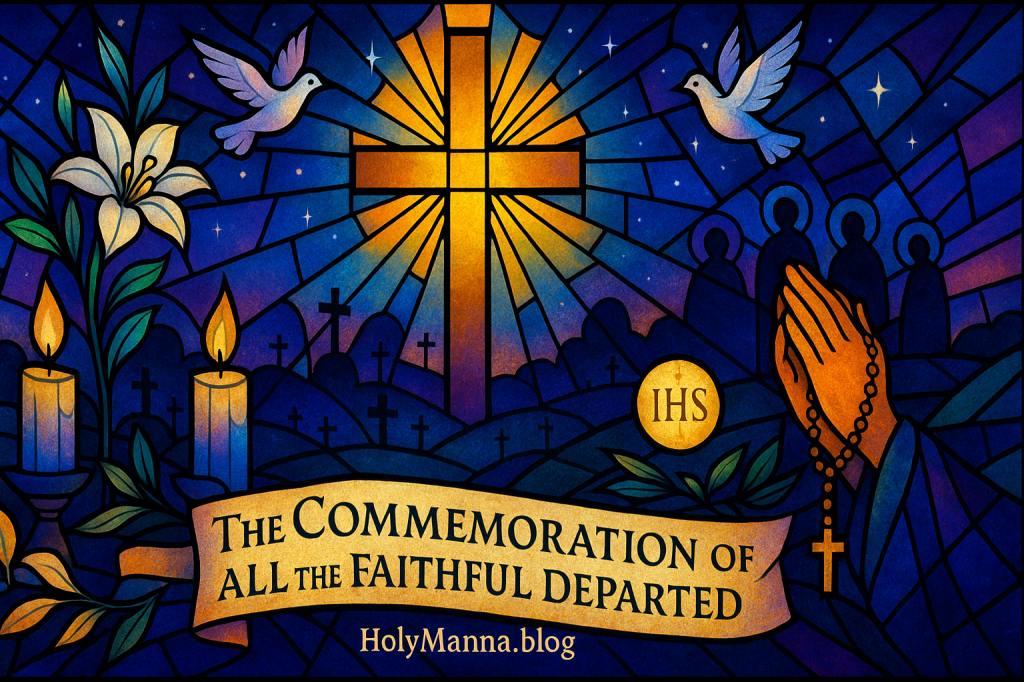
Love Stronger Than Death
All Souls’ Day on November 2 is the Church’s yearly act of mercy for every baptized person who has died and is being purified by God’s love. It sits right after All Saints’ Day to remind the faithful that heaven’s joy and earth’s prayer remain connected in Christ. The Church does not treat death as the end of the story. She treats it as the threshold that faithful love crosses with prayer, especially the Holy Sacrifice of the Mass. The Catechism of the Catholic Church teaches that those who die in God’s grace but are not yet perfectly purified are assured of salvation and undergo purification after death. “Our prayer for them is capable not only of helping them, but also of making their intercession for us effective.” This feast is a living expression of that communion.
From Cluny’s Bell To The World’s Calendar
The custom began in the late tenth century, Saint Odilo of Cluny asked all Cluniac monasteries to keep November 2 as a day of solemn remembrance for the faithful departed. The monks prayed the Office for the Dead, offered Masses, and sounded bells as a call for the whole community to lift up the departed to God. The practice spread from the Cluniac network to other Benedictine houses and then to many dioceses across Europe. Over the next centuries the commemoration became a fixed part of the Church’s liturgical life. During the tragedy of World War I, Pope Benedict XV extended a powerful pastoral privilege that allowed every priest to offer three Masses on All Souls’ Day. That decision shows the heart of the Church in a time of grief. She multiplies suffrages for the departed and strengthens the hope of the living. The date itself is not accidental. All Souls follows All Saints so that the Church can praise God for those already glorified and then plead for those still being purified. Both days are framed by the promise of Christ in The Gospel of John: “Everyone who sees the Son and believes in Him may have eternal life; and I shall raise him on the last day.”
Communion, Purification, And Eucharistic Hope
All Souls’ Day brings three truths into sharp focus. First, the communion of saints is real and active. The faithful on earth, the souls being purified, and the saints in glory remain united in Christ. The living can help the dead through prayer, while the dead who are saved already belong to Christ and can pray for the living in a bond of charity that does not break. Second, the final purification often called purgatory is not a second chance, and it is not punishment for the forgiven. It is the healing fire of divine love that completes the work of grace in a soul that died in friendship with God but still needed cleansing. Scripture hints at this mystery in the call to pray for the dead, and the Church has consistently taught it in her councils and catechism. Third, the Eucharist is the Church’s most effective prayer for the departed. The fruits of the sacrifice of Christ on the altar are applied to souls with immense power. That is why All Souls’ Day centers on Mass intentions, the Office for the Dead, and the Church’s indulgenced works for those who have died. In a world that often avoids the topic of death, this feast teaches the faithful to face it with Christian realism and steady hope.
How The Church Prays Her Love
The heart of this day is the offering of Masses for the faithful departed. Families write the names of loved ones in a parish book of remembrance and bring those names to the altar. Many Catholics make a pilgrimage to local cemeteries between November 1 and November 8 to pray for the dead and to renew trust in the Resurrection. These visits are not morbid. They are acts of faith that Christ has conquered the grave. The Church also encourages the Rosary for the dead, the Chaplet of Divine Mercy, the prayer “Eternal rest grant unto them, O Lord, and let perpetual light shine upon them.” and works of mercy offered on behalf of a specific soul. In Rome, the Church of the Sacred Heart of Suffrage keeps a small museum that preserves witnesses to prayers for the souls in purgatory as a visual catechesis on intercession and hope. Pilgrimage to this and other shrines deepens a Catholic’s sense that praying for the dead is not a private hobby but a shared mission. Devotions like these shape the heart to be generous, patient, and confident in God’s justice and mercy.
Cultural Impact and Celebration
The commemoration looks different across cultures while keeping the same core. In Poland, faithful families transform cemeteries into seas of candlelight as they keep vigil and pray. In Mexico, the traditions around Día de los Muertos often include visits to graves and family prayer that harmonize with the Church’s teaching on remembrance and intercession. In the Philippines, Undas blends reunion and reverence as relatives gather at gravesites to pray and to honor the memory of loved ones. In many places parishes hold solemn evening Masses, candlelit processions, and choral settings of the Requiem that lift minds and hearts to God. The Pope often chooses a cemetery for the All Souls’ Mass, especially military cemeteries, as a sign that no life and no death is forgotten before the face of the Father. These regional expressions are not distractions from doctrine. They are the human face of a supernatural truth. Love keeps remembering, and faith keeps praying.
Praying Our Love Into Eternity
All Souls’ Day invites practical charity that reaches beyond the grave. Offer a Mass intention for a specific person and let the parish know a name and a date. Visit a cemetery and pray the Rosary right there among the headstones. Write a family list of departed relatives and place it near a crucifix or a home altar throughout November. Choose a small sacrifice and explicitly offer it to the Lord for the sake of a soul who needs purification. Read the prayers of the funeral liturgy and let their words form the imagination with Christian hope. This is the kind of love that does not quit. It trusts that Christ is Lord of both the living and the dead, that mercy finishes what grace began, and that the Father wastes nothing of the good work He started in the baptized. “Blessed are the dead who die in the Lord.” Let that blessing become a habit of prayer in daily life.
Engage With Us!
Share your intentions and stories below—we would be honored to pray with you for your loved ones.
- Whom will you entrust to God’s mercy this week, and what specific prayer or sacrifice will you offer for them?
- How does the truth of purgatory deepen your hope in Christ’s victory over sin and death?
- Which All Souls’ tradition (cemetery visit, candlelight, almsgiving, indulgence, Rosary) will you practice—and why?
- How can your family keep a year-round “memory and hope” rhythm for praying for the dead?
- What Scripture or liturgical text (e.g., Wis 3; Jn 6) speaks most to you about Christian death and eternal life?
Be encouraged: keep the faith, keep charity aflame, and do everything with the love and mercy Jesus taught us—for in Him, even our tears become prayer, and our prayer becomes hope.
Sacred Heart of Jesus, we trust in You!
Immaculate Heart of Mary, pray for us!
Saint Michael the Archangel, defend us in battle!
Follow us on Instagram and Facebook for more insights and reflections on living a faith-filled life.

 Holy Manna!
Leave a comment