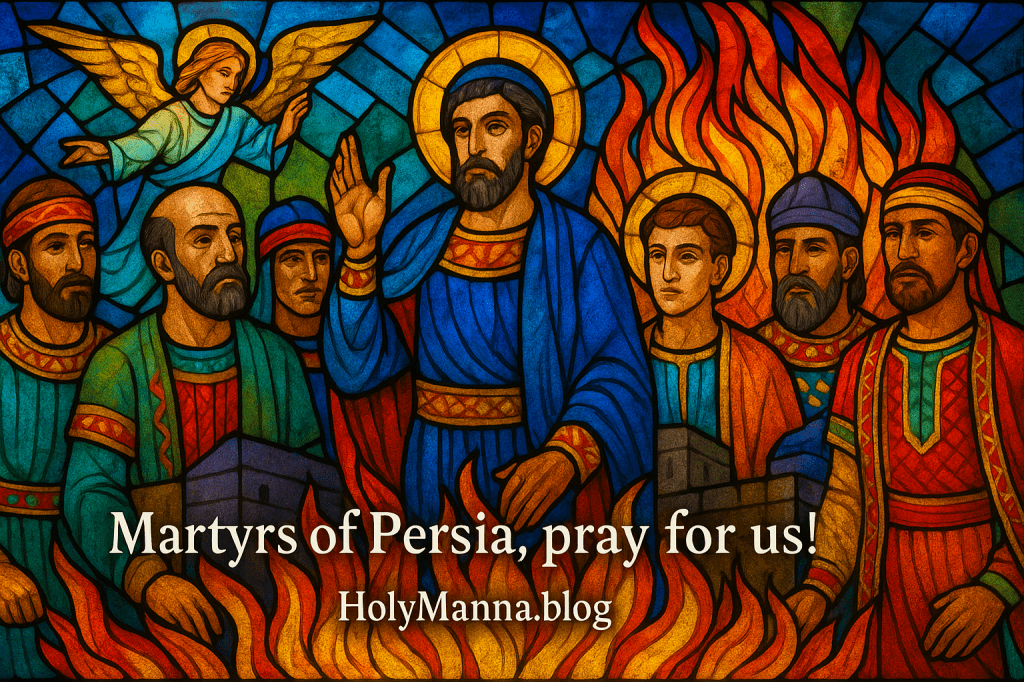
A Crown Tested in Fire
Under King Shapur II in the fourth century, Christians in the Sasanian Empire faced suspicion, exile, torture, and death. Authorities feared divided loyalties after Christianity gained legal protection in the Roman Empire, and believers were accused of aiding a foreign power. In that storm, Saints Acyndinus, Pegasius, Aphthonius, Elpidephorus, Anempodistus, and an immense company of confessors stepped forward as living proof that Jesus is worth everything. Their steadfast confession continues to teach that the Church does not merely survive by numbers or political favor. The Church lives by fidelity to Christ. The Catechism of the Catholic Church puts it plainly and beautifully: “Martyrdom is the supreme witness given to the truth of the faith.” CCC 2473. Their memory invites a deeper trust in divine providence, a bolder love for enemies, and a readiness to prefer eternal glory over temporary safety.
Roots of Faith in a Hostile Empire
The precise birthplaces and family backgrounds of these martyrs are not recorded with modern precision, which often happens with ancient passion narratives. Tradition describes Acyndinus, Pegasius, and Anempodistus as Persian Christians connected to royal service who kept their faith while serving in a Zoroastrian court culture. Elpidephorus is remembered as a noble who openly defended the innocent and rebuked injustice. Aphthonius is reported to have served among the torturers before a shocking conversion. When the persecution intensified, these men stood firm, confessing the Holy Trinity while urging wavering believers not to compromise. Their lives are best known for courageous confession before power, unwavering charity toward the fearful, and a refusal to worship the created order instead of the Creator. No authenticated writings or personal letters from them survive, and no verified direct quotations are preserved. Sacred tradition, however, remembers the dramatic conversion of Aphthonius with the shout that echoed through the court, “Great is the God of the Christians!” That cry, preserved in the Church’s memory, expresses the heart of their witness when hearts were hardest and the cost was highest.
Lives Set Ablaze With Hope
The daily pattern of their discipleship matters. These martyrs prayed with the Church, cared for the weak, encouraged those who were tempted to apostatize, and testified to the Resurrection when it was least convenient. Their example teaches that holiness is not a special hobby for a few. Holiness is ordinary Christian life lived with extraordinary fidelity. Ancient accounts speak of miracles that supported the brethren when fear was thick. Boiling lead reportedly could not harm them. Shackles fell away as if they were thread. Accusers stumbled while the confessors stood quiet and composed. Whether facing the king, speaking to jailers, or strengthening frightened catechumens, they radiated the theological virtue of hope. The Catechism reminds believers that hope “keeps man from discouragement” and “opens up his heart in expectation of eternal beatitude.” CCC 1818. Their holiness was not a stunt. It was a steady love for Jesus that overflowed into courage, compassion, and a contagious peace.
Trials, Torments, and the Final Furnace
Their hardships unfolded within a deliberate plan to humiliate and break Christians. Stripes and wounds were followed by humiliation in public squares. Tradition recounts that some were sewn into animal skins and cast into the sea, only to be preserved by God’s intervention. Others were led again before the king and commanded to sacrifice to fire. Like the three young men in Daniel, they refused to adore the creature rather than the Creator. The climax came when Acyndinus, Pegasius, and Anempodistus were cast into a raging furnace. Accounts say the flames consumed executioners while leaving the martyrs unharmed for a time, a sign that judgment belongs to God and not to earthly thrones. Elpidephorus spoke openly that the shedding of innocent blood calls for repentance and not for more violence, and he received the martyr’s crown by the sword. Their martyrdom is significant because it demonstrates that Christian victory is not a change of regime. Christian victory is communion with Christ crucified and risen. The Catechism teaches that the saints are “models of holiness” and that their heroic lives bear lasting fruit in the Church. CCC 828. Their final witness shows that love really is stronger than death and that forgiveness is not naïve, it is divine.
The Legacy That Kept Healing
After their deaths, devotion to the Martyrs of Persia spread widely in the Christian East and later took root in the West through martyrologies and liturgical remembrance. Churches were dedicated to them, and their names entered the long litany of intercessors invoked by the faithful. The Church believes that the saints, being more closely united to Christ, continue to intercede for the pilgrim Church on earth. “Those who dwell in heaven fix the whole Church more firmly in holiness. They do not cease to intercede with the Father for us.” CCC 956. Accounts of favors received through their intercession include healings of body and soul, reconciliations within families bitterly divided by persecution, and courage granted to priests and laypeople under hostile regimes. While exact relic locations from antiquity are not cataloged with modern standards, the tradition of honoring their memory in iconography and liturgy endures, and the fruit of their intercession keeps appearing wherever believers turn to them with faith.
A Heart Check for Today
The Martyrs of Persia offer a straightforward path for modern disciples who feel squeezed by cultural pressure. Confess Christ without embarrassment. Love truth without cruelty. Pray for those who oppose the Gospel. Encourage the wavering instead of mocking their weakness. Choose practices that build spiritual stamina, such as a weekly Holy Hour, Friday penance done with intentionality, and a simple morning offering that hands the day to Jesus. Let their courage shape daily speech at work and online. When anger surges, remember that these martyrs did not win by rage. They won by union with the Lamb. The Catechism adds that the way of perfection passes by way of the Cross. “There is no holiness without renunciation and spiritual battle.” CCC 2015. Ask the Martyrs of Persia to steady your heart, to purify your motives, and to kindle a durable hope that refuses despair.
Engage with Us!
Share your thoughts and reflections in the comments. Which moment in this martyr story speaks most directly to your life right now?
- Where is God asking for a public witness to Jesus that you have been hesitating to give?
- How can you encourage a struggling believer this week the way these martyrs encouraged others?
- What concrete practice of prayer, fasting, or almsgiving will strengthen your hope when you face pressure for your faith?
- Will you ask the Martyrs of Persia to intercede for someone who is suffering for the Gospel today?
Go forward with courage. Live the faith with love and mercy, just as Jesus taught, and let the fire of the Holy Spirit make your heart steadfast.
Martyrs of Persia, pray for us!
Follow us on Instagram and Facebook for more insights and reflections on living a faith-filled life.

 Holy Manna!
Leave a comment