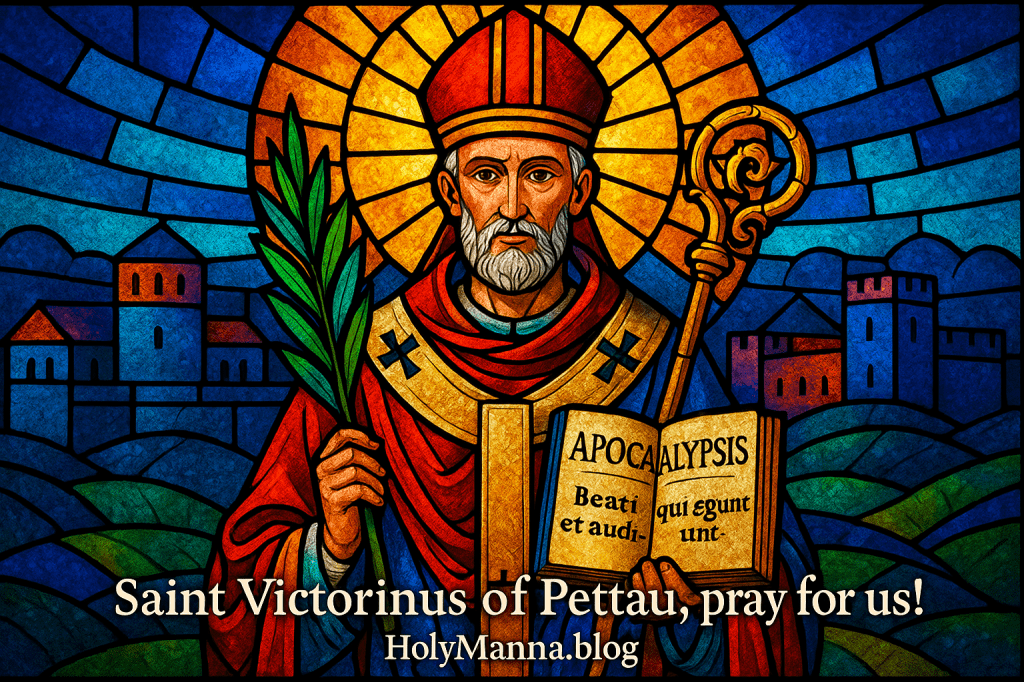
Victorinus the Scripture Teacher
Saint Victorinus of Pettau shines as one of the earliest Latin commentators on Sacred Scripture and a bishop who sealed his teaching with martyrdom in the early fourth century. The Church remembers him as a pastor who loved the Word of God, a careful reader of the Book of Revelation, and a shepherd who fed his people with sound doctrine during an age of fierce persecution. His most enduring work is the Commentary on the Apocalypse, widely regarded as the earliest surviving Latin commentary on Saint John’s Revelation. Through that book and through fragments of other writings, Victorinus still speaks with a steady voice that calls believers to read, to understand, and to obey the Word of God. His memory is kept on November 2 in the Roman Martyrology, reminding the faithful that sanctity often looks like patient study, courageous preaching, and a willingness to suffer for Christ.
How God Formed a Bishop
Victorinus likely came from a Greek-speaking background and later served as bishop of Poetovio, the Roman city now called Ptuj in modern-day Slovenia. Poetovio stood on the empire’s frontier routes, a place where traders, soldiers, and settlers mixed languages and customs. In that setting Victorinus learned to think and pray with the whole Church, drawing from Greek exegetical traditions while communicating in the plain Latin of everyday people. Details of his family life and conversion are not preserved, which is common for early bishops on the margins of the empire. What is clear is the path God traced through him. He grew deep in Scripture, embraced the demands of episcopal ministry, and gave himself to forming Christians who could withstand pressure from the surrounding culture. He became known above all for explaining Scripture book by book, showing how the literal sense grounds Christian life and how the spiritual sense lifts minds and hearts to Christ. The reputation that followed him was not about rhetorical polish. It was about fidelity. He wanted the truth clear enough for farmers, craftsmen, and soldiers to carry it into their homes and their work.
The Shepherd Who Opened Revelation
Victorinus devoted his life to teaching the Bible in a way that led people to worship and obedience. He did not read Revelation as a code to crack but as a proclamation of Jesus Christ victorious. He urged Christians to hear the blessing promised at the very start of the book and to live it. In his Commentary on the Apocalypse he explains the beatitude of Revelation 1:3 with pastoral clarity: “that he who takes pains about the reading may thence learn to do works, and may keep the precepts.” That single line reveals his whole method. Read carefully, learn humbly, and keep the Lord’s commands joyfully. He appears to have written short commentaries on several other books, and even where the texts no longer survive, ancient witnesses remember the effort of a bishop who kept opening the Scriptures for his people.
Reports of spectacular wonders during his lifetime do not survive, which should not surprise anyone familiar with the earliest centuries. The ordinary marvel of his days was a church that took root in difficult soil because a pastor sowed the Word and guarded the flock. If a sign is needed, his works served as one. Generations after his death still turned to his Commentary on the Apocalypse for nourishment, and that kind of fruit speaks powerfully about the divine help that sustained his ministry.
Steel in the Storm
Victorinus guided his church into the teeth of the Diocletian persecution, which erupted in A.D. 303 with a calculated effort to dismantle Christian life. Edicts targeted churches, Scriptures, clergy, and lay leaders. In that climate Victorinus continued to confess Christ as Lord and refused to compromise the worship owed to God. Tradition holds that he was put to death at Poetovio around A.D. 303 or 304. The manner of his execution is not recorded with certainty, yet the substance matters more than the method. He bore witness to the truth of the faith and offered his life as a final homily on the hope of the Resurrection.
His writings were discussed and sometimes debated in later centuries, particularly his expectation of a millennial reign as described in Revelation. The Church did not canonize every detail of his exegesis, but the Church did canonize his holiness. That is the Catholic way. The Lord raises saints who can err on secondary questions while remaining radiant in charity, steadfast in worship, and unshakable in their confession of Christ. Victorinus’s crown was not handed to a theorist but to a pastor who loved the flock and would not abandon them when the cost of discipleship rose.
After Glory
After his death the Church cherished Victorinus’s name in the liturgical memory of the saints. Stories of dramatic posthumous miracles are scarce, which again fits the pattern of many early martyrs from frontier regions. His legacy did not center on relics that drew massive crowds to a single shrine, although local veneration surely honored him in the region he served. His legacy centered on the Scriptures he opened and the courage he modeled. Where others sought the sensational, Victorinus left a quieter gift that keeps working. Catholics who read the Commentary on the Apocalypse find a bishop who points to Jesus Christ as the meaning of history, shows the Church how to stand firm in trials, and calls believers to obey the Lord’s commands with a hopeful heart.
School of the Word
Victorinus offers Catholics a simple and demanding pattern for discipleship. First, take Sacred Scripture seriously and read it with the Church. The literal sense anchors every other sense, so begin with what the text actually says and then allow the Holy Spirit to unveil how the words of Scripture lead to Christ. Second, obey what is read. The Bible is not a trophy for the shelf but a lamp for the path. That is why his line still cuts through the noise: “that he who takes pains about the reading may thence learn to do works, and may keep the precepts.” Third, witness with courage. The grace that carried Victorinus through ordinary days also carried him on the day of trial. Martyrdom is the Church’s supreme witness, and while most believers will not be asked to shed blood, every believer is asked to live with the same inner clarity. Let the Word shape the imagination. Let worship strengthen the will. Let hope set the tone. Victorinus helps the faithful read Revelation without fear by keeping their eyes on the Lamb who was slain and now lives, who reigns over history and judges with mercy and justice.
Engage with Us!
Share how Saint Victorinus’s story speaks to you in the comments below.
- What step can be taken this week to “read, hear, and keep” the Word, following Victorinus’s counsel about doing works and keeping the precepts?
- Which part of the Church’s teaching on Scripture’s senses helps the most right now, and how can that guide a daily reading plan?
- Where is the Lord inviting a bolder witness to the faith, inspired by the Catechism’s teaching on martyrdom as the supreme testimony?
- How can Saint Victorinus’s example shape the way Revelation is read, turning fear into hope and worship?
Keep going with courage. Let the Word form the mind, ignite the heart, and shape a life that bears witness to Jesus with love and mercy in every choice.
Saint Victorinus of Pettau, pray for us!
Follow us on Instagram and Facebook for more insights and reflections on living a faith-filled life.

 Holy Manna!
Leave a comment