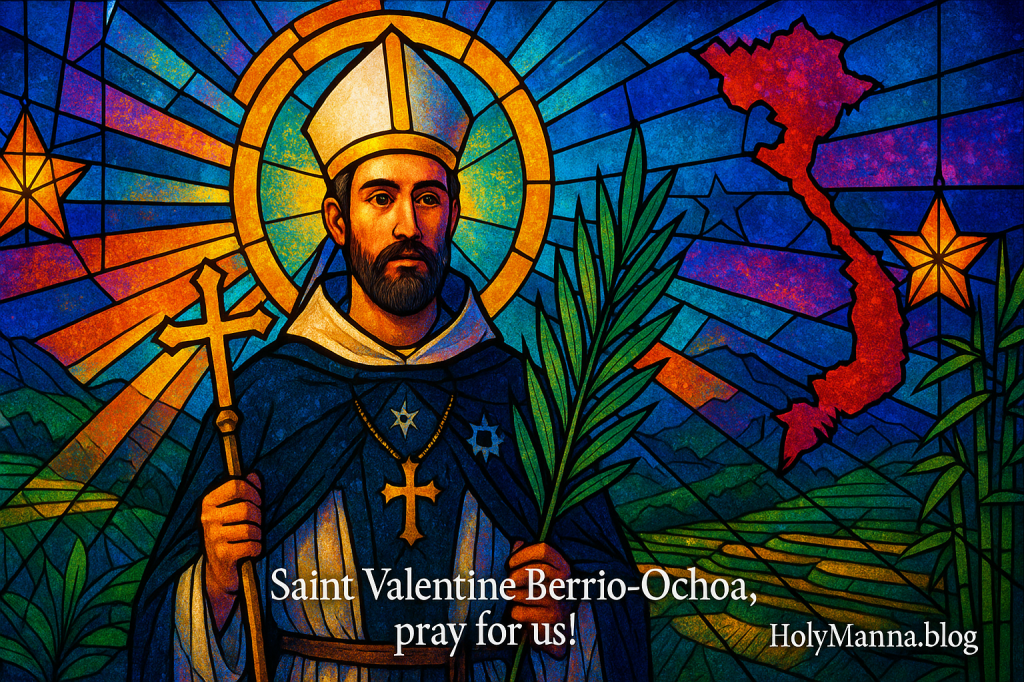
Roots in Basque Soil, Heart Set on Mission
Valentín Faustino de Berrio-Ochoa was born on February 14, 1827, in Elorrio in Spain’s Basque Country, where faith, family, and hard work shaped his character. He learned carpentry from his father and served faithfully at the altar, which cultivated a steady rhythm of prayer and service. Drawn to priestly life, he was ordained a diocesan priest on June 14, 1851. His heart, however, burned for the missions, and he entered the Order of Preachers, receiving the Dominican habit in 1853 and making profession in 1854. After formation and preparation for the East Asian missions, he sailed to Manila in 1857 to be assigned to Tonkin in present-day northern Vietnam. The Holy See soon named him coadjutor Vicar Apostolic of Central Tonkin, and he was consecrated a bishop on June 27, 1858. He learned to travel lightly, to live simply, and to put everything at the service of evangelization, which is exactly what the Church asks of her missionaries. As the Catechism reminds us, “All members of the Church share in this mission, though in various ways.” (CCC 863).
Lantern in the Night
Bishop Valentine arrived during a particularly violent persecution under Emperor Tu Duc, when edicts targeted clergy, catechists, and even families who sheltered Christians. He governed the vicariate from safe houses and caves, strengthening the local Church through quiet visits, clandestine liturgies, and carefully written letters. He formed seminarians and catechists in hidden settings and kept the sacraments flowing to the faithful despite constant surveillance. The creativity of charity became his trademark. He traveled by night to avoid detection, confirmed new Catholics in small gatherings, and reconciled penitents who had lapsed under pressure, reminding them that Christ’s mercy restores wounded hearts. Although dramatic miracles during his public ministry are not specifically recorded, his life displayed the kind of supernatural fruit the Gospel promises in ordinary fidelity. He preserved the apostolic life of the Church under conditions that seemed designed to extinguish it, and that steady endurance is a powerful sign of grace at work.
Courage in Chains
The noose tightened in 1861 as rewards were offered for the capture of clergy. Bishop Valentine was seized, imprisoned in a cramped cage, and interrogated repeatedly. Pressure mounted for him to renounce the faith or cooperate with the authorities, but he remained a calm and fatherly witness for his flock. He endured humiliation and physical suffering, placing everything in the wounded Heart of Christ and interceding for his captors. On November 1, 1861, at Hai Duong, he was beheaded alongside Bishop Jerome Hermosilla and the Dominican priest Peter Almató. The Church teaches with crystalline clarity what he lived: “Martyrdom is the supreme witness given to the truth of the faith: it means bearing witness even unto death.” (CCC 2473). This is fortitude in its purest form, the moral strength the Catechism describes as “firmness in difficulties and constancy in the pursuit of the good.” (CCC 1808). His death strengthened the Vietnamese faithful, encouraged hidden clergy, and planted seeds that would ripen into a flourishing Church.
A Living Memory
After the persecution ebbed, the faithful preserved his memory with gratitude. His remains were brought to Elorrio in 1886 and enshrined with honor so that families, religious, and pilgrims could ask for his intercession. He was beatified in 1906 and canonized by Pope Saint John Paul II in 1988 with the 117 Martyrs of Vietnam, a luminous choir of bishops, priests, religious, and lay witnesses. While the formal canonization miracle was attributed to the group rather than to him alone, many Catholics have quietly reported graces through his intercession, such as strengthened vocations, reconciled families, and renewed courage to practice the faith publicly. Vietnamese communities around the world honor the Martyrs on November 24, and in his hometown of Elorrio many pause before his shrine to give thanks for his fatherly care. These devotions testify to the Church’s conviction that the saints continue to work for our good from the presence of God.
Lessons for Discouraging Times
Saint Valentine Berrio-Ochoa shows that a bishop’s office is not about comfort but about fatherhood and sacrifice. His pastoral plan was simple and powerful. He stayed close to the Eucharist, he formed evangelizers, he kept the sacraments available, and he encouraged the fearful with steady hope. The Catechism centers our gaze where he kept his own: “The Eucharist is ‘the source and summit of the Christian life.’” (CCC 1324). His life invites Catholics today to put the essentials first. Seek the sacraments, take catechesis seriously, defend the vulnerable, and speak of Jesus with both clarity and charity. If no widely documented personal quotations of his survive, the witness of his letters still shines through as a steady courage that refused to dramatize danger or to minimize grace. The path forward in a skeptical culture is the same path he walked. Love God. Serve the Church. Be faithful in little things. Encourage the weak. Trust that Christ is building his Church even when the headlines say otherwise.
Walk the Narrow Path with Hope
Let the bishop-martyr teach a practical Christianity. Begin the day with Scripture and offer work as a prayer. Make Confession a regular habit and encounter Christ in the Eucharist frequently, because grace gives a backbone to love. When pressure rises, choose witness over worry. The Catechism calls every baptized person to bear the light of Christ in public life, “not to be ashamed of testifying to our Lord.” (CCC 2471). Ask Saint Valentine to help you meet trials with a cheerful courage that protects the weak, consoles the anxious, and keeps the faith when it is costly.
Engage with Us!
Share your thoughts and graces in the comments. How does Saint Valentine’s story challenge, console, or motivate you today?
- Where is God inviting a more joyful courage in your vocation right now?
- What “hidden cave” of perseverance—prayer, confession, acts of mercy—needs attention this week?
- Who in your life needs a hopeful word, like the ones Saint Valentine sent to his mother?
- How can the witness of the Vietnamese Martyrs shape the way you handle pressure and public faith?
- What concrete habit will help you stay close to the sacraments when it is inconvenient or costly?
May the intercession of Saint Valentine Berrio-Ochoa kindle a resilient love for Jesus, so that every task, trial, and triumph is done with the mercy and charity He taught.
Saint Valentine Berrio-Ochoa, pray for us!
Follow us on Instagram and Facebook for more insights and reflections on living a faith-filled life.

 Holy Manna!
Leave a comment