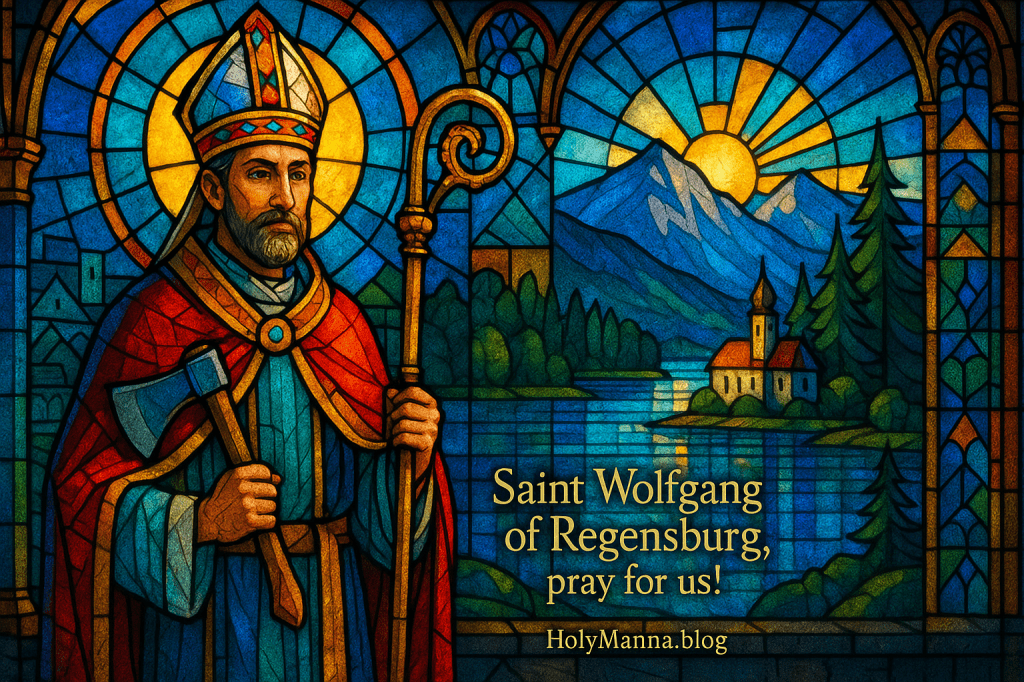
A Bishop With an Axe and a Heart of Fire
Saint Wolfgang of Regensburg shines as a tenth century Benedictine monk and reforming bishop whose love for Jesus brought fresh life to Bavaria and the borderlands of central Europe. His feast falls on October 31, a fitting date because his holiness cut through the seasonal darkness with the light of charity and truth. Iconography often shows him with a bishop’s crozier in one hand and an axe in the other, a reminder of the beloved tradition that he marked out a church site by throwing an axe and building where it landed. He is honored as a patron for carpenters and woodworkers, and as an intercessor for those who suffer from paralysis, strokes, and stomach ailments. His canonization in 1052 recognized what the faithful already knew, that his pastoral zeal, his commitment to reform, and his mercy toward the poor were clear fruits of the Gospel.
Roots in Swabia, Zeal for Christ
Wolfgang was born around 934 in the region of Swabia, in southern Germany, where a strong Christian culture and a family of some standing gave him a serious education and a love for order and prayer. As a young man he studied at the famed monastic school on the island of Reichenau, then continued at Würzburg, where the Scriptures, the Fathers, and the discipline of the Church shaped his mind and heart. A close friendship with Henry, who would become Archbishop of Trier, brought Wolfgang to teach at the cathedral school there, and his gift for forming minds quickly became evident. Drawn to a deeper surrender, he entered the Benedictine Abbey of Einsiedeln and embraced the rhythm of ora et labora with joy. Saint Ulrich of Augsburg ordained him a priest in 968, and the monk who loved silence proved just as faithful when called into active service for the salvation of souls. There are no widely attested verbatim quotations from Saint Wolfgang that can be cited with confidence, which makes his deeds and the memory of his students all the more important as voices that speak for him.
Teacher, Monk, and Missionary on the Edge of Christendom
The decades after the Magyar defeat at Lechfeld opened new paths for evangelization among the Hungarians, and Wolfgang went as a missionary with the humility of a monk and the courage of a pastor. He preached Christ, taught the basics of the faith, baptized converts, and worked to plant stable Christian life where it had been fragile. In 972 he was chosen Bishop of Regensburg, one of the most significant sees in Germany. His reputation as a teacher continued because he educated and influenced the young Henry, the future Emperor Saint Henry II, whose holiness and leadership would bless the Church. The Catechism of the Catholic Church explains the role he lived so well, “The individual bishops are the visible source and foundation of unity in their own particular Churches.” That line captures Wolfgang’s episcopal ministry, because he guarded unity in faith, sacraments, and discipline while keeping his heart open to the poor.
Reform That Brought Life
Wolfgang’s reforms were concrete and courageous. He restored strict Benedictine observance in monasteries that had grown lax, starting with the great house of Saint Emmeram in Regensburg. He separated the abbacy from his own episcopal office in order to protect monastic integrity, and he summoned the monk Ramwold to lead Saint Emmeram and renew prayer, learning, and work. He strengthened the diocesan schools, encouraged sacred chant and liturgical reverence, and invested in the formation of clergy who could preach clearly and live with integrity. His care extended to the women’s monasteries of Obermünster and Niedermünster, where he supported a strong rhythm of prayer and service. He also cooperated with the establishment of the Diocese of Prague for the good of Bohemia, even though it meant reducing the territory of his own see. That decision shows a pastor who valued evangelization over prestige and who trusted that the Church flourishes when local communities receive shepherds close to their people.
Legends at the Lake, Mercy in His Hands
When tensions around reform rose, Wolfgang withdrew for a time to the Salzkammergut, near Lake Abersee, to pray and live in greater simplicity. There the cherished story says he threw his axe from the mountain at Falkenstein to mark the spot for a church, then built there with his own hands. Another tradition tells how he compelled the devil to haul stones for the foundations, only for God’s providence to overturn the enemy’s scheme. Pilgrims also remember a moment when Wolfgang struck a rock to find water for a thirsty companion, and a spring flowed. These legends do not replace history, but they capture a real truth about him, that he put his strength, his craftsmanship, and his prayer at the service of God and neighbor. The lakeside sanctuary that bears his name became a place of healing and conversion, and later art, like the celebrated altar by Michael Pacher, testified to the faith his life inspired.
Hardships Without Martyrdom
Wolfgang did not die a martyr, yet he carried a heavy cross as a bishop who reformed with charity. He faced resistance from those who preferred the status quo, and he navigated complex relationships with princes and emperors who had strong opinions about church affairs. At times he stepped back into solitude to protect peace and to regain clarity in prayer, then returned to the work with renewed patience. In the year 994, during a pastoral journey through present day Upper Austria, he fell ill at Pupping and surrendered his soul to God on October 31. Christians mourned a father who had restored discipline and tenderness in equal measure, and the people of Regensburg brought his body back to Saint Emmeram’s with reverence. His death sealed a life of service marked by obedience, humility, and steady love for Christ’s flock.
Heaven’s Power at His Tomb
Miracles multiplied after Wolfgang’s death. The faithful reported healings at his tomb, especially for paralysis, strokes, and disorders of the stomach, and word spread quickly that Bishop Wolfgang continued to care for his people through powerful intercession. Pilgrims traveled to Regensburg to pray, and others journeyed to the sanctuary at Saint Wolfgang on the lakeshore, where the memory of his hidden years still invites conversion. The Church recognized his sanctity formally in 1052, and devotion to him took root across Bavaria, Austria, and Bohemia. The Catechism explains why this devotion matters, “They do not cease to intercede with the Father for us.” It also teaches, “By canonizing some of the faithful… the Church… proposes the saints to them as models and intercessors.” In Saint Wolfgang, the model is as clear as the intercessor, because he shows how prayer, reform, and mercy can live together in one heart.
Living the Pattern of Saint Wolfgang Today
Saint Wolfgang’s life offers a practical pattern for discipleship in a noisy age. He prayed like a monk, he taught like a father, and he governed like a servant. He was not afraid to make structural changes when holiness required it, and he was not ashamed to seek solitude when charity needed space to breathe. He loved the poor and protected consecrated life. He strengthened schools because truth sets people free, and he ceded territory for the sake of evangelization because unity in Christ matters more than personal influence. The Catechism encourages confidence in the friendship of the saints with the same clear promise already quoted, “They do not cease to intercede with the Father for us.” Ask Saint Wolfgang to help families set a steady rule of prayer and to help parishes build real communion through the sacraments and service. Let his example push Christians to be faithful in small tasks, brave in necessary reforms, and gentle with the weak, because that combination always looks like Jesus.
Engage with Us!
Share your thoughts and any graces you have received through the intercession of Saint Wolfgang in the comments. How is the Lord inviting you to practice charity and renewal in your corner of the Church today?
- What part of Saint Wolfgang’s life strikes you most, his courageous reforms, his missionary heart, or his hidden prayer at the lake, and why?
- Where might God be asking you to choose humble cooperation for the good of the Church, even when it costs something dear?
- How can you combine a deeper commitment to prayer with concrete works of mercy this week for someone in need?
- What step could strengthen unity in your parish or family, in light of the Catechism’s teaching that bishops are a visible source and foundation of unity?
Be encouraged to live the faith with conviction, to pray with trust in the saints, and to do everything with the love and mercy that Jesus taught.
Saint Wolfgang of Regensburg, pray for us!
Follow us on Instagram and Facebook for more insights and reflections on living a faith-filled life.

 Holy Manna!
Leave a comment