Friday of the Thirtieth Week in Ordinary Time – Lectionary: 483
Mercy at the Heart of the Covenant
The readings open a window into the Father’s heart, where election, promise, and law all find their fulfillment in living, active mercy. In Romans 9:1-5, Paul speaks with aching love for Israel, naming their unique privileges as God’s chosen people, adoption, glory, covenants, worship, and promises, and then pointing to the Messiah who comes from them according to the flesh. Psalm 147 sings the same melody of favor and responsibility, praising the Lord who strengthens, feeds, and teaches His people, “He proclaims his word to Jacob”, while reminding that this gift of the Word is a singular grace. In Luke 14:1-6, Jesus steps into a Pharisee’s home on the Sabbath and reveals the law’s true center by healing a man with dropsy, asking the piercing question, “Is it lawful to cure on the sabbath or not?” and then restoring the man to wholeness.
Historically and religiously, Israel treasured the Torah as the covenant’s lifeline, and the Sabbath as a sign of God’s sanctifying love and rest. In the time of Jesus, faithful teachers wrestled with how to guard the Sabbath while not neglecting works of necessity and compassion. Jesus resolves the tension by embodying the very purpose of the law, which is charity that safeguards life. The Church teaches that Christ does not abolish the law but brings it to perfection in love, as taught in CCC 1965-1974, and that He clarifies the Sabbath by restoring it to the service of mercy, as taught in CCC 582. Across today’s texts, the pattern is clear. God’s Word is given to a people, that Word moves swiftly, “his word runs swiftly” in Psalm 147, and in Jesus the Word-made-flesh acts decisively to heal, to reconcile, and to fulfill every covenant promise.
Where might the Lord be inviting a heart to let mercy move first, so that obedience becomes love in action rather than fear in motion?
First Reading – Romans 9:1-5
Aching Love for the Covenant People, Fulfilled in the Messiah
Paul opens a profound section of Romans with an anguished confession of love for Israel that is both historically grounded and theologically rich. In the first century, Jewish identity centered on the covenant signs that marked God’s fidelity, the gift of the Torah, temple worship, the promises made to the patriarchs, and a living memory of God’s glory among His people. Paul speaks as a Jew formed by this story, now convinced that the covenant reaches its telos in Jesus the Messiah who comes “according to the flesh” from Israel. The significance for today’s theme is clear. God’s election does not cancel mercy, it reveals it, and the Law finds its fullness in love that saves. Paul’s reverence for Israel’s privileges prepares the heart to see that Christ is not a rival to God’s promises but their fulfillment, the place where covenant gifts become grace for all.
Romans 9:1-5
New American Bible (Revised Edition)
Paul’s Love for Israel. 1 I speak the truth in Christ, I do not lie; my conscience joins with the holy Spirit in bearing me witness 2 that I have great sorrow and constant anguish in my heart. 3 For I could wish that I myself were accursed and separated from Christ for the sake of my brothers, my kin according to the flesh. 4 They are Israelites; theirs the adoption, the glory, the covenants, the giving of the law, the worship, and the promises; 5 theirs the patriarchs, and from them, according to the flesh, is the Messiah. God who is over all be blessed forever. Amen.
Detailed Exegesis
Verse 1 – “I speak the truth in Christ, I do not lie; my conscience joins with the holy Spirit in bearing me witness”
Paul invokes Christ and the Holy Spirit to certify the sincerity of his testimony. This double appeal shows the gravity of what follows. His conscience, enlightened by the Spirit, testifies that his stance toward Israel is not irritation or triumphalism but truthful, Spirit-led love. In the light of Romans as a whole, this frames the next chapters as a sacred discernment about God’s fidelity rather than a mere argument.
Verse 2 – “that I have great sorrow and constant anguish in my heart.”
The apostle describes a steady interior pain over the estrangement of many of his kinsmen from the gospel. The language echoes the prophets who grieved over Israel’s hardness of heart. This sorrow is not despair. It is the compassion of one who knows the promises and longs for their recognition in Christ.
Verse 3 – “For I could wish that I myself were accursed and separated from Christ for the sake of my brothers, my kin according to the flesh.”
Paul uses shocking language of self-offering, reminiscent of Moses who begged to be blotted out for Israel after the golden calf. The hyperbolic wish expresses a Christ-shaped charity that would rather suffer loss than see others perish. The theology is not that anyone other than Christ can atone for others, but that apostolic love mirrors the self-gift of the Savior.
Verse 4 – “They are Israelites; theirs the adoption, the glory, the covenants, the giving of the law, the worship, and the promises;”
Here Paul reverently catalogs Israel’s privileges. Adoption recalls God’s fatherly claim on Israel. Glory evokes the divine Presence that filled tabernacle and temple. The covenants run from Abraham through Sinai to David. The giving of the law signals God’s revealed will for holy living. The worship points to temple liturgy and sacrificial life. The promises encompass the prophetic hope for redemption. Paul insists these are real and enduring gifts that disclose God’s faithful character.
Verse 5 – “theirs the patriarchs, and from them, according to the flesh, is the Messiah. God who is over all be blessed forever. Amen.”
The climax arrives. From Israel’s line comes the Messiah according to the flesh. Paul moves from catalog to doxology, blessing God who stands sovereign over history. The blessing affirms that Jesus is not a break with Israel but her fruit. The Messiah’s Jewish flesh is the seal of God’s fidelity, and the spontaneous praise declares that salvation history is coherent and trustworthy.
Teachings
Paul’s sorrowful love and his list of Israel’s privileges open onto the Church’s constant teaching about the Old Covenant and its fulfillment in Christ. The Catechism is clear that the Old Testament’s value endures and that the Church’s identity is inseparably linked with Israel. “The Old Testament is an indispensable part of Sacred Scripture. Its books are divinely inspired and retain a permanent value, for the Old Covenant has never been revoked.” (CCC 121). The relationship is not merely historical but living. “When she delves into her own mystery, the Church, the People of God in the New Covenant, discovers her link with the Jewish People, ‘the first to hear the Word of God.’ The Jewish faith, unlike other non-Christian religions, is already a response to God’s revelation in the Old Covenant.” (CCC 839).
These teachings illuminate Paul’s reverence for Israel’s adoption, glory, and promises. The Messiah’s coming “according to the flesh” from Israel confirms that God binds salvation to a concrete people and a real history. Paul’s willingness to suffer for his kin reflects the logic of redemptive love that reaches its summit in Christ’s self-gift. The enduring privileges named in Romans 9 safeguard two truths at once. God is faithful to His promises to Israel, and in Jesus those promises open to the nations without canceling their source. This is why praise erupts at the end of verse 5. Doxology is the proper response when the covenant story proves trustworthy in the Messiah.
Reflection
This reading invites a heart to hold together truth and love, doctrine and mercy. It challenges any attitude that treats the Old Testament as obsolete or the Jewish people as sidelined. It also calls for a charity that aches for the salvation of others and acts with prayerful sacrifice for their good. One helpful practice is to pray with gratitude for the concrete ways God has delivered His Word through Israel and to intercede for deeper recognition of Jesus as the faithful fulfillment of God’s promises. Another step is to cultivate doxology, to bless God daily for the unity of salvation history and for the gift of the Messiah who comes from Israel. Where is the Lord inviting a deeper reverence for the roots of the faith, so that love for Jesus naturally includes love for the people and story that bear Him to the world? How might the Holy Spirit be stirring a willingness to suffer in intercession for the salvation of family members, friends, or even enemies? What words of blessing can rise today in honest praise of God who is over all, blessed forever?
Responsorial Psalm – Psalm 147:12-15, 19-20
Praise for the Word that Builds, Feeds, and Heals
This psalm rises from Jerusalem’s liturgical heart, likely in the period after the return from exile when the city’s walls were restored and worship was renewed. In Psalm 147, Israel sings gratitude for concrete mercies, strong gates, flourishing families, peace at the borders, and daily bread. The praise centers on God’s effective Word, the same creative command that orders creation and forms a holy people. Today’s theme comes into focus here. God’s covenant gifts are not abstract ideas. They are living mercies given to Israel so that the nations might see the radiance of God’s fidelity. The psalm’s celebration of statutes and commands prepares the way for the Gospel’s revelation that the Law’s deepest meaning is merciful love that acts.
Psalm 147:12-15, 19-20
New American Bible (Revised Edition)
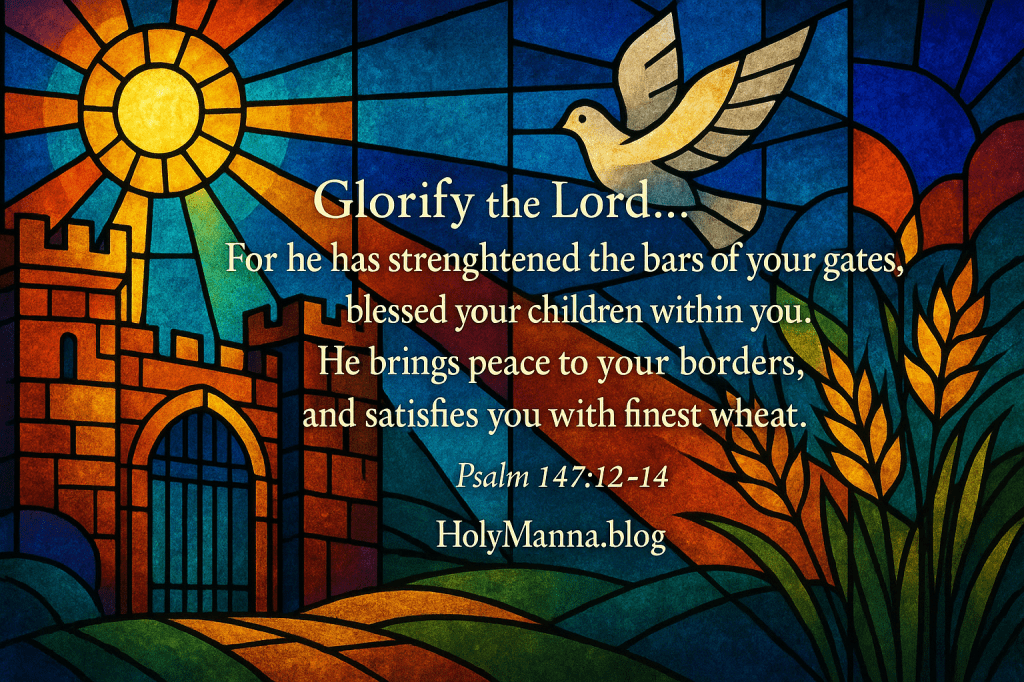
12 Glorify the Lord, Jerusalem;
Zion, offer praise to your God,
13 For he has strengthened the bars of your gates,
blessed your children within you.
14 He brings peace to your borders,
and satisfies you with finest wheat.
15 He sends his command to earth;
his word runs swiftly!
19 He proclaims his word to Jacob,
his statutes and laws to Israel.
20 He has not done this for any other nation;
of such laws they know nothing.
Hallelujah!
Detailed Exegesis
Verse 12 – “Glorify the Lord, Jerusalem; Zion, offer praise to your God,”
The summons addresses the worshiping city by its covenant names, Jerusalem and Zion. Praise is not escapist emotion. It is Israel’s public acknowledgment that every good gift comes from the Lord. The communal call frames obedience as glad worship, not as mere compliance.
Verse 13 – “For he has strengthened the bars of your gates, blessed your children within you.”
Rebuilt gates signal God’s protection after vulnerability. The blessing upon children reveals that the Lord’s care touches both public security and family life. Covenant fidelity safeguards the common good and renews generations.
Verse 14 – “He brings peace to your borders, and satisfies you with finest wheat.”
Peace, or shalom, is more than the absence of conflict. It is wholeness under God’s reign. The finest wheat evokes God’s providence and hints at a sacramental horizon, since divine feeding becomes full in the Eucharist. God’s care nourishes body and soul.
Verse 15 – “He sends his command to earth; his word runs swiftly!”
God’s Word is living and efficacious. It does not crawl. It runs. The psalmist proclaims that salvation is not delayed when God wills to act. The same swiftness that orders creation now builds up Zion and moves hearts to mercy.
Verse 19 – “He proclaims his word to Jacob, his statutes and laws to Israel.”
The statutes are not burdens but gifts. Revelation is God’s condescension into history so that His people can walk in wisdom. The law is God’s fatherly instruction, shaping a people capable of justice and compassion.
Verse 20 – “He has not done this for any other nation; of such laws they know nothing. Hallelujah!”
Election is named without apology. God entrusted Israel with a unique revelation so that the blessing might go forth to all. This verse harmonizes with Romans 9:1-5. The Messiah comes from Israel according to the flesh, and through Him the gift given to one people becomes grace for the world.
Teachings
The Church receives this psalm as a hymn to the power and tenderness of God’s Word. Divine revelation grounds the life of worship and the mission to love. The Catechism teaches with clarity. “God inspired the human authors of the sacred books. To compose the sacred books, God chose certain men who, while employed by him, made use of their powers and abilities, so that with him acting in them and through them, they, as true authors, consigned to writing everything and only those things which he wanted.” (CCC 106). Because Scripture is God’s Word given through human authors, the statutes praised in Psalm 147 are trustworthy and life giving. The permanence of the Old Covenant’s value is also affirmed. “The Old Testament is an indispensable part of Sacred Scripture. Its books are divinely inspired and retain a permanent value, for the Old Covenant has never been revoked.” (CCC 121). The psalm’s focus on the gift of the Word to Israel resonates with the Church’s exhortation to dwell in Scripture. “The Church ‘forcefully and specifically exhorts all the Christian faithful… to learn the surpassing knowledge of Jesus Christ, by frequent reading of the divine Scriptures. Prayer should accompany the reading of Sacred Scripture, so that a dialogue takes place between God and man.’ For this reason the Church ‘has always venerated the Scriptures as she venerates the Lord’s Body.’ ‘Ignorance of the Scriptures is ignorance of Christ.’” (CCC 133). The praise of statutes and the celebration of God’s swift Word lead naturally to the Gospel truth that the Law is fulfilled in charity, which acts for the good of the other.
Reflection
This psalm invites a habit of praise that notices God’s concrete mercies and a discipline of Scripture that lets God’s Word run swiftly in daily life. A simple step is to begin and end the day with a short act of thanksgiving that names specific gifts, protection received, reconciliation at home, or daily bread provided. Another practice is to commit to a steady rhythm of lectio divina with one psalm each day, letting God’s statutes form a heart for mercy. Where is the Lord strengthening the gates of the soul so that peace grows at the borders of relationships? What small act today could let God’s Word “run swiftly,” perhaps a prompt reconciliation, a phone call to encourage someone, or a concrete work of mercy? How might regular praise reshape the way decisions are made, so that obedience becomes love in action rather than fear in motion?
Holy Gospel – Luke 14:1-6
Mercy That Interprets the Sabbath
The scene unfolds at a Sabbath meal in the home of a leading Pharisee, a setting where honor, hospitality, and halakhic fidelity shaped every gesture. In first century Judaism, the Sabbath was a covenant sign that proclaimed God’s creative love and saving rest, so legal debate about what constituted work was not pettiness but zeal to protect a holy gift. Into this careful world steps Jesus with a man suffering from dropsy, a painful swelling likely due to fluid retention. The Gospel places mercy in the very center of Sabbath observance and invites an a fortiori reasoning that was familiar to Jewish teachers. If compassion for an animal in distress is permitted on the holy day, then compassion for a suffering son of Abraham is not only allowed but demanded. Today’s theme shines clearly. Covenant gifts are fulfilled in merciful love, and the law finds its deepest meaning when a human person is restored.
Luke 14:1-6
New American Bible (Revised Edition)
Healing of the Man with Dropsy on the Sabbath. 1 On a sabbath he went to dine at the home of one of the leading Pharisees, and the people there were observing him carefully. 2 In front of him there was a man suffering from dropsy. 3 Jesus spoke to the scholars of the law and Pharisees in reply, asking, “Is it lawful to cure on the sabbath or not?” 4 But they kept silent; so he took the man and, after he had healed him, dismissed him. 5 Then he said to them, “Who among you, if your son or ox falls into a cistern, would not immediately pull him out on the sabbath day?” 6 But they were unable to answer his question.
Detailed Exegesis
Verse 1 – “On a sabbath he went to dine at the home of one of the leading Pharisees, and the people there were observing him carefully.”
The Sabbath meal was a public moment of piety, community, and teaching. The careful observation signals a testing environment. Jesus accepts the invitation, not to provoke for its own sake, but to reveal the law’s heart where reverence for God and compassion for neighbor are inseparable.
Verse 2 – “In front of him there was a man suffering from dropsy.”
The sufferer stands before Jesus, not hidden on the margins. Illness in the ancient world often carried social and ritual consequences, yet the Gospel places the afflicted at center stage. The placement prepares for an act that restores dignity as well as health.
Verse 3 – “Jesus spoke to the scholars of the law and Pharisees in reply, asking, ‘Is it lawful to cure on the sabbath or not?’”
Before healing, Jesus appeals to the law itself. The question invites an authentic interpretation that honors the command while refusing indifference to suffering. This is not law against love. It is law interpreted by love, which is the fulfillment of the commandment.
Verse 4 – “But they kept silent; so he took the man and, after he had healed him, dismissed him.”
Silence reveals a legal impasse and a moral hesitation. Jesus acts first and then releases the man, a detail that suggests reintegration into ordinary life and community. The healing precedes debate, teaching that the law serves life and that mercy does not violate holiness.
Verse 5 – “Then he said to them, ‘Who among you, if your son or ox falls into a cistern, would not immediately pull him out on the sabbath day?’”
This argument moves from lesser to greater. If rescuing an animal or a child is permitted as a work of necessity, how much more should the rescue of a suffering neighbor be welcomed. The adverb “immediately” underscores urgency. Charity does not postpone help when a person is in distress.
Verse 6 – “But they were unable to answer his question.”
The inability to respond exposes the insufficiency of a reading of the law that hesitates before mercy. Jesus has not abolished the Sabbath. He has revealed its purpose, a day for worship and for the works that flow from worship, which are acts of life-giving love.
Teachings
The Church receives this passage as a luminous key for reading the Sabbath and, by extension, the whole moral law. Jesus does not diminish the holy day. He discloses its true meaning as a space for worship, rest, and merciful love. The Catechism articulates this with clarity. “The Gospel reports many incidents when Jesus was accused of violating the sabbath law. Jesus never fails to respect the holiness of this day. He gives this law its authentic and authoritative interpretation: ‘The sabbath was made for man, not man for the sabbath.’ With compassion, Christ declares the sabbath for doing good rather than harm, for saving life rather than for killing.” (CCC 2173). The healing touch of Christ is not merely symbolic. It is a sign of the Kingdom made present. “Christ’s compassion toward the sick and his many healings of every kind of infirmity are a resplendent sign that ‘God has visited his people’ and that the Kingdom of God is close at hand.” (CCC 1503). The moral contour of the scene is equally plain. Mercy is not an optional extra but the concrete shape of charity. “The works of mercy are charitable actions by which we come to the aid of our neighbor in his spiritual and bodily necessities.” (CCC 2447). These teachings show why the Gospel places a suffering man before Jesus on the Sabbath. The covenant sign is fulfilled when worship yields works of love that protect and restore life.
Reflection
This Gospel calls for a Sabbath and a Sunday that honor God through worship and through readiness to act when someone is in need. A simple way to live this is to plan the Lord’s Day with room for both Mass and mercy, family rest and a concrete work of compassion such as visiting someone who is sick, reconciling a strained relationship, or providing a meal for a neighbor. Another step is to examine the heart for places where fear of breaking a rule may have eclipsed the command to love, and then to ask for the grace to choose the good with promptness and peace. Where is the Lord inviting a heart to act immediately for the good of another rather than waiting for perfect conditions? How might Sunday practices be reoriented so that worship naturally overflows into a tangible work of mercy? What one person this week needs a timely rescue that only a phone call, a visit, or a generous gift can provide today?
Let the Word Run Swiftly, Let Mercy Move
Today’s readings reveal one seamless story of covenant love flowering into merciful action. In Romans 9:1-5, Paul honors Israel’s unique privileges and aches for his kin, naming adoption, glory, covenants, worship, promises, and patriarchs, then blessing God for the Messiah who comes from Israel according to the flesh, “God who is over all be blessed forever. Amen.” In Psalm 147:12-15, 19-20, Jerusalem is summoned to praise the Lord who strengthens gates, nourishes with wheat, and entrusts His statutes to His people, “his word runs swiftly.” In Luke 14:1-6, Jesus places a suffering man at the center of a Sabbath meal and shows that the law’s deepest meaning is love that heals, “Is it lawful to cure on the sabbath or not?”
The message is simple and strong. God’s gifts to Israel are real and irrevocable, and in Jesus they reach fulfillment that blesses the world. God’s Word is not an idea that waits, it moves, restores, and sends. The Sabbath is not a pause from love, it is a sanctuary for love to act. Let praise rise for what God has done, let the Scriptures shape the imagination, and let worship spill into concrete works of mercy. Choose one step today that brings a neighbor from the margins to the center, a visit to the sick, a call to reconcile, or a meal shared with someone in need. Set Sunday apart with reverent worship and with a plan for a deliberate act of compassion. Where is the Lord inviting a heart to bless instead of complain, to act instead of delay, to let the Word run swiftly instead of keeping it at the threshold? How might the next Sabbath become a day where prayer naturally becomes a rescue, a healing, or a generous gift that mirrors the Heart of Christ?
Engage with Us!
Share reflections in the comments below and join a conversation that helps the Word take root through concrete acts of mercy and love.
- Romans 9:1-5 – How does Paul’s sorrow for his kin stretch the heart toward sacrificial charity, and what specific intercession or fast can be offered this week for someone’s salvation? How does gratitude for Israel’s adoption, glory, covenants, worship, promises, and patriarchs shape deeper reverence for Jesus who comes from Israel according to the flesh?
- Psalm 147:12-15, 19-20 – Where has the Lord recently strengthened the “gates” of life, brought peace to strained borders, or fed with daily bread, and how can praise become a daily habit that notices these mercies? What simple practice of Scripture can help God’s word “run swiftly” through decisions and relationships today?
- Luke 14:1-6 – Where is the Lord inviting an immediate act of compassion that honors the true meaning of the Sabbath and the Lord’s Day, and what concrete step will be taken to help someone in need? How can worship naturally spill into a work of mercy that restores dignity and hope this week?
Choose mercy with courage, let praise rise with gratitude, and walk in the obedience of love that Jesus teaches, so that faith becomes a living witness in every hour.
Sacred Heart of Jesus, we trust in You!
Immaculate Heart of Mary, pray for us!
Saint Michael the Archangel, defend us in battle!
Follow us on Instagram and Facebook for more insights and reflections on living a faith-filled life.

 Holy Manna!
Leave a comment