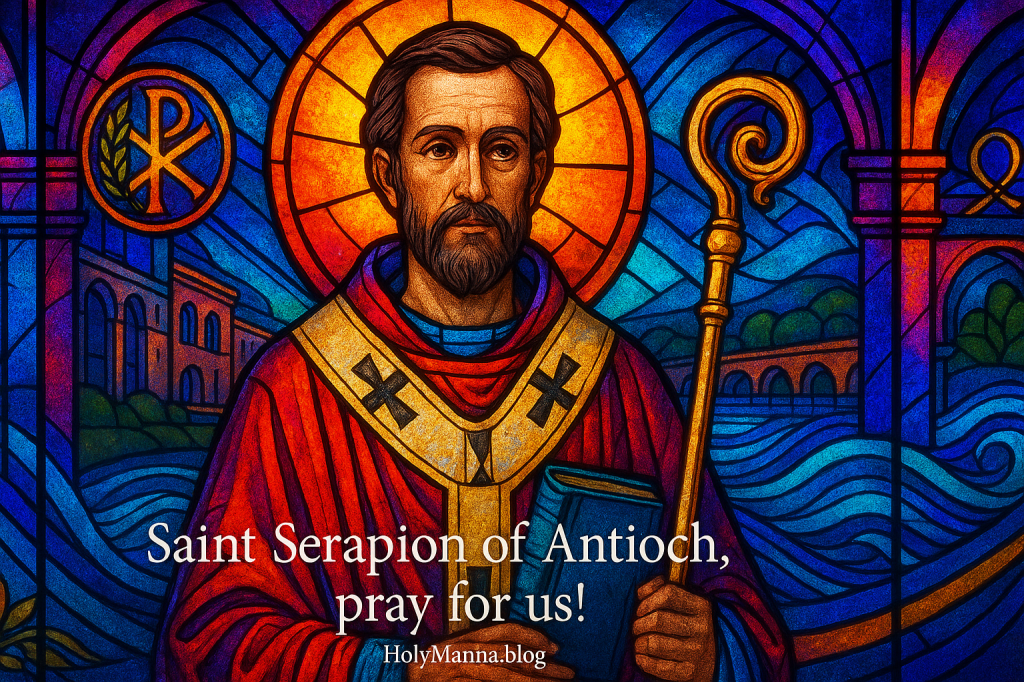
Guardian of the True Gospel
Serapion of Antioch served as bishop and patriarch of the Church in Antioch roughly from the closing years of the second century into the early third century, around 191 to 211. He is remembered as a trusted shepherd who defended the apostolic faith at a time when new movements and attractive but misleading writings were spreading quickly. His legacy rests on clear teaching, careful discernment, and pastoral courage. He guided his flock through doctrinal confusion, confronted errors such as Montanism and docetic distortions about Jesus, and helped the early Church recognize what truly belonged to the apostolic preaching. The Roman Martyrology commemorates him on October 30, which quietly honors a bishop whose fidelity strengthened Christian unity. The memory of Serapion matters today because it shows how a local pastor can steady the wider Church by holding close to the Gospel and handing it on without compromise.
Roots in a Crucible City
Very little about Serapion’s childhood or family survives in the historical record, which is not unusual for bishops of his era. What comes into view is his ministry in Antioch, one of the most vibrant centers of early Christianity. Antioch was the place where believers were first called Christians and it was a crossroads of cultures, philosophies, and trade. A leader in that city needed both spiritual depth and practical prudence. Serapion emerged as such a leader. He moved within a living stream of Tradition that linked his see back to the apostles, and he saw with clarity that love for Christ includes love for the truth about Christ. His writings show a pastor who cared about real communities, real confusion, and real souls. He addressed particular situations and names, but the concern behind his letters was always the same. He wanted his people to know Jesus as the Church confesses him and to remain in communion with the apostolic faith.
A Pastor With a Pen
Serapion’s pen was one of his most important pastoral tools. Fragments preserved by later historians describe at least three works. He wrote to Caricus and Pontius to warn against Montanist claims to new prophecy that placed private revelations above the Church’s discernment. He wrote to a man named Domninus, who had drifted into Judaizing practices, to call him back to the fullness of Christian faith. Most famously, he wrote to the community at Rhossus about a text circulating under the title Gospel of Peter. Serapion responded with warmth for the people but with a firm judgment about the writing. He expressed reverence for the apostle while rejecting a book that did not bear the marks of apostolic truth. His line is as bracing as it is beautiful: “We, brethren, receive Peter and the other apostles as Christ, but the writings that falsely bear their names we reject.” That single sentence captures the heart of episcopal ministry. A bishop loves the apostles by loving what they really taught. He loves the faithful by guarding them from the counterfeit.
Signs and Wonders of Discernment
No reliable ancient source records public miracle stories worked by Serapion during his lifetime. The wonder that shines through his life is the miracle of sound discernment in a noisy age. He lived what the Catechism of the Catholic Church teaches about the episcopal office. “Bishops, with priests as co-workers, have as their first task to preach the Gospel of God to all men.” He also lived what the Church teaches about the interpretation of revelation. “The task of interpreting the Word of God authentically has been entrusted solely to the Magisterium of the Church, that is, to the Pope and to the bishops in communion with him.” Serapion’s steady judgment about writings and movements preserved the freedom of the Gospel. His careful distinction between authentic apostolic witness and deviant ideas protected the faithful from confusion and kept communities anchored to Christ. In an age that was tempted by spiritual novelty, he modeled patient fidelity.
Trials Without Capitulation
Serapion led during the reign of Septimius Severus, a period that saw scattered persecutions and social pressure on Christians. The record does not indicate that he died a martyr, but it does show that he persevered as a confessor bishop who strengthened others through trials. His tenure framed a transition into years when confessors and martyrs would emerge from Antioch and surrounding regions. He held the line with teaching, with pastoral visitations, and with letters that corrected error without crushing hope. He reminds the Church that endurance often looks like day by day faithfulness. It looks like a pastor who will not abandon his post and who refuses to let fear or fatigue decide what is true.
Afterglow of a Faithful Bishop
There are no widely attested miracle accounts connected to Serapion’s relics or tomb, and there is no developed pilgrimage cult around his name. His veneration endures in the calendar because holiness is often quiet. His afterglow is doctrinal clarity handed down to future generations. The decision to reject spurious writings may not make for dramatic stories at shrines, but it preserved the faithful’s trust in the true Gospel and sustained the Church’s unity of worship and belief. His memory also illuminates how the canon of Scripture was received in the Church. The apostolic Tradition recognized the voice of the Shepherd in the writings of the apostles and their companions, while discerning and setting aside the texts that did not belong. “The apostles entrusted the ‘Sacred deposit’ of the faith, contained in Sacred Tradition and Sacred Scripture, to the whole of the Church.” Serapion served that deposit with a calm conscience and a firm hand.
How Serapion Trains the Heart Today
Serapion teaches that charity and truth are not rivals. He cared for confused communities and also said a clear no when a text or movement contradicted the apostolic faith. The Catechism of the Catholic Church gives language for why that clarity matters. “Heresy is the obstinate post baptismal denial of some truth which must be believed with divine and catholic faith, or it is likewise an obstinate doubt concerning the same.” Clarity about truth protects communion and guards charity. Practically, the lesson is simple. Read Scripture within the living Tradition of the Church. Stay close to the ordinary teaching of the bishops in communion with the Successor of Peter. Test attractive ideas by asking whether they keep the full truth about Christ crucified and risen. Pray for pastors to have Serapion’s courage and for communities to have docility of heart. The fruit of this way is deep peace, because the soul rests not on private inspiration but on the sturdy rock of the apostolic faith.
Engage with Us!
- Where does Serapion’s courage to say “no” to enticing ideas challenge spiritual habits that prefer novelty over truth?
- How can daily Scripture reading, done within the Church’s Tradition, reshape decisions this week?
- What concrete step will help grow docility to the bishops’ teaching ministry, especially when a teaching is difficult?
- When has protecting truth in love actually deepened friendships, families, or parish life?
Keep going with a confident, serene faith. Hold fast to the truth, love the Church, and do everything with the love and mercy Jesus taught.
Saint Serapion of Antioch, pray for us!
Follow us on Instagram and Facebook for more insights and reflections on living a faith-filled life.

 Holy Manna!
Leave a comment