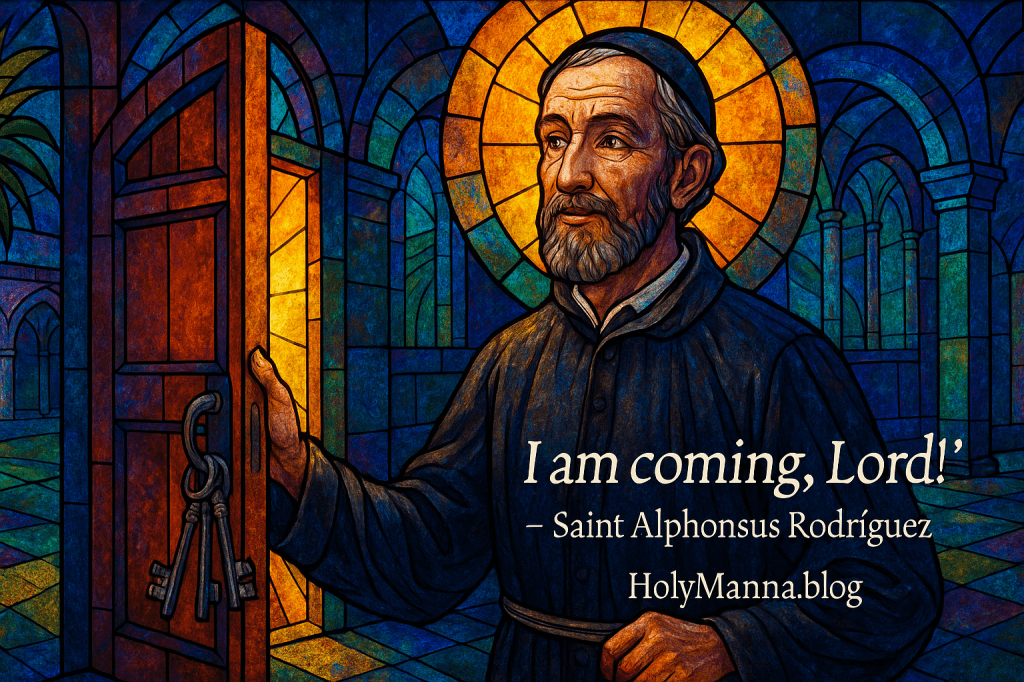
A Door Opened to God
Saint Alphonsus Rodríguez shows that holiness blossoms in the ordinary when love becomes the driving force. As a Jesuit lay brother and porter of the College of Montesión in Palma de Mallorca, he spent decades greeting visitors, guiding students, and quietly turning a threshold into a place of encounter with Christ. His humility, discernment, and spiritual counsel formed countless souls, including the young Jesuit Peter Claver who would later become a missionary and a champion for enslaved Africans. Alphonsus practiced relentless charity, constant prayer, and patient obedience, and he is honored on October 31 as a patron and model for those who seek perfection in daily duty.
From Segovia to the School Gate
Alphonsus was born in Segovia, Spain, on July 25, 1532, into a family in the wool trade. Early on he encountered the Society of Jesus and devout mentors who helped shape his love for prayer and the sacraments. He married María Suárez and experienced the joy of family life, followed by crushing grief as his wife and children died in close succession. That season of suffering deepened his conversion and drew him toward a life surrendered to God. He attempted to resume studies to become a priest but illness, age, and limited formal education made that path unworkable. The Society of Jesus received him instead as a lay brother in 1571, and he embraced that vocation with freedom and gratitude. Sent to Mallorca, he took up the role of porter and remained there until his death in 1617. His path to sanctity was not through dramatic public achievements but through a steady fidelity to prayer, charity, and the will of God.
A Life that Turned Service into Sanctity
At the porter’s lodge he met nobles and laborers, professors and beggars, and he welcomed each one as a guest sent by the Lord. It was his habit, when the bell rang, to whisper a short prayer, “I am coming, Lord!” That simple line reveals a whole spirituality. He believed interruptions were invitations from God, so the business of knocking, opening, listening, and guiding became a liturgy of love. He devoted long hours to Eucharistic adoration, meditated on the Passion, and nurtured a tender devotion to the Blessed Virgin Mary. Many who spoke with him testified to his wisdom and comforting presence. Some experienced conversions after his counsel. Others discovered renewed courage to follow difficult calls, as in the case of Peter Claver who left Mallorca for the missions in the New World. Alphonsus showed by example that ordinary tasks, carried out with extraordinary love, become a school of sanctity for the Church and a fragrant offering to God.
Trials, Loss, and the Long Obedience
Suffering was not a footnote in his story. Alphonsus endured widowhood, the death of his children, financial hardship, fragile health, and prolonged spiritual dryness. He wrestled at times with scruples and discouragement, yet he persevered through obedience, spiritual direction, and a disciplined life of prayer. He accepted with peace the disappointment of not being ordained and poured himself into the lay brother’s vocation. He practiced penance prudently, cultivated silence amid activity, and guarded charity in every conversation. No executioner’s sword touched him, yet he lived what Christians have long called a white martyrdom, a daily dying to self that allowed Christ to be formed in him. The grace he received did not isolate him from others but turned him outward in service and consolation, especially for the young Jesuits who sought his guidance at the door.
Signs and Favors During His Life
Accounts from those who knew Alphonsus describe a man graced with interior consolations, moments of ecstasy in prayer, and a striking ability to read hearts when souls sought direction. He was discreet about extraordinary gifts and preferred to hide them under obedience. Visitors later recalled being healed of heavy sadness after speaking with him, and some reported remarkable answers to prayer following his intercession. What stands out most is not one sensational episode but the persistent pattern of grace flowing through small, steady acts of love. His porter’s keys opened far more than a wooden door. They opened pathways for conversions, reconciliations, and renewed vocations, the kind of quiet miracles that often leave the deepest and most lasting mark.
The Echo of Grace After His Passing
Alphonsus died in Palma de Mallorca on October 31, 1617. The esteem of the faithful was immediate. Reports circulated of favors received at his bier and healings connected to prayers offered through his intercession. The Church recognized the enduring fruit of his life by advancing his cause, and he was eventually canonized by Pope Leo XIII in the nineteenth century. His remains are honored in Palma, where the memory of the gentle porter continues to draw pilgrims who seek consolation and the courage to sanctify their daily work. Devotion to Saint Alphonsus Rodríguez highlights the Church’s conviction that God writes the story of holiness not only in the lives of founders and preachers, but also in those who serve quietly and faithfully in hidden places.
Why His Keys Still Fit Our Hearts
Saint Alphonsus Rodríguez teaches that the most powerful evangelization often begins at home, at work, and at the very threshold of ordinary responsibilities. The Catechism of the Catholic Church reminds us that all the baptized are called to holiness and to the perfection of charity. Through his example, Alphonsus shows how to answer that call without fanfare. Begin the day by offering God the tasks ahead and welcome each interruption as a chance to love. Treat the person who arrives at your desk, in your messages, or at your actual door as a guest sent by Christ. Keep short prayers on your lips, guard your peace, and seek spiritual friendship and the sacraments when discouragement presses in. Let grief and weakness become places where God’s strength is revealed, and allow the works of mercy to shape your schedule. In this way, the humble duty in front of you becomes a gate to grace.
Living His Lesson Today
Take a moment before beginning a chore, a meeting, or a commute and offer it to Jesus. Prepare a simple phrase to sanctify interruptions, like “Jesus, be welcomed here.” Choose one specific work of mercy to practice consistently this week, such as advising the doubtful with patience, consoling the grieving with presence, or giving alms quietly and generously. Make time for Eucharistic adoration or a brief visit to the tabernacle, since Alphonsus drew strength from the Real Presence. Ask Our Lady to teach a heart of hospitality and to keep love at the center of ordinary duties. Hold to the Church’s promise that holiness is possible in every state of life, and let the rhythm of prayer and service turn thresholds into places where heaven touches earth.
Engage with Us!
Share your thoughts and reflections below. How does Saint Alphonsus Rodríguez challenge your view of “ordinary” vocation?
- Where is God asking for a deeper “yes” in today’s interruptions, and how can that yes become a habit?
- Which work of mercy can be practiced at your own “door,” whether at home, work, or parish?
- How can griefs or anxieties be offered to Christ in a way that makes you more available to others?
- Who is the “Peter Claver” in your life who needs encouragement to follow a hard but holy call?
- What short prayer will you adopt when the next “knock” comes?
Go with courage. Love the person in front of you. Do everything with the love and mercy Jesus taught, and let every knock on your door become a knock on heaven’s.
Saint Alphonsus Rodríguez, pray for us!
Follow us on Instagram and Facebook for more insights and reflections on living a faith-filled life.

 Holy Manna!
Leave a comment