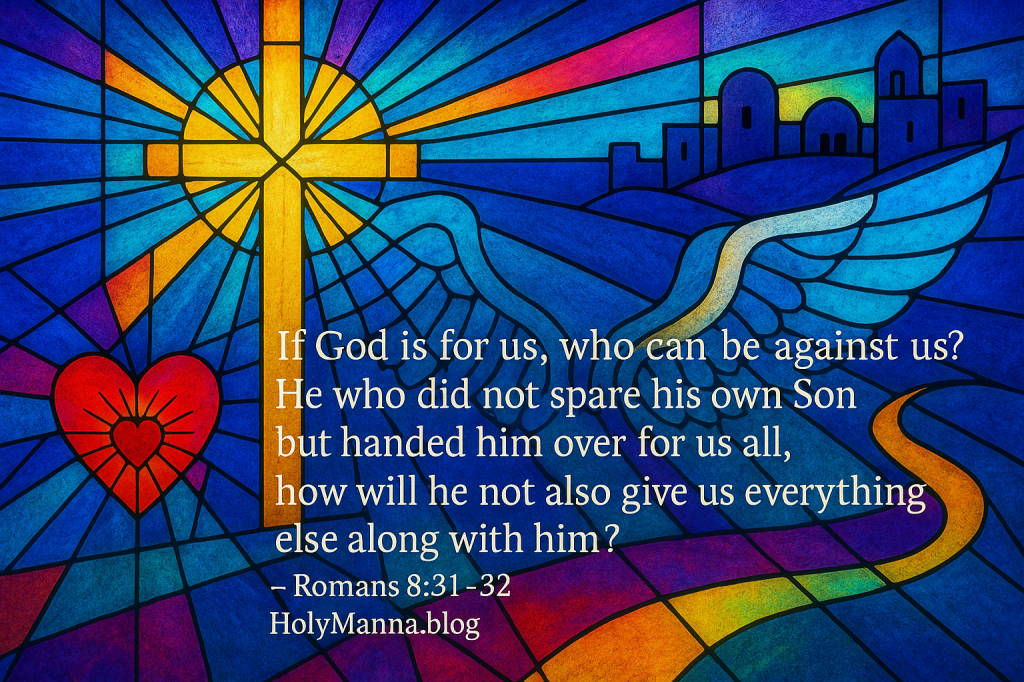
Thursday of the Thirtieth Week in Ordinary Time – Lectionary: 482
Under the Wing of Unfailing Love
Take a slow breath and step into a love that refuses to let go. In Romans 8:31–39, the Church hears a courtroom of objections silenced by divine mercy, “If God is for us, who can be against us?” and “What will separate us from the love of Christ?” Paul writes to a community in the heart of the empire, where believers lived under suspicion and social pressure, and he anchors courage in Christ seated at the Father’s right hand, interceding with victorious love, a truth confessed in CCC 662–667. The cry of the poor in Psalm 109 rises from this same world of judgment and vulnerability, “Help me, Lord, my God, save me in your mercy”, and “For he stands at the right hand of the poor”. That line about the right hand echoes Paul’s assurance, pairing the psalm’s liturgical lament with the Church’s proclamation that God’s power is made perfect in human weakness, as taught in CCC 272–274. Then Luke 13:31–35 shows Jesus moving steadily toward Jerusalem despite Herod Antipas, whom Jesus calls a fox, a common ancient image of cunning. The Lord reveals the Father’s heart with a striking maternal picture familiar to agrarian listeners, “How many times I yearned to gather your children together as a hen gathers her brood under her wings”, and He declares the divine timetable of salvation, “on the third day I accomplish my purpose.” The city that killed the prophets will not stop the Prophet who loves to the end, as taught in CCC 609. Taken together, these readings unveil one radiant theme, God’s steadfast love protects the disciple and propels the mission. The Intercessor at the right hand, the Defender at the right hand of the poor, and the Hen who gathers under her wings, all reveal a love that cannot be outmaneuvered, threatened, or exhausted. Where does Christ’s unbreakable love invite a move from fear into faithful action today?
First Reading – Romans 8:31–39
Unconquered by Fear, Carried by Christ’s Love
Paul addresses a mixed community in imperial Rome living with social pressure and suspicion, and he builds a courtroom scene where every accusation collapses under the weight of divine mercy. The Apostle anchors hope in the Father’s self-gift of the Son, in the Resurrection, and in Christ’s unending intercession at the right hand of the Father. This passage fits today’s theme by announcing that God’s steadfast love both protects the disciple and propels the mission. Confidence does not come from ease or status. It comes from the Cross, the Empty Tomb, and the heavenly advocacy of Jesus Christ.
Romans 8:31-39
New American Bible (Revised Edition)
31 What then shall we say to this? If God is for us, who can be against us? 32 He who did not spare his own Son but handed him over for us all, how will he not also give us everything else along with him? 33 Who will bring a charge against God’s chosen ones? It is God who acquits us. 34 Who will condemn? It is Christ [Jesus] who died, rather, was raised, who also is at the right hand of God, who indeed intercedes for us. 35 What will separate us from the love of Christ? Will anguish, or distress, or persecution, or famine, or nakedness, or peril, or the sword? 36 As it is written:
“For your sake we are being slain all the day;
we are looked upon as sheep to be slaughtered.”
37 No, in all these things we conquer overwhelmingly through him who loved us. 38 For I am convinced that neither death, nor life, nor angels, nor principalities, nor present things, nor future things, nor powers, 39 nor height, nor depth, nor any other creature will be able to separate us from the love of God in Christ Jesus our Lord.
Detailed Exegesis
Verse 31 – “What then shall we say to this? If God is for us, who can be against us?”
Paul’s rhetorical question crowns the argument of Romans 5–8. The verdict of justification has already been rendered by God. Opposition may be loud, but it cannot overrule the Judge.
Verse 32 – “He who did not spare his own Son but handed him over for us all, how will he not also give us everything else along with him?”
The Father’s most costly gift guarantees every lesser grace needed for salvation and sanctification. The logic is sacrificial and covenantal, echoing Isaiah 53. Divine generosity, not human performance, grounds confidence.
Verse 33 – “Who will bring a charge against God’s chosen ones? It is God who acquits us.”
The courtroom image becomes explicit. Accusations from enemies, culture, or conscience cannot stand where God has declared acquittal in Christ.
Verse 34 – “Who will condemn? It is Christ [Jesus] who died, rather, was raised, who also is at the right hand of God, who indeed intercedes for us.”
Paul stacks the pillars of assurance. Death removes guilt, Resurrection vindicates, enthronement manifests authority, and intercession sustains the redeemed. Salvation is not a momentary event but a present ministry of the risen Lord.
Verse 35 – “What will separate us from the love of Christ? Will anguish, or distress, or persecution, or famine, or nakedness, or peril, or the sword?”
The Apostle names the ordinary terrors of discipleship in the Roman world. Hardship does not signal abandonment. It becomes the place where love proves stronger.
Verse 36 – “For your sake we are being slain all the day; we are looked upon as sheep to be slaughtered.”
Quoting Psalm 44:22, Paul places Christian suffering inside Israel’s story. Fidelity often draws fire. The faithful are not forgotten. They are aligned with the righteous who suffer for God’s sake.
Verse 37 – “No, in all these things we conquer overwhelmingly through him who loved us.”
Victory is participation in Christ’s love, not escape from the battlefield. Belonging to the Crucified and Risen One makes endurance fruitful and triumphant.
Verse 38 – “For I am convinced that neither death, nor life, nor angels, nor principalities, nor present things, nor future things, nor powers,”
Paul surveys forces believed to control destiny and declares their impotence before the New Covenant. None can cancel God’s choice.
Verse 39 – “nor height, nor depth, nor any other creature will be able to separate us from the love of God in Christ Jesus our Lord.”
The conclusion is total and tender. The love is God’s, the place is Christ Jesus, and the bond is unbreakable. Identity and mission rest here.
Teachings
The Church reads this passage as a summit of confidence grounded in Christ’s total self-offering, heavenly intercession, and the Father’s almighty love revealed in the Paschal Mystery. “By embracing in his human heart the Father’s love for men, Jesus ‘loved them to the end,’ for ‘greater love has no man than this, that a man lay down his life for his friends.’ In suffering and death his humanity became the free and perfect instrument of his divine love which desires the salvation of men.” CCC 609. Christ’s saving work continues now in glory. “Jesus Christ, the one priest of the new and eternal Covenant, ‘entered, not into a sanctuary made by human hands but into heaven itself, now to appear in the presence of God on our behalf.’ There Christ permanently exercises his priesthood, for he ‘always lives to make intercession’ for ‘those who draw near to God through him.’” CCC 662. His enthronement is real and royal. “Henceforth Christ is seated at the right hand of the Father.” CCC 663. “Being seated at the Father’s right hand signifies the inauguration of the Messiah’s kingdom.” CCC 664. The confidence that flows from this does not deny suffering. It confesses God’s power at work in it. “In the most mysterious way God the Father has revealed his almighty power in the voluntary humiliation and Resurrection of his Son, by which he conquered evil.” CCC 272. “Only faith can embrace the mysterious ways of God’s almighty power. This faith glories in its weaknesses in order to draw to itself Christ’s power.” CCC 273. “Nothing is more apt to confirm our faith and hope than holding it fixed in our minds that nothing is impossible with God.” CCC 274. This confidence then flowers into praise, the fitting response of the redeemed. “Praise is the form of prayer which recognizes most immediately that God is God.” CCC 2639. The witnesses of the Church echo Paul’s assurance, as in the timeless counsel of St. Teresa of Ávila, “Let nothing disturb you, Let nothing frighten you, All things are passing away: God never changes. Patience obtains all things. Whoever has God lacks nothing. God alone suffices.”
Reflection
Let this verdict shape the day. Name the accusations and lay them at the feet of the One who intercedes. Choose a short act of praise when anxiety spikes, then make a concrete decision that expresses trust in God’s generosity. Encourage someone else by sharing a small testimony of how the Lord has provided. Return to this text until a line lives in memory and rises on its own in pressure.
Which fear most challenges the assurance “If God is for us, who can be against us?” right now?
Where is the Lord inviting a step that proves confidence in his generosity from verse 32?
What specific act of praise will replace anxious scripts this week so that love, not fear, sets the pace?
Responsorial Psalm – Psalm 109:21–22, 26–27, 30–31
The Defender at the Right Hand of the Poor
Composed as an individual lament in Israel’s worship, Psalm 109 gives voice to a believer under accusation who entrusts everything to the Lord’s justice and mercy. In the ancient Near Eastern imagination, the “right hand” signifies strength and advocacy, the place of a champion who steps in to defend the vulnerable. Prayed within the Church, this psalm tunes the heart to the truth announced in Romans 8:31–39: the One seated at the right hand of the Father stands at the right hand of the poor. Today’s theme comes into focus through this psalm’s rhythm of plea and praise. The cry, “Help me, Lord, my God”, ripens into public thanksgiving, “Before a crowd I will praise him”, which forms disciples who trust God’s steadfast love and witness to it boldly.
Psalm 109:21-22
New American Bible (Revised Edition)
21 But you, Lord, are my Lord,
deal kindly with me for your name’s sake;
in your great mercy rescue me.
22 For I am poor and needy;
my heart is pierced within me.
26 Help me, Lord, my God;
save me in your mercy.
27 Make them know this is your hand,
that you, Lord, have done this.
30 I will give fervent thanks to the Lord;
before a crowd I will praise him.
31 For he stands at the right hand of the poor
to save him from those who pass judgment on him.
Detailed Exegesis
Verse 21 – “But you, Lord, are my Lord, deal kindly with me for your name’s sake; in your great mercy rescue me.”
The prayer begins with covenant language. “For your name’s sake” invokes God’s revealed character and faithful reputation. The psalmist appeals not to personal merit but to divine mercy. In biblical spirituality, salvation is God’s self-consistent action that displays his name, so the plea is anchored in who God is rather than in what the sufferer can do.
Verse 22 – “For I am poor and needy; my heart is pierced within me.”
Poverty here is not only economic. It is existential vulnerability and spiritual lowliness. Scripture calls this the posture that invites God’s nearness. The pierced heart describes interior anguish, yet it becomes the very place where God’s mercy arrives. This prepares the community to recognize the Beatitudes’ logic of blessedness for the poor in spirit and to resist the lie that weakness cancels divine favor.
Verse 26 – “Help me, Lord, my God; save me in your mercy.”
The prayer tightens to a simple cry. The covenant name, “Lord, my God,” expresses intimate belonging. Salvation is described as an act of mercy, not a wage. The psalm models the Church’s short prayers in distress, the kind that can be whispered amid work, traffic, or trial.
Verse 27 – “Make them know this is your hand, that you, Lord, have done this.”
The goal of deliverance is God’s glory made visible. Vindication becomes evangelization, because others see the Lord’s hand and learn his name. The psalmist desires not personal triumph but public recognition that God acts for the lowly.
Verse 30 – “I will give fervent thanks to the Lord; before a crowd I will praise him.”
Lament blossoms into liturgical praise. Personal rescue moves outward into communal witness. The psalm trains disciples to carry gratitude from the secret place of prayer into the assembly, where thanksgiving strengthens the faith of others.
Verse 31 – “For he stands at the right hand of the poor to save him from those who pass judgment on him.”
This climactic image answers the opening need. The Lord himself takes the advocate’s place beside the poor. Judgment from others does not get the last word because God, the true Judge, draws near as defender. For Christians, this resonates with the confession that Christ intercedes at the Father’s right hand while also standing with the least in their need.
Teachings
The Church receives this psalm as a school of humble petition and robust praise. Praise is not an optional flourish. It is the heart’s immediate recognition of who God is and it reshapes the community’s imagination for deliverance and mission. “Praise is the form of prayer which recognizes most immediately that God is God. It lauds God for his own sake and gives him glory.” CCC 2639. This psalm also forms a preferential attention to the poor, reminding the faithful that God’s saving action is revealed where human resources fail, as taught in CCC 2448 on the Church’s love for the poor and in CCC 2616 on the prayer of faith. Finally, it points to Christ’s solidarity and advocacy. “Christ enables us to live in him all that he himself lived, and he lives it in us.” CCC 521. In other words, the Lord who stands at the right hand of the poor teaches his disciples to do the same by grace, turning lament into thanksgiving and fear into witness.
Reflection
This psalm offers a clear path for the soul that feels accused, overlooked, or exhausted. Begin the day by taking the psalmist’s words as your own. Speak them slowly and let the name of the Lord steady the heart. When anxiety rises, repeat verse 26 as a short prayer until peace returns. When help arrives, give thanks publicly and encourage someone else with the story of how God provided. Look for one concrete way to stand at the right hand of someone poor or judged, whether through quiet advocacy, a listening ear, or material help. Allow the rhythm of plea and praise to reframe the week so that God’s hand becomes visible in the ordinary.
Where does the Lord invite a move from silent worry into honest prayer today?
Who around you needs an advocate at their right hand, and how can God’s mercy flow through your presence?
What specific thanksgiving can you bring “before a crowd” to strengthen another person’s faith this week?
Holy Gospel – Luke 13:31–35
Fearless Mission and Tender Mercy in the Shadow of a Fox
Set against the rule of Herod Antipas, the tetrarch who executed John the Baptist and kept uneasy peace in Galilee, this scene shows Jesus steadying his steps toward Jerusalem while political threats swirl. Some Pharisees warn him to flee, which hints at the complex alliances and rivalries that marked first century Judea. Jesus answers with royal calm and prophetic clarity, naming Herod “a fox,” a common ancient image for cunning and smallness. He then reveals a divine timetable, speaking of “today… tomorrow… the third day”, a pattern that hints at completion and foreshadows the Paschal Mystery. The lament over Jerusalem gathers Israel’s story of rejected prophets into one aching sentence of maternal love, “as a hen gathers her brood under her wings”. This Gospel fits today’s theme by uniting unstoppable love with fearless purpose. The Lord refuses to withdraw in fear. He advances in mercy, determined to gather the unwilling and to accomplish the Father’s saving plan.
Luke 13:31-35
New American Bible (Revised Edition)
Herod’s Desire to Kill Jesus. 31 At that time some Pharisees came to him and said, “Go away, leave this area because Herod wants to kill you.” 32 He replied, “Go and tell that fox, ‘Behold, I cast out demons and I perform healings today and tomorrow, and on the third day I accomplish my purpose. 33 Yet I must continue on my way today, tomorrow, and the following day, for it is impossible that a prophet should die outside of Jerusalem.’
The Lament over Jerusalem. 34 “Jerusalem, Jerusalem, you who kill the prophets and stone those sent to you, how many times I yearned to gather your children together as a hen gathers her brood under her wings, but you were unwilling! 35 Behold, your house will be abandoned. [But] I tell you, you will not see me until [the time comes when] you say, ‘Blessed is he who comes in the name of the Lord.’”
Detailed Exegesis
Verse 31 – “At that time some Pharisees came to him and said, ‘Go away, leave this area because Herod wants to kill you.’”
The warning situates Jesus inside real political danger. Whether these Pharisees are sincere or manipulative, the threat recalls John the Baptist’s fate. The Gospel highlights that discipleship unfolds amid pressures from both religious elites and state power, yet God’s plan does not bend to intimidation.
Verse 32 – “He replied, ‘Go and tell that fox, “Behold, I cast out demons and I perform healings today and tomorrow, and on the third day I accomplish my purpose.”’”
Calling Herod “that fox” underscores the contrast between human scheming and divine sovereignty. Exorcisms and healings are signs that the Kingdom is at work in the present. “On the third day I accomplish my purpose” signals completion in God’s time and anticipates the Resurrection. The Greek idea behind “accomplish” conveys being perfected or brought to fulfillment. Mission continues not because threats disappear, but because love compels the timetable.
Verse 33 – “‘Yet I must continue on my way today, tomorrow, and the following day, for it is impossible that a prophet should die outside of Jerusalem.’”
“I must” expresses divine necessity. Jesus reads his journey as obedience to the Father’s will. The line about a prophet dying in Jerusalem is a tragic irony that frames the city as the place where God’s messengers are often rejected. The Savior moves toward that rejection with clarity and courage.
Verse 34 – “‘Jerusalem, Jerusalem, you who kill the prophets and stone those sent to you, how many times I yearned to gather your children together as a hen gathers her brood under her wings, but you were unwilling!’”
The repetition of the city’s name carries tenderness and grief. The maternal image of a hen evokes covenant protection “under wings,” an Old Testament theme of refuge. The problem is not God’s willingness but Jerusalem’s refusal. Divine love reveals a heart that longs to gather even the resistant.
Verse 35 – “‘Behold, your house will be abandoned. [But] I tell you, you will not see me until [the time comes when] you say, “Blessed is he who comes in the name of the Lord.”’”
“Your house” points to the Temple and, more broadly, to the national life ordered around God’s presence. Abandonment signals judgment that follows persistent refusal. Yet hope remains. The line from Psalm 118:26 looks to the acclamation at the entry into Jerusalem and ultimately to the day of recognition when hearts welcome the King.
Teachings
The Catechism gathers this Lukan moment into Jesus’ solemn ascent to Jerusalem, where love fulfills the plan of the Father. “When the days drew near for him to be taken up he set his face to go to Jerusalem.” CCC 557. Jesus’ lament remembers Israel’s history of rejecting God’s messengers while still expressing a desire to gather the city into peace. “Jesus recalls the martyrdom of the prophets sent to Jerusalem. Nevertheless, he continues to call Jerusalem to gather around him: ‘How often would I have gathered your children together as a hen gathers her brood under her wings, and you would not.’” CCC 558. The Catechism then links the Psalm 118 acclamation to the mystery that Jesus will accomplish. “Jesus’ entry into Jerusalem manifests the coming of the kingdom that the King-Messiah is going to accomplish by the Passover of his Death and Resurrection.” CCC 560. All of this unfolds because the Son embraces the Father’s will without hesitation. “The desire to embrace his Father’s plan of redeeming love inspired Jesus’ whole life.” CCC 606. In short, the Gospel reveals a Lord whose fearless mission springs from inexhaustible mercy, gathering the unwilling and accomplishing salvation in God’s time.
Reflection
This Gospel invites courageous fidelity and tender love at the same time. Threats, setbacks, and misunderstandings do not define the day when the Lord’s timetable sets the pace. Begin by naming where fear pushes toward flight. Offer that place to Christ who keeps working “today and tomorrow” in ordinary acts of mercy. Stay near to those who struggle, and choose a small action that shelters someone under the wings of concrete charity. When resistance appears, keep moving with clarity and peace, because love knows its hour.
Where is the Lord inviting a step forward that fear has delayed?
What work of mercy can become the “today and tomorrow” that keeps the heart aligned with Jesus’ mission?
How can praise from Psalm 118 shape the week so that welcoming the King becomes the instinct, even in pressure and uncertainty?
Gathered Under a Love That Will Not Let Go
Today’s Word stitches one clear thread through every line, God’s steadfast love protects the disciple and propels the mission. In Romans 8:31–39, the Spirit lifts the chin with “If God is for us, who can be against us?” and ends with unshakable confidence that nothing can separate the believer from the love of God in Christ Jesus. In Psalm 109:21–22, 26–27, 30–31, the cry of the poor becomes praise because “he stands at the right hand of the poor”, turning hidden lament into public thanksgiving. In Luke 13:31–35, Jesus refuses to run from Herod, keeps healing “today and tomorrow”, and promises “on the third day I accomplish my purpose”, while His heart longs to gather the unwilling “as a hen gathers her brood under her wings.” Taken together, the verdict is secure, the Advocate is near, and the Lord’s timetable sets the pace for courageous love.
Here is the invitation. Hand over every accusation and fear to the One who intercedes and choose a concrete work of mercy that shelters someone under His wings. Let a short act of praise rise during pressure, then share a simple testimony of how God helped this week. Memorize a line from Romans 8 or echo the psalm’s prayer until peace returns. Keep moving with the Lord’s steady cadence, trusting that love finishes what it starts. What fear needs to yield to Christ’s unbreakable love today? Who needs you to stand at their right hand so God’s mercy becomes visible? Where will the “today and tomorrow” of ordinary faithfulness let Jesus accomplish His purpose in you?
Engage with Us!
Share reflections in the comments below and let the conversation build up the Church.
- First Reading – Romans 8:31–39: Which fear most challenges the assurance “If God is for us, who can be against us?” right now? Where does your heart need to remember that Christ intercedes at the right hand of the Father today? What concrete decision this week will show trust that nothing can separate you from the love of God in Christ Jesus?
- Responsorial Psalm – Psalm 109:21–22, 26–27, 30–31: What short prayer from this psalm will you repeat in pressure, for example “Help me, Lord, my God; save me in your mercy”? Who near you needs someone to stand at their right hand today, and how can you make God’s mercy visible? What thanksgiving will you bring “before a crowd” so that others know “the Lord has done this”?
- Holy Gospel – Luke 13:31–35: Where is the Lord inviting a step forward even with opposition in view? What act of mercy can become the “today and tomorrow” that aligns your life with Jesus’ mission? How will you welcome the King with “Blessed is he who comes in the name of the Lord” in the routines of daily life?
May the Holy Spirit strengthen every heart to live a clear and courageous faith, to shelter others under the wings of mercy, and to do everything with the love and compassion Jesus taught.
Sacred Heart of Jesus, we trust in You!
Immaculate Heart of Mary, pray for us!
Saint Michael the Archangel, defend us in battle!
Follow us on Instagram and Facebook for more insights and reflections on living a faith-filled life.

 Holy Manna!
Leave a comment