Wednesday of the Thirtieth Week in Ordinary Time – Lectionary: 481
Through the Narrow Door, Carried by the Spirit
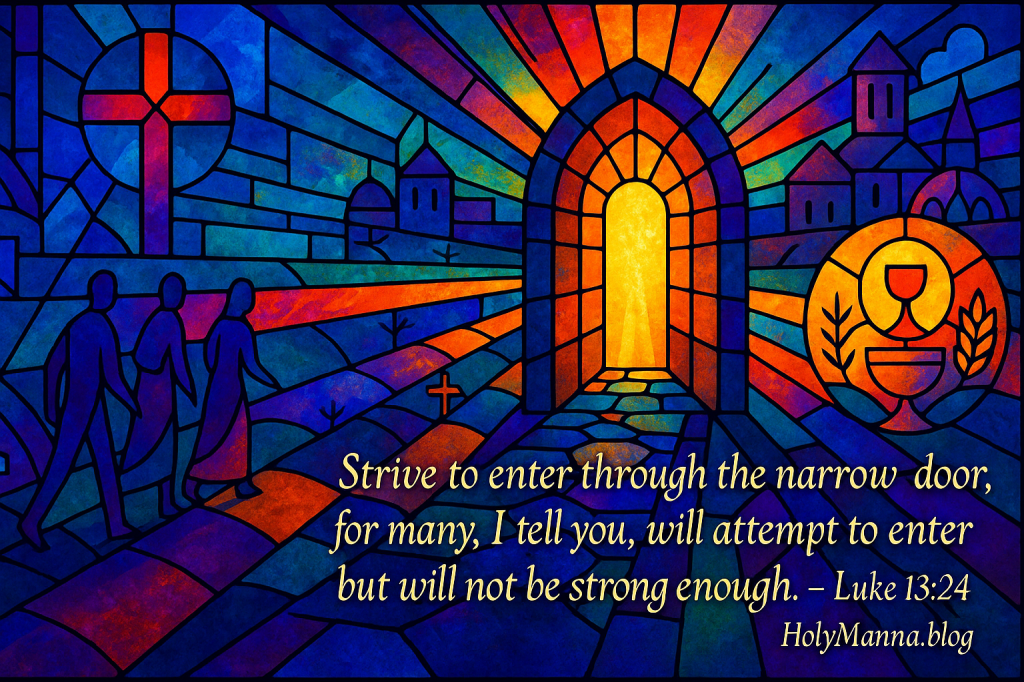
Settle in for a moment and picture the Christian life as a pilgrimage toward a small, shining doorway, a place where joy is real and every tear is remembered. Today’s readings trace that path with clarity: Romans 8:26–30 reveals that our journey is not powered by human strength alone, because “the Spirit… intercedes with inexpressible groanings”, and the Father weaves “all things… for good for those who love God” as He conforms hearts to the image of His Son. Psalm 13:4–6 gives language to that dependence, moving from raw plea to steady trust as the psalmist begs, “Give light to my eyes lest I sleep in death”, then celebrates, “I will sing to the Lord, for he has dealt bountifully with me”. In Luke 13:22–30, Jesus answers the anxious question about who is saved by calling for real engagement: “Strive to enter through the narrow door”. Proximity to Jesus is not the same as communion with Him; the Kingdom’s banquet welcomes people from east and west, north and south, yet entry rests on authentic conversion and obedient love. Historically, Jesus delivers this teaching on the road to Jerusalem, where His Passover will open the covenant to the nations and enact the great reversal, “some are last who will be first, and some are first who will be last”. In Saint Paul’s day, the Roman church held both Jewish and Gentile believers who wrestled with the mystery of God’s plan; Romans 8 assured them that the Father’s initiative, long prefigured in Israel, reaches its fulfillment by the Spirit in Christ’s body. The language of Psalm 13 reflects ancient Israel’s pattern of lament that becomes praise, a rhythm every disciple learns when weakness meets grace. The Church teaches that grace always comes first and invites cooperation, since “Grace is favor, the free and undeserved help that God gives us” (CCC 1996), and that the narrow way requires perseverance in virtue and spiritual battle (CCC 2015; 1811; 2001; 2630; 1036). All together, the Word draws a single line: the Spirit supplies what human weakness lacks, God’s providence turns even trials toward conformity to Christ, and the disciple responds with steady effort at the narrow door. Where does the Spirit’s quiet help invite a concrete step of trust and obedience today?
First Reading – Romans 8:26–30
Strength for prayer, providence in trials, and a destiny shaped to look like Christ
Paul writes to a mixed community of Jewish and Gentile believers in Rome around the late 50s A.D., addressing a church navigating imperial pressure, cultural tensions, and the question of how God’s saving plan unfolds in history. Within that landscape, Romans 8:26–30 anchors disciples in the Holy Spirit’s help, the Father’s wise providence, and the Son’s image as the goal of every life. The passage stands at the summit of Romans 8, where Paul gathers the threads of suffering, hope, and adoption to show that the Spirit supplies what human weakness lacks, that God works even painful seasons for good, and that the entire journey leads to conformity to Christ. In light of today’s theme, this reading explains how the narrow way becomes possible. The Spirit strengthens prayer, the Father’s purpose transforms every circumstance, and the end of the path is glory in the Son.
Romans 8:26-30
New American Bible (Revised Edition)
26 In the same way, the Spirit too comes to the aid of our weakness; for we do not know how to pray as we ought, but the Spirit itself intercedes with inexpressible groanings. 27 And the one who searches hearts knows what is the intention of the Spirit, because it intercedes for the holy ones according to God’s will.
God’s Indomitable Love in Christ. 28 We know that all things work for good for those who love God, who are called according to his purpose. 29 For those he foreknew he also predestined to be conformed to the image of his Son, so that he might be the firstborn among many brothers. 30 And those he predestined he also called; and those he called he also justified; and those he justified he also glorified.
Detailed Exegesis
Verse 26 — “In the same way, the Spirit too comes to the aid of our weakness; for we do not know how to pray as we ought, but the Spirit itself intercedes with inexpressible groanings.”
Paul names the honest limits of human prayer and lifts the veil on the Spirit’s interior work. Prayer does not begin with human eloquence. Prayer begins with divine assistance. The Spirit bends human poverty toward the Father and turns sighs into intercession. The helplessness that often discourages prayer becomes the very place where grace acts most powerfully.
Verse 27 — “And the one who searches hearts knows what is the intention of the Spirit, because it intercedes for the holy ones according to God’s will.”
The Father, who searches hearts, fully receives the Spirit’s intercession within the redeemed. Prayer is not guesswork in the dark. Through the Spirit, prayer is aligned to God’s will. Holiness grows as desire is purified and intention is reshaped to mirror the Son’s obedience.
Verse 28 — “We know that all things work for good for those who love God, who are called according to his purpose.”
This is not a promise that all things are good. It is the pledge that God can weave every thread, including loss and trial, into a tapestry that serves salvation. Love for God and the call according to his purpose form the context in which suffering becomes seed for glory. Confidence rests not in circumstances but in the faithfulness of the One who guides them.
Verse 29 — “For those he foreknew he also predestined to be conformed to the image of his Son, so that he might be the firstborn among many brothers.”
Foreknowledge is not cold fate. It is the eternal, loving gaze by which God wills creatures into communion. Predestination here names the gracious plan to shape believers into the likeness of Jesus. The goal is filial resemblance. Christ the Firstborn establishes a new family, and every disciple is fashioned to look like him.
Verse 30 — “And those he predestined he also called; and those he called he also justified; and those he justified he also glorified.”
Often called the golden chain, this verse links the stages of salvation in a single, unbreakable work of God. Paul even speaks of glory in the past tense to underline the certainty of God’s promise. The path passes through calling and justification toward final glory, which begins now as a hidden life and will be revealed in the resurrection.
Teachings
The Church insists that grace initiates, accompanies, and brings to completion the entire Christian life. “Our justification comes from the grace of God. Grace is favor, the free and undeserved help that God gives us to respond to his call to become children of God, adoptive sons, partakers of the divine nature and of eternal life.” CCC 1996. This primacy of grace is why prayer remains possible even in weakness. “The Holy Spirit who helps us in our weakness; for we do not know how to pray as we ought, but the Spirit himself intercedes for us with sighs too deep for words.” CCC 2630. Regarding predestination, the Church holds together God’s sovereignty and real human freedom. “To God, all moments of time are present in their immediacy. When therefore he establishes his eternal plan of ‘predestination’, he includes in it each person’s free response to his grace.” CCC 600. Because the journey to glory is a path of real transformation, it necessarily involves spiritual combat. “The way of perfection passes by way of the Cross. There is no holiness without renunciation and spiritual battle.” CCC 2015. Growth in virtue depends on this same grace. “It is not easy for man, wounded by sin, to maintain moral balance. Christ’s gift of salvation offers us the grace necessary to persevere in the pursuit of the virtues. Everyone should always ask for this grace of light and strength, frequent the sacraments, cooperate with the Holy Spirit, and follow his calls to love what is good and shun evil.” CCC 1811. Finally, salvation cannot be self earned at the start. “Since the initiative belongs to God in the order of grace, no one can merit the initial grace of forgiveness and justification.” CCC 2010. The Fathers echo this synergy of grace and response with pastoral clarity. “He who created you without you will not justify you without you.” St. Augustine, Sermon 169, 13. Historically, Paul writes Romans during his Corinth stay before traveling to Jerusalem, addressing a church shaped by the return of Jewish Christians after Claudius’s earlier expulsion. The Spirit’s help, the universality of the call, and the promise of glory speak directly into a community learning unity and perseverance under pressure.
Reflection
This passage invites concrete trust when prayer feels dry or when circumstances feel confusing. Begin by setting aside a small, consistent time each day to let the Spirit carry prayer, even if words feel few. When anxiety rises, repeat today’s promise from Romans 8:28 and ask for the grace to love God in the middle of the present situation. Seek the sacraments regularly, especially Confession and the Eucharist, where justification is deepened and conformation to Christ advances. Practice one act today that reflects the Son’s image, such as forgiving an offense, serving a hidden need, or offering a quiet sacrifice without complaint. Where is the Spirit inviting a simple yes that seems small but will shape the heart toward Christ’s likeness? Which circumstance today can be entrusted to the Father’s providence with a deliberate act of faith in his goodness? How might daily prayer shift if the starting point is confidence that the Spirit is already interceding within?
Responsorial Psalm – Psalm 13:4–6
From lament to praise, the heart learns trust
Psalm 13 is a classic individual lament that likely arose from a season of acute danger, perhaps sickness or mortal threat. In Israel’s worship this kind of prayer trained the community to bring raw fear and frustration to God without pretending to be strong. The psalm follows the ancient pattern of complaint, petition, and trust, which became a school of faith in the temple and later in the synagogue. Within today’s theme, the movement of Psalm 13 shows how grace meets weakness. The cry for light becomes confidence in mercy, and the pleading heart discovers joy in salvation. This is the inner shape of the narrow way. Disciples do not hide their need. They hand it to God and learn to sing.
Psalm 13:4-6
New American Bible (Revised Edition)
4 Look upon me, answer me, Lord, my God!
Give light to my eyes lest I sleep in death,
5 Lest my enemy say, “I have prevailed,”
lest my foes rejoice at my downfall.
6 But I trust in your mercy.
Grant my heart joy in your salvation,
I will sing to the Lord,
for he has dealt bountifully with me!
Detailed Exegesis
Verse 4 — “Look upon me, answer me, Lord, my God! Give light to my eyes lest I sleep in death,”
The prayer begins with a direct appeal to God’s attention and action. “Look,” “answer,” and “give” are covenant words. The psalmist knows that life depends on the Lord’s gaze and gift. “Light to my eyes” evokes renewed vitality, since dimming eyes signaled the approach of death in ancient speech. This petition resonates with Romans 8:26, where the Spirit aids weakness. Honest poverty becomes the doorway where divine help enters.
Verse 5 — “Lest my enemy say, ‘I have prevailed,’ lest my foes rejoice at my downfall.”
The threat is not only personal harm but public humiliation that would mock God’s care for His own. In biblical lament, God’s honor is always at stake with the petitioner’s fate. The psalmist appeals to the Lord’s covenant fidelity, trusting that deliverance will display divine justice. This aligns with the Church’s teaching that trials test and strengthen trust in God’s providence, which orders all things toward the good for those who love Him, as taught in Romans 8:28.
Verse 6 — “But I trust in your mercy. Grant my heart joy in your salvation, I will sing to the Lord, for he has dealt bountifully with me!”
The turning point arrives with a deliberate act of trust. “Mercy” translates the rich covenant term hesed, God’s steadfast love. Joy is not denial of pain. Joy is confidence that God will act as Savior. Praise springs up ahead of visible rescue because memory reads the past as bounty and expects the same faithful love again. The psalm ends where Christian prayer always aims, with adoration that lifts the heart and steadies the will for the narrow door.
Teachings
The Church places the Psalms at the center of prayer because they teach hearts to pray through every season. “The Psalter is the book in which the word of God becomes man’s prayer.” CCC 2587. This is why lament can move so quickly into praise. The Psalms turn God’s promises into the words that shape desire and trust. Christian prayer grows as a living habit, animated by grace. “Prayer is the life of the new heart.” CCC 2697. Confidence in trials draws strength from God’s initiative, not human effort. “Our justification comes from the grace of God. Grace is favor, the free and undeserved help that God gives us to respond to his call to become children of God, adoptive sons, partakers of the divine nature and of eternal life.” CCC 1996. The saints echo this path from cry to confidence. “He who created you without you will not justify you without you.” St. Augustine, Sermon 169, 13. Lament opens the soul to cooperate with grace, while trust chooses to lean on the Father’s mercy before circumstances change.
Reflection
Let this psalm tutor prayer in hard days. Begin by speaking plainly to the Lord about the exact fear or pressure that weighs on the heart, and ask for light where vision feels dim. Choose a short act of trust, such as repeating the words “But I trust in your mercy” throughout the day until anxiety loosens its grip. Recall one concrete instance of God’s past help and let memory fuel present praise. Make time for the Eucharist and Confession when possible, since grace deepens trust and turns lament into thanksgiving. What situation today calls for the words “Look upon me, answer me, Lord, my God”? Where can a deliberate act of trust replace spiraling worry? How might nightly prayer change if it always ends with a brief song of gratitude for how the Lord has dealt bountifully?
Holy Gospel – Luke 13:22–30
The door is narrow, everyone is invited, and the time is now
Luke places this teaching on Jesus’ journey to Jerusalem, the climactic road where His Passover will open the covenant to the nations. In first century Palestine, the image of a household door closing at night signaled finality and accountability, while the banquet evoked the prophetic promise of a messianic feast that gathers the scattered. Within Luke 13:22–30, Jesus addresses the anxious question about how many are saved by refocusing hearts on how to be saved. Familiarity with Jesus is not the same as communion with Him. The Kingdom welcomes people from every direction, yet entry passes through the “narrow door” of real conversion, persevering obedience, and grace fueled effort. In light of today’s theme, this Gospel shows the shape of Spirit led perseverance. The Spirit supplies strength, the disciple strives, and the Father’s providence gathers a people who are conformed to the Son.
Luke 13:22-30
New American Bible (Revised Edition)
22 He passed through towns and villages, teaching as he went and making his way to Jerusalem. 23 Someone asked him, “Lord, will only a few people be saved?” He answered them, 24 “Strive to enter through the narrow door, for many, I tell you, will attempt to enter but will not be strong enough. 25 After the master of the house has arisen and locked the door, then will you stand outside knocking and saying, ‘Lord, open the door for us.’ He will say to you in reply, ‘I do not know where you are from.’ 26 And you will say, ‘We ate and drank in your company and you taught in our streets.’ 27 Then he will say to you, ‘I do not know where [you] are from. Depart from me, all you evildoers!’ 28 And there will be wailing and grinding of teeth when you see Abraham, Isaac, and Jacob and all the prophets in the kingdom of God and you yourselves cast out. 29 And people will come from the east and the west and from the north and the south and will recline at table in the kingdom of God. 30 For behold, some are last who will be first, and some are first who will be last.”
Detailed Exegesis
Verse 22 — “He passed through towns and villages, teaching as he went and making his way to Jerusalem.”
The journey motif frames everything. Jerusalem is not only a destination. It is the place where salvation will be accomplished. Teaching on the road signals that discipleship is learned in motion and tested by the Cross.
Verse 23 — “Someone asked him, ‘Lord, will only a few people be saved?’ He answered them,”
The question reflects common debates in Second Temple Judaism about the scope of salvation. Jesus declines to satisfy curiosity about numbers and instead calls for personal decision. Salvation is not a statistic. Salvation is a covenant relationship that demands response.
Verse 24 — “‘Strive to enter through the narrow door, for many, I tell you, will attempt to enter but will not be strong enough.’”
“Strive” translates the verb that gives us “agony,” suggesting disciplined effort. The door is narrow because the way is Christ shaped. Pride, self reliance, and habitual sin do not fit. Strength here is not mere willpower. Strength comes from grace embraced and lived, which ties this command to the Spirit’s aid described in Romans 8:26.
Verse 25 — “‘After the master of the house has arisen and locked the door, then will you stand outside knocking and saying, “Lord, open the door for us.” He will say to you in reply, “I do not know where you are from.”’”
The closed door evokes final judgment. Once the master rises, the time of repentance has passed. “I do not know where you are from” exposes a lack of covenant identity. The issue is not information, but relationship. Knowledge in Scripture is relational and covenantal.
Verse 26 — “‘And you will say, “We ate and drank in your company and you taught in our streets.”’”
Mere proximity to sacred things does not save. Eating with Jesus or hearing His words without conversion leaves the heart unchanged. The Eucharist calls for a life that matches the sacrament’s grace through repentance and charity.
Verse 27 — “‘Then he will say to you, “I do not know where [you] are from. Depart from me, all you evildoers!”’”
The echo of “Depart from me” recalls the Psalmist’s language about evildoers and Jesus’ warning elsewhere to workers of lawlessness. Persistent refusal of grace results in self exclusion from the Kingdom. Judgment confirms the truth of a life’s choices.
Verse 28 — “‘And there will be wailing and grinding of teeth when you see Abraham, Isaac, and Jacob and all the prophets in the kingdom of God and you yourselves cast out.’”
This is the pain of lost communion. The patriarchs and prophets symbolize the faithful who responded to God’s call. Seeing the joy of the righteous without sharing it heightens the tragedy of a hardened heart.
Verse 29 — “‘And people will come from the east and the west and from the north and the south and will recline at table in the kingdom of God.’”
Here is the global horizon of the Gospel. The banquet gathers the nations as promised by the prophets. The narrow door is not a tiny welcome. It is a holy welcome. The standard is Christ and the source is grace.
Verse 30 — “‘For behold, some are last who will be first, and some are first who will be last.’”
God’s judgments reveal a great reversal. External privilege without conversion becomes loss, while humble repentance becomes honor. The line summons vigilance and hope, because the door remains open now to any heart that turns.
Teachings
The Gospel’s urgent call sits within the Church’s clear teaching on grace, freedom, and judgment. “Our justification comes from the grace of God. Grace is favor, the free and undeserved help that God gives us to respond to his call to become children of God, adoptive sons, partakers of the divine nature and of eternal life.” CCC 1996. The path is demanding because holiness is real. “The way of perfection passes by way of the Cross. There is no holiness without renunciation and spiritual battle.” CCC 2015. Growth in virtue requires ongoing cooperation with the Holy Spirit. “It is not easy for man, wounded by sin, to maintain moral balance. Christ’s gift of salvation offers us the grace necessary to persevere in the pursuit of the virtues. Everyone should always ask for this grace of light and strength, frequent the sacraments, cooperate with the Holy Spirit, and follow his calls to love what is good and shun evil.” CCC 1811. Final judgment respects real freedom. “God predestines no one to go to hell; for this, a willful turning away from God (a mortal sin) is necessary, and persistence in it until the end.” CCC 1037. Divine providence includes our free response without negating it. “To God, all moments of time are present in their immediacy. When therefore he establishes his eternal plan of ‘predestination’, he includes in it each person’s free response to his grace.” CCC 600. The saints summarize the synergy of grace and cooperation. “He who created you without you will not justify you without you.” St. Augustine, Sermon 169, 13. “At the evening of life, we will be examined in love.” St. John of the Cross, Sayings of Light and Love, 57. Taken together, these teachings illuminate the narrow door as a life of grace strengthened effort that bears the fruit of charity.
Reflection
This Gospel invites an honest inventory before God. Begin by asking for the Holy Spirit’s light to reveal where life has settled for proximity to Jesus rather than communion with Him. Make a concrete turn today through Confession if serious sin is present, or through a specific act of repentance and reconciliation where relationships are wounded. Choose one practice that fits through the narrow door, such as daily Scripture meditation, a hidden work of mercy, or consistent custody of speech. Return to the sacraments with expectancy, since grace gives the strength to strive. Where is the Lord prompting a choice that no longer fits through the narrow door? What step today expresses real desire for communion rather than mere familiarity? How might prayer change if each day begins with the petition for grace to strive and ends with gratitude for how the Lord has helped?
Carried to Glory through the Narrow Door
Today’s Word draws a single line of grace and response. Romans 8:26–30 unveils the engine of salvation as “the Spirit… intercedes with inexpressible groanings” and assures that “all things work for good for those who love God”, moving hearts toward conformity to the Son. Psalm 13:4–6 trains that heart to pray honestly, to ask for light when strength feels thin, and to choose praise ahead of visible rescue with the cry, “But I trust in your mercy.” Luke 13:22–30 gives the shape and urgency of discipleship, calling every seeker to “strive to enter through the narrow door”, where proximity to Jesus yields to real communion and the Father gathers a people from every direction into the Kingdom banquet.
Here is the invitation. Ask the Holy Spirit for light each morning and let a simple yes begin the day’s prayer. Entrust the hardest circumstance to the Father’s providence using the promise of Romans 8:28. Make a concrete turn from sin through Confession when needed and receive the Eucharist with a desire to live what is received. Choose one hidden work of mercy, one moment of custody of speech, and one act of forgiveness that fits through the narrow door. End the day with gratitude, recalling how the Lord has already dealt bountifully.
The path is narrow because love is real and glory is the goal. The welcome is wide because mercy goes first and the Spirit supplies the strength. What step today will let the Spirit carry weakness into prayer? Where can trust replace worry with a deliberate act of praise? Which choice will open the heart to communion rather than mere familiarity with Jesus?
Engage with Us!
Please share your reflections in the comments below to encourage and build up the community.
- First Reading — Romans 8:26–30: Where is weakness most felt in prayer, and how might the Holy Spirit’s intercession reshape that space today? What situation can be entrusted to the Father with the promise “all things work for good for those who love God”? How is daily life being conformed to the image of the Son, and what one habit can better reflect His likeness?
- Responsorial Psalm — Psalm 13:4–6: What would it sound like to pray, “Look upon me, answer me, Lord, my God”, with honest detail about today’s struggle? Where can a deliberate act of trust replace anxiety with praise, beginning with the words “But I trust in your mercy”? Which memory of God’s help can be named tonight to fuel a song of gratitude?
- Holy Gospel — Luke 13:22–30: What choice does not fit through the narrow door, and how can grace powered repentance begin today? How can real communion with Jesus be chosen over mere familiarity this week through a concrete practice of prayer, mercy, or forgiveness? Who is the unexpected person from the east or west whom the Lord is inviting you to welcome with hospitality that reflects the Kingdom banquet?
Go forward with courage. Ask the Spirit for light, entrust every circumstance to the Father’s providence, and walk the narrow way with steady hope. Live a life of faith today and do everything with the love and mercy Jesus taught.
Sacred Heart of Jesus, we trust in You!
Immaculate Heart of Mary, pray for us!
Saint Michael the Archangel, defend us in battle!
Follow us on Instagram and Facebook for more insights and reflections on living a faith-filled life.

 Holy Manna!
Leave a comment