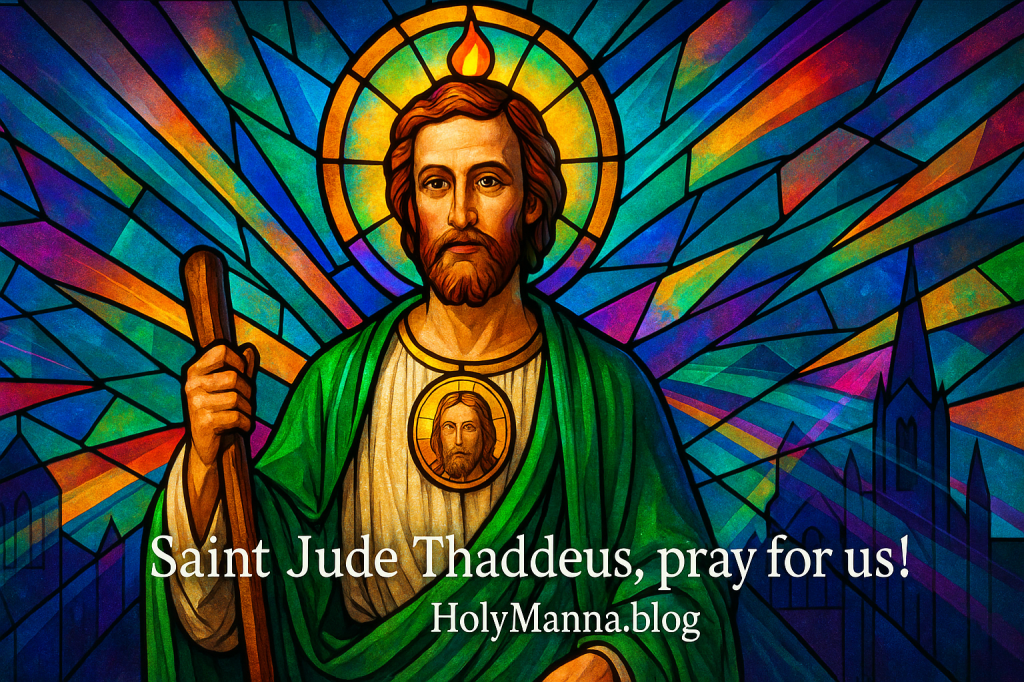
Apostle of the Impossible
“Jude, a servant of Jesus Christ and brother of James” is the humble way this Apostle signs his short yet blazing New Testament letter. Revered as patron of desperate and impossible causes and celebrated with Saint Simon on October 28, Saint Jude Thaddeus remains a steady friend for those who feel forgotten or stuck. The Church treasures the canonical Epistle of Jude, traditionally attributed to him, as a bold wake up call against false teaching and a tender guide to mercy, perseverance, and praise. He is often shown with a flame over his head to recall Pentecost and with an image of Christ on his chest to declare that he brings the face of Jesus into the darkest places. The Church proposes the saints as models and intercessors, and “by their fraternal concern our weakness is greatly helped” (CCC 956). Their lives are proof that the Gospel is not theory but grace in action, which is why devotion to Saint Jude has blossomed wherever Christians need courage to keep trusting God.
From Galilee to the Twelve
The Gospels identify him as Jude or Judas, also called Thaddaeus, and distinguish him clearly from Judas Iscariot. Luke lists him as “Jude of James,” which ancient tradition reads as a close relative of Saint James the Less, placing him within the wider family circle of the Lord. During the Last Supper he steps forward with a sincere question that pulls back the curtain on his heart: “Lord, how is it that you will reveal yourself to us and not to the world?” (Gospel of John 14:22). After Christ’s Ascension he remains with the Apostles and with Mary in prayer until the outpouring of the Holy Spirit at Pentecost. Christian memory associates his later preaching with regions in the Near East, often naming Syria, Mesopotamia, Armenia, and Persia among his missionary fields. What defines him most is not a detailed biography but a clear identity as an Apostle of Jesus, formed by the Master, filled with the Spirit, and entrusted with the deposit of faith. In the opening lines of his letter he greets the Church with a fatherly blessing that still consoles wounded souls today: “May mercy, peace, and love be multiplied to you.” (Jude 2)
A Shepherd’s Fire
Open the Epistle of Jude and the Apostle’s pastoral voice comes alive. He urges believers to courage and clarity, “contend for the faith that was once for all delivered to the saints” (Jude 3), because the Gospel is not a moving target. He warns against false teachers who twist grace into license, yet he will not let zeal become harshness. His remedy is a life woven from prayer, love, and mercy: “Build yourselves up in your most holy faith; pray in the Holy Spirit; keep yourselves in the love of God; wait for the mercy of our Lord Jesus Christ that leads to eternal life.” (Jude 20–21) He then turns to practical rescue work for souls on the edge, “convince those who doubt, save others by snatching them out of the fire, show mercy with fear” (Jude 22–23). That balance of conviction and compassion is why Saint Jude remains so important. He shows how to hold fast to the apostolic Gospel without bitterness, how to speak the truth with a tenderness that actually heals, and how to worship with a praise that steadies the heart. His soaring doxology has strengthened countless believers at the end of hard days: “To him who is able to keep you from falling and to present you without blemish before the presence of his glory with rejoicing, to the only God, our Savior, through Jesus Christ our Lord, be glory, majesty, dominion, and authority, before all time and now and forever.” (Jude 24–25)
Apostolic Wonders and the Face of Christ
The Acts of the Apostles records that many signs and wonders accompanied the preaching of the Twelve, and Saint Jude shared fully in that mission of healing, deliverance, and proclamation. The New Testament does not single him out for a specific miracle by name, but the Church’s memory places him among those whose hands became instruments of Christ’s mercy. Ancient traditions about a royal healing in Edessa are sometimes linked to a disciple named Thaddaeus. Scholars debate whether that story refers to the Apostle Jude or to another early disciple with the same name, yet the iconography that shows Jude bearing the Holy Face points to a beautiful truth. He carries the living presence of Jesus into places that have forgotten hope. The Catechism reminds the faithful that Scripture was written under the breath of God and teaches the truth without error for the sake of our salvation, which is why the Apostolic witness remains our anchor today, “firmly, faithfully, and without error” in what God wanted written for us (CCC 107).
Trials and the Crown
Apostolic life in the first generations came with real danger. Tradition holds that Jude faced hostility as he preached, often alongside Saint Simon, and that he sealed his testimony with martyrdom. Various ancient accounts place their death in Persia or in the region of Beirut, and Christian art often shows Jude with a club or axe to recall the instrument of his passion. What is constant across the sources is the truth of his courage. He followed Christ to the end with a love that did not back away from threats or suffering. The Church calls martyrdom the supreme witness to the truth of the faith, and “it means bearing witness even unto death” (CCC 2473). Remembering Jude’s courage strengthens believers to confess Christ at work, at home, and in public life, not with anger but with the kind of patient boldness that only grace can give.
Hope That Spreads
The most documented wonders of Saint Jude’s intercession bloom after his earthly life. Across centuries and cultures, testimonies of help at the eleventh hour have poured in through novenas, thanksgiving letters, and pilgrim visits. Devotion to Saint Jude flourished in the modern period when families devastated by war, illness, or financial ruin found unexpected doors opening through prayer. Shrines dedicated to him have become places of quiet tears and surprising joy, including well loved sanctuaries in Chicago, in Faversham in Kent, and in Manila. These communities exist because the Church knows that the saints do not replace Christ, they lead to Him. The Catechism explains that the saints, already united to Christ, “do not cease to intercede with the Father for us” and “their intercession is their most exalted service to God’s plan” (CCC 956). When the faithful thank Saint Jude for favors received, they are really glorifying the mercy of God who delights to answer prayers through His friends.
A Reflection with Saint Jude
Saint Jude teaches how to be sturdy without becoming hard. He calls disciples to protect the integrity of the Gospel while staying tender toward those who struggle. His letter sketches a simple, concrete path that busy people can live right now. Remain rooted in the sacraments so that grace keeps the heart steady. Pray in the Holy Spirit through Scripture, the Rosary, and quiet time before the Blessed Sacrament. Choose charity that rescues rather than shames. Guard the mind with sound doctrine, because truth sets people free. The Catechism describes faith as a supernatural virtue by which we believe in God and in all that He has said and revealed, “because he is truth itself” (CCC 1814). It also reminds us that charity is the soul of holiness and “the form of the virtues” (CCC 1827, 1829). Saint Jude’s final counsel can become a daily rhythm. Keep yourself in the love of God. Let mercy lead. Praise the Lord who holds you steady, and ask Saint Jude to intercede whenever the road narrows and the odds look grim.
Engage with Us!
Share your thoughts and stories of hope in the comments below. How has Saint Jude’s witness or intercession touched your life?
- What line from the Epistle of Jude speaks most to your situation right now, and why?
- Where is Christ inviting you to “keep yourself in the love of God” this week, and what will that look like in practice?
- Who in your circle is doubting or hurting, and how can you extend Jude’s merciful firmness to them today?
- Which habit would help you “pray in the Holy Spirit” more consistently, and when will you begin?
- How does remembering the apostolic foundations of the Church strengthen your trust in her teaching and sacraments?
May Saint Jude Thaddeus help you live a courageous, hope filled Catholic life. Stay faithful, stay merciful, and do everything with the love and mercy Jesus taught.
Saint Jude Thaddeus, pray for us!
Follow us on Instagram and Facebook for more insights and reflections on living a faith-filled life.

 Holy Manna!
Leave a comment