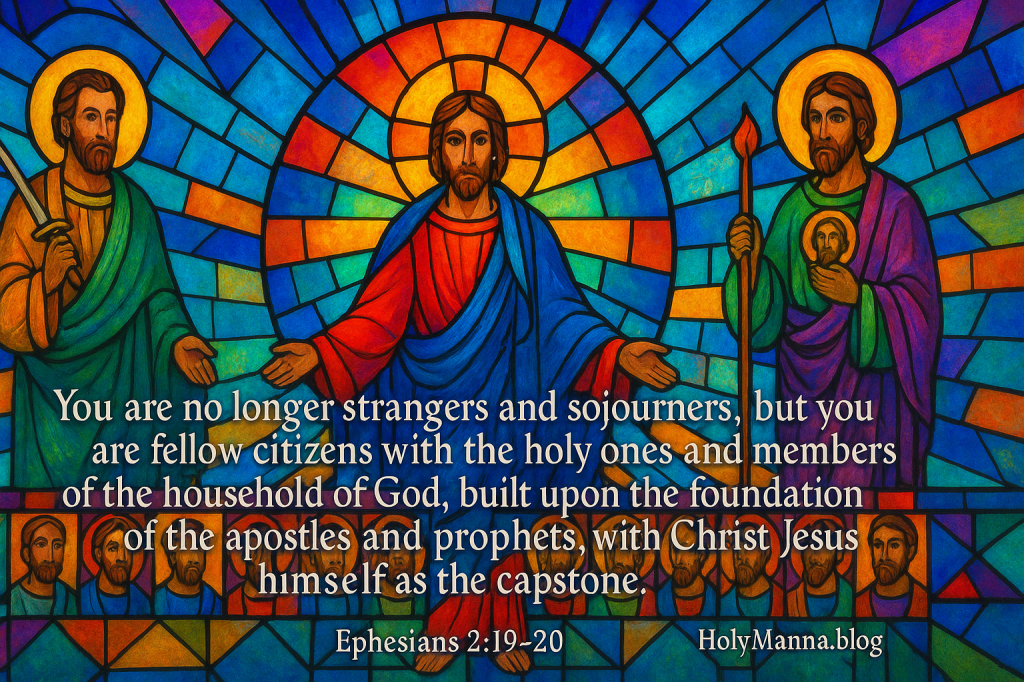
Feast of Saints Simon and Jude, Apostles – Lectionary: 666
Living Stones, Chosen in Prayer
Heaven speaks without words, and the Church rises as a living temple, stone by stone, because Christ chose and sent apostles in the silence of prayer. The central theme that unites today is simple and sweeping: Christ forms a single household of God on the foundation of apostles chosen in prayer, and through their witness His glory goes out to the ends of the earth. In Luke 6:12–16, the Lord withdraws to the mountain and “he spent the night in prayer to God”, then He names the Twelve, establishing the apostolic college that serves His mission and guards His teaching for every generation (CCC 857–860, 861–862). In Ephesians 2:19–22, the baptized are told, “you are fellow citizens with the holy ones”, no longer strangers, because the Church is “built upon the foundation of the apostles and prophets, with Christ Jesus himself as the capstone,” growing into a holy temple in the Spirit, a dwelling place of God that is visible and concrete in the world (CCC 756). In Psalm 19:2–5, creation itself models evangelization as “A report goes forth through all the earth”, a poetic image that mirrors apostolic preaching made audible across time and culture.
This feast honors Saints Simon and Jude, two of the Twelve whose names are set among the foundation stones of the New Jerusalem, witnesses whose fidelity helps bind the whole structure together in Christ. Simon is identified as “the Zealot,” a title that highlights fervent devotion to God’s reign within Israel’s charged first century context. Jude is named “son of James,” known in Christian memory for courageous proclamation and steadfast hope. Their shared feast underlines what the readings proclaim. The Church is not an idea, it is a people gathered, taught, and built up through apostolic faith that still speaks with living authority in Scripture, Tradition, and apostolic succession (CCC 857–860, 869). In this light, Luke 6:12–16 invites attention to the source of mission in prayer, Ephesians 2:19–22 reveals the architecture of communion with Christ as capstone, and Psalm 19:2–5 enlarges the horizon so that the whole cosmos becomes a classroom of praise. Where might your life be fitted into this living temple today, and how can your voice join that report that runs to the ends of the world?
First Reading – Ephesians 2:19–22
Built Into a Living Temple on Apostolic Foundations
The city of Ephesus was a vibrant crossroads of the Roman world, known for trade, philosophy, and a towering devotion to the goddess Artemis. Into this pluralistic setting, the Gospel announced that Gentiles and Jews are now one people in Christ. The language of Ephesians 2:19–22 speaks directly into that world, not with the promise of another stone sanctuary but with the revelation of a living temple. The reading declares that believers are no longer outsiders. They are citizens of a new commonwealth and members of God’s household, a family whose very architecture rests on the apostles and prophets with Christ as the capstone. This fits today’s theme and the Feast of Saints Simon and Jude because it highlights how the Church’s unity and mission rest on apostles chosen in prayer, whose faithful witness lets God’s glory be heard “to the ends of the world.” The household of God is not abstract. It is concrete communion, a structure held together by Christ and animated by the Holy Spirit, where every baptized person is placed as a living stone.
Ephesians 2:19-22
New American Bible (Revised Edition)
19 So then you are no longer strangers and sojourners, but you are fellow citizens with the holy ones and members of the household of God, 20 built upon the foundation of the apostles and prophets, with Christ Jesus himself as the capstone. 21 Through him the whole structure is held together and grows into a temple sacred in the Lord; 22 in him you also are being built together into a dwelling place of God in the Spirit.
Detailed Exegesis
Verse 19 – “So then you are no longer strangers and sojourners, but you are fellow citizens with the holy ones and members of the household of God,”
Paul addresses Gentile Christians who once stood outside Israel’s covenant life. In Christ, the division between insider and outsider collapses. Citizenship imagery communicates legal belonging, dignity, and shared responsibility. “Holy ones” points to the sanctified people of God across time, so the new members receive a past, a present, and a future within this family. The phrase “household of God” signals intimate kinship as well as a structured community that receives and hands on the apostolic faith.
Verse 20 – “built upon the foundation of the apostles and prophets, with Christ Jesus himself as the capstone.”
The image shifts from family to architecture. Foundations do not change, which is why the apostles are foundational. Their preaching, sacraments, and witness to the Resurrection fix the Church’s identity. The “prophets” recalls both Israel’s prophetic tradition and the New Testament prophets who confirmed and strengthened the Church’s mission. Naming Christ as “capstone” locates the decisive, weight-bearing point of the whole structure in Him. He aligns the walls, bears the load, and integrates every stone into right relationship.
Verse 21 – “Through him the whole structure is held together and grows into a temple sacred in the Lord;”
This is not a static building. It is a living temple that grows. The verb “held together” underscores that the Church’s unity is not a human project but a grace flowing “through him.” Sacredness is not merely ritual separation but the indwelling presence of God that consecrates a people for worship and mission.
Verse 22 – “in him you also are being built together into a dwelling place of God in the Spirit.”
The focus narrows to “you also,” drawing each believer and each local church into the mystery. The Spirit is the divine builder who fits believers together so that God truly dwells in His people. The verse safeguards both the personal and corporate dimensions of salvation. Individuals are sanctified, yet always as members of a people formed for communion, worship, and witness.
Teachings
This passage reveals the Church as both household and temple, where belonging is a grace and structure is a gift. The apostles serve as the once-for-all foundation because they were chosen in prayer by Christ and entrusted with His teaching, His sacraments, and His mission. The imagery of Christ as capstone affirms that no ministry in the Church exists apart from Him, since He alone bears the full weight of salvation and aligns every member to Himself. The language of growth teaches that holiness is dynamic. The Spirit actively builds the Church across cultures and centuries, integrating new stones without erasing the foundation. Early Christians in Ephesus would have heard temple language in a city defined by a famous pagan shrine, yet Paul reframes temple as a living communion where God dwells. This reading, proclaimed on the feast of Saints Simon and Jude, invites gratitude for apostolic succession and fidelity to the apostolic faith that binds the whole structure together in Christ. It also points to the universality of salvation, since citizenship in God’s kingdom gathers peoples once divided and makes them one family in the Lord. The Catechism teaches that the Church is apostolic in origin, in teaching, and in mission, and that the Holy Spirit is the soul of this Body, continually sanctifying and guiding the Church toward the fullness of unity and truth in Christ.
Reflection
A life of faith is not lived as a spiritual drifter but as a citizen who belongs to a people and a son or daughter at home in a family. The Spirit patiently fits hearts together, heals old divisions, and aligns each person to Christ the capstone so that the Church can truly be a dwelling place for God. Consider simple ways to let the Lord place you as a living stone this week through regular prayer, Sunday worship, confession if needed, and some concrete act of charity that strengthens communion in your parish. Where is the Spirit inviting deeper belonging rather than solitary striving? What attitudes or habits keep you at the threshold instead of at the table of the household? How might fidelity to the apostles’ teaching shape decisions about time, media, friendships, and service? Will you let Christ align your life to Himself so that His presence can dwell more fully in you and radiate through you to others?
Responsorial Psalm – Psalm 19:2–5
Creation as the First Evangelist
In ancient Israel, the sky was not just a backdrop. It was a teacher. The dome of the heavens and the steady rhythm of day and night formed a living catechism that announced the wisdom, power, and fidelity of the Creator. Psalm 19:2–5 gives poetic voice to this cosmic proclamation. Without syllables or scripts, creation makes God known with a message that reaches every land and culture. This fits today’s theme and the Feast of Saints Simon and Jude because the Psalm’s worldwide “report” foreshadows the apostolic mission. The same God who made the heavens speak chose the Twelve in prayer, then sent them so that the Gospel would be heard “to the ends of the world.” The cosmos bears witness. The apostles interpret that witness and announce Christ, the capstone, so that all may become fellow citizens in the household of God.
Psalm 19:2-5
New American Bible (Revised Edition)
2 The heavens declare the glory of God;
the firmament proclaims the works of his hands.
3 Day unto day pours forth speech;
night unto night whispers knowledge.
4 There is no speech, no words;
their voice is not heard;
5 A report goes forth through all the earth,
their messages, to the ends of the world.
He has pitched in them a tent for the sun
Detailed Exegesis
Verse 2 – “The heavens declare the glory of God; the firmament proclaims the works of his hands.”
The Psalm begins with parallel lines that reinforce a single truth. Glory is not confined to the sanctuary. It shines in what God has made. “Heavens” and “firmament” evoke the vast dome above, which in Israel’s prayer became a signboard for God’s artistry and care. The verbs “declare” and “proclaims” suggest ongoing action. Creation does not give a one time lecture. It teaches continually and invites humble listening.
Verse 3 – “Day unto day pours forth speech; night unto night whispers knowledge.”
Time becomes a preacher. Each day hands the microphone to the next. “Pours forth” pictures an overflowing stream of testimony, while “whispers” suggests that God’s wisdom can be heard in quiet, ordinary cycles. The alternation of day and night hints at the constancy of grace. Whether in bright clarity or in hushed darkness, God communicates Himself through His works.
Verse 4 – “There is no speech, no words; their voice is not heard;”
The Psalmist acknowledges a paradox. The message is universal, yet wordless. Creation’s language is symbolic and sacramental. It does not coerce belief. It invites contemplation. This prepares the way for revelation in words, which reaches its fullness in Christ and is safeguarded by the apostles. The verse reminds that reason and faith cooperate. Creation sets the stage so that the Gospel can be received with trust.
Verse 5 – “A report goes forth through all the earth, their messages, to the ends of the world. He has pitched in them a tent for the sun”
The “report” signals universality. The witness of creation does not belong to a single nation. It stretches across borders and cultures. The mention of a “tent for the sun” echoes tabernacle imagery and acknowledges popular ancient imagery of the sun’s path while reorienting it toward the true God. The line anticipates apostolic preaching. What the heavens announce without words, the apostles will proclaim with Spirit given words, reaching the same ends of the world.
Teachings
The Psalm’s cosmic witness harmonizes with the Church’s teaching that God communicates through creation and invites every person to seek Him. The Catechism teaches, “Even before revealing himself to man in words of truth, God reveals himself to him through the universal language of creation.” CCC 2500. It also affirms the sacramental logic of created signs, “God speaks to man through the visible creation.” CCC 1147. Sacred Scripture confirms this universal witness, “For from the greatness and beauty of created things comes a corresponding perception of their Creator.” Wis 13:5. The Psalm’s worldwide “report” is taken up by apostolic mission in the New Covenant, as the Apostle Paul applies this verse to the spread of the Gospel, “Their voice has gone out to all the earth, and their words to the ends of the world.” Rom 10:18. In light of today’s feast, the Church recognizes that this worldwide announcement becomes concrete and saving when Christ chooses and sends apostles in prayer. Their preaching, sacraments, and shepherding give voice to creation’s silent praise and gather the nations into God’s household where Christ is the capstone.
Reflection
Creation is speaking today. The question is whether hearts are listening. A simple habit like stepping outside with Psalm 19 before screens and schedules can re tune attention to God’s presence. Silence in prayer lets the “whisper” of the night and the “pouring forth” of the day lead to gratitude and adoration. Consider sharing one concrete word of praise with a friend or family member and letting that small witness become part of the “report” that reaches further than expected. How might a daily moment of awe before the Creator change the pace and pressure of the day? Where is God inviting a response of praise that turns wonder into worship? What step could make your life a clearer message about God’s goodness in your neighborhood, workplace, and parish? Will you ask Saints Simon and Jude to help your voice join creation’s chorus so that Christ is known and loved to the ends of the earth?
Holy Gospel – Luke 6:12–16
Apostles Chosen in the Night of Prayer
First century Galilee knew pressure from Roman power, a swirl of religious hopes, and the ache of a people awaiting God’s decisive action. In that world Jesus retreats to a mountain for deep communion with the Father, then calls a community that will carry His mission to every nation. Luke 6:12–16 places the choosing of the Twelve inside a vigil of prayer, which reveals that apostolic authority is received from God, not manufactured by human strategy. This fits today’s theme on the Feast of Saints Simon and Jude because the Church is built on the foundation of apostles chosen in prayer, with Christ as the capstone, so that God’s glory will resound to the ends of the earth. The names listed here are not museum labels. They are living stones through whom the Lord forms a household where once there were strangers, and they stand as a reminder that mission flows from intimacy with the Father.
Luke 6:12-16
New American Bible (Revised Edition)
12 In those days he departed to the mountain to pray, and he spent the night in prayer to God. 13 When day came, he called his disciples to himself, and from them he chose Twelve, whom he also named apostles: 14 Simon, whom he named Peter, and his brother Andrew, James, John, Philip, Bartholomew, 15 Matthew, Thomas, James the son of Alphaeus, Simon who was called a Zealot, 16 and Judas the son of James, and Judas Iscariot,[e] who became a traitor.
Detailed Exegesis
Verse 12 – “In those days he departed to the mountain to pray, and he spent the night in prayer to God.”
Luke highlights Jesus’ habit of seeking the Father before pivotal moments. The mountain signals revelation and covenant, echoing Sinai and preparing for a new people gathered in Christ. The all night vigil shows the wellspring of mission. As the Catechism affirms, “Jesus often draws apart to pray in solitude, on a mountain, preferably at night.” CCC 2602. Election in the Church begins in adoration.
Verse 13 – “When day came, he called his disciples to himself, and from them he chose Twelve, whom he also named apostles:”
The dawn follows the night of prayer. Disciples are many, but Twelve are chosen and named “apostles,” which means “sent ones.” The number twelve evokes the tribes of Israel, signaling restoration and universality. The call “to himself” grounds their mission in communion with Jesus. The Catechism captures the pattern of sending rooted in Jesus’ identity, “The Church is apostolic because she is founded on the apostles, in three ways.” CCC 857.
Verse 14 – “Simon, whom he named Peter, and his brother Andrew, James, John, Philip, Bartholomew,”
The list begins with Simon, renamed Peter, which in the Gospels marks his singular role among the Twelve. Kinship ties appear, yet the call transcends bloodlines. Names like Philip and Bartholomew point to a Church that will bridge cultures and languages. The naming shows personal election. The Lord knows His witnesses by name.
Verse 15 – “Matthew, Thomas, James the son of Alphaeus, Simon who was called a Zealot,”
A tax collector stands beside a former Zealot. Grace forges unity among those who were once social and political opposites. The Gospel creates a communion no ideology can manufacture. On this feast, attention rests on Simon the Zealot, whose fervor is redirected to the kingship of Christ.
Verse 16 – “and Judas the son of James, and Judas Iscariot, who became a traitor.”
Jude, also known as Thaddeus, is honored today with Simon as a pillar of the apostolic foundation. Luke’s sober note about Judas Iscariot reminds that God’s plan passes through human freedom and failure, yet the mission endures because its source is divine. Apostolic authority is not defeated by betrayal. It is entrusted by Christ and sustained by the Spirit through history.
Teachings
This passage reveals that apostolic identity springs from the Son’s prayer to the Father and is given for the sake of the Church’s structure and mission. The Lord establishes not only a message but a college of witnesses who receive authority to teach, sanctify, and shepherd. The Catechism states, “The Lord Jesus endowed his community with a structure that will remain until the Kingdom is fully achieved.” CCC 765. It also teaches the source and nature of apostolicity, “The Church is apostolic because she is founded on the apostles, in three ways.” CCC 857. The sending flows from Christ’s own mission, as the Catechism opens this teaching by confessing, “Jesus is the Father’s Emissary.” CCC 858. The Gospel’s listing of names shows concrete continuity that will unfold in apostolic succession. Prayer precedes election, election precedes mission, and mission continues in the Church through those joined to the apostles. This is why the memorial of Saints Simon and Jude matters. Their fidelity is not a private devotion. It is part of the living foundation on which the household of God is built, with Christ as capstone and the Spirit as the soul of the temple.
Reflection
Prayer comes before choices that shape a life. The Gospel invites a return to the mountain with Jesus through a deliberate habit of quiet, Scripture, and trust. Consider setting aside a weekly holy hour for intercession for bishops and priests who stand in apostolic ministry, and for your pastor by name. Let the names of the Twelve become a simple litany over your week and ask Simon and Jude to kindle zeal that is steady, humble, and obedient to Christ. Make significant decisions only after time with the Father, and seek unity with people who would not naturally be at the same table. Where might the Lord be inviting a night of prayer before a pivotal decision? What would change if decisions were made from communion with Jesus rather than hurry or anxiety? How could support for the apostolic ministry in your parish become concrete through prayer, encouragement, and service? Will you ask Saints Simon and Jude to help align your zeal with Christ so that your life becomes a clear witness to the Gospel?
Gathered, Built, and Sent
Today reveals a single movement of grace. In Luke 6:12–16 the Lord withdraws to the mountain and “he spent the night in prayer to God”, then He calls and names the Twelve so that mission flows from communion with the Father. In Ephesians 2:19–22 that mission becomes a people as the baptized are told, “you are fellow citizens with the holy ones” and are being built on the foundation of the apostles with Christ as the capstone into a dwelling place of God in the Spirit. In Psalm 19:2–5 creation itself models evangelization, since “The heavens declare the glory of God” and their report runs to the ends of the earth. The Feast of Saints Simon and Jude draws all of this together. Prayer gives birth to apostolic witness. Apostolic witness gathers strangers into a household. The household becomes a living temple where God dwells and from which praise and proclamation continue to spread.
The call now is simple and concrete. Return to the mountain with Jesus in deliberate prayer. Stand on the apostolic foundation by receiving and living the faith handed on through the Church. Let your life echo the Psalm by offering words of praise and works of charity that speak without noise yet carry far. Ask Saints Simon and Jude to steady zeal with humility and to set feet on paths that build communion rather than division. Where is the Spirit inviting deeper belonging in the household of God this week? What decision needs to begin in prayer before it moves into action? How might daily praise and a clear act of love become your small report that reaches farther than expected? May the Father fit every heart more closely to Christ the capstone so that the Church grows, and may the Spirit make each soul a bright window of the living temple through which others glimpse the glory of God.
Engage with Us!
Share your reflections in the comments below, and let this community help one another grow as living stones in God’s household.
- First Reading – Ephesians 2:19–22: Where is the Holy Spirit inviting deeper belonging in the household of God this week, and what concrete step will help move from feeling like an outsider to living as family? How might fidelity to the apostolic foundation shape choices about prayer, parish life, and acts of charity in the days ahead?
- Responsorial Psalm – Psalm 19:2–5: When did creation most recently lead your heart to praise, and how can a simple daily moment of awe become a steady habit? What quiet witness could your life offer this week so that God’s goodness is heard without many words?
- Holy Gospel – Luke 6:12–16: What important decision needs to begin in prayer before any action is taken, and when will that time of prayer happen? How can support for the Church’s apostolic ministry become tangible through intercession, encouragement, and service in your parish?
May the Lord strengthen every heart to live a sincere life of faith, and may each word and work be done with the love and mercy that Jesus taught.
Sacred Heart of Jesus, we trust in You!
Immaculate Heart of Mary, pray for us!
Saint Michael the Archangel, defend us in battle!
Follow us on Instagram and Facebook for more insights and reflections on living a faith-filled life.

 Holy Manna!
Leave a comment