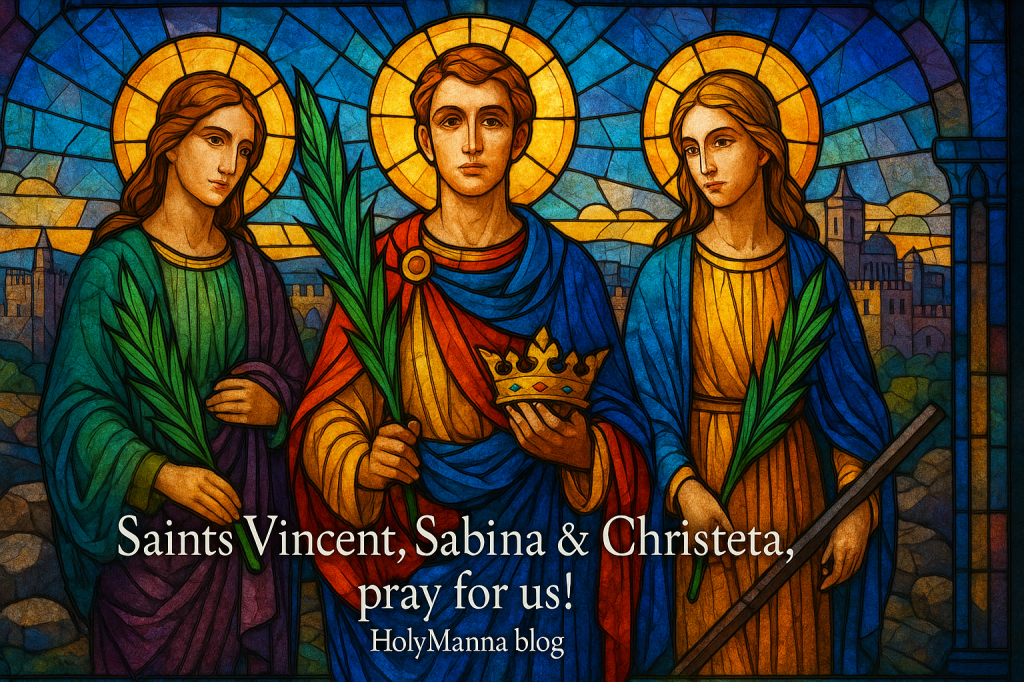
Three Siblings, One Unbreakable Witness
Across the ancient stones of Ávila rings the memory of three siblings who chose Christ over comfort and truth over terror. Saints Vincent, Sabina and Christeta are venerated as martyrs of Roman Spain, remembered in the Roman Martyrology for their steadfast fidelity under persecution. Their story is lean on personal detail and rich in courage, the kind that inspires ordinary believers to live the Gospel with clarity. The Church sums up their vocation with a single burning line from the Catechism of the Catholic Church: “Martyrdom is the supreme witness given to the truth of the faith.” (CCC 2473)
Roots in Hispania and a Heart Set on Christ
Tradition places their origins in Talavera de la Reina, a thriving settlement in late third and early fourth century Hispania. Precise information about their family and formation has not survived, which is not unusual for local martyrs of that era. What the Church has always remembered is their belonging to the Christian community and their solidarity as siblings who encouraged one another to follow Jesus without compromise. By the time imperial hostility swelled, their discipleship was already firm. They would have known the Scriptures proclaimed in the assembly, the discipline of prayer and fasting, and the grace of the sacraments that welded the early Church into a resilient communion. They are best known not for a long list of personal writings or public sermons, but for a single, decisive “yes” to Christ that shaped their entire legacy.
Ordinary Faith, Extraordinary Fruit
There are no reliable accounts of spectacular deeds during their earthly life, and no authenticated sayings or letters from the saints have come down to us. That absence does not dim their light. In the logic of the Gospel, the greatest miracle can be a heart that refuses to bend to false worship. Their importance lies in the way their daily fidelity ripened into heroic witness when tested. The Catechism helps make sense of why they matter today: “By canonizing certain Christians, the Church proclaims the Paschal mystery in those who have suffered for Christ.” (CCC 828) Their legacy invites every believer to see that quiet perseverance in prayer, sacramental life, and works of mercy prepares the soul for the hour of trial.
The Storm of Persecution and the Crown of Martyrdom
Their passion unfolds against the backdrop of the Diocletianic persecutions, when imperial edicts sought to crush the Church throughout the Roman world. Local tradition names the governor Dacian as their persecutor, a figure often linked to martyrdoms in Hispania. The siblings were arrested and tortured because they would not sacrifice to the Roman gods. Accounts of their martyrdom speak of racking and the brutal crushing of their skulls with iron implements while their heads lay on stones. The stark simplicity of that testimony has carried through the centuries, not as a tale of defeat but as an announcement of victory in Christ. The Catechism frames it with luminous clarity: “The martyr bears witness to Christ who died and rose, to whom he is united by charity.” (CCC 2474)
Grace That Keeps Speaking After Death
The tomb of the martyrs became a wellspring of devotion. Over their traditional resting place, the great Romanesque Basilica of San Vicente rises near Ávila’s walls. Pilgrims have entered that church for centuries, reading their story in the sculpted cenotaph that narrates their passion in stone. Veneration spread through Ávila and Talavera in particular, where local calendars and processions kept their memory alive. The faithful have long sought the intercession of these siblings for courage, perseverance, and unity within families. The Catechism explains why Christians confidently approach the martyrs even now: “Being more closely united to Christ, those who dwell in heaven do not cease to intercede for us.” (CCC 956) Their relics have been honored and safeguarded through turbulent ages, a tangible reminder that the Church stands on the witness of her saints.
Why Their Witness Still Matters
The example of Vincent, Sabina and Christeta lands right where modern life hurts. They show that truth and love can stand firm in the face of cultural pressure. They model a family’s shared mission, where siblings help one another reach heaven. Their memory encourages practical fidelity today: keep a rhythm of prayer that no calendar can erase, receive the Eucharist with devotion, examine the conscience honestly, and refuse whatever wounds the soul. The Church’s teaching sums up the posture of the heart that learns from the saints: “It is not merely by the title of example that we cherish the memory of those in heaven; rather, we seek their intercession.” (CCC 957) That is how their story becomes strength for ordinary Christians right now.
Engage with Us!
Share thoughts and reflections in the comments below. How do these holy siblings challenge and encourage Christian life today?
- Where does modern life pressure the heart to compromise worship and truth, and how can their steadfastness inspire a different response?
- What concrete practices this week will strengthen courage: a weekday Mass, a Rosary, an hour of adoration, or a sincere confession?
- How can love for family be ordered toward holiness so that siblings and friends help one another reach heaven, as Vincent, Sabina and Christeta did?
Hold fast to Christ with a joyful heart. Live each day from the Eucharist and let every word and act be shaped by the love and mercy that Jesus teaches.
Saints Vincent, Sabina & Christeta, pray for us!
Follow us on Instagram and Facebook for more insights and reflections on living a faith-filled life.

 Holy Manna!
Leave a comment