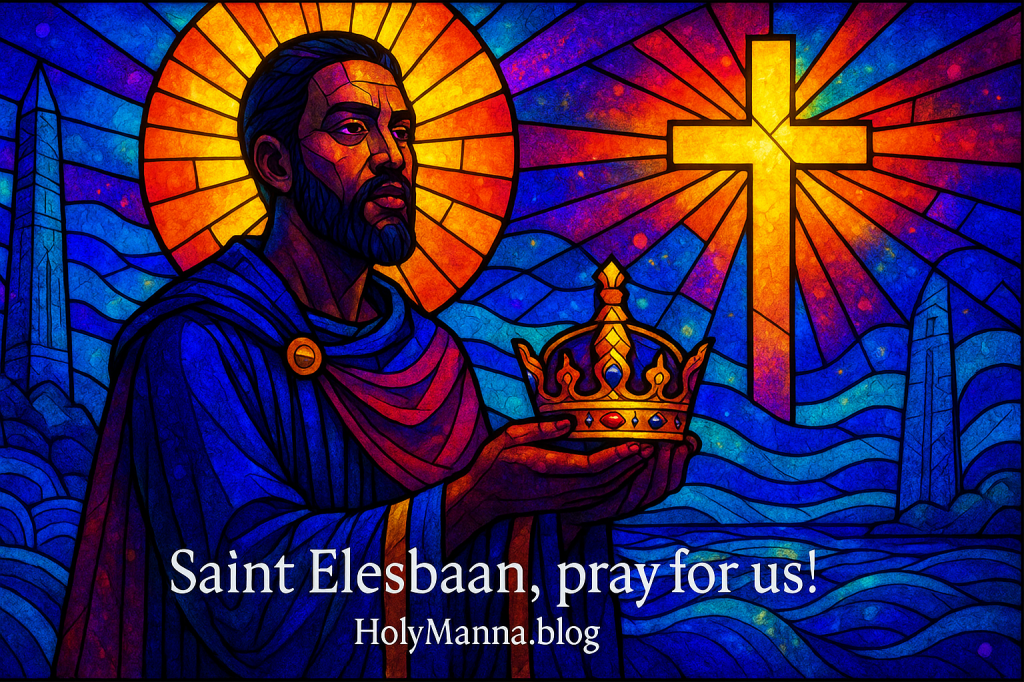
The Ethiopian King Who Defended the Persecuted
Saint Elesbaan, remembered in Ethiopian history as King Kaleb of Aksum, is a model of a ruler who let the Gospel shape policy, war, and personal vocation. In the early sixth century he answered the cry of Christians in southern Arabia who were suffering violent persecution. He organized an expedition across the Red Sea, halted the killings, and restored peace so the Church could breathe again. What makes his sanctity so compelling is not only the courage to act, but the humility to step away from glory once justice had been served. Christian memory praises him as a king who kept a vow to God, sent his royal diadem to Jerusalem as a sign of thanksgiving, and retired into a life of fasting and prayer. His story echoes the heart of The Catechism of the Catholic Church, which teaches that rulers must order power to the protection of human dignity and the common good, not to self-exaltation.
A Faith-Filled Childhood That Shaped a King
Elesbaan’s given name was Kaleb, and he ruled the Aksumite kingdom, a Christian realm in the Horn of Africa that had embraced the faith centuries earlier through the preaching of Saint Frumentius. Tradition names his father as Tazena and his son as Gabra Masqal, which situates him within a royal house that valued both statecraft and piety. Raised within a culture where the Gospel was publicly honored, Kaleb learned that kingship is stewardship before God. News eventually reached his court that Christians in Najran, in the Himyarite kingdom of Arabia, had been massacred and that churches had been desecrated. That report ignited the event that would define his legacy. He sought to defend the innocent, not for conquest or plunder, but for the sake of justice and the honor of Christ. In Christian memory he is most known for that decision and for the radical follow-through on his vow after victory. No reliably preserved direct sayings of Saint Elesbaan survive, and nothing trustworthy suggests a personal written quote. The absence of his own words only sharpens the witness of his deeds.
A Just War, A Kept Vow
The Aksumite campaign unfolded across the busy Red Sea corridor, a route well known to merchants and envoys. Kaleb assembled forces at the port of Adulis, crossed to Arabia, and defeated the persecuting ruler who had targeted Christians. He then installed a governor favorable to the Church so the region could be stabilized and the faithful protected. The point was never empire for its own sake, it was the rescue of a battered flock. Catholic moral teaching helps make sense of his choice. The Catechism of the Catholic Church states, “Legitimate defense can be not only a right but a grave duty for one who is responsible for the lives of others.” It also affirms that public authority may use force to repel aggression when ordered to the common good, which is a sober, limited mandate, not an open door to vengeance. Kaleb’s vow gave the campaign a spiritual contour. After peace was restored he sent his crown to the Holy City as a votive gift and prepared to leave the throne. Leadership for him was never an idol. It was an offering.
Power Renounced for the Kingdom of God
Political crosswinds rose quickly once the dust settled. Control in Arabia shifted again, and Aksum’s direct influence waned. Rather than cling to power or try to force history to bend to his plans, Kaleb handed rule to his son and stepped into the hidden life. Ethiopian tradition remembers him embracing asceticism in the region of Aksum, choosing watchfulness, fasting, and prayer over courtly privilege. This is a different kind of battle, the one within. The Church teaches that those who hold authority must serve the people, and when that service calls for letting go, humility becomes the sharpest proof of holiness. Elesbaan’s renunciation shows what real victory looks like. The world calls it a step down. Heaven calls it fidelity.
After the Crown
Elesbaan is honored as a confessor king, not a martyr, which is fitting because his witness came through defending martyrs and then renouncing earthly honor. Western calendars remember him on October 27, and Eastern traditions commemorate him around the same time, which keeps his memory alive across the Christian world. In Ethiopia sites associated with Kaleb and his son remain points of historical and devotional interest. Pilgrims remember him not through spectacular wonder tales, but through the enduring grace that flows from his intercession and example. Many saints are known for numerous recorded miracles after death. In Elesbaan’s case the Church treasures a different sign. The sign is a life that bent kingship to mercy and then yielded kingship to God. The measure of his sanctity is the peace he bought for the persecuted and the silence he chose afterward. As The Catechism of the Catholic Church teaches about witness to the truth, “Martyrdom is the supreme witness to the truth of the faith.” Elesbaan did not die a martyr, yet he offered a royal form of confession of faith by risking his kingdom for the defenseless and then surrendering it for Christ.
Courage, Mercy, and a Heart Free for God
Elesbaan’s path speaks to anyone with responsibility at home, at work, or in public life. When people are vulnerable, love must become practical and brave. The Catechism of the Catholic Church describes the works of mercy as “charitable actions by which we come to the aid of our neighbor in his spiritual and bodily necessities.” Sometimes that mercy means advocacy in the public square. Sometimes it means protecting the weak within a family or a parish. His vow teaches detachment, which is the freedom to let go of good things so that better things can flourish. Scripture names the inner logic of that freedom: “For where your treasure is, there your heart will be also.” The Gospel of Matthew sets the compass, and Elesbaan shows the road. Use authority to shield the small. Keep promises when the spotlight moves on. Seek the quiet that keeps the heart close to God.
Engage with Us!
Share thoughts or a short prayer in the comments. How does Saint Elesbaan’s courage and humility challenge and encourage today’s disciples?
- When has defending someone vulnerable required real courage, and how did the Holy Spirit meet that moment?
- What “crowns” might need to be laid down so that Christ truly reigns in the heart and home?
- How can authority at work, in family life, or in ministry be used this week to protect the dignity of others and witness to the Gospel?
Be strong in faith, steady in hope, and generous in love. Do everything with the mercy and truth that Jesus taught.
Saint Elesbaan, pray for us!
Follow us on Instagram and Facebook for more insights and reflections on living a faith-filled life.

 Holy Manna!
Leave a comment