Monday of the Thirtieth Week in Ordinary Time – Lectionary: 479
From Bondage to Abba’s Freedom
Take a quiet breath and picture the Father stooping to untie what keeps the heart bent low, then lifting it into light. Today’s readings sing in harmony about divine liberation that is not just release from something, but entrance into a family. In Romans 8:12-17, Saint Paul speaks to believers living under Roman law where adoption conferred a new name, a new inheritance, and full legal standing. With that cultural backdrop, the promise lands with force. By the Spirit, the baptized are no longer debtors to the flesh or slaves to fear, but cry “Abba, Father” and stand as heirs with Christ. The Church teaches that grace truly frees the human person from interior bondage, “for freedom Christ has set us free”, as summarized in CCC 1741, and it makes the baptized a new creation, adopted into God’s household, as affirmed in CCC 1265. Psalm 68 then gives the soundtrack of this family life with God as “Father of the fatherless”, the one who “leads prisoners out to prosperity”, and who bears the people day by day, a victory hymn that recalls exodus mercy and proclaims that the Lord saves. In Luke 13:10-17, Jesus reveals the heart of the Sabbath by loosing a long-suffering daughter of Abraham, declaring with his touch, “you are set free”. In a synagogue setting shaped by reverence for Sabbath rest, he shows that rest reaches its goal in healing and mercy. As The Catechism teaches, Jesus gives the Sabbath its true interpretation, where works of compassion manifest God’s kingdom, as explained in CCC 2173. Together these passages prepare the soul to meet a Father who lifts from slavery into sonship, who turns fear into filial joy, and who makes worship a place where bonds are untied and heads are lifted high to glorify God. Where is the Spirit inviting a step from fear to freedom, from bent over to upright praise, in the ordinary rhythm of today?
First Reading – Romans 8:12-17
Adopted Into Freedom: From Fear to Heirship in the Spirit
This passage stands at the heart of Paul’s proclamation to the Christians living in Rome, a city where legal adoption could elevate a person from slavery to full family status with a new name and a real inheritance. Into that cultural reality, Romans 8:12-17 announces that baptismal grace is not a mere moral uplift but a new birth into God’s household. The Spirit does not negotiate with the flesh or decorate old chains. The Spirit breaks them, teaches the Church to pray “Abba, Father”, and leads believers into the bold joy of sonship. Within today’s theme of liberation that becomes worship, Paul shows that Christian freedom is not aimless autonomy. It is belonging to the Father through the Son in the Spirit, which reorders desires, strengthens endurance, and prepares the heart to glorify God in every moment.
Romans 8:12-17
New American Bible (Revised Edition)
12 Consequently, brothers, we are not debtors to the flesh, to live according to the flesh. 13 For if you live according to the flesh, you will die, but if by the spirit you put to death the deeds of the body, you will live.
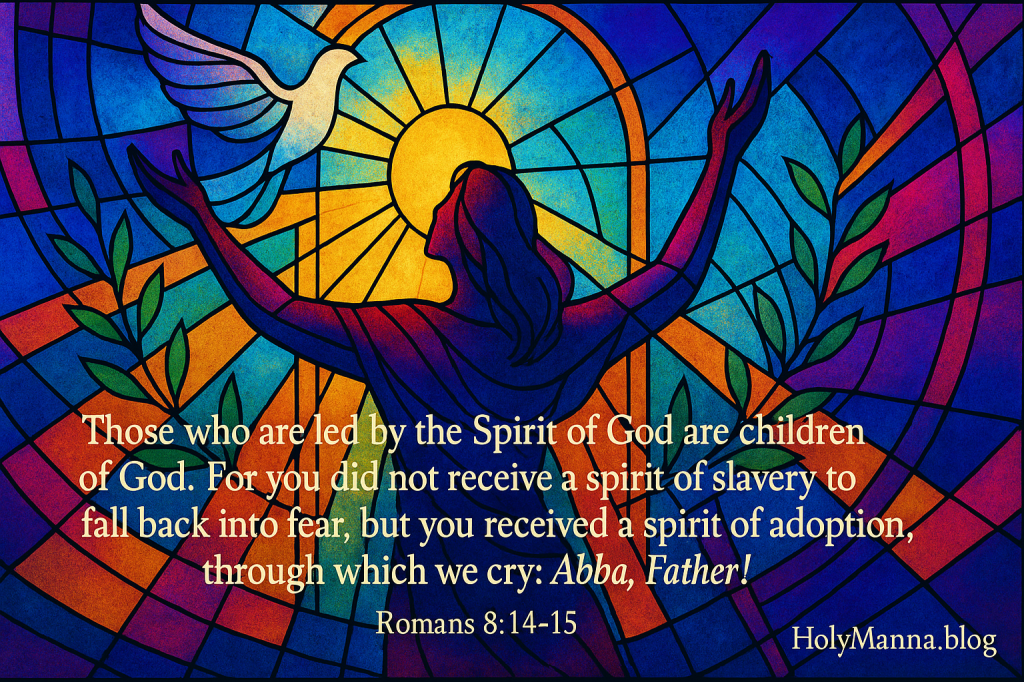
Children of God Through Adoption. 14 For those who are led by the Spirit of God are children of God. 15 For you did not receive a spirit of slavery to fall back into fear, but you received a spirit of adoption, through which we cry, “Abba, Father!” 16 The Spirit itself bears witness with our spirit that we are children of God, 17 and if children, then heirs, heirs of God and joint heirs with Christ, if only we suffer with him so that we may also be glorified with him.
Detailed Exegesis
Verse 12 – “Consequently, brothers, we are not debtors to the flesh, to live according to the flesh.”
Paul draws a firm conclusion from the preceding teaching on life in the Spirit. The phrase “debtors to the flesh” evokes obligation language. In Roman society, debt bound a person. Paul declares that those in Christ no longer owe allegiance to the old regime of sin. The Spirit has introduced a new order, so moral life flows from a changed identity rather than external pressure.
Verse 13 – “For if you live according to the flesh, you will die, but if by the spirit you put to death the deeds of the body, you will live.”
Here Paul names the decisive combat. “Flesh” in this context means fallen human nature oriented away from God. Death is its inevitable wage. By contrast, the Spirit empowers real asceticism that does not despise the body but heals and reorders it. The paradox is striking. Life comes through a daily “putting to death,” which is the Spirit’s work in cooperation with human freedom, as taught in The Catechism of the Catholic Church on the synergy of grace and freedom in sanctification.
Verse 14 – “For those who are led by the Spirit of God are children of God.”
Being “led” signals an ongoing relationship. Divine filiation is not a static title but a lived guidance. Israel was led by the pillar in the wilderness. Now each baptized person is led within by the Spirit, fulfilling the promise of a new heart. Sonship is verified not by sentiment but by a Spirit-formed life.
Verse 15 – “For you did not receive a spirit of slavery to fall back into fear, but you received a spirit of adoption, through which we cry, ‘Abba, Father!’”
Paul contrasts two interior climates. Slavery breeds fear, especially fear of punishment. Adoption confers intimacy, confidence, and delight in the Father. The Aramaic “Abba” preserves the familial warmth Jesus revealed in prayer and shares with his members. Under Roman law, adoption granted a new status and inheritance. Paul uses that lived reality to explain sacramental identity. The Spirit does not merely inspire the cry. The Spirit enables it from within the believer’s heart.
Verse 16 – “The Spirit itself bears witness with our spirit that we are children of God,”
Two witnesses agree. The Spirit testifies, and the renewed human spirit resonates. This is not vague optimism. It is a supernatural assurance that shapes conscience, courage, and hope. The inner testimony strengthens perseverance in trials and keeps the believer anchored in the Father’s faithful love.
Verse 17 – “and if children, then heirs, heirs of God and joint heirs with Christ, if only we suffer with him so that we may also be glorified with him.”
Sonship blossoms into heirship. The inheritance is God himself, shared with the Firstborn, Jesus Christ. Participation in Christ includes the pattern of his Passover. Suffering with him is not an optional add-on. It is the pathway the Spirit uses to conform believers to the Son and to prepare for glory.
Teachings
Paul’s teaching is the Church’s teaching, and the Church reads this passage as a charter of Christian freedom and divine filiation. The Catechism of the Catholic Church speaks plainly about the Spirit’s liberating work: “By his glorious Cross Christ has won salvation for all men. He redeemed them from the sin that held them in bondage… ‘For freedom Christ has set us free.’” (CCC 1741). On baptismal adoption the Catechism says: “Baptism not only purifies from all sins, but also makes the neophyte ‘a new creature,’ an adopted son of God, who has become a ‘partaker of the divine nature,’ member of Christ and co-heir with him, and a temple of the Holy Spirit.” (CCC 1265). The gift of filiation is therefore Trinitarian and participatory: “The grace of Christ is the gratuitous gift that God makes to us of his own life, infused by the Holy Spirit into our soul to heal it of sin and to sanctify it.” (CCC 1999). Prayer itself witnesses to this adoption: “The baptismal seal enables and commits Christians to serve God by a vital participation in the holy liturgy of the Church and to exercise their baptismal priesthood by the witness of holy lives and practical charity.” (CCC 1273), and in the school of prayer the Church confesses with boldness, “We can adore the Father because he has caused us to be reborn to his life by adopting us as his children in his only Son.” (CCC 2780).
The saints echo Paul’s audacity. Saint Athanasius crystallizes the mystery of adoption in On the Incarnation: “For the Son of God became man so that we might become God.” This classic line expresses participation by grace in God’s life, not confusion of natures, and it illuminates what Paul means by being “heirs of God and joint heirs with Christ.” Saint Augustine testifies to the rest that filiation brings in Confessions: “You have made us for yourself, O Lord, and our heart is restless until it rests in you.” The restlessness of the flesh yields to the peace of children who know the Father.
Historically, Paul’s Roman audience understood adoption as a decisive legal act that erased former debts and established a permanent new standing. That cultural reality sharpens the Gospel edge of this reading. In Christ, adoption is not only legal but ontological. Grace gives what the law could only promise. The Spirit does not only declare freedom. The Spirit effects it within, enabling a life that looks like the Son’s.
Reflection
Freedom in the Spirit is not a slogan. It is a daily way of life for those who belong to the Father. Begin the day by renewing baptismal identity with a simple act of trust, calling on the Father with confidence and asking the Holy Spirit to lead every decision. When temptation surfaces, remember that no debt is owed to the flesh. Choose one concrete act of self-denial today that helps “put to death the deeds of the body,” such as guarding the eyes, taming the tongue, or interrupting a pattern of distraction with a brief prayer of praise. When suffering arrives, unite it to Christ instead of trying to escape it at any cost. Offer it for a specific person, and ask to share not only the cross but also the joy that follows.
Where has fear been steering the heart, and how is the Spirit inviting a turn toward filial confidence today? What would it look like to let the Spirit lead one ordinary decision this week, and how might that decision reflect the dignity of being an heir with Christ? Who needs a word or gesture from a son or daughter of the Father, and how can that love be given before the day ends?
Responsorial Psalm – Psalm 68:2, 4, 6-7, 20-21
The Father Who Lifts the Lowly and Leads the Captives Home
Psalm 68 is a majestic victory hymn likely sung in a festive procession, celebrating the Lord who rises to defend his people and dwell among them. In Israel’s memory, God’s rising evokes the exodus, the ark going forth, and the enemies of life scattering before the Holy One. The psalm reveals the character of the covenant God who is not distant from the afflicted but close to the vulnerable, naming him Father and Defender. Within today’s theme of liberation that matures into worship, these verses proclaim a God who does more than topple enemies. He builds a home, restores dignity, and carries his people daily. Read in light of Romans 8:12-17 and the healing in Luke 13:10-17, this psalm sings the same truth. The Spirit makes slaves into children, Jesus unties burdens on the Sabbath, and the Father delights to set captives free.
Psalm 68:2, 4, 6-7, 20-21
New American Bible (Revised Edition)
2 May God arise;
may his enemies be scattered;
may those who hate him flee before him.
4 Then the just will be glad;
they will rejoice before God;
they will celebrate with great joy.
6 Father of the fatherless, defender of widows—
God in his holy abode,
7 God gives a home to the forsaken,
who leads prisoners out to prosperity,
while rebels live in the desert.
20 Blessed be the Lord day by day,
God, our salvation, who carries us.
Selah
21 Our God is a God who saves;
escape from death is the Lord God’s.
Detailed Exegesis
Verse 2 – “May God arise; may his enemies be scattered; may those who hate him flee before him.”
The opening petition calls to mind the wilderness cry when the ark set out. God’s rising is not a small mood change. It is covenant action. Evil is not equal to God. When God stands, the forces that oppose life lose their footing. The verse frames the whole psalm as the Church’s confident prayer that the Father would act again to scatter what bends his children down.
Verse 4 – “Then the just will be glad; they will rejoice before God; they will celebrate with great joy.”
When God acts, the righteous do not merely breathe easier. They rejoice before his face. Joy is not a private feeling but a liturgical stance that answers God’s saving work. The movement from fear to gladness anticipates the Gospel scene where a healed woman glorifies God. True justice expresses itself in praise because it lives in right relationship with the Lord.
Verse 6 – “Father of the fatherless, defender of widows, God in his holy abode,”
The psalm names God’s heart. He is Father and Defender. This is not poetic flattery. It is covenant identity. In Israel’s law and prophets, the orphan and widow are the litmus test of fidelity. God’s holiness does not isolate him from human sorrow. His holiness moves him toward it. The verse prepares the mind to hear Paul’s word that the Spirit gives the baptized the cry “Abba, Father.”
Verse 7 – “God gives a home to the forsaken, who leads prisoners out to prosperity, while rebels live in the desert.”
The God who arises does not leave the rescued in the street. He grants a home and leads from captivity into flourishing. Salvation is restorative and communal. It builds a household. The caution at the end reminds the heart that rebellion dries up life. The desert is not only a place. It is a spiritual condition apart from the living God.
Verse 20 – “Blessed be the Lord day by day, God, our salvation, who carries us. Selah”
Praise becomes a daily habit, not an occasional reflex. The verb picture is tender. God carries his people. The line sits well beside the woman whom Jesus raises upright. Before she walked, she was carried by grace. The pause word “Selah” invites a holy linger over this image.
Verse 21 – “Our God is a God who saves; escape from death is the Lord God’s.”
The psalm closes this selection with a creed-like declaration. Salvation belongs to the Lord. Deliverance from death is not a human achievement. It is a gift. In Christ, this line opens fully, since the Father brings life from the grave and shares that victory with his children.
Teachings
The Church prays Psalm 68 as a confession that salvation is God’s work and as a school of praise that forms the heart for daily trust. The Catechism of the Catholic Church teaches the nature of praise with clarity: “Praise is the form of prayer which recognizes most immediately that God is God. It lauds God for his own sake and gives him glory, quite beyond what he does, but simply because HE IS.” (CCC 2639). The same God who is worthy in himself reveals his paternal nearness in adoption. The Catechism declares: “We can adore the Father because he has caused us to be reborn to his life by adopting us as his children in his only Son.” (CCC 2780). Liberation is not abstract. Christ enacts it. The Church summarizes this with Paul’s language of freedom: “By his glorious Cross Christ has won salvation for all men. He redeemed them from the sin that held them in bondage… ‘For freedom Christ has set us free.’” (CCC 1741). This liberation culminates in a new identity given at baptism. The Catechism confesses: “Baptism not only purifies from all sins, but also makes the neophyte ‘a new creature,’ an adopted son of God, who has become a ‘partaker of the divine nature,’ member of Christ and co-heir with him, and a temple of the Holy Spirit.” (CCC 1265).
Christian tradition often hears in Psalm 68 the triumph of the risen Lord. Saint Paul applies its victory theme to Christ’s Paschal mystery when he writes, “When he ascended on high he took captives captive; he gave gifts to men.” (Ephesians 4:8). The God who “leads prisoners out to prosperity” is the same Lord who in the Gospel unbinds a daughter of Abraham on the Sabbath and who in baptism raises sons and daughters into a royal household of praise.
Reflection
Let the psalm tutor the heart in two movements. Begin by blessing the Lord each morning with a short act of praise that names who God is rather than what is wanted, and allow that praise to become the lens for the day. Then imitate the Father’s concern for the vulnerable by making home for someone who feels forsaken. Offer a meal, a ride, or a listening ear, and do it consciously before God’s face. When discouragement presses, picture the Lord carrying his people and say aloud, “Our God is a God who saves.” Carry that line into the errands and the inbox like a quiet shield.
Where is the Spirit inviting praise to become a daily habit rather than a rare response to good news? Who nearby needs a sign that God gives a home to the forsaken, and what concrete hospitality can be offered this week? What enemy of the soul needs to be brought into the light so that the Father may arise and scatter it through grace and the sacraments?
Holy Gospel – Luke 13:10-17
Sabbath Mercy That Stands the Bent Upright
Luke 13:10-17 places Jesus in a synagogue on the Sabbath, the weekly covenant day set apart for worship, rest, and remembrance of God’s saving works. In first century Jewish practice, necessary care for animals and acts that preserved life were commonly permitted even on the Sabbath, which makes Jesus’ argument both pastoral and rooted in the lived tradition. Into this sacred setting steps a woman bent over for eighteen long years, described as bound by a spirit. Jesus names her a “daughter of Abraham,” a rare and tender title that restores her covenant dignity before the community. When he frees her, he reveals the true heart of Sabbath rest. Rest is not passivity. Rest means God’s mercy loosens bonds and restores the human person to praise. This scene fits today’s theme perfectly. The Father does not leave his children in slavery. Through the Son and in the Spirit, he unties what bends them down and raises them to the posture of worship.
Luke 13:10-17
New American Bible (Revised Edition)
10 He was teaching in a synagogue on the sabbath. 11 And a woman was there who for eighteen years had been crippled by a spirit; she was bent over, completely incapable of standing erect. 12 When Jesus saw her, he called to her and said, “Woman, you are set free of your infirmity.” 13 He laid his hands on her, and she at once stood up straight and glorified God. 14 But the leader of the synagogue, indignant that Jesus had cured on the sabbath, said to the crowd in reply, “There are six days when work should be done. Come on those days to be cured, not on the sabbath day.” 15 The Lord said to him in reply, “Hypocrites! Does not each one of you on the sabbath untie his ox or his ass from the manger and lead it out for watering? 16 This daughter of Abraham, whom Satan has bound for eighteen years now, ought she not to have been set free on the sabbath day from this bondage?” 17 When he said this, all his adversaries were humiliated; and the whole crowd rejoiced at all the splendid deeds done by him.
Detailed Exegesis
Verse 10 – “He was teaching in a synagogue on the sabbath.”
The setting matters. Teaching in the synagogue on the Sabbath situates Jesus within Israel’s liturgical life. He does not abolish worship but fulfills it. His presence makes the day’s rest radiant with revelation.
Verse 11 – “And a woman was there who for eighteen years had been crippled by a spirit; she was bent over, completely incapable of standing erect.”
Luke highlights the duration to underline real bondage. The bent posture is more than a medical description. It is an icon of captivity. Before any debate, the Gospel places a suffering person at the center, inviting compassion.
Verse 12 – “When Jesus saw her, he called to her and said, ‘Woman, you are set free of your infirmity.’”
Jesus initiates. He sees, calls, and declares liberation. The verb “set free” fits the Exodus pattern and anticipates the Paschal victory. His word carries authority to loose bonds.
Verse 13 – “He laid his hands on her and she at once stood up straight and glorified God.”
Touch confirms the word. The immediate result is posture and praise. Standing upright signals restored dignity. Glorifying God shows that true healing flowers into worship, which is the goal of Sabbath rest.
Verse 14 – “But the leader of the synagogue, indignant that Jesus had cured on the sabbath, said to the crowd in reply, ‘There are six days when work should be done. Come on those days to be cured, not on the sabbath day.’”
The objection reframes mercy as forbidden labor. The leader appeals to the command to rest, but his reading disconnects law from love. By addressing the crowd rather than Jesus, he risks turning worship into a courtroom rather than a place of compassion.
Verse 15 – “The Lord said to him in reply, ‘Hypocrites! Does not each one of you on the sabbath untie his ox or his ass from the manger and lead it out for watering?’”
Jesus answers with common practice. If animals may be untied and led to water, how much more should a covenant daughter be untied and led to life. His sharp word “Hypocrites” unmasks a duplicity that honors exceptions for property but withholds mercy from persons.
Verse 16 – “‘This daughter of Abraham, whom Satan has bound for eighteen years now, ought she not to have been set free on the sabbath day from this bondage?’”
“Daughter of Abraham” restores identity and claims her publicly for the covenant. Jesus names the true oppressor and insists that the Sabbath is precisely the right day for liberation. Mercy does not violate rest. Mercy completes it.
Verse 17 – “When he said this, all his adversaries were humiliated; and the whole crowd rejoiced at all the splendid deeds done by him.”
The narrative ends with two responses. Opponents are confounded, and the people rejoice. The fruit of authentic Sabbath is joy before God’s splendid works, which confirms that Jesus has given the law its living heart.
Teachings
The Church reads this Gospel as Jesus’ authoritative interpretation of the Sabbath. The Catechism of the Catholic Church teaches: “The Gospel reports many incidents when Jesus was accused of violating the sabbath law. But Jesus never fails to respect the holiness of this day. He gives this law its authentic and authoritative interpretation: ‘The sabbath was made for man, not man for the sabbath.’ With compassion, Christ declares the sabbath for doing good rather than harm, for saving life rather than killing.” (CCC 2173). The healings of Jesus are not spectacles. They reveal who he is and what he came to do. The Catechism explains: “The signs worked by Jesus attest that the Father has sent him. They invite belief in him. To those who turn to him in faith, he grants what they ask. So miracles strengthen faith in the One who does his Father’s works; they bear witness that he is the Son of God. But his miracles can also be occasions for ‘offense’; they are not intended to satisfy people’s curiosity or desire for magic.” (CCC 548). Healings point to a deeper liberation from sin’s slavery. The Church says: “By freeing some individuals from the earthly evils of hunger, injustice, illness and death, Jesus performed messianic signs. Nevertheless he did not come to abolish all evils here below, but to free men from the gravest slavery, sin.” (CCC 549). In the same current of mercy, the Church notes Christ’s nearness to the suffering: “Christ’s compassion toward the sick and his many healings of every kind of infirmity are a resplendent sign that ‘God has visited his people’ and that the Kingdom of God is close at hand.” (CCC 1503). All of this converges with the gift of divine filiation announced by Paul. Sabbath mercy is ordered to sonship. The Father unties so that his children may stand and praise.
Reflection
Receive this Gospel by letting Jesus’ gaze meet any hidden place that feels bent or bound. Name that area simply in prayer and hear the Lord speak liberty. Choose one Sabbath practice that embodies mercy, such as visiting someone who is homebound, reconciling with a family member, or making space for unhurried prayer that leads to praise. When scruples or rigid fears rise, remember that the Lord of the Sabbath restores dignity and calls each person by name into the Father’s house.
What posture of the heart has been bent by fear, resentment, or shame, and how is Jesus inviting that place to stand upright in his presence today? Where can Sabbath become a day of freeing rather than merely pausing, and what concrete act of mercy will express that? Who needs to be publicly affirmed as a son or daughter of the Father through words of blessing or simple attention this week?
Stand Upright in the Father’s House
Today’s Word draws a single line of grace from slavery to sonship and rests it in praise. In Romans 8:12-17 the Spirit breaks fear and teaches the Church to cry “Abba, Father”, marking believers as heirs with Christ who learn to put to death what once controlled them. In Psalm 68 the Father is revealed as the One who “leads prisoners out to prosperity”, who carries his people day by day, and who builds a home for the forsaken. In Luke 13:10-17 Jesus gives Sabbath its living heart by setting a “daughter of Abraham” free so that she stands upright and glorifies God. The message is clear. The Father liberates, the Son restores, and the Spirit adopts, so that worship becomes the natural posture of a healed people.
Step into this week with filial courage. Begin each morning by naming the Father and praying with confidence, then make one concrete act of mercy that unties a burden for someone nearby. Welcome the Spirit’s guidance in daily decisions and let praise become a habit that steadies the heart. When suffering or temptation presses, remember the Gospel voice that says “you are set free”, and answer with the psalmist, “Our God is a God who saves.” Where is the Spirit inviting a move from fear to freedom today? Whom can be lifted with a word, a visit, or a quiet act of love before the day ends? What will it look like to live as an heir and not a slave in the Father’s house this week?
Engage with Us!
Share your reflections in the comments below and help build a conversation that strengthens faith and hope.
- First Reading, Romans 8:12-17: How is the Spirit inviting a move from fear to filial confidence so that the heart can cry “Abba, Father” today? What concrete deed can be put to death so that life in the Spirit may grow with real freedom? Where might sharing in Christ’s sufferings shape the hope of glory in the week ahead?
- Responsorial Psalm, Psalm 68:2, 4, 6-7, 20-21: What would it look like to pray “May God arise” over the place where the soul feels most bent or besieged? How can daily praise become a habit that remembers “Our God is a God who saves” during ordinary pressures? Who nearby needs a sign that God gives a home to the forsaken, and what simple act of hospitality can be offered?
- Holy Gospel, Luke 13:10-17: Where is Jesus speaking “you are set free” into a hidden burden, and what step will confirm that word in action? How can Sabbath become a day of freeing rather than merely pausing, and which act of mercy will make that visible? Who needs to be affirmed as a “daughter of Abraham” or a son of the Father through a word of blessing this week?
Go forward with courage. Live a life of faith, and do everything with the love and the mercy Jesus taught, so that praise rises and many stand upright in the Father’s house.
Sacred Heart of Jesus, we trust in You!
Immaculate Heart of Mary, pray for us!
Saint Michael the Archangel, defend us in battle!
Follow us on Instagram and Facebook for more insights and reflections on living a faith-filled life.

 Holy Manna!
Leave a comment