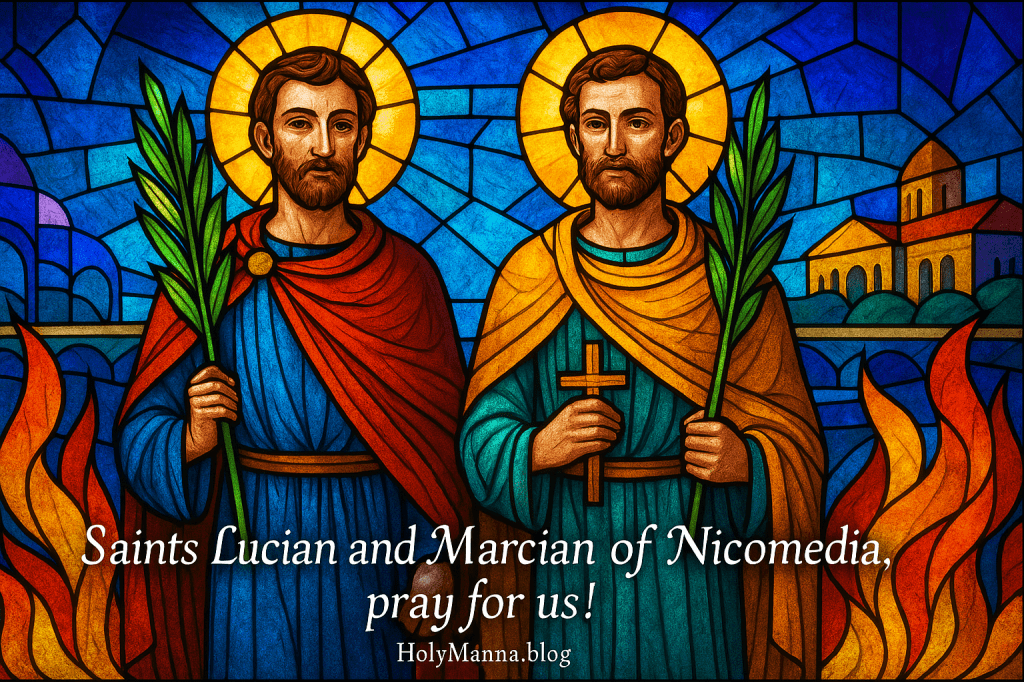
A Fire That Purified
Two companions from Nicomedia in ancient Bithynia turned completely from the occult to the living God, then sealed their conversion with a fearless witness. Saints Lucian and Marcian are remembered for publicly renouncing magic, distributing their possessions to the poor, embracing prayer and fasting, and preaching Jesus with clarity. Their story unfolds during the mid–third century, when the emperor Decius ordered all citizens to offer sacrifice to the Roman gods. Refusing to betray Christ brought arrest, torture, and death. Their steadfastness still matters because it shows what real conversion looks like. It is decisive, public, and fruitful in charity and evangelization. The Church holds them up as models of the First Commandment lived to the end, a reminder that the Gospel overcomes every counterfeit of the spiritual life. The Catechism of the Catholic Church teaches that superstition and magic distort worship, while true religion offers God the adoration He deserves (see Catechism, 2110–2117).
From Darkness to Daybreak
Tradition says Lucian and Marcian once practiced the “black arts” in Nicomedia. Their turning point came when their enchantments failed against a Christian maiden, and the sign of the Cross routed the spirits they tried to command. Confronted with the power of Christ, they repented. They made a public bonfire of their books in the city, received baptism, gave away their wealth, and withdrew for a time into solitude to pray, fast on simple fare, and build firm habits of virtue. Only after that hidden season did they begin to preach. Their ancient Acts preserve a brief line from Lucian that captures their new mission: “Every man does well to endeavor to draw his brother out of a dangerous error.” The Catechism echoes the grace they embraced: “All forms of divination are to be rejected.” (Catechism, 2116) and “All practices of magic or sorcery… are gravely contrary to the virtue of religion.” (Catechism, 2117). Their lives became a living catechesis on first turning away from sin, then turning toward God through prayer, penance, and works of mercy (see Catechism, 1427–1430).
The Cross Overcomes
The most striking sign tied to their conversion is simple and unforgettable. Their spells failed, and the Cross triumphed. That defeat of the demonic was followed by visible fruits. The book burning showed a clean break from the past. Their almsgiving repaired old harm with generous love. Their fasting and solitude taught humility and single-hearted devotion. Their preaching brought others to Christ. Even if spectacular wonders are not listed beyond the conversion event, their holiness itself became the enduring “miracle” that convinces. The Catechism reminds that authentic signs point beyond themselves to God, and genuine worship is freed from superstition and fear (see Catechism, 2111, 2117). Lucian and Marcian embody that freedom.
Trial by Flame
When Decius’s edicts reached Bithynia around the year 250, Lucian and Marcian were arrested and brought before the proconsul Sabinus. They were stretched on the rack and cruelly tortured. The Acts report their protest that while they had lived in sin and practiced magic, they suffered no punishment, yet once they became Christians and good citizens they were treated like criminals. Threats of harsher pain could not shake their resolve. Marcian’s answer is the line that still sounds like thunder: “We are ready to suffer, but we will never renounce the true God, lest we be cast into a fire which will never be quenched.” They were condemned to be burned alive. On the way to execution they sang hymns and died in the flames, giving the supreme witness to the truth of the faith. The Catechism names this witness plainly: “Martyrdom is the supreme witness given to the truth of the faith.” (Catechism, 2473). Their feast is kept on October 26.
After the Flames
The Church’s ancient martyrologies commemorate Lucian and Marcian at Nicomedia, preserving their names among those who loved Christ unto death. Over centuries their memory spread quietly through liturgical calendars and local devotion. Some churches have venerated relics identified with them, and in at least one modern reliquary chapel their names appear, though scholars prudently note that the authenticity of such relics is uncertain. Even where historical details are sparse, the core stands firm. Two men turned decisively from the occult, embraced the Gospel, and suffered death by fire rather than deny the Lord. That testimony continues to purify hearts and inspire repentance.
Turning From Counterfeits to Christ
Lucian and Marcian show how to make a clean break with spiritual counterfeits and live in the light of Christ. Replace horoscopes, crystals, tarot, and “manifesting” with Scripture, the Rosary, and Eucharistic adoration. Make a thorough confession and renounce any involvement with the occult, even if it began as curiosity. Bring sacramentals like a blessed crucifix into the home, not as talismans, but as reminders of the Cross that saves. Fast one day a week for purity of heart and for friends who dabble in harmful practices. Practice almsgiving that is as bold as their book burning, trading the thrill of secret “power” for the joy of mercy. The Catechism gives the guiding principle in a single sentence: “Superstition is a deviation of religious feeling and of the practices this feeling imposes.” (Catechism, 2111). Lucian and Marcian answer it with lives centered on Christ, shaped by prayer, and sealed by love unto death.
Engage with Us!
Share your thoughts and reflections in the comments below.
- Where do subtle forms of superstition or “good luck” habits try to creep into daily life, and how can they be replaced by prayer and trust in God?
- What concrete “book-burning” step would help break with old patterns and make room for the Holy Spirit?
- How does the witness of martyrs strengthen your resolve to confess Jesus openly in family, work, and friendships?
- Which passage from the Bible or the Catechism most emboldens you to stand firm when faith is tested?
Take heart. Christ is stronger than every counterfeit. Choose Him today, and do everything with the love and mercy He taught.
Saints Lucian and Marcian of Nicomedia, pray for us!
Follow us on Instagram and Facebook for more insights and reflections on living a faith-filled life.

 Holy Manna!
Leave a comment