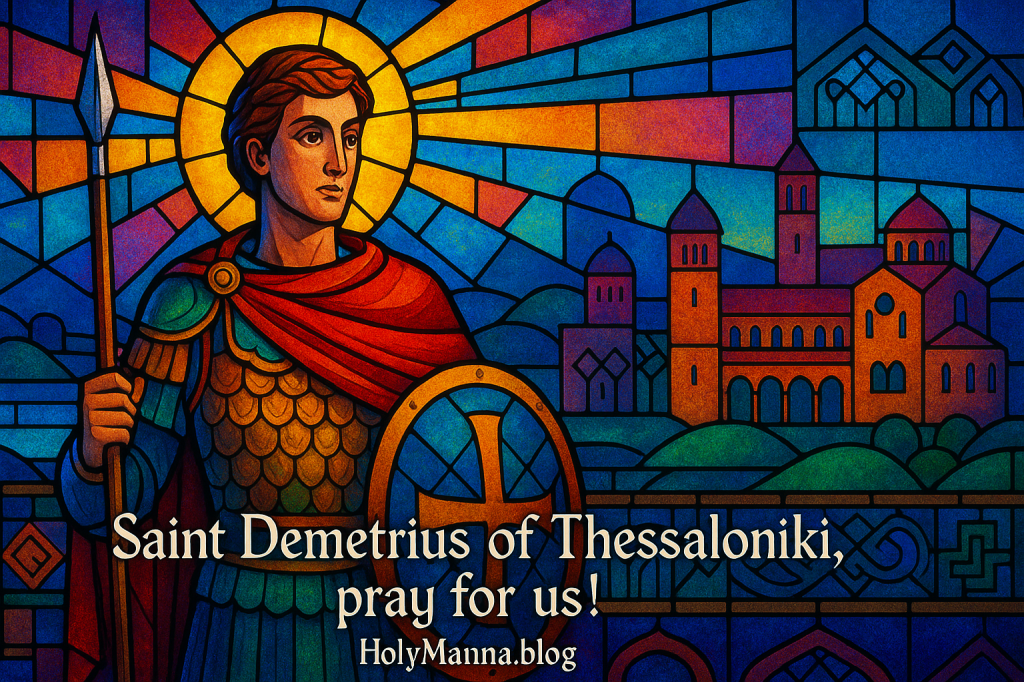
A Myrrh-Streaming Guardian of a City and Its People
Saint Demetrius of Thessaloniki stands in the heart of Christian memory as a great martyr, a protector of the faithful, and a sign that God still moves powerfully in history. He is venerated as the Myroblyte, the “myrrh-gusher,” because fragrant oil was long reported to flow from his shrine, bringing consolation and healings to those who sought his intercession. His feast on October 26 is kept with deep devotion in the East, and his cult shaped the identity of Thessaloniki for centuries. In the West, the Roman Martyrology also recalls a martyr named Demetrius at Sirmium, and over time the church in Thessaloniki became the principal center of his veneration. What makes Demetrius stand out is not only the courage of his confession but the way his intercession rallied a whole city to trust Christ. The Church honors such witness because “martyrdom is the supreme witness given to the truth of the faith.” The Catechism of the Catholic Church 2473.
Roots and Rising Zeal in Macedonia
Tradition places Demetrius’s life in the early fourth century during the era of Diocletian and Galerius. Ancient accounts connect him closely to Thessaloniki, while older Western notices remember a Demetrius martyred at Sirmium, a Roman administrative center in the same broader region. As devotion developed, Thessaloniki’s memory of Demetrius grew into a living tradition that shaped prayers, processions, and the very streets of the city around his basilica. Some narratives present him as a Roman officer who used his position to proclaim Christ openly. Other early sources highlight him as a catechist who formed believers with Scripture and encouraged them to hold fast during trials. What unites these strands is a portrait of a courageous disciple whose public identity was inseparable from the Gospel. No authentic sayings from Saint Demetrius have been preserved, and there are no verified personal writings that survive. His voice comes to us instead through the testimony of those who loved him, the liturgy that celebrates him, and the city that bears his protection.
Teaching Behind Bars and a Blessing in the Arena
The most cherished story from Demetrius’s life describes how he strengthened a young Christian named Nestor during a public spectacle. Imprisoned for preaching Christ, Demetrius welcomed Nestor into his cell and gave him a blessing in the name of the Lord. Nestor then faced the emperor’s champion, a feared giant named Lyaeus, and prevailed against him. Believers saw this not as a mere athletic surprise but as a sign that the Lord exalts the humble and casts down human pride. The narrative of Demetrius teaching from prison and blessing Nestor reveals the heart of his sanctity. He was a shepherd who formed souls to trust God, a man who believed that grace can make the weak strong, and a witness whose quiet courage kindled heroism in others. The Church proposes such saints as models for every generation because “by canonizing some of the faithful… the Church… proposes the saints to them as models and intercessors.” The Catechism of the Catholic Church 828.
Spears in the Bathhouse and a Crown of Glory
After Nestor’s victory the authorities responded with rage. The tradition of Thessaloniki locates Demetrius’s confinement in a Roman bathhouse, a place that still echoes in the crypt beneath the great basilica. Soldiers entered the chamber and put him to death by spearing. The details of date and imperial involvement vary in the sources, yet the core memory is constant. Demetrius confessed Christ, refused to compromise, and embraced death rather than deny the Lord who had conquered death. His martyrdom embodies what the Church calls the perfection of charity, where the disciple unites himself completely to Jesus crucified and risen. The Catechism teaches that such witness makes the Gospel credible because it shows what grace can do in a human life. “Martyrdom is an exceptional gift and the supreme proof of love.” The Catechism of the Catholic Church 2473.
The Perfume of Victory and a City Preserved
After his death the faithful of Thessaloniki experienced powerful signs of God’s nearness at Demetrius’s tomb. Accounts from late antiquity and the early medieval period describe healings, deliverance from danger, and especially the exudation of fragrant myron from his shrine. A celebrated collection known as The Miracles of Saint Demetrius recounts how the saint’s intercession preserved Thessaloniki during desperate sieges, when Avar and Slavic forces threatened to overwhelm the city. Christians believed that Demetrius, already victorious with Christ, guarded his people and stirred them to conversion, repentance, and mutual charity. These stories are not mere civic folklore. They express the Church’s belief in the communion of saints, where those in glory intercede for those on earth. “We believe in the communion of all the faithful of Christ… all together forming one Church.” The Catechism of the Catholic Church 962. Popular piety around Demetrius’s relics fits the Church’s understanding of authentic devotion. “The religious sense of the Christian people… finds expression in the veneration of relics, visits to sanctuaries, and pilgrimages.” The Catechism of the Catholic Church 1674.
Stones That Remember
The five-aisled basilica of Hagios Demetrios rose over the remembered site of the martyr’s passion and soon became Thessaloniki’s beating heart of worship. Fire damaged it more than once, and during centuries of foreign rule it was converted to other uses, yet the memory of the martyr endured. The Great Fire of 1917 devastated the structure; painstaking restoration followed, and the basilica was reconsecrated in the mid twentieth century. The rediscovery of the crypt unveiled foundations of the Roman baths and unearthed artifacts tied to the saint’s cult. Mosaics shimmer with his image as a youthful protector who draws citizens and pilgrims into the mystery of Christ’s victory. The church is not merely a museum of the past. It is a living house of prayer where the faithful still ask for Demetrius’s intercession and give thanks for grace received.
Why He Matters Today
Saint Demetrius shows how holiness shapes a whole community. He formed one disciple in a prison cell, and that blessing helped overturn an arena where fear ruled. He loved his city so well that generations believed he kept vigil over their walls. His life invites a fresh look at the power of spiritual fatherhood, the quiet influence of faithful witness, and the way public devotion can renew a people. The path to imitate him is not complicated. Pray daily with Scripture and ask for a share in his courage. Bless others with words that lift their eyes to Jesus. Stand firm in the truth with humility and peace. Visit a church, venerate a relic if possible, and remember that the saints do not compete with the Lord’s glory; they magnify it by interceding for us. “In this communion the merciful love of God and his saints is always attentive to our prayers.” The Catechism of the Catholic Church 962. Keep close to the sacraments, and let the Gospel shape every decision, so that the fragrance of Christ’s love spreads through homes, workplaces, and neighborhoods.
Engage with Us!
Share your thoughts and reflections in the comments below. How does Saint Demetrius’s witness challenge and encourage a life of courageous charity today?
- Which moment in Demetrius’s story most strengthens your resolve to witness to Christ at work, at home, or online?
- Where is God asking for boldness like Nestor’s, and whose blessing or mentorship do you need to pursue it with humility?
- How can you honor the communion of saints this week through a pilgrimage, a simple visit to a church, or prayer before a relic?
- What practical step will help your home “carry the aroma of Christ,” whether through Scripture, acts of mercy, or family prayer?
May Saint Demetrius teach a love that is courageous, pure, and joyful. May his prayers help every heart live a life of faith and do everything with the love and mercy Jesus taught.
Saint Demetrius of Thessaloniki, pray for us!
Follow us on Instagram and Facebook for more insights and reflections on living a faith-filled life.

 Holy Manna!
Leave a comment