Thirtieth Sunday in Ordinary Time – Lectionary: 150
Humbled Hearts and the Just Judge Who Listens
Come close to the heart of God today, where quiet humility speaks louder than polished performance and where honest need becomes a doorway to mercy. The readings move together like a single procession toward the temple: Sirach 35 teaches that true worship is generous and just, Psalm 34 sings that the Lord draws near to the brokenhearted, 2 Timothy 4 shows a faithful life poured out in trust, and Luke 18:9–14 reveals that only the contrite go home justified. The central theme is simple and demanding. God, the just Judge, exalts the humble and hears the poor, while self-congratulation blinds the soul to grace.
These passages rise from a real world with real pressures. Sirach comes from the wisdom tradition of Second Temple Jerusalem, where sacrifices and almsgiving were daily signs of devotion, yet the inspired sage insists that God cannot be bribed and that He hears the cry of the widow and orphan. The psalm brings the spirituality of the anawim, the poor of the Lord, into focus with the assurance “The Lord is close to the brokenhearted.” In the Roman world of 2 Timothy, a prisoner awaiting death can still declare “I have competed well; I have finished the race; I have kept the faith.” Paul’s “libation” image echoes temple worship and signals a life offered to God in love, not a resume held up for applause. In Luke’s parable, a respected religious man stands front and center listing devotional achievements, while a despised tax collector stands back, beats his breast, and pleads, “O God, be merciful to me, a sinner.” Jesus concludes with the verdict that shocks expectations: “Everyone who exalts himself will be humbled, and the one who humbles himself will be exalted.”
Read through this lens and a coherent path appears. Authentic worship gives generously without manipulation, trusts God amid abandonment and trial, and prays from the low place where truth and mercy meet. The Catechism anchors this path. CCC 2559 teaches that humility is the foundation of prayer. CCC 2631 reminds that the first movement of petition is asking forgiveness. CCC 2448 affirms that Christ is especially present among the poor and afflicted. These teachings invite a concrete response right now. Let the lips bless the Lord at all times, let the hands open to the needy, and let the heart take the lowest place so that the Father who sees in secret may lift it up. Where is the Lord inviting a humbler prayer, a truer generosity, and a steadier fidelity today?
First Reading – Sirach 35:12–14, 16–18
Worship That Cannot Be Bought, Mercy That Cannot Be Silenced
Composed in the wisdom world of Second Temple Jerusalem, Sirach comes from Ben Sira, a teacher who formed students to live covenant fidelity in a culture that outwardly prized sacrifice and almsgiving. In that setting, offerings could drift into showmanship or social leverage, yet the inspired sage insists that the living God cannot be bribed. True worship looks like justice for the vulnerable and generosity that mirrors the Lord’s own largesse. This reading fits the day’s theme by drawing a clear line between humble, Godward devotion and self-serving religiosity. The just Judge listens to the lowly, attends to the widow and orphan, and rewards those who give as they have received. Read through the lens of Psalm 34, 2 Timothy, and The Gospel of Luke, this passage anchors a spirituality where contrition, generosity, and trust stand in the temple while pride stays outside.
Sirach 35:12-14, 16-18
New American Bible (Revised Edition)
12 Give to the Most High as he has given to you,
generously, according to your means.
13 For he is a God who always repays
and will give back to you sevenfold.
14 But offer no bribes; these he does not accept!
16 He shows no partiality to the weak
but hears the grievance of the oppressed.
17 He does not forsake the cry of the orphan,
nor the widow when she pours out her complaint.
18 Do not the tears that stream down her cheek
Detailed Exegesis
Verse 12 — “Give to the Most High as he has given to you, generously, according to your means.”
Ben Sira begins with the source of all giving. God gives first, and human generosity answers that prior gift. The measure is not performance before others but gratitude before God. This verse harmonizes with the Church’s teaching that worship flows from acknowledging God as Creator and Giver, and it anticipates the Gospel’s call to humility by locating the heart of religion in response rather than display.
Verse 13 — “For he is a God who always repays and will give back to you sevenfold.”
The “sevenfold” image signals covenant fullness. God’s justice is neither stingy nor forgetful. In Catholic tradition, reward language never reduces God to a transactional partner. Rather, divine recompense is the Father’s faithful recognition of grace-formed deeds. The verse encourages confidence that no act of hidden fidelity is lost to the just Judge.
Verse 14 — “But offer no bribes; these he does not accept!”
Here the prophet-teacher slams the door on manipulation. In the ancient Near Eastern world, gifts to rulers could purchase favor. Israel’s God is unlike the nations. He is holy and impartial, so offerings cannot excuse injustice. This anticipates Luke 18, where the Pharisee’s spiritual résumé fails to move heaven, while the tax collector’s contrition finds mercy.
Verse 16 — “He shows no partiality to the weak but hears the grievance of the oppressed.”
Divine neutrality does not mean indifference. God’s “impartiality” means He cannot be bought, which is precisely why the oppressed are heard. Their case is not advanced by influence but by truth and need. The line implies a courtroom scene where God’s ear bends toward those without human advocates.
Verse 17 — “He does not forsake the cry of the orphan, nor the widow when she pours out her complaint.”
Widows and orphans, emblematic of the unprotected, stand at the center of biblical justice. To “pour out” a complaint evokes temple prayer that is honest and bold. This verse prepares the heart to pray like the tax collector in Luke 18, whose breast-beating plea reaches the Father more surely than polished self-congratulation.
Verse 18 — “Do not the tears that stream down her cheek…”
Even in fragment, the image is unmistakable. God counts tears as testimony. Sorrow becomes intercession, and suffering becomes a summons to divine action. Catholic spirituality recognizes such tears as a grace that softens the heart and opens it to mercy, aligning the soul with the poor whom God defends.
Teachings
The reading’s inner logic is the logic of humble prayer. The Catechism teaches, “Humility is the foundation of prayer. Only when we humbly acknowledge that we do not know how to pray as we ought, are we ready to receive freely the gift of prayer.” CCC 2559. The same page of tradition binds worship to mercy for the vulnerable. The Catechism states plainly, “The Church’s love for the poor is a part of her constant tradition.” CCC 2448. In other words, gifts placed on the altar must flow from a heart shaped by God’s own generosity and must return as justice for those He hears first. Within salvation history, Israel’s festivals and sacrifices were always ordered toward covenant fidelity, not leverage. The early Church inherited this vision, seeing almsgiving, fasting, and prayer as acts that open the soul to God rather than strategies to secure human advantage. Read with Luke 18, authentic religion takes the lowest place, confesses sin, and trusts the Lord who vindicates the small and rescues the faithful, as witnessed in 2 Timothy where Paul’s poured-out life is received and rewarded by the “just judge.”
Reflection
The path is clear and concrete. Let worship begin with gratitude for what God has already given, then let that gratitude become generosity that seeks no return. Let prayer rise from the low place, naming sin and asking for mercy with confidence that the Father hears. Let every encounter with need be treated as sacred, because the Lord is listening to that cry. Where is a hidden opportunity to give generously today without seeking credit? How can prayer become more honest, more like the widow’s poured-out complaint and the tax collector’s humble plea? What injustice near home needs a quiet act of reparation and a faithful intercession? Will the heart take the lowest place so that the just Judge may lift it in His time?
Responsorial Psalm – Psalm 34:2–3, 17–19, 23
Praise From the Low Place, Rescue From the Just Judge
Rooted in Israel’s worship and traditionally associated with David’s deliverance, Psalm 34 embodies the spirituality of the anawim, the poor who trust entirely in the Lord. In the culture of temple praise and personal lament, this song teaches the community to bless God at all times, especially when hearts are crushed and spirits are worn thin. The psalm is not optimistic spin. It is a confession that the Lord bends toward those who cry out in truth and that His justice is not for sale. Within today’s theme, these verses place humble praise and honest petition side by side. The just Judge listens to contrite hearts, draws near to the brokenhearted, opposes evil, and redeems those who seek refuge in Him.
Psalm 34:2-3, 17-19, 23
New American Bible (Revised Edition)
2 I will bless the Lord at all times;
his praise shall be always in my mouth.
3 My soul will glory in the Lord;
let the poor hear and be glad.
17 The Lord’s face is against evildoers
to wipe out their memory from the earth.
18 The righteous cry out, the Lord hears
and he rescues them from all their afflictions.
19 The Lord is close to the brokenhearted,
saves those whose spirit is crushed.
23 The Lord is the redeemer of the souls of his servants;
and none are condemned who take refuge in him.
Detailed Exegesis
Verse 2 — “I will bless the Lord at all times; his praise shall be always in my mouth.”
Praise becomes a habit of the covenant people, not a mood. “At all times” includes distress and confusion. The psalm trains believers to fix the heart on God’s character before considering circumstances. This aligns with the Church’s understanding of praise as a form of prayer that acknowledges God for who He is, not only for what He gives.
Verse 3 — “My soul will glory in the Lord; let the poor hear and be glad.”
To “glory” in the Lord means to boast only in God’s steadfast love. The horizon widens from one voice to a community of the poor who find joy when they hear that God is enough. The movement is evangelical. Personal praise becomes public encouragement for those who suffer and need hope.
Verse 17 — “The Lord’s face is against evildoers to wipe out their memory from the earth.”
The “face” of the Lord is a biblical way of speaking about God’s personal attention. Here it names judgment. Evil is not neutral and will not have the last word. God’s opposition to evil safeguards the hope of the afflicted. Justice is not vengeance but the restoration of right order under God.
Verse 18 — “The righteous cry out, the Lord hears and he rescues them from all their afflictions.”
Righteousness in the Psalms is not sinless perfection. It is covenant fidelity expressed in trust. The assurance that God “hears” grounds the believer’s courage to pray. Rescue may take different forms, but the promise stands. God’s hearing is already a first act of deliverance because it draws the sufferer into communion.
Verse 19 — “The Lord is close to the brokenhearted, saves those whose spirit is crushed.”
Nearness is the gift. The verse moves from courtroom imagery to intimacy. God does not explain away pain. He comes close and saves in the midst of it. This is the heart of the day’s theme. Humility is not humiliation. It is the space where God’s nearness becomes tangible.
Verse 23 — “The Lord is the redeemer of the souls of his servants; and none are condemned who take refuge in him.”
Redemption language recalls the Exodus and anticipates Christ. Refuge is active trust, a concrete turning toward God. The verdict is set in advance for those who take shelter in Him. No condemnation awaits those who cling to the Redeemer, which prepares for the Gospel promise of justification given to the contrite.
Teachings
The Catechism articulates the heart of this psalmic praise. “Praise is the form of prayer which recognizes most immediately that God is God; it lauds God for his own sake and gives him glory, not because of what he does, but simply because he is.” CCC 2639. The psalm’s insistence that God hears the poor belongs to the Church’s constant witness. “The Church’s love for the poor is a part of her constant tradition.” CCC 2448. The experience of crying out from affliction is not a failure of faith. It is the doorway to authentic prayer. “Prayer is the raising of one’s mind and heart to God or the requesting of good things from God. But when we pray, do we speak from the height of our pride and will, or ‘out of the depths’ of a humble and contrite heart? He who humbles himself will be exalted. Humility is the foundation of prayer; only when we humbly acknowledge that ‘we do not know how to pray as we ought,’ are we ready to receive freely the gift of prayer. ‘Man is a beggar before God.’” CCC 2559; cf. Ps 130:1; Rom 8:26; St. Augustine. Read with Sirach 35, 2 Timothy 4, and Luke 18, Psalm 34 shows that praise and petition are not opposites. They are two breaths of one prayer from a humble heart that trusts the just Judge who saves.
Reflection
Begin where the psalm begins. Bless the Lord at set moments each day, not because feelings are high but because God is worthy. Speak praise aloud in simple words drawn from Psalm 34 and let that praise become a shield in moments of anxiety. Bring specific afflictions into prayer and name them before the Redeemer who promises refuge. Intercede for the poor, the orphan, and the widow whom God hears first, and allow that intercession to shape concrete generosity. Where is praise being withheld because circumstances feel heavy? What would it look like to take refuge in God today rather than in distraction or resentment? Whose cry is the Lord inviting the heart to hear and answer with real help and steady prayer? How can the mouth learn to bless at all times so that the heart learns to trust at all times?
Second Reading – 2 Timothy 4:6–8, 16–18
Poured Out in Trust, Crowned by the Just Judge
Written near the end of Paul’s life, 2 Timothy reflects a veteran apostle under Roman custody, likely during the Neronian persecutions in the mid to late sixties. The language of being “poured out like a libation” draws on temple sacrifice and signals that Paul sees his impending death as worship rather than defeat. In the Roman legal world, a defendant needed advocates at a first hearing, yet Paul records abandonment and still speaks forgiveness. The passage fits today’s theme by showing that the just Judge vindicates humble fidelity. The servant who takes the lowest place and trusts in God’s nearness is not forgotten. The one who keeps the faith receives the crown, not because of self promotion but because the Lord himself stands near and saves.
2 Timothy 4:6-8, 16-18
New American Bible (Revised Edition)
Reward for Fidelity. 6 For I am already being poured out like a libation, and the time of my departure is at hand. 7 I have competed well; I have finished the race; I have kept the faith. 8 From now on the crown of righteousness awaits me, which the Lord, the just judge, will award to me on that day, and not only to me, but to all who have longed for his appearance.
16 At my first defense no one appeared on my behalf, but everyone deserted me. May it not be held against them! 17 But the Lord stood by me and gave me strength, so that through me the proclamation might be completed and all the Gentiles might hear it. And I was rescued from the lion’s mouth. 18 The Lord will rescue me from every evil threat and will bring me safe to his heavenly kingdom. To him be glory forever and ever. Amen.
Detailed Exegesis
Verse 6 — “For I am already being poured out like a libation, and the time of my departure is at hand.”
Paul casts his life and death in sacrificial terms. A libation completed an offering. The apostle’s entire mission is worship aimed at God’s glory. The “departure” hints at both death and Exodus like deliverance. Catholic tradition sees in this a model of dying as self offering united to Christ’s Pasch.
Verse 7 — “I have competed well; I have finished the race; I have kept the faith.”
The athletic imagery evokes discipline, perseverance, and public witness. “Kept the faith” means guarded and handed on the deposit of truth. The emphasis rests on fidelity rather than visible results. The victory is to finish in faith, which prepares the heart for the Gospel’s praise of humble reliance on God rather than comparison with others.
Verse 8 — “From now on the crown of righteousness awaits me, which the Lord, the just judge, will award to me on that day, and not only to me, but to all who have longed for his appearance.”
The “crown” is both reward and participation in the life of Christ the King. Calling the Lord the “just judge” answers the anxiety of earthly courts. God’s verdict is true and generous, promised to all who love his appearing. Desire for the Lord shapes life toward holiness and hope.
Verse 16 — “At my first defense no one appeared on my behalf, but everyone deserted me. May it not be held against them!”
Here is humility tested by betrayal. Paul names the wound without bitterness and echoes Christ’s mercy. Forgiveness breaks the cycle of self pity and becomes intercession. The absent advocates do not cancel God’s presence.
Verse 17 — “But the Lord stood by me and gave me strength, so that through me the proclamation might be completed and all the Gentiles might hear it. And I was rescued from the lion’s mouth.”
Divine nearness replaces human absence. Strength is given for mission so that the Gospel reaches the nations. The “lion’s mouth” can be metaphor for deadly peril. In Christian memory it also evokes martyr stories, yet Paul’s rescue serves proclamation rather than comfort.
Verse 18 — “The Lord will rescue me from every evil threat and will bring me safe to his heavenly kingdom. To him be glory forever and ever. Amen.”
This is confidence without presumption. Rescue may not mean escape from death, but safe arrival into the kingdom. The doxology seals the testimony. Glory returns to God, which is the point of a life poured out.
Teachings
The Catechism describes the witness at the heart of Paul’s words: “Martyrdom is the supreme witness given to the truth of the faith: it means bearing witness even unto death; the martyr bears witness to Christ who died and rose, to whom he is united by charity. He bears witness to the truth of the faith and of Christian doctrine. He endures death through an act of fortitude.” CCC 2473. That fortitude is a virtue for every disciple, not only for martyrs: “Fortitude is the moral virtue that ensures firmness in difficulties and constancy in the pursuit of the good. It strengthens the resolve to resist temptations and to overcome obstacles in the moral life. The virtue of fortitude enables one to conquer fear, even fear of death, and to face trials and persecutions. It disposes one even to renounce and sacrifice his life in defense of a just cause.” CCC 1808. Paul’s hope rests finally in the life to come promised by the just Judge: “Those who die in God’s grace and friendship and are perfectly purified live forever with Christ. They are like God forever, for they ‘see him as he is,’ face to face.” CCC 1023. The humility that shapes his prayer and forgiveness is the Church’s perennial path to authentic petition: “Prayer is the raising of one’s mind and heart to God or the requesting of good things from God. But when we pray, do we speak from the height of our pride and will, or ‘out of the depths’ of a humble and contrite heart? He who humbles himself will be exalted. Humility is the foundation of prayer; only when we humbly acknowledge that ‘we do not know how to pray as we ought,’ are we ready to receive freely the gift of prayer. ‘Man is a beggar before God.’” CCC 2559. The saints echo this same confidence in trial. Tertullian famously writes, “We become more numerous whenever we are mown down by you; the blood of Christians is seed.” Apologeticus 50. Saint Ignatius of Antioch, on his way to martyrdom, puts it this way: “I am God’s wheat, and I shall be ground by the teeth of beasts, that I may become the pure bread of Christ.” Letter to the Romans. Read against the backdrop of Roman hearings and Neronian hostility, Paul’s testimony becomes the Church’s template for finishing the race with hope, forgiving enemies, and trusting the Judge who cannot be bought and who loves to save.
Reflection
Let prayer take on Paul’s shape of self-offering by dedicating work, rest, and hidden sacrifices to God each day. Let perseverance grow by choosing one concrete practice that keeps the faith steady, such as a brief examination at night or a weekly time of intercession for those who have caused hurt. Let forgiveness become an act of worship by naming those who failed to stand by and asking God to bless them. Let hope be nourished by meditating on the crown that awaits all who love the Lord’s appearing. Where is the Lord inviting a libation like offering of time, comfort, or reputation for the sake of the Gospel? What small race needs to be finished faithfully this week rather than left half run? Who needs to be released from debt in prayer so that the heart may be free? How can daily choices reflect real longing for the Lord’s appearing and for safe arrival in his heavenly kingdom?
Holy Gospel – Luke 18:9–14
Two Men, One Temple, One Verdict
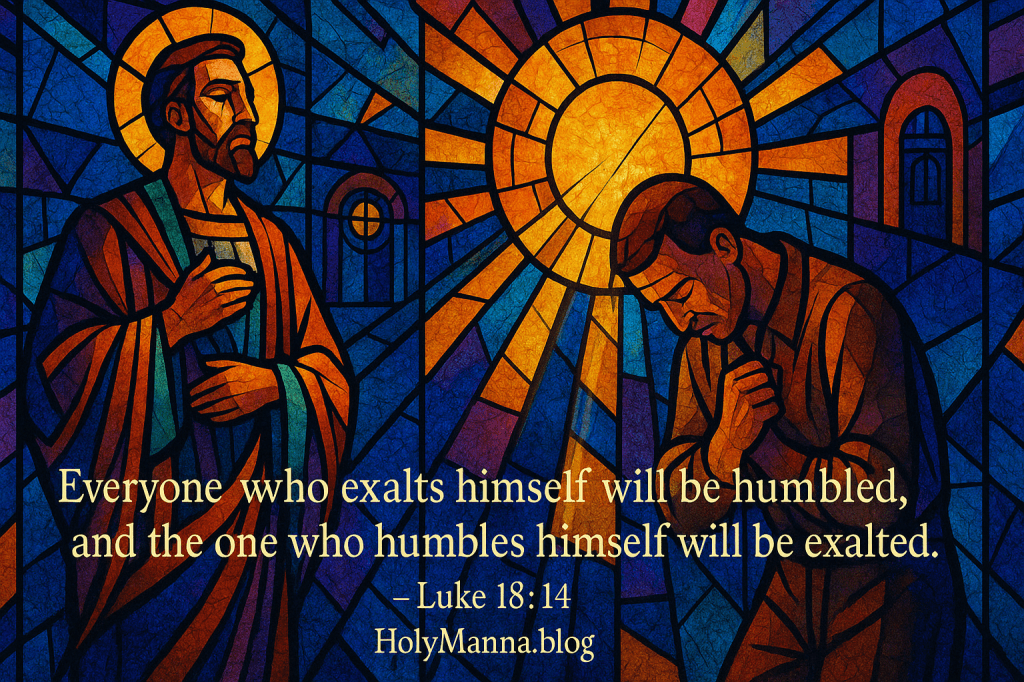
Set in the daily rhythm of temple prayer in first century Jerusalem, The Gospel of Luke places a respected Pharisee and a despised tax collector side by side. Pharisees were lay scholars devoted to the Law and to practices like fasting and tithing. Tax collectors were contractors for Rome, often viewed as traitors and extortionists. Into that charged scene Jesus tells a parable that overturns conventional religious expectations. The point is not ritual precision or public image. The point is humble truth before the just Judge who sees the heart. In the context of today’s theme, this passage makes the clearest claim possible. God hears contrition, not self congratulation. The one who takes the lowest place goes home justified, while the self satisfied leave the temple empty.
Luke 18:9-14
New American Bible (Revised Edition)
The Parable of the Pharisee and the Tax Collector. 9 He then addressed this parable to those who were convinced of their own righteousness and despised everyone else. 10 “Two people went up to the temple area to pray; one was a Pharisee and the other was a tax collector. 11 The Pharisee took up his position and spoke this prayer to himself, ‘O God, I thank you that I am not like the rest of humanity—greedy, dishonest, adulterous—or even like this tax collector. 12 I fast twice a week, and I pay tithes on my whole income.’ 13 But the tax collector stood off at a distance and would not even raise his eyes to heaven but beat his breast and prayed, ‘O God, be merciful to me a sinner.’ 14 I tell you, the latter went home justified, not the former; for everyone who exalts himself will be humbled, and the one who humbles himself will be exalted.”
Detailed Exegesis
Verse 9 — “He then addressed this parable to those who were convinced of their own righteousness and despised everyone else.”
Luke frames the story with a warning label. Confidence rooted in oneself breeds contempt for others. The parable is targeted at hearts that compare and condemn. The danger is spiritual pride that masks the need for mercy. This line prepares readers to see that justification belongs to the humble.
Verse 10 — “Two people went up to the temple area to pray; one was a Pharisee and the other was a tax collector.”
Both characters go to pray. Proximity to sacred space is not the issue. Disposition is. The pairing sets up a contrast between reputation and repentance. Listeners would expect the Pharisee to be the hero and the tax collector to be the villain, which makes the reversal all the more vivid.
Verse 11 — “The Pharisee took up his position and spoke this prayer to himself, ‘O God, I thank you that I am not like the rest of humanity, greedy, dishonest, adulterous, or even like this tax collector.’”
The prayer begins with thanksgiving but quickly becomes a mirror of the self. The comparison with “the rest of humanity” reveals a heart turned inward. The phrase “to himself” hints that the prayer never really reaches God. External righteousness without humility becomes self worship that cannot receive grace.
Verse 12 — “I fast twice a week, and I pay tithes on my whole income.”
The practices are good in themselves. Fasting and tithing are biblical. The problem is using holy works as leverage before God or as a scoreboard against others. Works without contrition do not justify. They are meant to be fruits of grace, not currency to buy divine favor.
Verse 13 — “But the tax collector stood off at a distance and would not even raise his eyes to heaven but beat his breast and prayed, ‘O God, be merciful to me a sinner.’”
Everything about the posture speaks humility. Distance. Downcast eyes. A penitential gesture. The prayer is short and direct. It is a confession that banks on mercy. This is the model of petition that The Catechism highlights. Honest need meets generous compassion.
Verse 14 — “I tell you, the latter went home justified, not the former; for everyone who exalts himself will be humbled, and the one who humbles himself will be exalted.”
Jesus delivers the verdict. Justification belongs to the contrite, not the complacent. The principle is universal. Exaltation comes by way of humility. The tax collector receives what the Pharisee seeks to earn. Grace is gift, not wages.
Teachings
Humility is the very ground of prayer. The Catechism teaches, “Prayer is the raising of one’s mind and heart to God or the requesting of good things from God. But when we pray, do we speak from the height of our pride and will, or ‘out of the depths’ of a humble and contrite heart? He who humbles himself will be exalted. Humility is the foundation of prayer; only when we humbly acknowledge that ‘we do not know how to pray as we ought,’ are we ready to receive freely the gift of prayer. ‘Man is a beggar before God.’” CCC 2559. This parable also reveals the first movement of true petition. The Catechism states, “The first movement of the prayer of petition is asking forgiveness, like the tax collector in the parable: ‘God, be merciful to me a sinner!’ It is a prerequisite for righteous and pure prayer.” CCC 2631. Jesus’ method itself matters. He teaches in parables to invite conversion of heart. The Catechism explains, “Jesus’ invitation to enter his kingdom comes in the form of parables, a characteristic feature of his teaching. Through his parables he invites people to the feast of the kingdom, but he also asks for a radical choice: to gain the kingdom, one must give everything.” CCC 546. Finally, the outcome named by Jesus is justification, which is God’s work of mercy. The Catechism affirms, “Justification is not only the remission of sins, but also the sanctification and renewal of the interior man.” CCC 1989. In light of this teaching, the tax collector’s plea is not self improvement. It is surrender to grace. The Pharisee’s boasting is not fidelity. It is resistance to the gift.
Reflection
The way forward is beautifully simple. Pray from the low place with the tax collector’s words on the lips each day. Make a brief examination of conscience every evening and bring specific sins to the Lord’s mercy. Let good works flow from grace rather than from a need to be seen. Choose a hidden act of generosity for someone who cannot repay. Forgive those who look down or compare. Where has comparison stolen the freedom to pray honestly? What concrete moment today could be offered as a quiet act of repentance and trust? How might regular confession align the heart with the tax collector’s simple plea and open it to the joy of justification? What practice can keep humility at the center so that the just Judge may lift up the heart in His time?
Go Home Justified
Today’s Word draws a single line from the temple steps to the secret place of the heart. Sirach 35 insists that worship cannot be bought and that the just Judge hears the tears of the widow and the cry of the orphan. Psalm 34 teaches a melody for that truth, where praise rises from the low place and the Lord draws near to the brokenhearted. 2 Timothy 4 shows what this looks like in a life poured out, where abandonment does not cancel hope and where the “crown of righteousness” awaits those who keep the faith. The Gospel of Luke delivers the final verdict. The contrite tax collector goes home justified while the self satisfied Pharisee leaves the temple unchanged, because “everyone who exalts himself will be humbled, and the one who humbles himself will be exalted.”
The path forward is clear and concrete. Choose the low place in prayer and begin with the tax collector’s plea, “O God, be merciful to me, a sinner.” Bless the Lord at set moments each day as Psalm 34 teaches and let that praise shape the mind more than any fear or comparison. Give as Sirach 35 commands, generously and without manipulation, and make a quiet act of mercy for someone who cannot repay. Keep the race of faith with Paul’s perseverance in 2 Timothy 4, forgiving those who failed to stand by and trusting the Lord who stands near. Seek the Sacrament of Reconciliation soon, carry a small examination of conscience into the evening, and let humility become the doorway to deeper intimacy with God. What step today will make room for God’s nearness? Where can generosity replace self protection? How can praise become a daily habit that keeps the heart ready for the just Judge who loves to save?
Go Home Justified
Today’s Word draws a single line from the temple steps to the secret place of the heart. Sirach 35 insists that worship cannot be bought and that the just Judge hears the tears of the widow and the cry of the orphan. Psalm 34 teaches a melody for that truth, where praise rises from the low place and the Lord draws near to the brokenhearted. 2 Timothy 4 shows what this looks like in a life poured out, where abandonment does not cancel hope and where the “crown of righteousness” awaits those who keep the faith. The Gospel of Luke delivers the final verdict. The contrite tax collector goes home justified while the self satisfied Pharisee leaves the temple unchanged, because “everyone who exalts himself will be humbled, and the one who humbles himself will be exalted.”
The path forward is clear and concrete. Choose the low place in prayer and begin with the tax collector’s plea, “O God, be merciful to me, a sinner.” Bless the Lord at set moments each day as Psalm 34 teaches and let that praise shape the mind more than any fear or comparison. Give as Sirach 35 commands, generously and without manipulation, and make a quiet act of mercy for someone who cannot repay. Keep the race of faith with Paul’s perseverance in 2 Timothy 4, forgiving those who failed to stand by and trusting the Lord who stands near. Seek the Sacrament of Reconciliation soon, carry a small examination of conscience into the evening, and let humility become the doorway to deeper intimacy with God. What step today will make room for God’s nearness? Where can generosity replace self protection? How can praise become a daily habit that keeps the heart ready for the just Judge who loves to save?
Engage with Us!
Share your reflections in the comments below and encourage one another with the ways God is moving in your life.
- From Sirach 35, where is the heart being called to give generously without seeking return, and what concrete step can be taken this week to honor God by serving someone who cannot repay?
- Praying with Psalm 34, when has the Lord felt close to a broken heart, and how can daily praise become a habit that steadies the soul during stress?
- In 2 Timothy 4, what small race needs to be finished faithfully right now, and what practice of perseverance or forgiveness will help keep the faith steady?
- Hearing The Gospel of Luke 18:9–14, where has comparison slipped into prayer, and how will the tax collector’s prayer shape the next confession and the next quiet act of mercy?
Be strengthened to live a life of faith, and do everything with the love and mercy Jesus taught.
Sacred Heart of Jesus, we trust in You!
Immaculate Heart of Mary, pray for us!
Saint Michael the Archangel, defend us in battle!
Follow us on Instagram and Facebook for more insights and reflections on living a faith-filled life.

 Holy Manna!
Leave a comment