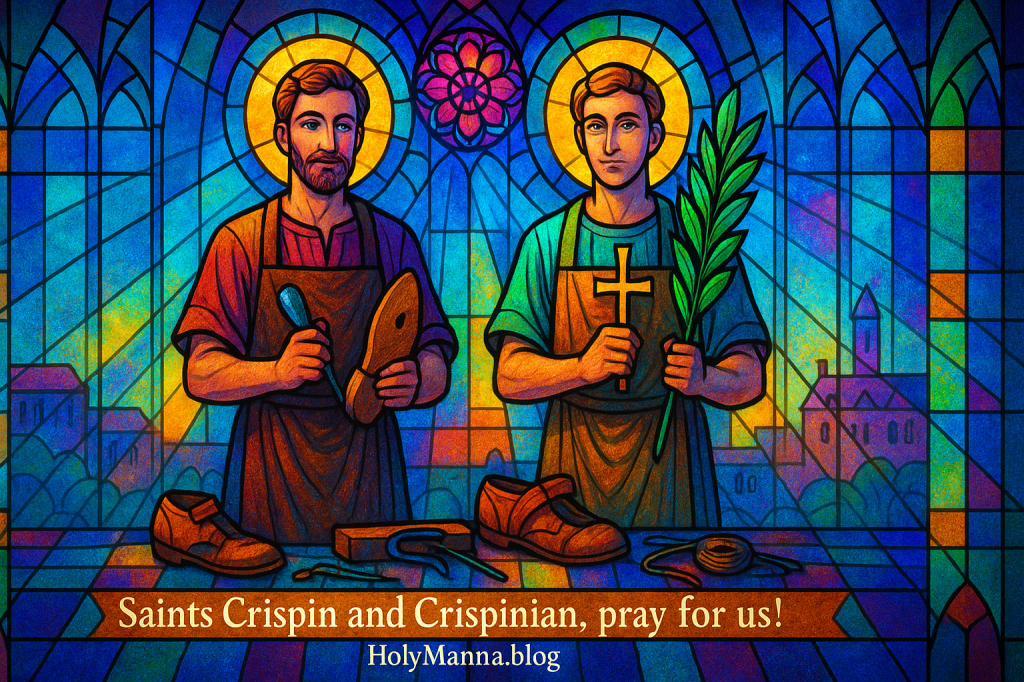
Shoemakers Who Preached Christ
Saints Crispin and Crispinian stand in the Church’s memory as brother martyrs of the late third century who carried the Gospel from Rome into northern Gaul, settling at Soissons. Their feast on October 25 became a touchstone for Christian artisans and a cultural byword for courageous witness on “St. Crispin’s Day.” They are patrons of shoemakers, cobblers, leather workers, and tanners because they supported their mission through honest manual labor. Their story is cherished not because it offers a long literary record but because it reveals a distinctly lay path to holiness, where a workbench becomes a place of prayer, evangelization, and charity. The Catechism of the Catholic Church affirms this vocation, teaching that “Human work proceeds directly from persons created in the image of God and called to prolong the work of creation” and that work, offered to God, becomes a path of sanctification (CCC 2427). Their lives show what it looks like when the Gospel is stitched into the seams of ordinary life.
From Noble Rome to the Streets of Soissons
Traditional accounts describe the brothers as Romans of good family who chose to live as missionaries in Gaul during a time when the Christian name could cost a life. They settled at Soissons, a Roman civitas on the Aisne River, where they earned daily bread by crafting and repairing shoes while quietly proclaiming Christ. The pattern many sources highlight is simple and compelling: they labored by day and evangelized by evening, welcoming seekers, catechizing neighbors, and serving the poor without fanfare. Across these narratives, one consistent thread emerges with clarity. Their reputation for integrity and mercy drew people to the faith, not through public office or clerical status, but through the credibility of lives shaped by prayer, simplicity, and tireless work. The brothers are best known as models of the lay apostolate that the Catechism calls every baptized person to exercise in the heart of the world, sharing in Christ’s mission as priest, prophet, and king in daily life (CCC 897–900).
Soles for Souls
Accounts from Christian memory portray the workshop as their pulpit and the poor as their honored guests. Customers encountered craftsmen who refused to cheat, who spoke of Jesus with warmth, and who quietly slipped alms into the hands of those who needed help. Their craft did not distract from discipleship; it made discipleship visible. The holiness that radiated from their bench embodied Saint Paul’s charge, echoed in the Church’s teaching on work, that “Whatever you do, do from the heart, as for the Lord.” The stories focus less on spectacular wonders during their early ministry and more on the slow miracle of hearts turning to God through patient charity, truthful speech, and the credibility of consistent virtue. In that sense, their “daily miracles” look like reconciled neighbors, relieved burdens, and converts won by kindness. The Church treasures this witness because it shows how the Gospel advances one conversation at a time, one stitch at a time, one act of mercy at a time.
Witness unto Blood
Persecution caught up with the brothers during the reign of the emperors Diocletian and Maximian. Tradition names a regional official, often called Rictiovarus, who sought to break their resolve through torture. Hagiographic accounts describe ordeals that included attempts to drown them with millstones and to destroy them by fire, followed by scourging and other torments. These narratives culminate in their beheading at Soissons, often dated to around the year 286 or 287. The precise historical details vary across ancient texts, and the Church is careful to read early martyr acts with humility. Even so, the central claim has never wavered. Crispin and Crispinian died because they would not renounce Christ. The Catechism names this gift with solemn brevity: “Martyrdom is the supreme witness given to the truth of the faith.” It “bears witness to the truth of the faith and to Christian doctrine” and remains the measure of total fidelity to Jesus (CCC 2473–2474). Their unbroken confession of Christ, sealed in blood and received by the Church as a shining pattern of steadfast courage.
After their Witness
Veneration of the martyrs rose early at Soissons, where a church was built over their resting place. Over the centuries their relics were honored, and notable figures such as Saint Eligius crafted rich reliquaries for them as devotion spread among craftsmen’s guilds. Portions of their relics were later reported in other churches of Europe, and their names became rallying points for confraternities of leather workers and shoemakers who looked to them as heavenly patrons. Medieval pilgrims asked their intercession for health, provision, and protection in work, and tradition remembers many favors and healings granted through their prayers. While the chronicles do not preserve a neat catalog of specific posthumous miracles in the modern sense, the durable reach of their cult, the building of shrines, the translations of relics, and the adoption of their feast by guilds all testify to a living reputation for answered prayer. The Catechism explains this bond with luminous clarity, teaching that in the communion of saints “the intercession of the saints is their most exalted service to God’s plan” and that “being more closely united to Christ, those who dwell in heaven fix the whole Church more firmly in holiness.” (CCC 956–957)
Walking It Out
Crispin and Crispinian speak to anyone trying to follow Christ in an office, on a job site, or at a kitchen table scattered with tools. Their lives teach that sanctity is not reserved for pulpits or cloisters. It grows in a workshop, on a commute, and in conversations with customers and colleagues. They invite a renewed reverence for work as participation in God’s providence, a renewed tenderness for the poor as honored guests of Christ, and a renewed courage to confess the faith when pressure mounts. The saints are not museum pieces. The Catechism calls them “models who encourage us” and explains that their memory stirs hope and love in the Church (CCC 828). How might an ordinary Tuesday become a school of charity, patience, and integrity? Where can prayer quietly lace through tasks, decisions, and conversations so that work becomes worship and witness? Let the brothers’ story simplify the path. Love God. Serve people. Tell the truth. Do good work. Ask the saints to pray, and trust Jesus to complete what grace begins.
Engage with Us!
How has God invited you to sanctify your daily work this week?
- Where do today’s responsibilities give you a chance to serve the poor with concrete generosity, as these saints did with their craft?
- What pressure tempts you to compromise the faith, and how can the courage of Crispin and Crispinian strengthen your resolve?
- How might you ask their intercession to renew integrity, patience, and boldness in the workplace?
- Which friend or coworker needs a quiet word of hope from you today, and how can you offer it with humility and love?
Go forward encouraged. Live the faith openly, labor honestly, and do everything with the love and mercy Jesus taught.
Saints Crispin and Crispinian, pray for us!
Follow us on Instagram and Facebook for more insights and reflections on living a faith-filled life.

 Holy Manna!
Leave a comment