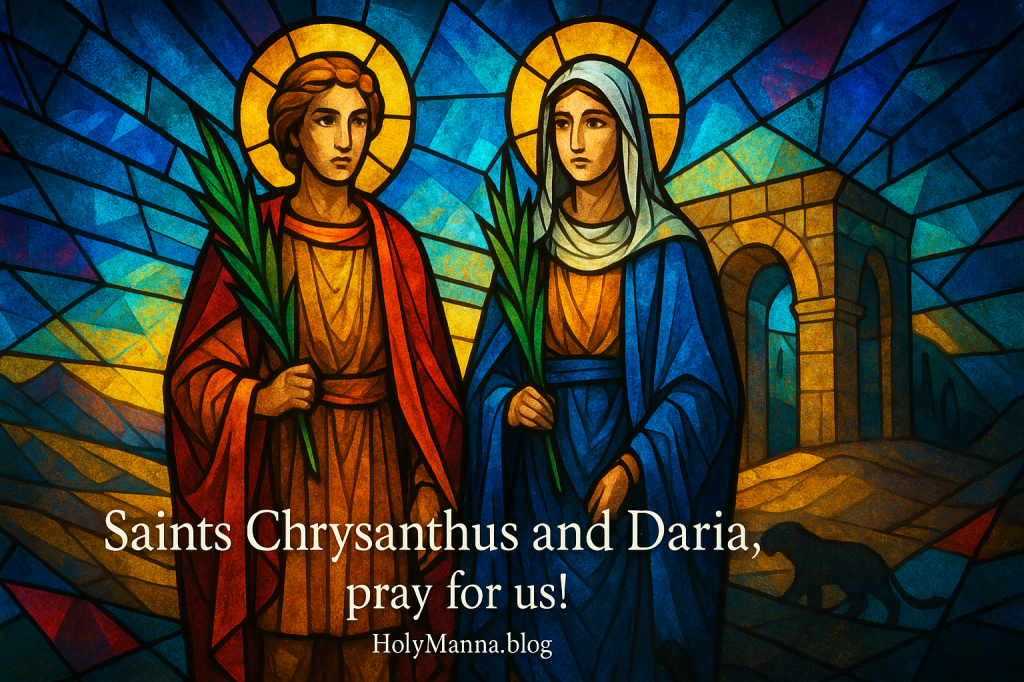
A Love Sealed by the Cross
The Church treasures Saints Chrysanthus and Daria as a married pair whose unity in Christ turned a hostile pagan world into a field ripe for grace. Their feast in the Roman calendar falls on October 25, and their memory stretches back to the earliest centuries when Christians gathered near their burial outside Rome. They are honored as patrons of steadfast evangelization, chaste fidelity, and courageous hope under pressure. Their witness helps believers see marriage as a path to holiness and martyrdom as the ultimate proclamation of the Gospel. The Catechism of the Catholic Church puts it plainly and powerfully: “Martyrdom is the supreme witness given to the truth of the faith.” (CCC 2473)
From Seeking Truth to Finding Christ
Ancient tradition places Chrysanthus’ roots in the Greek speaking world, with studies that trained his intellect and stirred a hunger for truth. After coming to Rome he encountered Christian teaching and embraced the Gospel despite family resistance. The stories preserved by the early faithful describe how a learned pagan woman named Daria, sometimes remembered as a Vestal, was brought forward to argue against the faith. Their meeting became a moment of grace. Daria listened, questioned, and discovered in Christ the fulfillment of what philosophy sought. She asked for baptism and freely joined Chrysanthus in a virginal marriage offered to God. Their household became a small school of the Lord, and many who met them found in their peace and clarity a path into the Church. While specific details in these ancient “Acts” are not all historically verifiable, the Church’s continuous memory is clear. This couple lived for Christ, they drew others to Him, and their names were honored where their bodies rested.
Signs of Grace in a City That Resisted
Their life together centered on prayer, instruction, and the quiet hospitality that draws the curious to Christ. Tradition says their words pierced hearts because they were matched by a life of holiness. Accounts from the early faithful remember striking protections that underlined God’s nearness in their trials. One narrative tells that Chrysanthus’ prison shone like a garden of light and that his chains fell as if they had never been clasped. Another recounts that when Daria was handed over to a brothel as a cruel humiliation, a lioness guarded her from harm. These stories are part of the Church’s early memory. Even where the historical contours are difficult to prove line by line, the Church has always heard in them a theological truth. God defends the dignity of those who belong to Him and He confirms the Gospel in the lives of His friends.
Their choice of a virginal marriage highlights a special charism. It is not the norm for Christian spouses, yet it witnesses to a total gift to Christ that the Church venerates without imposing universally. The Catechism of the Catholic Church teaches, “Virginity for the sake of the kingdom of heaven is an unfolding of baptismal grace.” (CCC 1618) At the same time, their married bond itself became a sacramental school of charity. The Catechism also reminds the faithful, “By reason of their state in life and of their order, Christian spouses have their own special gifts in the People of God.” (CCC 1641)
The Sandpit on the Salarian Way
Their preaching and the conversions that followed provoked hostility from authorities in the late third century. The couple endured interrogations, confinement, and public humiliations. Daria was subjected to attempts at disgrace and Chrysanthus was pressed to recant. Neither yielded. Their final sentence came at a sandpit off the Via Salaria outside Rome, where they were buried alive beneath earth and stones. The cruelty was intended to silence them. Instead, it completed their testimony. Their death bears the unmistakable shape of the Cross. “Who shall separate us from the love of Christ?” asks Saint Paul, and their answer is written in the soil that covered them. The faithful kept their names as a banner of hope and gathered at their grave to sing the victory of Jesus.
A Tomb That Would Not Be Silent
After their death the place of their burial became a living altar of prayer. Pilgrims came to ask for help and to thank God for favors received. The early Church remembered that on one anniversary of their martyrdom soldiers tried to suffocate the faithful inside the underground chamber, a horrific scene that paradoxically deepened devotion. Generations later their fame had spread across Italy and into the German lands as churches and altars bearing their names welcomed the poor, the sick, and the penitent. Healings and conversions were reported by those who invoked them with faith. The precise details of relic journeys are hard to untangle so many centuries later, yet the widespread veneration is not in doubt. The saints’ memory traveled because the Lord continued to work through their intercession. As the Catechism teaches, “Being more closely united to Christ, those who dwell in heaven fix the whole Church more firmly in holiness.” (CCC 957)
How Their Witness Reaches Today
Their story speaks clearly to this moment. They show that marriage can be a mission field and a lighthouse for the neighborhood. They show that chastity is not a restriction but a powerful way of loving with freedom and joy. They show that suffering for the name of Jesus is never wasted. In practical terms, their example invites couples to pray together every day, to keep a crucifix at the center of the home, to attend Mass with devotion, and to make frequent use of Confession so that love stays fresh and faithful. Their courage emboldens students, coworkers, and parents to speak of Jesus without embarrassment and to live the Beatitudes without compromise. Their intercession strengthens those who endure ridicule for the faith or pressure to conform. The Catechism sums up the point of the saints’ witness in every age. “The saints have always been the source and origin of renewal in the most difficult moments in the Church’s history.” (CCC 828)
Engage with Us!
Share your thoughts and reflections in the comments below.
- Where is the Lord inviting you to a bolder witness to the truth this week?
- How can your home become a clearer sign that Christ is the center of your love and your decisions?
- Which form of prayer strengthens you most when you face pressure for your beliefs?
- Who in your life needs a hopeful word about Jesus today, and how will you offer it with gentleness and courage?
Go forward encouraged. Live the faith openly, love generously, and do everything with the mercy and courage Jesus taught.
Saints Chrysanthus and Daria, pray for us!
Follow us on Instagram and Facebook for more insights and reflections on living a faith-filled life.

 Holy Manna!
Leave a comment