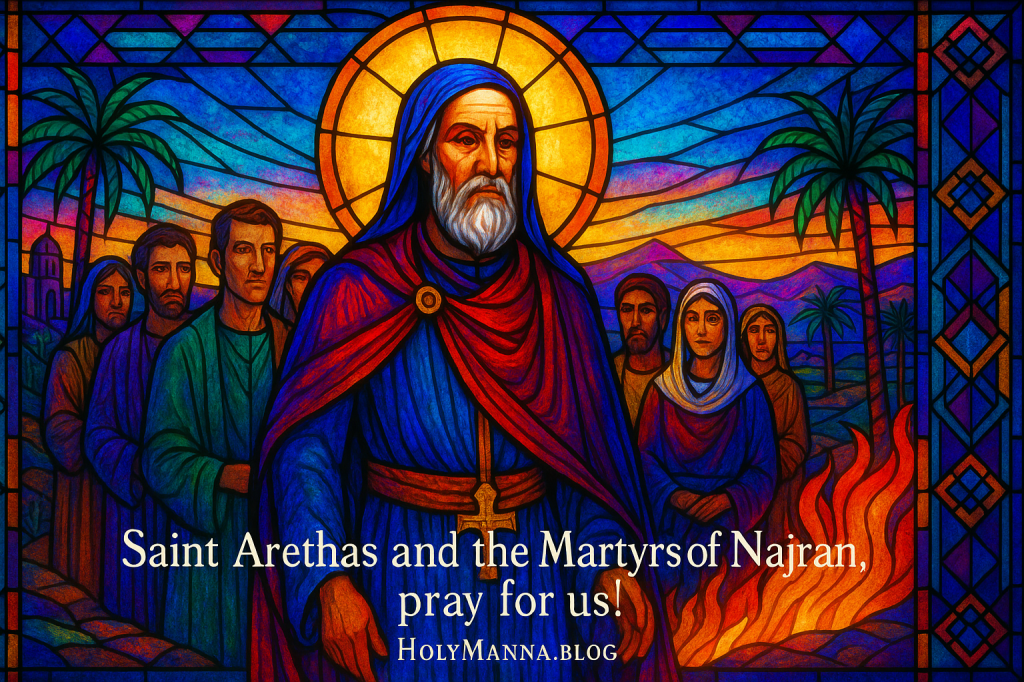
A Crown in the Desert
Saint Arethas and the Martyrs of Najran shine as a crown of fidelity raised in the deserts of southern Arabia. Their witness, sealed in A.D. 523, reveals what love for Christ looks like when every earthly advantage is stripped away. The Church remembers them for heroic steadfastness, clear Christian leadership, and a charity that chose the Gospel rather than survival at any cost. Their feast is kept on October 24, and their story is treasured in the Church’s memory as a model of fortitude. In the language of the Catechism of the Catholic Church, “Martyrdom is the supreme witness given to the truth of the faith: it means bearing witness even unto death.” Catechism of the Catholic Church, 2473.
Oasis Roots and a Leader Forged by Faith
Najran was a flourishing oasis city on the caravan routes of Arabia. By the early sixth century it had a robust Christian community with clergy, consecrated women, and families who lived the faith with conviction. Arethas, also known as al Harith, emerged as an elder statesman among the Christians, respected for prudence, courage, and piety. The surviving records do not give a detailed family biography or a dramatic conversion moment. Instead they present a seasoned believer whose faith had matured through years of communal service. When pressure mounted, Arethas did not become someone new. He simply became more fully himself, a Christian leader whose counsel and constancy steadied others. The accounts describe him as advanced in age, yet spiritually vigorous, and uniquely placed to guide a people who suddenly found themselves targeted for their belief in Jesus Christ.
Everyday Holiness More Powerful Than Headlines
Arethas is remembered less for spectacle and more for ordinary holiness lived at full strength. The earliest traditions emphasize pastoral care, public confession of faith, and the courage to remain loyal to Christ and to the sacraments when apostasy would have purchased safety. That emphasis is itself a lesson. Sanctity is not about chasing the extraordinary. It is about daily fidelity ripened by prayer and sacramental life until, if called upon, it can withstand the storm. The Church holds up witnesses like Arethas so that disciples in every age will recognize the dignity of small but steady acts of faith that prepare the soul for great trials. As the Catechism teaches, “All Christians… have an obligation to manifest the new man which they have put on in Baptism.” Catechism of the Catholic Church, 2472.
The Ditch of Fire and the Elder’s Final Confession
The Himyarite ruler Dhu Nuwas launched a violent persecution of Christians in the region and fixed his anger on Najran. Soldiers encircled the city and demanded renunciations of Christ. Trenches were dug and set ablaze to terrorize the believers. Christians who refused to abjure the Gospel faced beheading or death by fire. Arethas, as the community’s foremost Christian, was executed publicly after steadfastly confessing the Lord. The accounts remember not only an elder who would not bend, but also clergy, consecrated women, and families who chose fidelity over fear. Their martyrdom is one of those moments when Scripture seems to come alive before our eyes. “Be faithful unto death, and I will give you the crown of life.” Revelation 2:10. That promise sustained them, and it continues to sustain the Church whenever disciples face real cost for the name of Jesus.
After the Sword: Memory That Moved Nations
News of the massacre traveled quickly across the Christian world. The Christian kingdom of Aksum responded within a few years by overthrowing the persecutor, which believers at the time regarded as a sign of divine justice. Over the centuries, the memory of Arethas and his companions has been woven into liturgical calendars across both East and West. Their names and their story are read in churches and monasteries as a living proclamation that Christ’s grace triumphs through fidelity. The earliest texts do not dwell on a chain of posthumous healings, translations of relics, or specific shrines accessible today. Given the region’s later history, widely recognized pilgrimage destinations tied to Arethas are not common. Yet their legacy has functioned like an enduring miracle of conscience. Their acts continue to rouse courage, convert hearts, and anchor Christian communities that face hostility. The Catechism captures this dynamic with striking clarity: “The Church has painstakingly collected the records of those who persevered to the end… They form the archives of truth written in letters of blood.” Catechism of the Catholic Church, 2474.
Do We Have Any Words From Arethas Himself
The sources that describe Arethas and the martyrs preserve their deeds and their confession rather than a collection of personal sayings. No universally accepted, verbatim quotation from Saint Arethas has come down to us the way it has for some later saints. This absence does not diminish the power of their testimony. In a sense, their most eloquent statement is the one their lives already gave. When called to choose, they chose Christ. Their silence leaves room for the voice of Scripture to sound even more clearly: “Whoever loses his life for my sake will find it.” Matthew 16:25.
How To Walk In Their Footsteps Today
The martyrs of Najran teach that fidelity is a daily habit long before it becomes a final confession. Their path invites a renewed love for Sunday Mass, a regular rhythm of Confession, and a deeper devotion to prayer that keeps the heart tethered to Christ. Their courage inspires the quiet heroism of telling the truth with charity in the workplace, guarding the dignity of marriage and family at home, and choosing integrity when shortcuts would seem easier. Growth in the virtue of fortitude does not happen by accident. It grows when believers ask for the help of the Holy Spirit and cooperate with grace through consistent acts of faith, hope, and love. When discouragement whispers that fidelity is pointless, remember the promise that carried them through the fire. “Be faithful unto death, and I will give you the crown of life.” The same Lord who strengthened them is present to strengthen every disciple today.
Engage with Us!
- Where do the martyrs’ choices challenge areas of fear or compromise in your life?
- How can daily prayer and the sacraments strengthen a courageous witness to Christ in your home and workplace?
- What practical step will you take this week to speak the truth in charity, even if it costs you comfort or approval?
- How does the Church’s teaching on martyrdom in the Catechism reshape the way you think about suffering and fidelity?
Keep going with confident trust. Let faith shape every decision, and do everything with the love and mercy Jesus taught.
Saint Arethas and the Martyrs of Najran, pray for us!
Follow us on Instagram and Facebook for more insights and reflections on living a faith-filled life.

 Holy Manna!
Leave a comment