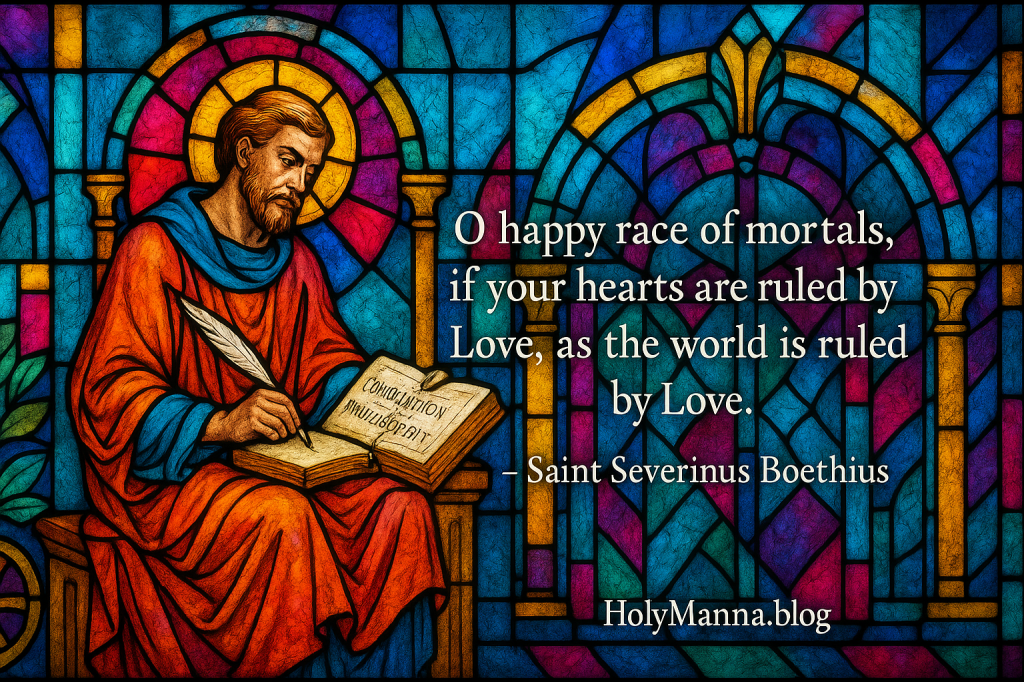
A Philosopher’s Lamp in the Twilight of Rome
Saint Severinus Boethius shines as the last great Roman philosopher and a faithful Christian whose mind and heart helped carry classical wisdom into the life of the Church. A senator, statesman, mathematician, musician, logician, and theologian, he wrote The Consolation of Philosophy while unjustly imprisoned, meditating on happiness, Providence, and the restless search for the highest good. His synthesis of reason and faith made him a trusted guide for centuries of Christian thinkers, and the local Church of Pavia has long honored him as a martyr on October 23. He is revered because he shows that authentic wisdom never competes with the Gospel. Instead, it kneels before God and serves charity.
From Anician Blood to Baptized Wisdom
Boethius was born around 480 into the illustrious Anician family in Rome. Orphaned at a young age, he was raised in the household of the respected statesman and scholar Quintus Aurelius Memmius Symmachus, later marrying Symmachus’s daughter Rusticiana. Gifted with languages and unusually broad learning, he moved easily in the highest circles of Roman society while remaining a committed Christian. He served as consul in 510 and later accepted the demanding post of magister officiorum under King Theodoric. In 522, both of his young sons were named joint consuls, a public sign of the family’s stature and of Boethius’s reputation for integrity. He is remembered most for a monumental intellectual project. He set out to translate and interpret Aristotle and Plato for Latin Christendom and to reconcile their insights within a Christian vision of the world. His textbooks on arithmetic and music shaped the medieval curriculum, and his theological treatises clarified the language of the Trinity and the person of Christ using careful definitions and sound logic. His life reads like a witness to the Church’s claim that faith and reason, when rightly ordered, grow together.
Teaching Rome to Think with the Church
Boethius wrote two streams of works that still matter. First are the logical and scientific texts that formed the core of later medieval education. De institutione musica placed music among the mathematical arts and explored how harmony reflects the order of creation. His commentaries on the Organon made Aristotle comprehensible to Latin readers and gave Christian theologians precise tools for argument. Second are his theological tractates, especially De Trinitate and Contra Eutychen et Nestorium, where he defended right teaching on the triune God and on the unity of Christ’s person with both a divine nature and a human nature. When prison closed in around him, Boethius wrote The Consolation of Philosophy, a dialogue with Lady Philosophy that refuses the illusions of fortune and directs the soul to the highest good. In that work he reminds us, “O happy race of mortals, if your hearts are ruled by Love, as the world is ruled by Love.” He presses further with a definition that shaped Christian thought for centuries, “The highest good is that which, once possessed, makes a man happy.” The text does not cite Scripture directly, yet its moral vision and hope are steeped in a Christian understanding of Providence and of the soul’s longing for God.
Chains, Consolation, and a Martyr’s Crown
Public virtue brought Boethius both honor and danger. In the political tensions of his day, he defended a fellow senator against charges of treason and was himself accused, arrested, and imprisoned at Ticinum, modern Pavia. There he composed The Consolation of Philosophy, searching for meaning as power slipped away and as death drew near. Tradition holds that he was executed around 524 for standing by justice and truth. The Church in Pavia venerates him as a martyr, seeing his death as a witness that truth is worth more than office or life. In the face of suffering, he taught that no turn of fortune can steal the interior freedom that comes from clinging to God. His famous reflection on the instability of worldly success still stings and heals in equal measure, “In all adversity of fortune, the most wretched kind is former happiness.” The Catechism’s teaching on Providence, virtue, and martyrdom helps name what Boethius lived with clarity and courage.
A Quiet Following
After his death, Boethius was buried in Pavia at the Basilica of San Pietro in Ciel d’Oro, the same church that enshrines the remains of Saint Augustine. Through the centuries, pilgrims have honored his tomb, giving thanks for a Christian mind that helped the Church think more clearly and love more deeply. Medieval readers copied his works tirelessly. Dante placed Boethius among the wise in the heaven of the Sun, a poetic nod to his enduring light. While there is no widely attested catalog of specific posthumous miracles connected to his relics, the steady devotion surrounding his resting place and the unbroken study of his writings testify to a different kind of wonder. God used Boethius’s patient reasoning and faithful endurance to heal errors, strengthen minds, and draw hearts to the highest good.
Faith That Thinks, Reason That Prays
Boethius invites today’s disciple to integrate head and heart in the school of Christ. Begin by remembering that truth is one and that every genuine insight points back to its source in God. Read a short passage of The Consolation of Philosophy alongside Scripture, and let that pairing train attention on what truly lasts. Practice the virtues he cherished. Seek prudence by weighing decisions in light of the highest good rather than the quickest payoff. Practice fortitude by holding steady when reputation wobbles or outcomes disappoint. Cultivate hope by trusting Providence when plans fail. Bring the week’s anxieties into prayer and ask for the grace to love God above every lesser good. Let this conviction settle in the heart and shape choices, “The highest good is that which, once possessed, makes a man happy.” The life of Boethius confirms that the good is not fragile and that God’s wisdom can console the soul even in the darkest cell.
Engage with Us!
- Where do you most feel the tug between earthly success and the pursuit of wisdom that leads to God?
- How might you let prayer and reason work together this week to resolve a concrete decision?
- What “true goods” remain in your life even when your circumstances feel unjust or unstable?
- How does Boethius’ courage under pressure challenge your own approach to fear, reputation, and truth?
- What line from The Consolation of Philosophy or from The Catechism could you memorize to guide your heart in trials?
May the witness of Saint Severinus Boethius strengthen resolute minds and tender hearts. Live your faith boldly, think clearly, pray humbly, and do everything with the love and mercy Jesus taught us.
Saint Severinus Boethius, pray for us!
Follow us on Instagram and Facebook for more insights and reflections on living a faith-filled life.

 Holy Manna!
Leave a comment