Thursday of the Twenty-ninth Week in Ordinary Time – Lectionary: 476
Standing at the Fork in the Road
Every disciple eventually reaches a fork in the road, and today’s readings bring that decision into clear focus with fire, freedom, and fruitfulness. The central theme is decisive discipleship: grace frees from the old slavery of sin and invites a joyful submission to righteousness that sanctifies the heart, bears enduring fruit, and may cost social peace for the sake of the Prince of Peace. In Romans 6:19–23, Saint Paul uses a familiar image from the first-century Roman world, where slavery was a known social reality, to underscore total belonging. Bodies once offered to impurity must now be offered to righteousness for sanctification, since “the wages of sin is death, but the gift of God is eternal life in Christ Jesus our Lord.” In Psalm 1, Israel’s wisdom tradition frames life as two ways, the flourishing of the just who meditate on God’s law and the weightless end of the wicked, captured in the beatitude “Blessed is the man who does not walk in the counsel of the wicked.” In Luke 12:49–53, the Lord speaks of a baptism that points to his Passion and of a purifying fire that refines and divides, declaring with burning urgency, “I have come to set the earth on fire.” In a Mediterranean honor and kinship culture where family loyalty shaped identity, allegiance to Jesus could fracture households, yet this division clarifies the heart’s true center.
This call is not harsh servitude but liberating holiness. The path of the just in Psalm 1 previews the sanctification Paul celebrates, while the Gospel’s fire anticipates the Holy Spirit’s work to transform, purify, and embolden. The Catechism names this ancient choice as the way of life or the way of death in CCC 1696, teaches that authentic freedom grows as the good is chosen in CCC 1733, explains the Spirit’s purifying fire in CCC 696, and affirms the primacy of following Christ even when family ties resist in CCC 2232–2233. Taken together, these texts prepare the heart to hear that discipleship is comprehensive, concrete, and costly, yet radiant with divine gift. Where is the Lord inviting a clean break from the old path, and how will his grace help the soul choose the living way today?
First Reading – Romans 6:19–23
Freed From Sin, Bound for Holiness
Paul writes into the heart of the first century Roman world, where the institution of slavery was a daily social reality and a vivid metaphor for total belonging. In this setting, Romans 6:19–23 uses the language of servitude to make a stark comparison between two masters and two destinies. Bodies once presented to impurity are now to be offered to righteousness for sanctification. This is not a swap of chains but an exchange of lords that leads from shame and death to holiness and life. Within today’s theme of decisive discipleship, this passage anchors the call to make a clear and comprehensive choice. It complements Psalm 1 by contrasting the fruitless path of the wicked with the rooted flourishing of the just, and it prepares the way for the Gospel’s purifying fire by showing that grace does not merely forgive but also reclaims, redirects, and sanctifies.
Romans 6:19-23
New American Bible (Revised Edition)
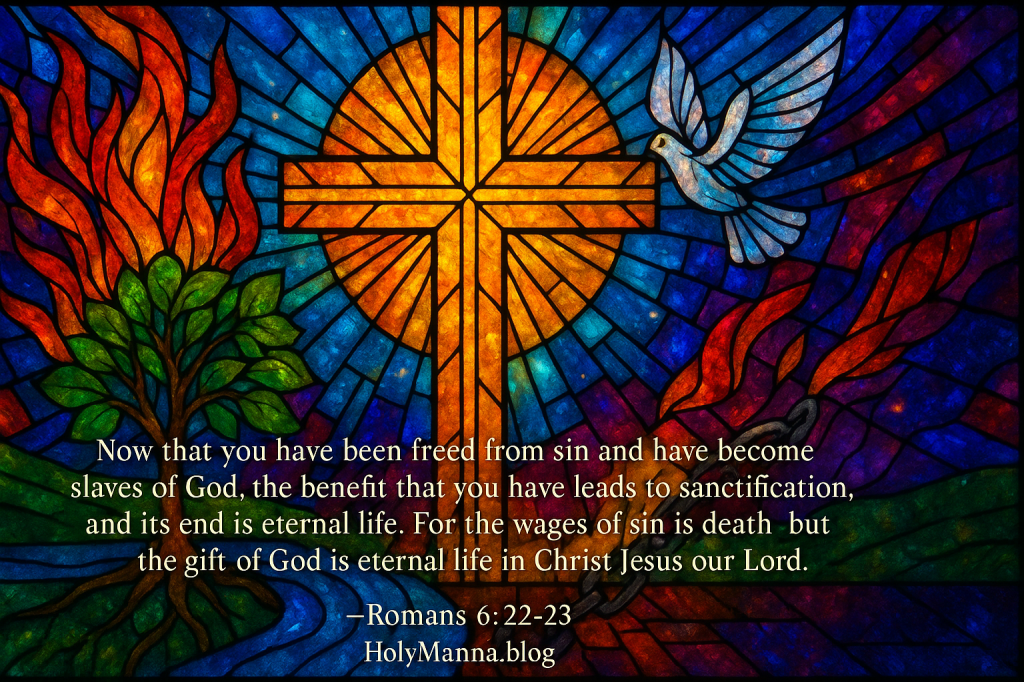
19 I am speaking in human terms because of the weakness of your nature. For just as you presented the parts of your bodies as slaves to impurity and to lawlessness for lawlessness, so now present them as slaves to righteousness for sanctification. 20 For when you were slaves of sin, you were free from righteousness. 21 But what profit did you get then from the things of which you are now ashamed? For the end of those things is death. 22 But now that you have been freed from sin and have become slaves of God, the benefit that you have leads to sanctification, and its end is eternal life. 23 For the wages of sin is death, but the gift of God is eternal life in Christ Jesus our Lord.
Detailed Exegesis
Verse 19 – “I am speaking in human terms because of the weakness of your nature. For just as you presented the parts of your bodies as slaves to impurity and to lawlessness for lawlessness, so now present them as slaves to righteousness for sanctification.”
Paul acknowledges the limits of human understanding and adopts an accessible image. The body’s “parts” include the full range of human powers and capacities. Once these powers were yielded to impurity, leading to escalating lawlessness. Now the same totality is to be yielded to righteousness, not halfway but wholly, with sanctification as the goal. The Catechism echoes the dynamic of cooperation with grace in growth toward holiness, teaching that sanctification is not automatic but involves a real offering of one’s powers to God.
Verse 20 – “For when you were slaves of sin, you were free from righteousness.”
This is a sobering irony. The prior “freedom” from righteousness was not genuine freedom but a tragic autonomy cut off from the good. The line unmasks neutrality as a myth. Everyone serves something. If righteousness does not command the body, sin will.
Verse 21 – “But what profit did you get then from the things of which you are now ashamed? For the end of those things is death.”
Paul invites a moral audit. Past choices promised gain but yielded shame and, ultimately, death. The language of “end” highlights trajectory. Sin’s apparent returns are counterfeit, and its compounding interest is ruin. The shame is not mere feeling but recognition of objective disorder that separates from God.
Verse 22 – “But now that you have been freed from sin and have become slaves of God, the benefit that you have leads to sanctification, and its end is eternal life.”
Grace changes owners and outcomes. The new “slavery” is filial belonging under a Father who dignifies and heals. The present “benefit” is sanctification, which is the Spirit’s ongoing work of conforming the believer to Christ. The final “end” is not decay but eternal life, signaling that holiness is both the road and the destination.
Verse 23 – “For the wages of sin is death, but the gift of God is eternal life in Christ Jesus our Lord.”
Paul contrasts two economies. Sin pays wages that are earned and exact, and the pay is death. God gives a gift that is unearned and overflowing, and the gift is eternal life in Christ. The verse crystallizes the whole passage and invites the only reasonable response, which is to live under the Giver rather than the taskmaster.
Teachings
Paul’s realism about freedom and service harmonizes with The Catechism. CCC 1733 teaches, “The more one does what is good, the freer one becomes. There is no true freedom except in the service of what is good and just. The choice to disobey and do evil is an abuse of freedom and leads to ‘the slavery of sin’.” This clarifies that Christian belonging is not constriction but the condition for genuine freedom. The moral struggle is likewise addressed in CCC 1811: “It is not easy for man, wounded by sin, to maintain moral balance. Christ’s gift of salvation offers us the grace necessary to persevere in the pursuit of the virtues. Everyone should always ask for this grace of light and strength, frequent the sacraments, cooperate with the Holy Spirit, and follow his calls to love what is good and shun evil.” The horizon of this sanctifying path is universal, as CCC 2013 proclaims, “All Christians in any state or walk of life are called to the fullness of Christian life and to the perfection of charity.”
Historically, Paul’s metaphor carried sharp force in Rome, where slavery was woven into law, economy, and household life. By transposing that reality into a spiritual key, the Apostle insists that the believer’s new allegiance is total. The sanctifying work that follows is the fruit of the Spirit, whom The Catechism describes with purifying imagery in CCC 696: “While water signifies birth and the fruitfulness of life given in the Holy Spirit, fire symbolizes the transforming energy of the Holy Spirit’s actions.” This aligns the First Reading with the day’s Gospel, where the Lord speaks of a fire that refines and divides, because the Spirit’s transformation cannot leave divided loyalties intact.
Reflection
The passage invites a clean transfer of ownership in concrete terms. Old habits that once claimed time, imagination, and desire can be placed under new management through daily offering, sacramental life, and a plan for virtue that engages the body, the mind, and the will. A simple rhythm of morning consecration, midday examen, and evening thanksgiving lets grace retrain desire. Meditating on Psalm 1 trains the mind to love what God loves, while disciplined acts of service offer the “parts” of the body to righteousness in real time. What habits or patterns still treat sin as a viable employer? What specific time, place, or practice will be handed over to the Lord this week so that sanctification can grow roots? How will the grace of the sacraments strengthen resolve to live under the Giver rather than under the taskmaster today?
Responsorial Psalm – Psalm 1:1–4, 6
Rooted Delight That Chooses the Living Way
Psalm 1 stands as the doorway to Israel’s prayer book, placing the worshiper at a crossroads between two ways. In the world of ancient Israel this wisdom psalm shaped a people who measured success not by power or prestige but by covenant fidelity and steady meditation on God’s Torah. The images come from everyday agrarian life along watercourses where a well planted tree flourishes while threshing floors cast off weightless chaff on the wind. Within today’s theme of decisive discipleship, Psalm 1 explains that true freedom grows as the heart delights in the Lord’s instruction, bears fruit in season, and resists the hollow path that ends in ruin. It harmonizes with Romans 6 by contrasting rooted righteousness with the old slavery to sin, and it anticipates the Gospel’s purifying fire by insisting that loyalty to God’s way inevitably distinguishes the just from the wicked.
Psalm 1:1-4, 6
New American Bible (Revised Edition)
True Happiness in God’s Law
1 Blessed is the man who does not walk
in the counsel of the wicked,
Nor stand in the way of sinners,
nor sit in company with scoffers.
2 Rather, the law of the Lord is his joy;
and on his law he meditates day and night.
3 He is like a tree
planted near streams of water,
that yields its fruit in season;
Its leaves never wither;
whatever he does prospers.
4 But not so are the wicked, not so!
They are like chaff driven by the wind.
6 Because the Lord knows the way of the just,
but the way of the wicked leads to ruin.
Detailed Exegesis
Verse 1 – “Blessed is the man who does not walk in the counsel of the wicked, Nor stand in the way of sinners, nor sit in company with scoffers.”
The psalm begins with a beatitude that describes movement from subtle influence to settled belonging. To “walk,” “stand,” and “sit” trace a descent from listening to lingering to identifying. Wisdom guards the heart’s counsel, the feet’s path, and the seat of belonging. Decisive discipleship refuses environments that normalize contempt for God and his ways, because counsel shapes conscience and community forms character.
Verse 2 – “Rather, the law of the Lord is his joy; and on his law he meditates day and night.”
The alternative is not a vacuum but delight. “Law” here means Torah, God’s loving instruction that reveals reality and righteousness. Meditation “day and night” describes a steady rhythm of ruminating prayer in which the word is chewed, prayed, and obeyed. Joy is both motive and fruit. This verse links worship and wisdom, showing that holiness grows where Scripture becomes the soul’s native speech.
Verse 3 – “He is like a tree planted near streams of water, that yields its fruit in season; Its leaves never wither; whatever he does prospers.”
The righteous life is rooted, irrigated, and fruitful. “Planted” suggests intentional placement by a master gardener. “Streams” evoke channels that carry living water through dry land. “In season” guards against hurried perfectionism; fruit arrives according to God’s timing. “Prospers” names thriving as fidelity to God’s design, not mere success by worldly measures. This is the opposite of burnout: resilient leaves, steady fruit, quiet strength.
Verse 4 – “But not so are the wicked, not so! They are like chaff driven by the wind.”
The wicked lack weight and root. Chaff is the husk separated from grain at threshing, a vivid image of spiritual insubstance. Without rooted delight in God, life becomes reactive and directionless, easily carried by cultural gusts and shifting desires. The double “not so” sharpens the contrast, warning that neutrality is an illusion.
Verse 6 – “Because the Lord knows the way of the just, but the way of the wicked leads to ruin.”
“Knows” in biblical language means intimate care and covenant watchfulness. God attends to the path of the just so that it becomes a pilgrimage under providence. The wicked path is self chosen isolation that ends in loss. The psalm’s final word seals the two ways: one path is companioned, the other collapses.
Teachings
The Catechism explains freedom’s growth in the good. CCC 1733 teaches, “The more one does what is good, the freer one becomes. There is no true freedom except in the service of what is good and just. The choice to disobey and do evil is an abuse of freedom and leads to ‘the slavery of sin’.” This clarifies why the blessed one refuses corrosive counsel and chooses delight in God’s instruction.
On prayerful meditation, CCC 2705 instructs, “Meditation is above all a quest. The mind seeks to understand the why and how of the Christian life, in order to adhere and respond to what the Lord is asking.” This captures the psalmist’s “day and night” rumination that turns Scripture into steady desire and obedient action.
The tradition underscores Scripture’s primacy in this path. Saint Jerome famously says, “Ignorance of the Scriptures is ignorance of Christ.” Joyful immersion in the word is not optional piety but the very way the disciple knows and loves the Lord.
Today’s Gospel speaks of a purifying fire that distinguishes true allegiance. The Spirit’s work is often described as transformative flame. CCC 696 teaches, “While water signifies birth and the fruitfulness of life given in the Holy Spirit, fire symbolizes the transforming energy of the Holy Spirit’s actions.” As the Spirit kindles love for God’s law, the soul gains weight and resilience, becoming a planted tree rather than scattered chaff.
Historically, Psalm 1 likely functioned as an editorial gateway to the Psalter, summoning Israel to read and pray the entire collection as a school of righteousness. In a world of competing voices, the psalm trains ears for God’s counsel and orients the heart toward covenant fidelity that bears enduring fruit.
Reflection
A planted life does not happen by accident. Scripture must move from occasional reading to delighted meditation that reshapes attention, affection, and action. A simple rule of life can help. Choose a fixed time morning and evening to pray with a short passage, ask for the Spirit’s light, and carry one phrase into the day as a quiet refrain. Replace unhelpful counsel by seeking companions who speak with reverence for God and wisdom about virtue. When anxiety gusts, return to the image of the tree and breathe a brief prayer that roots the heart again in the Lord’s presence. What counsel most shapes the inner life right now, and does it lead toward delight in God or toward cynicism and drift? Which concrete time and place can be dedicated to meditating on Scripture day and night so that roots go deep and fruit comes in season? Where is the Spirit inviting a trade from weightless chaff to rooted delight today?
Holy Gospel – Luke 12:49–53
The Fire That Clarifies Allegiance
In Luke 12:49–53 Jesus speaks during the long journey toward Jerusalem, where his Passion will accomplish the decisive work of salvation. The language of fire evokes both judgment and the purifying action of the Holy Spirit within a world shaped by strong kinship bonds and honor codes. In a Mediterranean household culture, loyalty to family defined identity, yet Jesus reveals a love that claims the whole person and reorders every attachment. The “baptism” he must undergo points to the Cross, while the “division” he announces names the unavoidable impact of truth in a sinful world. Within today’s theme of decisive discipleship, this Gospel shows that grace does not blur differences. It kindles hearts with charity and clarity so that allegiance to Christ stands firm even when it costs social peace.
Detailed Exegesis
Verse 49 – “I have come to set the earth on fire, and how I wish it were already blazing!”
Fire here signifies the purifying and energizing work of God. Jesus longs for the world to burn with holy love, not with destruction but with transformation. This anticipates the Spirit’s action that cleanses the heart and empowers witness. The desire is urgent because divided hearts need decisive healing.
Verse 50 – “There is a baptism with which I must be baptized, and how great is my anguish until it is accomplished!”
“Baptism” names the Passion, an immersion into suffering that will pour out life for the world. The anguish is the intense pressure of mission until the Cross is completed. This shows that the blaze of divine charity is ignited through sacrificial love, and that discipleship will share that pattern.
Verse 51 – “Do you think that I have come to establish peace on the earth? No, I tell you, but rather division.”
This is not a denial of the Gospel of peace but a clarification that the peace of Christ comes through truth and conversion. When loyalties clash, fidelity to Jesus exposes fault lines. Division arises not from cruelty but from the collision between the kingdom and entrenched sin.
Verse 52 – “From now on a household of five will be divided, three against two and two against three;”
Jesus applies the principle to the basic social unit of his time. Households were multigenerational and deeply bound by honor. When some embrace the Gospel and others resist, the result is relational strain. The timeline “from now on” signals that with Jesus’ mission the decisive hour has arrived.
Verse 53 – “a father will be divided against his son and a son against his father, a mother against her daughter and a daughter against her mother, a mother-in-law against her daughter-in-law and a daughter-in-law against her mother-in-law.”
The list covers primary bonds and in-law ties that structured daily life. The Gospel penetrates the most intimate spaces, not to destroy them but to purify them. Love for family remains a command, yet it is now ordered under a higher allegiance. Holiness sometimes exposes resistance even at the dinner table.
Teachings
The Catechism explains the symbol Jesus uses. CCC 696 teaches, “While water signifies birth and the fruitfulness of life given in the Holy Spirit, fire symbolizes the transforming energy of the Holy Spirit’s actions.” The Lord’s fiery mission is the Spirit’s work to cleanse attachments and inflame charity.
Regarding the “baptism” of suffering, CCC 1225 states, “In his Passover Christ opened to all men the fountain of Baptism. He had already spoken of his Passion, which he was about to suffer in Jerusalem, as a ‘baptism’ with which he had to be baptized.” The path to peace runs through the Cross, and the disciple’s life will be patterned accordingly.
Discipleship demands a clear public allegiance. CCC 1816 teaches, “The disciple of Christ must not only keep the faith and live on it, but also profess it, confidently bear witness to it, and spread it. All must be prepared to confess Christ before men and to follow him along the way of the Cross, amidst the persecutions which the Church never lacks.” Witness sometimes strains relationships, yet charity must remain patient, truthful, and steadfast.
This passage also illuminates the reordering of earthly ties. The Church teaches that the call to follow Christ holds primacy when loyalties conflict, while still honoring the commandment to love and respect family. The Gospel’s fire does not excuse harshness. It calls for firm conscience, meek speech, and persevering love that seeks the other’s eternal good.
Reflection
The Lord’s words invite a courageous and charitable clarity. When conscience is tested at home, at work, or among friends, the Spirit’s fire can refine speech and steady resolve. Begin the day by asking for that fire to purify motives and inflame love. Choose one concrete act that expresses allegiance to Christ, such as blessing the household, keeping a small fast for a family member’s conversion, or speaking a needed truth with gentleness and patience. If tension surfaces, resist retaliatory pride and return to prayer, trusting that the Cross is the path to real peace. Where does allegiance to Jesus need to move from vague sentiment to concrete decision today? What conversation or habit needs the Spirit’s fire so that truth and love stand together? How can charity remain steadfast toward family and friends who resist the Gospel while the heart stays firmly anchored in Christ?
Holy Gospel – Luke 12:49–53
The Fire That Clarifies Allegiance
In Luke 12:49–53 Jesus speaks during the long journey toward Jerusalem, where his Passion will accomplish the decisive work of salvation. The language of fire evokes both judgment and the purifying action of the Holy Spirit within a world shaped by strong kinship bonds and honor codes. In a Mediterranean household culture, loyalty to family defined identity, yet Jesus reveals a love that claims the whole person and reorders every attachment. The “baptism” he must undergo points to the Cross, while the “division” he announces names the unavoidable impact of truth in a sinful world. Within today’s theme of decisive discipleship, this Gospel shows that grace does not blur differences. It kindles hearts with charity and clarity so that allegiance to Christ stands firm even when it costs social peace.
Luke 12:49-53
New American Bible (Revised Edition)
49 “I have come to set the earth on fire, and how I wish it were already blazing! 50 There is a baptism with which I must be baptized, and how great is my anguish until it is accomplished! 51 Do you think that I have come to establish peace on the earth? No, I tell you, but rather division. 52 From now on a household of five will be divided, three against two and two against three; 53 a father will be divided against his son and a son against his father, a mother against her daughter and a daughter against her mother, a mother-in-law against her daughter-in-law and a daughter-in-law against her mother-in-law.”
Detailed Exegesis
Verse 49 – “I have come to set the earth on fire, and how I wish it were already blazing!”
Fire here signifies the purifying and energizing work of God. Jesus longs for the world to burn with holy love, not with destruction but with transformation. This anticipates the Spirit’s action that cleanses the heart and empowers witness. The desire is urgent because divided hearts need decisive healing.
Verse 50 – “There is a baptism with which I must be baptized, and how great is my anguish until it is accomplished!”
“Baptism” names the Passion, an immersion into suffering that will pour out life for the world. The anguish is the intense pressure of mission until the Cross is completed. This shows that the blaze of divine charity is ignited through sacrificial love, and that discipleship will share that pattern.
Verse 51 – “Do you think that I have come to establish peace on the earth? No, I tell you, but rather division.”
This is not a denial of the Gospel of peace but a clarification that the peace of Christ comes through truth and conversion. When loyalties clash, fidelity to Jesus exposes fault lines. Division arises not from cruelty but from the collision between the kingdom and entrenched sin.
Verse 52 – “From now on a household of five will be divided, three against two and two against three;”
Jesus applies the principle to the basic social unit of his time. Households were multigenerational and deeply bound by honor. When some embrace the Gospel and others resist, the result is relational strain. The timeline “from now on” signals that with Jesus’ mission the decisive hour has arrived.
Verse 53 – “a father will be divided against his son and a son against his father, a mother against her daughter and a daughter against her mother, a mother-in-law against her daughter-in-law and a daughter-in-law against her mother-in-law.”
The list covers primary bonds and in-law ties that structured daily life. The Gospel penetrates the most intimate spaces, not to destroy them but to purify them. Love for family remains a command, yet it is now ordered under a higher allegiance. Holiness sometimes exposes resistance even at the dinner table.
Teachings
The Catechism explains the symbol Jesus uses. CCC 696 teaches, “While water signifies birth and the fruitfulness of life given in the Holy Spirit, fire symbolizes the transforming energy of the Holy Spirit’s actions.” The Lord’s fiery mission is the Spirit’s work to cleanse attachments and inflame charity.
Regarding the “baptism” of suffering, CCC 1225 states, “In his Passover Christ opened to all men the fountain of Baptism. He had already spoken of his Passion, which he was about to suffer in Jerusalem, as a ‘baptism’ with which he had to be baptized.” The path to peace runs through the Cross, and the disciple’s life will be patterned accordingly.
Discipleship demands a clear public allegiance. CCC 1816 teaches, “The disciple of Christ must not only keep the faith and live on it, but also profess it, confidently bear witness to it, and spread it. All must be prepared to confess Christ before men and to follow him along the way of the Cross, amidst the persecutions which the Church never lacks.” Witness sometimes strains relationships, yet charity must remain patient, truthful, and steadfast.
This passage also illuminates the reordering of earthly ties. The Church teaches that the call to follow Christ holds primacy when loyalties conflict, while still honoring the commandment to love and respect family. The Gospel’s fire does not excuse harshness. It calls for firm conscience, meek speech, and persevering love that seeks the other’s eternal good.
Reflection
The Lord’s words invite a courageous and charitable clarity. When conscience is tested at home, at work, or among friends, the Spirit’s fire can refine speech and steady resolve. Begin the day by asking for that fire to purify motives and inflame love. Choose one concrete act that expresses allegiance to Christ, such as blessing the household, keeping a small fast for a family member’s conversion, or speaking a needed truth with gentleness and patience. If tension surfaces, resist retaliatory pride and return to prayer, trusting that the Cross is the path to real peace. Where does allegiance to Jesus need to move from vague sentiment to concrete decision today? What conversation or habit needs the Spirit’s fire so that truth and love stand together? How can charity remain steadfast toward family and friends who resist the Gospel while the heart stays firmly anchored in Christ?
Choose the Way of Life, Carry the Fire
Today’s word draws a clear line and lights it with holy flame. Romans 6:19–23 exposes the old master of sin and invites total belonging to God that leads to sanctification and ends in life. Psalm 1:1–4, 6 sets the scene with the wisdom of two ways, where the rooted one delights in the Lord’s law and bears fruit in season while the wicked drift like chaff. Luke 12:49–53 reveals the decisive heart of the Gospel as Jesus longs to kindle the earth with purifying fire, accepts the baptism of the Cross, and names the cost of allegiance that may even divide households. Together these readings proclaim that grace breaks chains, Scripture plants roots, and Christ’s fire clarifies loyalties.
This is not a call to harshness but to holiness. The pattern is simple and strong. Offer the whole self to God as a daily habit, let the word become delight, and receive the Spirit’s transforming fire that frees love to be truthful and brave. The Catechism reminds the Church that authentic freedom grows with every choice for the good in CCC 1733, that the Spirit purifies like fire in CCC 696, and that every believer is called to the fullness of holiness in CCC 2013. The path may strain relationships for a time, yet the peace Christ gives flows through the Cross and flowers in charity that refuses to compromise truth.
Here is a concrete way forward. Begin and end the day with a short offering of the mind, the words, and the body to God. Pray with Psalm 1 for a few minutes, carrying one phrase into work, school, or home. When a moment of tension or compromise appears, ask for the Spirit’s fire and choose a small act of obedience that keeps the heart steady and the speech gentle. Where does the Lord invite a clean break from the old employer today? What time and place will be given to the word so that roots sink deep and fruit arrives in season? Which relationship needs both truth and tenderness so that love stands firm under Christ’s banner?
Step onto the living way with confidence. Present the whole life to God, delight in his word, and welcome the fire that refines. “The wages of sin is death, but the gift of God is eternal life in Christ Jesus our Lord.” Let that promise steady the heart, brighten the face, and guide the next faithful step.
Engage with Us!
Share your reflections in the comments below and encourage a meaningful conversation that strengthens faith and friendship in Christ.
- First Reading – Romans 6:19–23: Which habit in your life still treats sin like a viable employer, and what concrete change will shift that area under God’s loving rule this week? Where can you present a specific “part” of your life to righteousness today, such as your speech, your screens, your schedule, or your spending? How does the promise of eternal life in Christ help you see through the short term “profits” of sin and choose the path that leads to holiness?
- Responsorial Psalm – Psalm 1:1–4, 6: What counsel most shapes your inner life right now, and does it lead you toward delight in the Lord or toward drift and cynicism? When and where will you meditate on the word day and night, even if it begins with a few quiet minutes and one verse to carry through the day? What rooted practice will help you bear fruit in season, such as a set time of prayer, weekly confession, or a small act of mercy for someone in need?
- Holy Gospel – Luke 12:49–53: Where is Jesus inviting you to let his fire purify a divided loyalty or a comfortable compromise so that your allegiance becomes clear and loving? Which conversation needs truth and tenderness, and how will you prepare in prayer to speak with charity and courage? How will you unite a daily sacrifice to the Lord’s “baptism” of the Cross for the conversion or healing of someone you love?
May these questions spark deeper trust, steady courage, and generous love. Live the faith with a whole heart today, and do everything with the love and mercy Jesus taught.
Sacred Heart of Jesus, we trust in You!
Immaculate Heart of Mary, pray for us!
Saint Michael the Archangel, defend us in battle!
Follow us on Instagram and Facebook for more insights and reflections on living a faith-filled life.

 Holy Manna!
Leave a comment