Wednesday of the Twenty-ninth Week in Ordinary Time – Lectionary: 475
Rescued for Responsibility
Settle in and let the Word set the tone for the day, because these passages move from rescue to responsibility and invite a steady, watchful heart. Romans 6:12–18 speaks the blunt language of the first century, where slavery was a daily reality and allegiance meant everything. Paul uses that cultural backdrop to make a spiritual point that still cuts to the core: “Freed from sin, you have become slaves of righteousness.” Bodies once used as instruments of sin now become instruments of virtue. This is not moralism. It is grace at work, the kind of grace The Catechism describes as God’s free and undeserved help that enables a real change of allegiance in the human heart (CCC 1996–2001). Psalm 124 gives the soundtrack for that change. It is a song of ascent, likely sung by pilgrims climbing toward Jerusalem, remembering that if the Lord had not intervened, enemies and floodwaters would have swallowed them whole. That memory of deliverance explodes into praise: “Our help is in the name of the Lord.” The Gospel completes the arc. In Luke 12:39–48, Jesus draws on a common household scene in the ancient world, where a steward managed a master’s estate and rationed food to the servants. The image is simple and convicting. The faithful steward stays at the task, because the master can return at any hour. “You also must be prepared.” The result is not fear but accountability, because “much will be required” when much has been entrusted. This is the rhythm of discipleship in the Church’s life. Grace rescues. Thanksgiving rises. Stewardship follows. Is the freedom given by Christ leading to alert obedience and concrete service today? The Church teaches that true freedom is ordered to the good and matures through virtuous action, especially prudence, which keeps a soul awake to God’s will (CCC 1730–1734; 1806). It also teaches that what has been received, from material goods to spiritual gifts, remains entrusted to human hands as a sacred charge before God (CCC 2404). Today’s readings weave these truths together. The Lord breaks the snare. The heart learns to serve. The steward keeps watch and keeps working. This is the road from baptismal grace to daily fidelity, and it is a road worth walking with eyes open and hands ready.
First Reading – Romans 6:12–18
How Grace Trains the Body for Righteousness
Paul writes to a mixed community of Jewish and Gentile Christians in imperial Rome, likely in the late fifties during Nero’s reign. The city’s daily life was saturated with the reality of slavery, household stewardship, and public rituals, so the language of allegiance and obedience would have landed with force. In Romans 6, Paul moves from the baptismal mystery to its moral consequence. Those who passed through the waters with Christ must now live as people raised from death to life. The body is not an enemy, but a battleground where grace retrains desire and redirects power. This reading fits today’s theme by showing that divine rescue blossoms into responsible vigilance. Gratitude for deliverance becomes concrete stewardship, because the members of the body are meant to be instruments that serve the Master’s will.
Romans 6:12-18
New American Bible (Revised Edition)
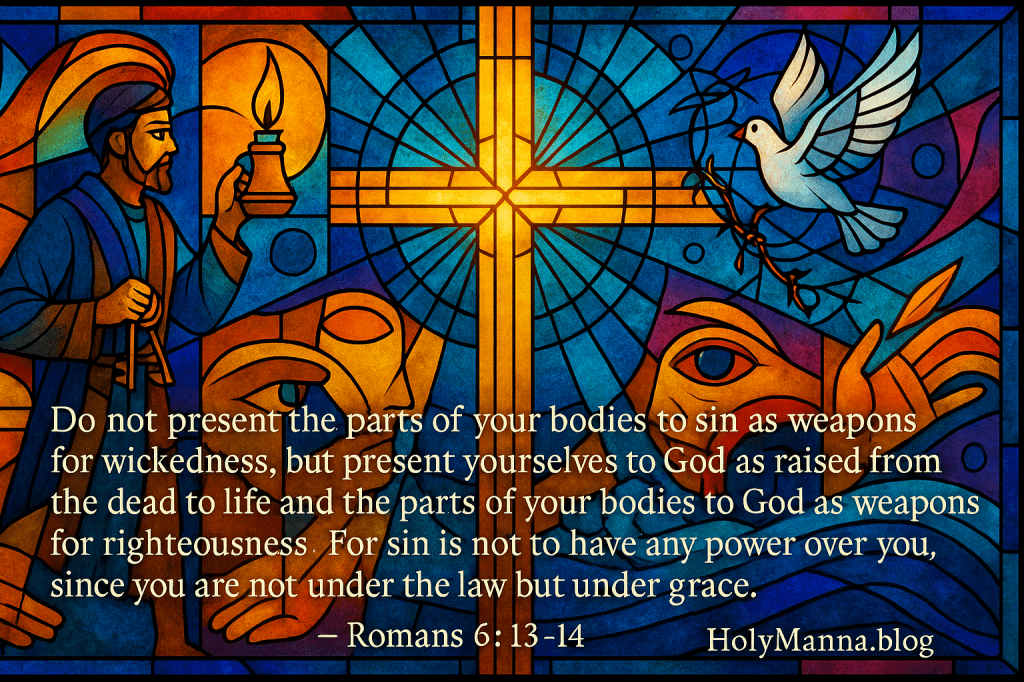
12 Therefore, sin must not reign over your mortal bodies so that you obey their desires. 13 And do not present the parts of your bodies to sin as weapons for wickedness, but present yourselves to God as raised from the dead to life and the parts of your bodies to God as weapons for righteousness. 14 For sin is not to have any power over you, since you are not under the law but under grace.
15 What then? Shall we sin because we are not under the law but under grace? Of course not! 16 Do you not know that if you present yourselves to someone as obedient slaves, you are slaves of the one you obey, either of sin, which leads to death, or of obedience, which leads to righteousness? 17 But thanks be to God that, although you were once slaves of sin, you have become obedient from the heart to the pattern of teaching to which you were entrusted. 18 Freed from sin, you have become slaves of righteousness.
Detailed Exegesis
Verse 12 – “Therefore, sin must not reign over your mortal bodies so that you obey their desires.”
Paul names a struggle every disciple recognizes. The body is mortal and vulnerable, yet it is also the very place where grace teaches the heart to say no to ruling passions. The verb “reign” underscores a question of lordship. In baptism Christ becomes Lord, which means sinful impulses no longer hold rightful authority.
Verse 13 – “And do not present the parts of your bodies to sin as weapons for wickedness, but present yourselves to God as raised from the dead to life and the parts of your bodies to God as weapons for righteousness.”
“Present” evoked temple offering and daily allegiance in the ancient world. The phrase “weapons for wickedness” is vivid because our faculties do not remain neutral. They are either commandeered by sin or consecrated for God. The baptized are “raised,” therefore hands, eyes, tongue, and imagination should become tools for justice, mercy, and truth.
Verse 14 – “For sin is not to have any power over you, since you are not under the law but under grace.”
This is not antinomianism. It is the announcement that grace gives what law can only command. Under grace, the Spirit writes the law on the heart and supplies power for obedience. The shift of regime means a shift of resources. Freedom is no longer a fragile project of willpower. It is a gift received and cooperated with.
Verse 15 – “What then? Shall we sin because we are not under the law but under grace? Of course not!”
Paul cuts off a perennial temptation to cheap grace. Divine mercy never licenses complacency. The logic of love is gratitude and growth. Grace is not an excuse. Grace is fuel.
Verse 16 – “Do you not know that if you present yourselves to someone as obedient slaves, you are slaves of the one you obey, either of sin, which leads to death, or of obedience, which leads to righteousness?”
In first century Rome, obedience defined one’s master. Paul presses the household image further. Neutrality is a myth. If the heart obeys sin, the path bends toward death. If the heart obeys God, the life of righteousness takes shape. This is moral clarity that protects true freedom.
Verse 17 – “But thanks be to God that, although you were once slaves of sin, you have become obedient from the heart to the pattern of teaching to which you were entrusted.”
The Gospel forms a “pattern,” a recognizable shape of life handed on in the Church’s catechesis and liturgy. Obedience “from the heart” signals interior conversion, not mere external compliance. Gratitude to God stays at the center, because this transformation is His work.
Verse 18 – “Freed from sin, you have become slaves of righteousness.”
This is the paradox of Christian liberty. The disciple is most free when bound to the Good. Service to righteousness is not bondage. It is delivered life. The will rests under a new lordship that heals, elevates, and deploys every capacity for love.
Teachings
Paul’s claim rests on the Church’s doctrine of grace and freedom. The Catechism states plainly: “Our justification comes from the grace of God. Grace is favor, the free and undeserved help that God gives us to respond to his call to become children of God, adoptive sons, partakers of the divine nature and of eternal life.” (CCC 1996). True freedom flowers under this grace: “Freedom is the power, rooted in reason and will, to act or not to act, to do this or that, and so to perform deliberate actions on one’s own responsibility.” (CCC 1731). The moral outcome of grace-filled obedience is deeper liberty: “The more one does what is good, the freer one becomes. There is no true freedom except in the service of what is good and just.” (CCC 1733). Prudence then tutors vigilance so that members of the body are used rightly: “Prudence is the virtue that disposes practical reason to discern our true good in every circumstance and to choose the right means of achieving it.” (CCC 1806). The baptismal root of this passage remains essential: “Baptism not only purifies from all sins, but also makes the neophyte ‘a new creature,’ an adopted son of God, who has become a ‘partaker of the divine nature,’ member of Christ and co-heir with him, and a temple of the Holy Spirit.” (CCC 1265). The saints echo Paul’s union of grace and cooperation. Saint Augustine teaches the synergy without confusion: “He who created you without you will not justify you without you.” Saint Josemaría Escrivá applies the “members as instruments” theme to daily stewardship: “Either we learn to find our Lord in ordinary, everyday life, or else we shall never find Him.”
Reflection
Grace is not a distant concept. It is a training ground for the body and a new allegiance for the heart. Habits that once felt inevitable begin to loosen when the day starts with a clear offering of mind, eyes, speech, and hands to God. Concrete steps help. A brief morning prayer of self-offering sets intention. Small acts of fasting teach desire to wait on God. Frequent confession breaks the snare and renews resolve. Intentional works of mercy turn faculties into instruments of love. Accountability with a trusted friend or spiritual guide keeps vigilance steady when emotions fade. Where is sin still trying to reign today, and what simple practice will shift allegiance toward Christ? Which member of the body needs a new assignment this week, and how can that faculty become a humble tool for righteousness? How will gratitude for deliverance become faithful stewardship in the ordinary work that lies ahead today?
Responsorial Psalm – Psalm 124
If the Lord Had Not Been With Us
Pilgrims once climbed the road to Jerusalem singing the Songs of Ascents, and Psalm 124 likely rang out as feet met stone and hearts recalled the mercy of God. The psalm’s imagery of raging enemies, crushing floodwaters, and a broken snare speaks to Israel’s lived memory of deliverance, whether from human foes or from the chaos that threatened covenant life. This memory does more than comfort. It forms a community that lives gratefully and faithfully under God’s protection. Within today’s theme of grace and vigilance, the psalm anchors the heart in what God has already done so that stewardship in the present becomes possible. The Church prays this psalm as a confession of dependence and a call to responsible praise. The refrain “Our help is in the name of the Lord” becomes a way of life that keeps hands ready for service and eyes alert for the Master’s return.
Psalm 124
New American Bible (Revised Edition)
God, the Rescuer of the People
1 A song of ascents. Of David.
Had not the Lord been with us,
let Israel say,
2 Had not the Lord been with us,
when people rose against us,
3 Then they would have swallowed us alive,
for their fury blazed against us.
4 Then the waters would have engulfed us,
the torrent overwhelmed us;
5 then seething water would have drowned us.
6 Blessed is the Lord, who did not leave us
to be torn by their teeth.
7 We escaped with our lives like a bird
from the fowler’s snare;
the snare was broken,
and we escaped.
8 Our help is in the name of the Lord,
the maker of heaven and earth.
Detailed Exegesis
Verse 1 – “A song of ascents. Of David. Had not the Lord been with us, let Israel say,”
The superscription situates the psalm within the pilgrim hymnal and attributes it to David’s tradition. The opening invites the entire people to testify. Salvation is never merely private. Communal memory strengthens communal fidelity and keeps the heart from pride.
Verse 2 – “Had not the Lord been with us, when people rose against us,”
The repetition underlines dependence. Human opposition is real, but the decisive factor is the Lord’s presence. This shapes a habit of attribution, where victory is credited to divine help rather than to human cleverness.
Verse 3 – “Then they would have swallowed us alive, for their fury blazed against us.”
The image of being swallowed evokes ancient Near Eastern chaos monsters and the terrifying experience of total defeat. The psalm teaches realism about enemies without surrendering to fear. God’s intervention breaks the cycle of violence.
Verse 4 – “Then the waters would have engulfed us, the torrent overwhelmed us;”
Flood imagery recalls both creation and the exodus, where God set boundaries to the waters and made a way through the sea. The psalm links personal and communal trials to the larger story of salvation history.
Verse 5 – “then seething water would have drowned us.”
The intensification from engulfing to drowning shows how close destruction came. Gratitude grows when the memory of peril is honest. The people did not barely need God. They utterly needed God.
Verse 6 – “Blessed is the Lord, who did not leave us to be torn by their teeth.”
Praise interrupts fear. The metaphor shifts to a predator’s jaws, underscoring how deliverance was not luck but Divine decision. Blessing the Lord becomes the right response to undeserved rescue.
Verse 7 – “We escaped with our lives like a bird from the fowler’s snare; the snare was broken, and we escaped.”
The fowler’s trap is hidden and sudden, like temptations and systemic evils that ensnare without warning. The decisive detail is not the bird’s skill but the broken snare. Salvation is God’s act that frees for obedient living.
Verse 8 – “Our help is in the name of the Lord, the maker of heaven and earth.”
The psalm ends with confession and creed. To invoke the Lord’s Name is to trust the Creator who holds all things in being. Dependence becomes mission, because those helped by God are sent to act as faithful stewards under His care.
Teachings
The Church understands this psalm as a school of praise and trust. The Catechism teaches: “Praise is the form of prayer which recognizes most immediately that God is God: it lauds God for his own sake and gives him glory, quite beyond what he does, but simply because HE IS.” (CCC 2639). Adoration grounds this praise in humility: “To adore God is to acknowledge, in respect and absolute submission, the ‘nothingness of the creature’ who would not exist but for God.” (CCC 2097). The closing verse confesses the Creator’s sovereignty that sustains providence: “The witness of Scripture is unanimous that the solicitude of divine providence is concrete and immediate; God cares for all, from the least things to the great events of the world and its history.” (CCC 303). The psalm’s cry, “Our help is in the name of the Lord,” finds its fullness in the revelation of the Holy Name given in the Incarnation: “‘Jesus’ means in Hebrew: ‘God saves.’ At the annunciation, the angel gave him the name Jesus as his proper name, which expresses both his identity and his mission.” (CCC 430). Saints echo this logic of remembered rescue that leads to responsible living. Saint Thérèse of Lisieux captures the heart of grateful dependence: “Everything is grace.” From Israel’s ascent to the Temple to the Church’s ascent to the altar, this psalm trains believers to attribute every escape to God and to offer every breath back to Him in service.
Reflection
Gratitude becomes a guardrail when memory is honest. The psalm invites a concrete practice of recounting past deliverance and letting that memory shape present choices. A few minutes of prayer that names where God has broken the snare can reframe the day’s work from self-reliance to stewardship. Acts of praise throughout the day, even a whispered “Our help is in the name of the Lord”, can interrupt fear and reopen trust. Intentional thanksgiving at meals or at day’s end can turn victories into service rather than self-congratulation. Choosing one area of hidden temptation and asking for the Lord to break the snare again keeps the heart humble and ready. Where has the Lord already shattered a trap, and how will that memory change the way responsibilities are carried today? What practical way of praise will keep trust alive during pressure or criticism? How will the confession that help comes from the Maker shape decisions about time, money, and relationships this week?
Holy Gospel – Luke 12:39–48
Faithful and Prudent
Jesus speaks in the context of everyday first century life, where a household steward managed provisions, timing, and people under the absent master’s authority. In a world without modern locks or lighting, night watches required real vigilance. The Lord uses that familiar scene to form disciples who live as responsible servants under grace. This Gospel stands inside the Church’s living memory that the Son of Man will come at an hour not expected, and that accountability is not a threat but the sober joy of belonging to a Master who trusts His servants. Within today’s theme, this passage shows how remembered rescue matures into responsible readiness. Those set free from sin are meant to be found working, distributing at the proper time, and treating others justly under the Master’s eye.
Luke 12:39-48
New American Bible (Revised Edition)
39 Be sure of this: if the master of the house had known the hour when the thief was coming, he would not have let his house be broken into. 40 You also must be prepared, for at an hour you do not expect, the Son of Man will come.”
41 Then Peter said, “Lord, is this parable meant for us or for everyone?” 42 And the Lord replied, “Who, then, is the faithful and prudent steward whom the master will put in charge of his servants to distribute [the] food allowance at the proper time? 43 Blessed is that servant whom his master on arrival finds doing so. 44 Truly, I say to you, he will put him in charge of all his property. 45 But if that servant says to himself, ‘My master is delayed in coming,’ and begins to beat the menservants and the maidservants, to eat and drink and get drunk, 46 then that servant’s master will come on an unexpected day and at an unknown hour and will punish him severely and assign him a place with the unfaithful. 47 That servant who knew his master’s will but did not make preparations nor act in accord with his will shall be beaten severely; 48 and the servant who was ignorant of his master’s will but acted in a way deserving of a severe beating shall be beaten only lightly. Much will be required of the person entrusted with much, and still more will be demanded of the person entrusted with more.
Detailed Exegesis
Verse 39 – “Be sure of this: if the master of the house had known the hour when the thief was coming, he would not have let his house be broken into.”
Jesus begins with a common sense image. A known threat changes behavior. The point is not to paint God as a thief but to stress the unpredictability of the decisive hour. Spiritual wakefulness is practical, not paranoid. It guards what truly belongs to the Lord.
Verse 40 – “You also must be prepared, for at an hour you do not expect, the Son of Man will come.”
The teaching shifts from analogy to command. Preparedness is the disciple’s normal posture. The title “Son of Man” echoes Daniel’s vision and signals both humility and hidden majesty. Expectancy converts time itself into an offering.
Verse 41 – “Then Peter said, ‘Lord, is this parable meant for us or for everyone?’”
Peter voices the community’s question about responsibility. Leadership in the Church carries privilege and weight. The question invites a clearer word for those charged with care.
Verse 42 – “And the Lord replied, ‘Who, then, is the faithful and prudent steward whom the master will put in charge of his servants to distribute [the] food allowance at the proper time?’”
Faithfulness and prudence are paired. The steward’s task is concrete: timely distribution of what sustains life. Stewardship is not vague spirituality. It is measured love that gives others what they need when they need it.
Verse 43 – “Blessed is that servant whom his master on arrival finds doing so.”
Blessing falls on steady obedience rather than on dramatic gestures. The Lord looks for servants simply found at their posts. The everyday becomes the site of beatitude.
Verse 44 – “Truly, I say to you, he will put him in charge of all his property.”
Greater trust follows proven fidelity. The reward is more responsibility in the Master’s domain. Authority in the Kingdom is participation in the Lord’s care, not exemption from service.
Verse 45 – “But if that servant says to himself, ‘My master is delayed in coming,’ and begins to beat the menservants and the maidservants, to eat and drink and get drunk,”
Presumed delay exposes the heart. Neglect of the Master breeds violence and self-indulgence. Abuse of persons and misuse of goods travel together when vigilance fades.
Verse 46 – “then that servant’s master will come on an unexpected day and at an unknown hour and will punish him severely and assign him a place with the unfaithful.”
Judgment arrives without timetable. The language is severe because injustice toward those in one’s charge desecrates the Master’s household. To live as if the Master never returns is to drift outside the circle of fidelity.
Verse 47 – “That servant who knew his master’s will but did not make preparations nor act in accord with his will shall be beaten severely;”
Knowledge heightens responsibility. Negligence in the face of clarity is not a minor fault. The Gospel insists that grace does not erase accountability. It deepens it.
Verse 48 – “and the servant who was ignorant of his master’s will but acted in a way deserving of a severe beating shall be beaten only lightly. Much will be required of the person entrusted with much, and still more will be demanded of the person entrusted with more.”
Ignorance mitigates but does not absolve. The maxim that closes the passage names the law of stewardship. Gifts, roles, resources, and revelation all come with proportionate demands. The Master’s trust is an honor that calls forth wholehearted service.
Teachings
The Church reads this Gospel through the lens of grace, freedom, judgment, and stewardship. The Catechism teaches the reality and purpose of the Last Judgment: “The Last Judgment will come when Christ returns in glory.” (CCC 1040). This truth does not paralyze. It calls to conversion and responsible love: “The more one does what is good, the freer one becomes. There is no true freedom except in the service of what is good and just.” (CCC 1733). Prudence shapes faithful stewardship in real time: “Prudence is the virtue that disposes practical reason to discern our true good in every circumstance and to choose the right means of achieving it.” (CCC 1806). What the steward manages never ceases to belong to God, so accountability extends to people and property alike: “In his use of things man should regard the external goods he legitimately owns not merely as exclusive to himself but common to others also, in the sense that they can benefit others as well. The ownership of any property makes its holder a steward of Providence, with the task of making it fruitful and communicating its benefits to others, first of all his family.” (CCC 2404). The saints underline vigilant cooperation with grace. Saint Augustine names the synergy of mercy and responsibility: “He who created you without you will not justify you without you.” Saint John Chrysostom warns pastors and all leaders against neglect masked as delay: “The higher the honor, the greater the danger if vigilance sleeps.” In the early Church, this passage shaped a culture where bishops, presbyters, deacons, and household heads were measured by fidelity to those in their care, especially in times of persecution or plague when the temptation to self-preservation was strong.
Reflection
Vigilance is not nervousness. It is love that keeps showing up. The steward’s life translates easily into ordinary routines where others depend on steady care. A simple plan that names who has been entrusted to one’s oversight clarifies where to be found at the post. A weekly examen that asks how time, money, and words were distributed keeps the heart honest about the Master’s priorities. Regular confession restores readiness when delay has bred harshness or self-indulgence. Intentional acts of justice and mercy at home, at work, and in the parish train prudence to give others what they truly need at the proper time. A short prayer at the start of the day that offers responsibilities to the Lord helps align tasks with His will. Where has presumed delay made vigilance grow cold, and what concrete change today will put the steward back at the post? Who has been entrusted to one’s care this week, and what timely provision will help them thrive? If the Master came this evening, how would He find the distribution of time, attention, and resources, and what adjustment would bring that distribution into faithful order?
From Rescue to Readiness: Living the Stewardship of Grace
Today’s Word forms a single movement from deliverance to duty. In Romans 6:12–18, grace breaks the old mastery of sin so the body can become an instrument of righteousness, and the heart can learn true freedom under a new Lord. Psalm 124 teaches the sound of grateful memory, because “Our help is in the name of the Lord”, and the broken snare becomes the reason for humble praise and steady faith. In Luke 12:39–48, the Master’s return reframes ordinary tasks with eternal weight, and the faithful steward is blessed when found distributing what sustains life at the proper time. Together these readings announce that salvation is a gift and a summons. Rescue gives rise to responsibility, and responsibility matures into watchful love.
This grace is not abstract. It retrains desire, reorders habits, and sends believers back into households, workplaces, and parishes as prudent stewards. The same Lord who breaks the trap entrusts real people and real resources to real care. The Gospel promise is clear and bracing: “You also must be prepared.” The Gospel warning is equally clear: “Much will be required of the person entrusted with much.” Freedom deepens when it serves the good, and joy grows where faithfulness is found at the post.
Here is the invitation. Begin the day with an offering of mind, eyes, speech, and hands to God. Choose one act of mercy that gives someone what they truly need at the proper time. Practice a brief nightly examen that asks how time, attention, and resources were distributed, then receive the Lord’s mercy wherever vigilance slipped. Keep the psalm’s confession close on the lips throughout the day, because “Our help is in the name of the Lord”, and grateful dependence fuels courageous service.
What concrete step today will shift allegiance from old desires to Christ’s righteousness? Who has been entrusted to your care right now, and how can timely love help them flourish? If the Master arrived this evening, would He find a steward awake and at work, and what one change would make that answer a confident yes?
Engage with Us!
Share your reflections in the comments below. Your insights help build a community that remembers God’s rescue, embraces real responsibility, and keeps watch with hope.
- Romans 6:12–18: Where is sin still trying to reign in your habits, and what concrete practice today will place your body at the service of righteousness? How does living “under grace” reshape your plans, your tone of voice, and your use of time? What would it look like this week to become, in Paul’s words, “slaves of righteousness”, in a way that is free, joyful, and fruitful?
- Psalm 124: Which “broken snares” from your past reveal the Lord’s rescue, and how can that memory fuel gratitude and steady obedience today? When fear rises, how will the confession “Our help is in the name of the Lord” become your first response rather than your last resort? How can praise at regular moments of the day reshape the way you carry responsibility for the people entrusted to you?
- Luke 12:39–48: If the Master arrived this evening, where would He find you at your post, and what one change would make that posture more faithful and more prepared? Who specifically has been entrusted to your care right now, and what timely provision would help them flourish today? How do the words “You also must be prepared” and “Much will be required” guide your stewardship of attention, money, and influence this week?
May the Lord strengthen every step as you live a life of faith, offer daily work with love, and do everything with the mercy Jesus taught us.
Sacred Heart of Jesus, we trust in You!
Immaculate Heart of Mary, pray for us!
Saint Michael the Archangel, defend us in battle!
Follow us on Instagram and Facebook for more insights and reflections on living a faith-filled life.

 Holy Manna!
Leave a comment