Fire in His Veins
Saint Gaspare del Bufalo, born in Rome in 1786 and canonized in 1954, set Italy on fire with love for Jesus Christ through a bold devotion to the Precious Blood. He founded the Missionaries of the Precious Blood, renewed shattered communities after the Napoleonic turmoil, and reconciled enemies through preaching, confession, and works of mercy. His whole life can be summed up in the words he spoke when ordered to betray the Church’s freedom: “Non deboo, non posso, non voglio.” (I must not, I cannot, I will not). He refused to take the oath to Napoleon, and that refusal cost him freedom and comfort, yet it opened the floodgates of grace for countless souls who encountered Christ through his missions.
Born Under the Star
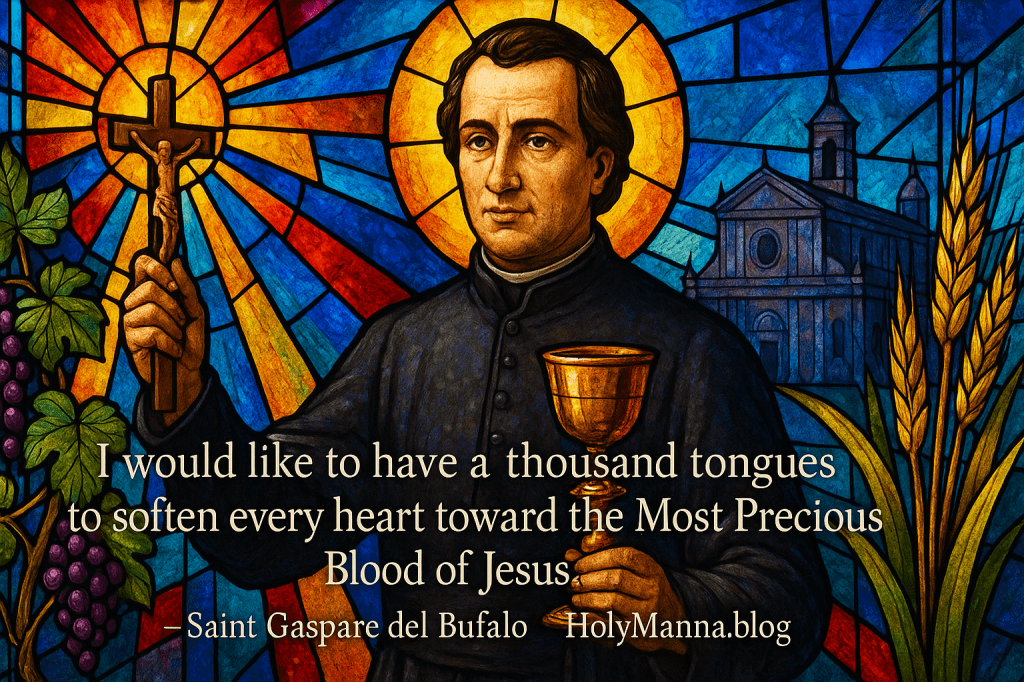
Gaspare Melchior Balthazar del Bufalo entered the world on Epiphany, January 6, 1786, a day that stamped his identity with missionary meaning. Childhood illness nearly blinded him, and his healing, asked through the intercession of St. Francis Xavier, planted in him a lifelong missionary ardor. As a teenager he taught catechism to children and the poor, and as a young priest he poured himself out in hospitals and shelters, especially at the Santa Galla Hospice in Rome, where he cared for men without homes and without hope. Ordained in 1808, he matured quickly in a crucible of trial. Napoleon’s regime demanded an oath that would sever his allegiance to the Pope. Gaspare chose fidelity to Christ and His Church. Imprisonment followed, then exile, then a return to Rome with a heart sharpened for mission. Guided by Canon Francesco Albertini and the Archconfraternity of the Most Precious Blood, he discerned his life’s work. On August 15, 1815, at San Felice in Giano, he founded a new community dedicated to preaching the power of Christ’s Blood. He longed to awaken every heart to that gift and once exclaimed, “I would like to have a thousand tongues to soften every heart toward the Most Precious Blood of Jesus.”
Missions That Mended Towns
Gaspare spent himself on the road, often preaching several times a day. He centered his missions on the Eucharist, reconciliation, and a tender invitation to conversion. Confession lines swelled, marriages were healed, and enemies forgave each other. He ventured into towns torn by brigandage and vendetta, places like Sonnino and surrounding regions that had become symbols of lawlessness. He entered with the Gospel of mercy, not with force, and men laid down their weapons. People called him the Apostle of the Precious Blood, and others called him the hammer of the brigands, not because he condemned, but because grace shattered chains of sin and fear. Accounts from his missions record remarkable healings and extraordinary answers to prayer, including moments when the simple obedience of going to pray led to sudden restoration of health. He formed mission houses as spiritual field hospitals and inspired collaborators who later helped St. Maria De Mattias found the Adorers of the Blood of Christ, extending the same charism of redemption to girls and women through education, prayer, and works of mercy.
From Prison Cells to Cholera Wards
For refusing the oath, Gaspare endured years of confinement that undermined his health. He also tasted the bitterness of misunderstanding, at times from civil authorities who profited from violence, and at times from within the Church. He answered slander with silence, restriction with obedience, and opposition with patience. In 1837, cholera struck Rome. Weary, often ill, and urged by friends to spare himself, he returned to the city to hear confessions and anoint the dying. He poured out the last drops of strength at the bedsides of the sick and died on December 28, 1837. His body rests at Santa Maria in Trivio near the Trevi Fountain. The manner of his death completes the testimony of his life. He preached the Precious Blood as our ransom, and he lived that truth by spending himself for souls until the final hour.
The Stream That Keeps Flowing
After Gaspare’s death, the Church investigated many graces attributed to his intercession. The causes for his beatification and canonization highlighted healings that defied medical explanation and conversions that bore the unmistakable stamp of divine mercy. Pilgrims continue to visit his tomb in Rome and the founding sites of his congregation, thanking God for favors received and asking for courage to preach Christ with lives of humble service. Within his spiritual family, stories of answered prayers are told with gratitude, not as spectacles, but as signs that the Blood of Christ still cleanses hearts and restores hope.
A Living Catechism
What Gaspare preached is nothing other than the Church’s faith. The Catechism of the Catholic Church teaches that our justification springs from Calvary, where Christ poured out His Blood for us. “Justification has been merited for us by the Passion of Christ who offered himself on the cross as a living victim, holy and pleasing to God, and whose blood has become the instrument of atonement for the sins of all men.” It also attests that the ordinary path back to grace after grave sin is the Sacrament of Penance. “The whole power of the sacrament of Penance consists in restoring us to God’s grace and joining us with him in an intimate friendship.” And it defines the works of mercy as the concrete shape of Christian love. “The works of mercy are charitable actions by which we come to the aid of our neighbor in his spiritual and bodily necessities.” Gaspare’s missions were a living catechism. He preached Christ crucified, sent people to confession, reconciled enemies, and organized practical charity. His spirituality flows from the altar into the streets, from adoration to reconciliation, from contemplation to service.
Walk the Road With Him
Saint Gaspare teaches us that cultures are healed when hearts are healed. If resentment or secret sin has hardened your heart, let the Precious Blood wash it in confession. If fear of the future steals your peace, bring that fear to Jesus in Eucharistic adoration and ask for courage to forgive and to begin again. Choose one concrete work of mercy this week. Visit someone who is lonely, reconcile with a family member, or give patient attention to a person who drains your energy. Ask Jesus to let one drop of His Blood fall upon your memory, your imagination, and your will, so that every thought, word, and decision bears the fragrance of redemption. Let your home become a mission house where forgiveness is practiced and the poor are welcomed. In this way you will imitate Saint Gaspare, who preached with words and proved those words with a life poured out in love.
Engage with Us!
I would love to hear how Saint Gaspare’s life speaks to you. Share your thoughts and your own stories of reconciliation in the comments.
- Where is Jesus inviting you to lay down a “weapon,” whether resentment, fear, or a sinful habit, and return to Him through Confession?
- Which work of mercy can you commit to this week for someone on the margins of your life?
- How does devotion to the Precious Blood deepen your understanding of the Eucharist and of Christ’s love for you personally?
Go in confidence. Live a life of faith, and do everything with the love and mercy Jesus taught us.
Saint Gaspare del Bufalo, pray for us!
Follow us on Instagram and Facebook for more insights and reflections on living a faith-filled life.

 Holy Manna!
Leave a comment