Tuesday of the Twenty-ninth Week in Ordinary Time – Lectionary: 474
Lamps Lit by Overflowing Grace
Grace does not trickle. It rushes in like light at dawn, healing what sin has darkened and teaching the heart to stay awake. Today’s readings unveil one movement of salvation: Christ’s superabundant grace reshapes us interiorly so that we live as joyful, vigilant servants.
In Romans 5:12, 15, 17–21, Saint Paul writes to a mixed Jewish and Gentile community in first-century Rome, contrasting Adam’s fall with Christ’s obedience. He proclaims that “where sin increased, grace overflowed all the more” so that grace would reign through justification and lead to eternal life. The Church summarizes this Adam–Christ parallel by teaching that all are implicated in Adam and all are offered new life in Christ, a truth at the heart of original sin and redemption in The Catechism (CCC 402–405; 1996–2001). This is not a mere legal shift. It is a new dominion of grace that equips us to love God’s will.
That interior transformation is the song of Psalm 40:7–10, 17. The psalmist discovers that God desires not external offerings alone but the heart that says, “I delight to do your will, my God; your law is in my inner being!” In Israel’s worship, sacrifices taught repentance and trust, yet the prophets and wisdom tradition consistently pointed to obedience from the heart as the true sacrifice. The Christian tradition reads this psalm in a Christ-centered key, seeing in it the obedience of the Son who fulfills the Father’s will and draws us into that same filial yes.
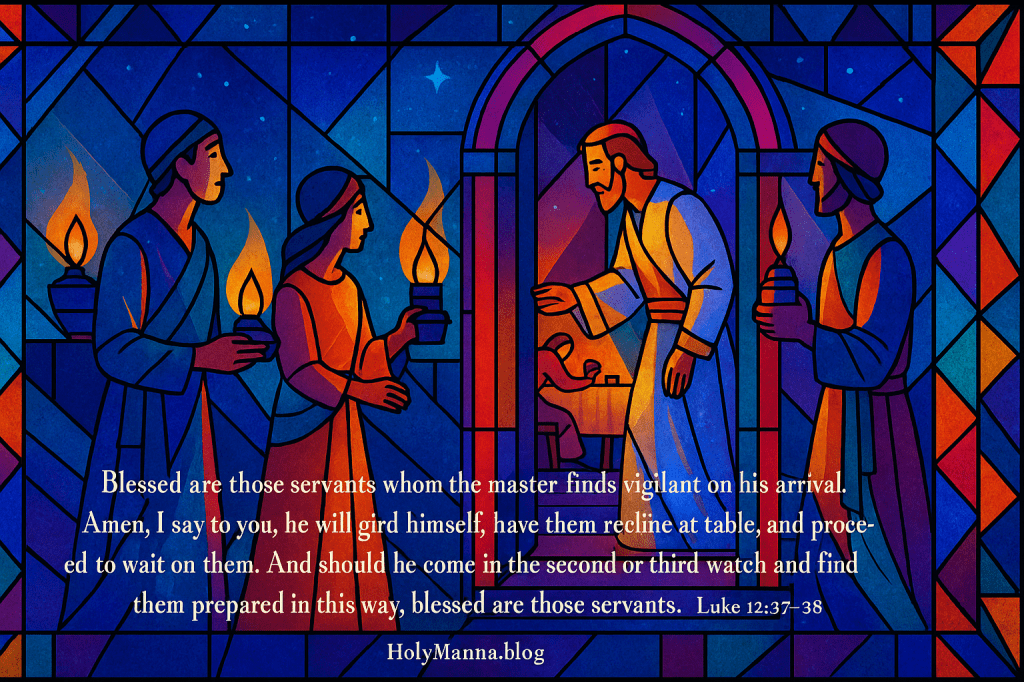
Finally, Luke 12:35–38 turns grace and interior obedience into a posture of daily readiness. Jesus speaks in the cultural language of the household: servants with tunics tucked up for service, lamps trimmed, and eyes fixed on the doorway. To “Gird your loins and light your lamps” evokes Passover vigilance and practical preparedness in a world without streetlights. When He mentions the second or third watch, He is naming the deep hours of the night in Jewish reckoning, when drowsiness is strongest and fidelity is tested. Astonishingly, the Master promises to return and serve the servants Himself, revealing the humility of God and the banquet of the Kingdom awaiting the watchful.
Taken together, these texts teach one theme: overflowing grace in Christ births interior obedience, and interior obedience blossoms into vigilant love. We are not merely avoiding sin. We are welcoming a Lord who comes at an unexpected hour and who longs to seat us at His table. What would it look like today to let grace move from your mind to your will, and from your will to a lamp that stays lit until He knocks?
First Reading – Romans 5:12, 15, 17–21
From One Man’s Fall to Christ’s Flood of Grace
Paul writes to the Christian community in first century Rome, where Jewish and Gentile believers wrestled with questions about the Law, sin, and salvation. In this section of Romans, he frames salvation history through a sweeping comparison between Adam and Christ. Adam’s disobedience ushers in sin and death as a reigning power. Christ’s obedience ushers in a new reign, where grace and justification lead to life. This Adam–Christ typology was central to the early Church’s proclamation and remains foundational in Catholic doctrine about original sin and redemption. Within today’s theme of overflowing grace that becomes obedient, watchful love, this reading supplies the fountainhead: grace does not merely counterbalance sin. It surpasses it. The result is not moral minimalism but transformed hearts ready to live in the light, prepared for the Lord who comes.
Romans 5:12, 15, 17-21
New American Bible (Revised Edition)
Humanity’s Sin Through Adam. 12 Therefore, just as through one person sin entered the world, and through sin, death, and thus death came to all, inasmuch as all sinned
Grace and Life Through Christ. 15 But the gift is not like the transgression. For if by that one person’s transgression the many died, how much more did the grace of God and the gracious gift of the one person Jesus Christ overflow for the many.
17 For if, by the transgression of one person, death came to reign through that one, how much more will those who receive the abundance of grace and of the gift of justification come to reign in life through the one person Jesus Christ. 18 In conclusion, just as through one transgression condemnation came upon all, so through one righteous act acquittal and life came to all. 19 For just as through the disobedience of one person the many were made sinners, so through the obedience of one the many will be made righteous. 20 The law entered in so that transgression might increase but, where sin increased, grace overflowed all the more, 21 so that, as sin reigned in death, grace also might reign through justification for eternal life through Jesus Christ our Lord.
Detailed Exegesis
Verse 12 – “Therefore, just as through one person sin entered the world, and through sin, death, and thus death came to all, inasmuch as all sinned”
Paul opens a universal horizon. Through Adam’s personal act, sin becomes a power that fractures human nature and introduces death into human experience. The phrase “all sinned” indicates solidarity in Adam and personal complicity. Catholic teaching holds both together without collapsing one into the other: we inherit a wounded nature inclined toward sin, and we also freely ratify sin in our choices. Paul’s “just as” begins a comparison that will be resolved in Christ, where the story does not end in death but in superabundant life.
Verse 15 – “But the gift is not like the transgression. For if by that one person’s transgression the many died, how much more did the grace of God and the gracious gift of the one person Jesus Christ overflow for the many.”
Paul insists on the “how much more.” Grace is not a mirror image of sin. It is greater in kind and in effect. The “gift” is the crucified and risen Christ himself and the saving life he pours out. The language of “overflow” evokes a lavish, kingly generosity that does not simply restore a balance but inaugurates a new creation.
Verse 17 – “For if, by the transgression of one person, death came to reign through that one, how much more will those who receive the abundance of grace and of the gift of justification come to reign in life through the one person Jesus Christ.”
Two reigns are contrasted: death through Adam and life through Christ. To “receive” the abundance of grace is to be drawn into Christ’s own life, justified and empowered to live as sons and daughters. “Reign in life” points beyond acquittal to participation, the sharing of Christ’s victorious life here and now, anticipatory of eternal glory.
Verse 18 – “In conclusion, just as through one transgression condemnation came upon all, so through one righteous act acquittal and life came to all.”
Paul tightens the parallel: one act to one act. Adam’s transgression yields condemnation. Christ’s obedient “righteous act,” culminating in the Cross, yields justification and life. The universality of the offer is affirmed. Salvation is genuinely proffered to all, even as it must be freely welcomed.
Verse 19 – “For just as through the disobedience of one person the many were made sinners, so through the obedience of one the many will be made righteous.”
Here Paul names the inner core of the contrast: disobedience versus obedience. Christ’s obedience is filial, loving, and total. By union with him, believers are not only declared righteous but are being made righteous, re-formed in the image of the Son who says, “Father, your will be done.”
Verse 20 – “The law entered in so that transgression might increase but, where sin increased, grace overflowed all the more,”
The Mosaic Law reveals sin by shining a light on it. In that sense transgression “increases” as the Law names and exposes it. Yet this disclosure serves mercy, because it positions us to receive the greater thing. Grace does not run out at the sight of multiplied sin. It multiplies its own triumph.
Verse 21 – “so that, as sin reigned in death, grace also might reign through justification for eternal life through Jesus Christ our Lord.”
Paul concludes with royal language. Sin once reigned, enthroned by death. Now grace reigns, enthroned through justification, leading to eternal life. The last word in the story is not Adam’s fall but Jesus Christ our Lord. Under his lordship we live a new obedience that is watchful, hopeful, and free.
Teachings
Paul’s teaching here is the backbone of Catholic doctrine on original sin and the primacy of grace. The Catechism clarifies both our solidarity in Adam and our deliverance in Christ. It teaches: “Original sin does not have the character of a personal fault in any of Adam’s descendants.” CCC 405. It also defines grace with luminous simplicity: “Grace is favor, the free and undeserved help that God gives us to respond to his call to become children of God.” CCC 1996. The grace given in justification is nothing less than God’s own life in us: “It is the sanctifying or deifying grace received in Baptism.” CCC 1999.
The tradition echoes Paul’s “how much more.” Saint Thomas Aquinas writes, “Grace does not destroy nature but perfects it.” Summa Theologiae I, q.1, a.8, ad 2. Saint Augustine contemplates divine providence in the face of Adam’s fall and concludes, “God judged it better to bring good out of evil than to allow no evil to exist.” Enchiridion 27. These voices underline that Christ’s obedience does more than cancel Adam’s loss. It elevates and heals us so that grace may reign in real lives, here and now.
Reflection
This reading invites you to live under a new reign. You are not condemned to be managed by old patterns. You are invited to receive an “abundance of grace” that makes obedience possible and joyful. Begin your day by naming where sin has seemed to reign. Ask for the specific grace to let Christ’s life reign there instead. Throughout the day, pause to whisper a simple prayer of surrender that places your will under his lordship. End your day with a brief examen that notices where grace overflowed and where you resisted it, then ask for deeper docility tomorrow. Where do you sense the Lord calling you to receive rather than strive? What one act of concrete obedience can you offer today as a response to grace? How might you keep your interior lamp lit so that, when he knocks, you open at once?
Responsorial Psalm – Psalm 40:7–10, 17
The True Sacrifice
Psalm 40 comes from Israel’s worship life where sacrifices and offerings expressed repentance, thanksgiving, and covenant fidelity. Yet, like the prophets, the psalmist insists that the worship God desires most is the heart taught by grace to obey. In the light of Romans 5, this psalm shows how Christ’s overflowing grace moves from outside ritual into an interior yes. The psalm’s language of opened ears, an inscribed scroll, and delight in God’s will prepares us to hear Jesus’ call in Luke 12 to live watchfully with lamps lit. Grace reigns by shaping the heart, and a shaped heart becomes vigilant love.
Psalm 40:7-10, 17
New American Bible (Revised Edition)
7 Sacrifice and offering you do not want;
you opened my ears.
Holocaust and sin-offering you do not request;
8 so I said, “See; I come
with an inscribed scroll written upon me.
9 I delight to do your will, my God;
your law is in my inner being!”
10 When I sing of your righteousness
in a great assembly,
See, I do not restrain my lips;
as you, Lord, know.
17 While those who seek you
rejoice and be glad in you.
May those who long for your salvation
always say, “The Lord is great.”
Detailed Exegesis
Verse 7 – “Sacrifice and offering you do not want; you opened my ears. Holocaust and sin-offering you do not request;”
God is not rejecting Israel’s sacrificial system as such. He is revealing its purpose. The goal of worship is a listening heart. “You opened my ears” evokes covenantal obedience born of grace. The ears opened by God prefigure the new covenant promise that His law will be written within.
Verse 8 – “so I said, ‘See; I come with an inscribed scroll written upon me.’”
The “scroll” signals a life aligned with God’s revealed will. In Christian reading, this line points to Christ who perfectly embodies the Father’s plan. He is the Word in flesh, the living Torah, who comes not only with the scroll but as its fulfillment.
Verse 9 – “I delight to do your will, my God; your law is in my inner being!”
Delight is the signature of grace. Obedience is not forced compliance. It is filial joy. The law moves from stone tablets to the heart’s interior. This anticipates the new covenant gift where the Spirit inscribes the divine will within the baptized, making holiness possible and attractive.
Verse 10 – “When I sing of your righteousness in a great assembly, See, I do not restrain my lips; as you, Lord, know.”
Interior obedience becomes public witness. True worship turns outward in proclamation. The psalmist’s unrestrained praise models how grace refuses secrecy. The “great assembly” hints at ecclesial worship where God’s righteousness is confessed and celebrated.
Verse 17 – “While those who seek you rejoice and be glad in you. May those who long for your salvation always say, ‘The Lord is great.’”
Seeking becomes rejoicing. Desire for salvation blossoms into praise. The refrain “The Lord is great” is not flattery. It is the truthful naming of God’s saving action. In today’s theme, the heart transformed by grace keeps vigil with joy on its lips.
Teachings
This psalm stands at the meeting point of sacrifice and obedience. Scripture interprets Scripture when Hebrews 10:5–7 cites this psalm to reveal Christ’s perfect self-offering in place of repeated ritual: “Sacrifices and offerings you have not desired, but a body have you prepared for me; in burnt offerings and sin offerings you have taken no pleasure. Then I said, ‘Behold, I have come to do your will, O God.’” The Church teaches that interior surrender is the essence of true sacrifice fulfilled in Christ and shared with us in grace. The Catechism defines grace with luminous clarity: “Grace is favor, the free and undeserved help that God gives us to respond to his call to become children of God, adoptive sons, partakers of the divine nature and of eternal life.” CCC 1996. It also describes prayer as God’s initiative that opens our ears and hearts: “God calls man first. Man may forget his Creator or hide far from his face; he may run after idols or accuse the deity of having abandoned him; yet the living and true God tirelessly calls each person to that mysterious encounter known as prayer.” CCC 2567. Our free cooperation is real, but it is already grace at work: “God’s free initiative demands man’s free response.” CCC 2002.
The saints echo the psalm’s interiority. Saint Augustine confesses the restless human heart that learns to delight in God’s will: “You have made us for yourself, O Lord, and our heart is restless until it rests in you.” Confessions I,1. And the prophet declares the priority of obedience that the psalm celebrates: “To obey is better than sacrifice.” 1 Samuel 15:22. In Christ, obedience becomes worship, and worship becomes life.
Reflection
Let this psalm tutor your heart into joyful obedience. Begin your prayer by asking God to open your ears so that His word moves from the page to your interior. Throughout the day, choose one concrete act that aligns your will with His, and do it with delight rather than reluctance. End the day by proclaiming His greatness in simple words of praise, even if you feel tired. Where is God inviting you to replace empty routine with a listening heart? What practice today will help His law move from your lips to your inner being? How can your worship overflow into public witness that quietly says, “The Lord is great”?
Holy Gospel – Luke 12:35–38
Keep The Night Watch With Joy
In the world of Luke’s Gospel, Jesus speaks to disciples who lived by lamplight and watched the doorway of their master’s house through the long hours of the night. Wedding feasts in first century Judea could last several days, and a master might return at any hour. Servants kept their tunics tucked up for service and lamps trimmed so they could open the door at once. To “Gird your loins and light your lamps” evokes the memory of Israel’s Passover readiness in Exodus and points to the Church’s vigilant hope for the Lord’s coming. Within today’s theme of grace overflowing into obedient watchfulness, this Gospel shows what grace looks like when it becomes habit. It becomes readiness, joy, and love that serves at any hour. Astonishingly, Jesus promises that the Master will return and serve the servants. This reveals the humility of God and foreshadows the banquet of the Kingdom where grace brings the watchful into communion.
Luke 12:35-38
New American Bible (Revised Edition)
35 “Gird your loins and light your lamps 36 and be like servants who await their master’s return from a wedding, ready to open immediately when he comes and knocks. 37 Blessed are those servants whom the master finds vigilant on his arrival. Amen, I say to you, he will gird himself, have them recline at table, and proceed to wait on them. 38 And should he come in the second or third watch and find them prepared in this way, blessed are those servants.
Detailed Exegesis
Verse 35 – “Gird your loins and light your lamps”
Jesus commands a posture, not a moment. To gird one’s loins means tucking up the long garment to move freely and serve without delay. Lighting lamps signals vigilance in the dark. Grace does not lull the disciple into passivity. It awakens attentiveness. Obedient hearts become ready hands.
Verse 36 – “and be like servants who await their master’s return from a wedding, ready to open immediately when he comes and knocks.”
The domestic image makes discipleship concrete. The servants are not anxious. They are prepared. The wedding setting hints at joy, not dread. Opening immediately is the reflex of a heart already given to the Master. This readiness is the fruit of grace that has moved from belief to habit.
Verse 37 – “Blessed are those servants whom the master finds vigilant on his arrival. Amen, I say to you, he will gird himself, have them recline at table, and proceed to wait on them.”
Here is the great reversal. The master becomes the one who serves. Jesus discloses the heart of God who delights to serve those who have served in love. The promise anticipates the eschatological banquet and recalls the Lord who girded himself to wash the feet of his disciples. Vigilance is not grim. It is beatitude. It ends in table fellowship.
Verse 38 – “And should he come in the second or third watch and find them prepared in this way, blessed are those servants.”
The second and third watches cover the deep night when drowsiness peaks. Jesus blesses perseverance. Real readiness lasts when it is hardest to keep the lamp lit. In the language of the spiritual life, this is fidelity in the ordinary, carried through the weary hours by grace.
Teachings
The Church reads this passage as a summons to hopeful vigilance sustained by grace. The Catechism situates our watchfulness within the time between the Lord’s Ascension and His return: “Though already present in his Church, Christ’s reign is nevertheless yet to be fulfilled ‘with power and great glory’ by the King’s return to earth.” CCC 671. This waiting is not passive. It is conversion in motion: “The message of the Last Judgment calls men to conversion while God is still giving them the ‘acceptable time,’ the day of salvation. It inspires a holy fear of God and commits them to the justice of the Kingdom of God.” CCC 1041. Prayer keeps the lamp burning because prayer is relationship with the living God: “In the New Covenant, prayer is the living relationship of the children of God with their Father who is good beyond measure, with his Son Jesus Christ and with the Holy Spirit.” CCC 2565. The promise of the Master who serves points toward the Eucharistic foretaste of the Kingdom: “Thus the Eucharist is also a pledge of the glory to come.” CCC 1344. These teachings gather the Gospel’s images into one truth. Grace trains the Church to be watchful in love, and the Lord who comes will seat the vigilant at his table.
Reflection
Let your day be shaped by this watchful love. Begin by asking for the grace to keep your interior lamp lit through small, prompt obedience. When someone knocks at the door of your time, open quickly with patience and charity. Offer a quiet prayer before tasks that tempt you to delay. In the late hours when fatigue flattens desire, renew your readiness with a brief act of hope and a simple act of service, even if it is unnoticed. End the day by picturing the Lord who delights to serve the vigilant and by thanking Him for every moment when grace helped you to be ready. Where are you tempted to let the lamp go out because it feels too late or too hard? What concrete act today would express immediate openness when He knocks? How can you let the promise of the coming banquet turn your nightly duties into joyful watchfulness?
Lamps Lit By Overflowing Grace
Today’s Word traces a single arc of salvation. In Romans 5:12, 15, 17–21, Saint Paul proclaims that “where sin increased, grace overflowed all the more”, revealing a new reign where justification in Christ leads to life. Psalm 40:7–10, 17 brings that grace into the heart that delights to obey, confessing, “I delight to do your will, my God; your law is in my inner being!” Luke 12:35–38 then shows what grace-formed obedience looks like in practice: “Gird your loins and light your lamps” so that, at whatever hour He comes, the Master may find you ready and seat you at His table.
Taken together, the message is clear. Grace does not only forgive the past. Grace trains the will in love and keeps the lamp of hope burning in the night. Christ’s obedience heals Adam’s disobedience. The Spirit writes the Father’s law within. Watchfulness becomes joy because the One we await is the Lord who serves His servants.
Let this day be your yes to that reign of grace. Receive God’s mercy with gratitude. Ask for the grace to make one prompt act of obedience. Keep a simple prayer on your lips so your interior lamp stays lit through ordinary tasks. End the day with a brief examen that notices where grace overflowed. Begin again tomorrow with confidence. Where is the Lord inviting you to welcome grace rather than manage sin on your own? What concrete, immediate act of love can you offer today when He knocks? How will you keep your lamp burning so that, whenever He comes, He finds you ready and glad?
Engage with Us!
We would love to hear your reflections in the comments below. Share how God’s Word spoke to you today and how you plan to live it out.
- In light of Romans 5:12, 15, 17–21, where do you most need to let “grace overflow all the more” in your life this week, and what concrete act of obedient trust will you take to let Christ’s reign of life begin there?
- Praying with Psalm 40:7–10, 17, what is one routine “sacrifice” you can surrender so that you may truly say, “I delight to do your will, my God; your law is in my inner being” and live a deeper interior yes today?
- Hearing Luke 12:35–38, what does it look like for you to “Gird your loins and light your lamps” in your present vocation, especially during the “second or third watch” when you are tired and tempted to give up?
Go forward with courage. Ask for grace, choose joyful obedience, and keep your lamp burning. Live a life of faith and do everything with the love and mercy Jesus taught us.
Sacred Heart of Jesus, we trust in You!
Immaculate Heart of Mary, pray for us!
Saint Michael the Archangel, defend us in battle!
Follow us on Instagram and Facebook for more insights and reflections on living a faith-filled life.

 Holy Manna!
Leave a comment