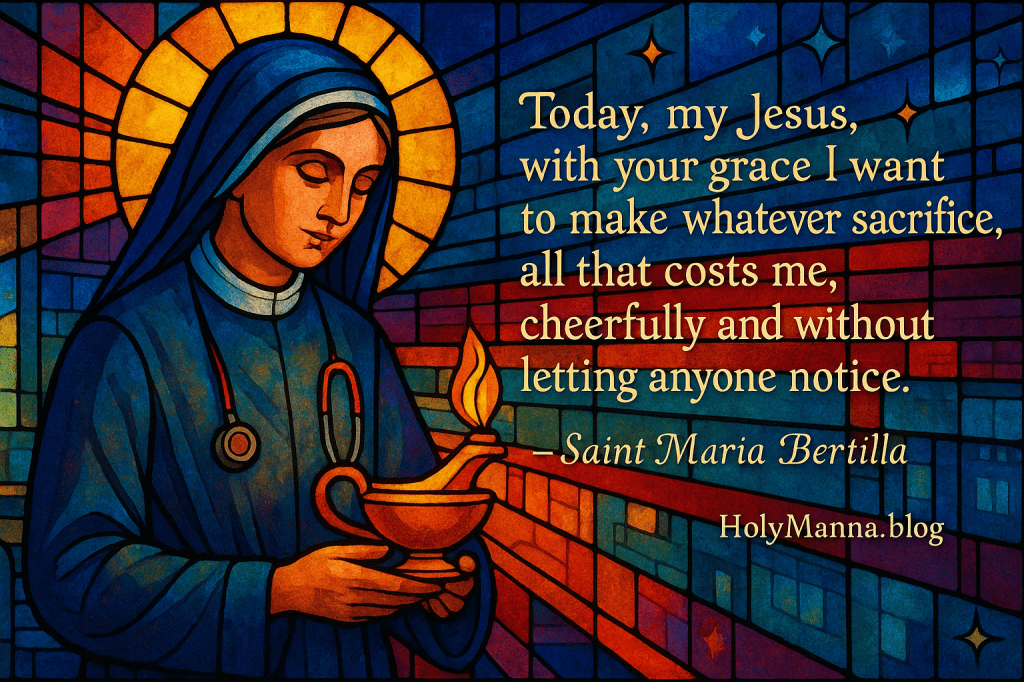
Quiet Brilliance in the Ward of Mercy
Saint Maria Bertilla Boscardin (1888 to 1922) shines as a model of hidden holiness lived in the corridors of a hospital. An Italian Sister of Saint Dorothy and a trained nurse, she poured herself out for children with infectious diseases and for wounded soldiers during World War I. Her tenderness toward the sick, her obedience in community life, and her calm courage during air raids made her a living icon of Christ the healer. The Church raised her to the altars when she was canonized by Saint John XXIII in 1961, and the faithful celebrate her feast on October 20. Healthcare workers and anyone who serves in quiet, unseen ways find in her a patron and a friend, because she shows how ordinary duty becomes extraordinary love when united to Jesus.
From Brendola’s Fields to a Vocation of Love
Maria was born Anna Francesca Boscardin in Brendola near Vicenza on October 6, 1888. Poverty marked her childhood, and an unstable, alcoholic father made the home a place of worry rather than rest. Schooling was minimal, so she worked in fields and in domestic service from a young age. Neighbors dismissed her as slow and unremarkable, yet grace was quietly at work. She loved prayer, visited the church frequently, and nurtured a simple devotion to the Sacred Heart of Jesus and to the Blessed Virgin Mary. At seventeen she entered the Sisters of Saint Dorothy, Daughters of the Sacred Hearts, took the name Sister Maria Bertilla, and began the long obedience of consecrated life. She discovered nursing not as a career but as a calling. In that calling she became what she seemed least likely to become, a wise and steady presence who brought peace to the frightened and hope to the gravely ill. Few of her own words were preserved, which makes her life itself the clearest testimony to her faith.
Love Under Air Raids
After initial formation, Sister Maria Bertilla was sent to the municipal hospital in Treviso. There she learned to care for children suffering from diphtheria and other infectious illnesses, which demanded gentleness, stamina, and constant vigilance. She managed equipment, sterilization, and difficult night watches, yet it was her prayerful calm that families remembered most. During World War I, when bombardments shook Treviso and the hospital came under military control, she remained at her post to serve patients who could not be moved. Physicians and officers learned to trust her judgment because she did not seek attention. She sought the good of the weakest. Many later testified that recoveries followed her all night vigils, her quiet encouragement at the bedside, and her habit of commending each child to the Heart of Jesus. Her daily fiat to God shone through actions more than speeches, and her steadiness taught colleagues how charity drives out fear. She is important to remember because she shows that holiness is not rarefied. It is faithful love, done well and done today.
Humiliation, Illness, and Unfailing Trust
Sanctity in Sister Maria’s life ripened through trials. A superior, jealous of her rapport with patients and staff, removed her from the wards and assigned her to the laundry. She accepted the humiliation without complaint, continued to pray for those in her care, and waited on God. When the Mother General visited and saw the situation, she restored Maria to nursing and later entrusted her with the children’s isolation ward. Illness also tested her. A tumor required surgery early in her religious life, and the condition later returned. Even as pain increased, she chose the harder tasks and offered hidden sacrifices for the conversion and consolation of others. She died in Treviso on October 20, 1922, at the age of thirty three. There was no martyrdom of blood, but there was the white martyrdom of obedience, patience, and charity that bears witness to Christ with every breath.
A Tomb That Heals
People began to pray at Sister Maria Bertilla’s grave soon after her death, and favors were reported by those who had known her and by strangers who sought her intercession. When her remains were translated to the motherhouse chapel of the Sisters of Saint Dorothy in Vicenza, more pilgrims came. The Church examined the graces and healings attributed to her prayers with rigorous care. These signs, together with the luminous simplicity of her life, led to her beatification and then to her canonization in 1961. Today the faithful still visit her resting place, ask her help for loved ones in hospitals, and entrust to her the intentions of nurses, doctors, chaplains, and caregivers who serve the sick with compassion.
Living Her Lesson Today
Saint Maria Bertilla’s life is a short course in charity and the works of mercy. The Catechism of the Catholic Church reminds us: “Charity is the theological virtue by which we love God above all things for his own sake, and our neighbor as ourselves for the love of God.” It also teaches very plainly: “The works of mercy are charitable actions by which we come to the aid of our neighbor in his spiritual and bodily necessities.” In Christ we see the source of this compassion, for the Catechism teaches of the Lord’s healings: “Christ’s compassion toward the sick and his many healings of every kind of infirmity are a resplendent sign that ‘God has visited his people’ and the Kingdom of God is close at hand.” If you serve in a clinic, tend a family member at home, or carry your own illness with faith, then Saint Maria Bertilla is a guide for you. Begin with one concrete act of love. Offer a calm word to someone who is anxious. Sit with a person who is alone. Pray a decade of the Rosary for those on a hospital’s intensive care floor. Whisper to the Lord throughout the day, Here I am. Then do the next small duty with love. In this way your life becomes a ward of mercy where Christ himself walks the halls.
Engage with Us!
I would love to hear your thoughts and your own experiences of finding Christ in the sick and the small.
- Where is Jesus inviting you today to say, “Here I am, Lord,” in simple and hidden service?
- Whom can you visit, call, or accompany this week to live the work of mercy of “visiting the sick”?
- How do Sister Maria Bertilla’s silent endurance and humility challenge your approach to unjust criticism or setbacks?
- What concrete habit can you adopt to practice solidarity with those who suffer in body or spirit?
- Which Scripture passage strengthens you to persevere in ordinary faithfulness?
May the intercession of Saint Maria Bertilla Boscardin help us live a life of faith, doing everything with the love and mercy that Jesus taught us.
Saint Maria Bertilla, pray for us!
Follow us on Instagram and Facebook for more insights and reflections on living a faith-filled life.

 Holy Manna!
Leave a comment