Monday of the Twenty-ninth Week in Ordinary Time – Lectionary: 473
Faith That Frees Us for Worship
Sometimes the heart knows that real wealth is not what fills our barns but Who fills our lives. Where is your treasure resting today? In Romans 4:20–25, Saint Paul points us to Abraham, who was “fully convinced that what [God] had promised he was also able to do”, and therefore “it was credited to him as righteousness.” Paul then anchors our hope in Christ, “handed over for our transgressions and raised for our justification.” This is the theological ground of today’s liturgy, a reminder that saving righteousness is God’s gift received by trusting His promise fulfilled in the death and resurrection of Jesus, as taught in CCC 1814 and CCC 1991. The Responsorial Psalm takes us into the Church’s morning canticle from Luke 1:69–75, where Zechariah sings that God has raised “a horn for our salvation within the house of David” and kept “the oath he swore to Abraham”, so that “without fear we might worship him in holiness and righteousness all our days.” Historically, “horn” was a symbol of strength and royal power, and the “house of David” signals the messianic kingdom promised to Israel. The Benedictus places us inside Israel’s long memory, where covenant fidelity culminates in Jesus who empowers our worship. Finally, the Holy Gospel in Luke 12:13–21 pulls the lens to the desires that tug at every generation. In a culture of inheritance disputes and grain hoarding, Jesus refuses to be a civil arbitrator and instead warns, “Take care to guard against all greed, for though one may be rich, one’s life does not consist of possessions.” The parable of the rich fool exposes the fragility of self-made security and calls us to be “rich in what matters to God.” Read through the lens of CCC 2541–2547 on poverty of heart, the message becomes clear. Faith in God’s promise frees us from fear and from grasping, so that we may live a life of worship, holiness, and generous trust. Today’s readings invite us to receive righteousness by faith, to sing the covenant with grateful hearts, and to let go of anxious accumulation in order to treasure the Kingdom that never fails.
First Reading – Romans 4:20–25
A Covenant Fulfilled in Christ
Paul writes to a mixed community of Jewish and Gentile believers in Rome who are learning how the covenant with Abraham embraces the nations through Jesus Christ. In the world of Second Temple Judaism, “crediting righteousness” drew on covenantal and legal language, where fidelity to God’s promise was recognized by God Himself. Paul reaches back to Genesis 15:6 to show that Abraham’s trust preceded the works of the Mosaic Law, which means that justification is God’s gracious initiative received by faith. In Romans 4:20–25, Abraham becomes the prototype of the Christian believer. God’s promise is not a fragile wish but a divine oath fulfilled in the death and resurrection of Jesus. This reading fits today’s theme by rooting true wealth in confident trust. God makes us righteous in Christ, which frees us from fear and the grasping mindset that the Gospel warns against, so that we may live in worship and generous love.
Romans 4:20-25
New American Bible (Revised Edition)
20 He did not doubt God’s promise in unbelief; rather, he was empowered by faith and gave glory to God 21 and was fully convinced that what he had promised he was also able to do. 22 That is why “it was credited to him as righteousness.” 23 But it was not for him alone that it was written that “it was credited to him”; 24 it was also for us, to whom it will be credited, who believe in the one who raised Jesus our Lord from the dead, 25 who was handed over for our transgressions and was raised for our justification.
Detailed Exegesis
Verse 20 – “He did not doubt God’s promise in unbelief; rather, he was empowered by faith and gave glory to God”
Paul contrasts unbelief with being “empowered by faith.” Abraham’s strength is not self-generated resolve. It is the fruit of trusting God’s word. Giving glory to God means recognizing God’s power and fidelity. This is the heart of worship that the Responsorial Psalm celebrates in Luke 1:69–75. In the life of the believer, glorifying God is inseparable from trusting His promise.
Verse 21 – “and was fully convinced that what he had promised he was also able to do.”
Faith is not vague optimism. It is certainty about God’s ability to accomplish what He promises. Paul highlights divine omnipotence as the ground of assurance. This anticipates Christian faith in the resurrection, because the God who gives life to Sarah’s barren womb also raises Jesus from the dead.
Verse 22 – “That is why ‘it was credited to him as righteousness.’”
Paul cites Genesis 15:6. The verb “credited” evokes the divine reckoning by which God counts Abraham as righteous. This is God’s gracious judgment, not human self justification. The citation shows that justification by faith is not a new idea. It is the original pattern of the covenant.
Verse 23 – “But it was not for him alone that it was written that ‘it was credited to him’;”
Scripture is written for the Church. Paul universalizes Abraham’s experience so that it becomes the map for all who believe. The inspired record is not a museum artifact. It is a living word addressed to us.
Verse 24 – “it was also for us, to whom it will be credited, who believe in the one who raised Jesus our Lord from the dead,”
Here Paul names the explicit content of Christian faith. We believe in the Father who raised Jesus. The resurrection confirms the reliability of every promise. What God did for Abraham’s body He has done definitively in the Body of Christ. Therefore righteousness is “credited” to all who entrust themselves to the Risen Lord.
Verse 25 – “who was handed over for our transgressions and was raised for our justification.”
Paul compresses the Paschal Mystery into a single line. The cross addresses our sins. The resurrection effects our justification and publicly vindicates Jesus as Son and Lord. This twofold movement shows that salvation is both atoning and life giving. We do not hoard merit. We receive a new standing before God and a new power to live in holiness, which prepares us to be “rich in what matters to God” in the Gospel.
Teachings
The Catechism explains the nature of faith as total self surrender to God. CCC 1814 teaches: “Faith is the theological virtue by which we believe in God and believe all that he has said and revealed to us, and that Holy Church proposes for our belief, because he is truth itself. By faith the human person freely commits his entire self to God. For this reason the believer seeks to know and do God’s will. ‘The righteous shall live by faith.’ Living faith ‘works through charity.’” This illuminates Abraham’s “full conviction” in Romans 4:21. Faith is not mere assent. It is personal entrustment that bears fruit in love.
On justification, CCC 1991 clarifies the grace Paul proclaims: “Justification is at the same time the acceptance of God’s righteousness through faith in Jesus Christ. Righteousness here means the rectitude of divine love. With justification, faith, hope, and charity are poured into our hearts, and obedience to the divine will is granted us.” Paul’s language of being “credited” points to this divine action that both declares and transforms.
The Catechism also reflects directly on Christ’s saving gift named in Romans 4:25. CCC 604 declares: “By giving up his own Son for our sins, God manifests that his plan for us is one of benevolent love, prior to any merit on our part: ‘In this is love, not that we loved God but that he loved us and sent his Son to be the expiation for our sins.’ ‘God proves his love for us in that while we were yet sinners Christ died for us.’” Paul’s phrase “handed over” echoes this gratuitous love which precedes and empowers every response.
Saint Thomas Aquinas describes the interior dynamism of such faith: “To believe is an act of the intellect assenting to the divine truth by command of the will moved by God by grace.” This insight, found in Summa Theologiae II–II, q.2, a.9, shows why Abraham’s conviction is itself a grace filled act. God moves the heart, and the believer assents with real freedom.
Reflection
Abraham’s story invites a daily exchange. We trade anxious self reliance for confident surrender to the Father who raised Jesus. Begin the morning with an act of faith, naming one promise of God and entrusting a concrete worry to Him. Practice gratitude that “gives glory to God” by recalling where He has been faithful in your life. Choose one act of generosity today that contradicts the fear of scarcity, since righteousness received by faith flowers in love. End the day by praying the Benedictus from Luke 1:69–75, asking for a heart that worships “without fear in holiness and righteousness.” Where is God inviting you to be fully convinced of His promise today? What barn of self made security is He asking you to leave behind so that you can be rich in what matters to Him?
Responsorial Psalm – Luke 1:69–75
Covenant Mercy That Frees Us for Worship
This canticle from Luke 1:69–75, known as the Benedictus, springs from the lips of Zechariah at the birth of John the Baptist. It stands within the living memory of Israel’s promises during the Second Temple period, when the people longed for the Davidic Messiah and the fulfillment of God’s oath to Abraham. The image of a “horn” evokes royal strength and victorious salvation. The “house of David” signals the messianic kingdom arriving in Jesus, while the oath to Abraham reaches its crescendo in a blessing that embraces all nations. In today’s theme, this psalm answers Saint Paul’s vision in Romans 4:20–25: God keeps His promises and credits righteousness to those who trust Him. The result is not anxious accumulation but liberated worship. God rescues us so that we might serve Him without fear, in holiness and righteousness all our days, which is precisely what Jesus calls “being rich in what matters to God” in Luke 12:13–21.
Luke 1:69-75
New American Bible (Revised Edition)
69 He has raised up a horn for our salvation
within the house of David his servant,
70 even as he promised through the mouth of his holy prophets from of old:
71 salvation from our enemies and from the hand of all who hate us,
72 to show mercy to our fathers
and to be mindful of his holy covenant
73 and of the oath he swore to Abraham our father,
and to grant us that, 74 rescued from the hand of enemies,
without fear we might worship him 75 in holiness and righteousness
before him all our days.
Detailed Exegesis
Verse 69 – “He has raised up a horn for our salvation within the house of David his servant,”
“Horn” is a biblical emblem of power and victory. Zechariah proclaims that God has acted with royal strength. The phrase “house of David” anchors salvation in God’s covenant with David, fulfilled in Jesus the Messiah. The psalm invites us to see redemption not as a human project but as divine initiative that establishes a kingdom of holiness.
Verse 70 – “even as he promised through the mouth of his holy prophets from of old:”
The prophets are God’s heralds who kept Israel’s hope alive. Zechariah interprets current events as the long pronunciation of a single faithful Word. The entire prophetic chorus converges on Jesus, the Yes of all God’s promises, which is the same promise Paul invokes in Romans 4.
Verse 71 – “salvation from our enemies and from the hand of all who hate us,”
Salvation includes real deliverance. Israel knew oppression, exile, and political threat. Yet the deepest enemy is sin and death. In Christ, God defeats the enemies that enslave the soul, creating space for fearless worship and generous love that the Gospel commends.
Verse 72 – “to show mercy to our fathers and to be mindful of his holy covenant”
“Mercy” translates the rich biblical sense of covenant love. God remembers, which in Scripture means God acts to fulfill His pledge. The covenant is not nostalgia. It is God’s operative faithfulness that heals generations.
Verse 73 – “and of the oath he swore to Abraham our father,”
An oath is the most solemn divine commitment. By invoking Abraham, Zechariah reaches back to the moment when righteousness was “credited” to faith. The psalm and Paul speak with one voice. God binds Himself to bless, and He keeps that oath in Christ.
Verse 74 – “and to grant us that, rescued from the hand of enemies, without fear we might worship him”
Rescue is ordered to worship. Freedom is not an end in itself. God liberates us from fear so that we may give Him adoration with undivided hearts. This stands against the grasping anxiety in Luke 12, where possessiveness chokes worship.
Verse 75 – “in holiness and righteousness before him all our days.”
The goal of salvation is a life lived in God’s presence. “Holiness and righteousness” name both consecration and right relationship. The psalm sketches the Church’s daily vocation. We are a people formed to live before God with integrity, generosity, and praise.
Teachings
On the essence of adoration that this psalm celebrates, CCC 2096 teaches: “Adoration is the first act of the virtue of religion. To adore God is to acknowledge him as God, as the Creator and Savior, the Lord and Master of everything that exists, as infinite and merciful Love.” Fearless worship flows from recognizing who God is and what He has done.
On the character of faith that receives God’s oath, CCC 1814 states: “Faith is the theological virtue by which we believe in God and believe all that he has said and revealed to us, and that Holy Church proposes for our belief, because he is truth itself. By faith the human person freely commits his entire self to God. For this reason the believer seeks to know and do God’s will.” Zechariah’s song arises from this trusting surrender to God’s faithful word.
Saint Augustine describes the end for which we were made, the very heart of worship sung in the Benedictus: “You have made us for yourself, O Lord, and our heart is restless until it rests in you.” This rest is the fearless worship promised to God’s people.
Reflection
Begin each morning by praying these verses from Luke 1:69–75, and ask the Lord to make your heart free for worship. Name one concrete fear, and surrender it to the Father whose oath in Christ is unbreakable. Choose one small act of praise before any work or phone check, and let that act become your anchor for the day. Practice mercy where there has been resentment, since covenant love is the signature of those who have been rescued. Where is fear dampening your worship today? What step can you take to adore God first, before you organize or protect your possessions? How will you embody holiness and righteousness before Him in one practical choice today?
Holy Gospel – Luke 12:13–21
A Heart Freed from Greed
Set within Jesus’ journey to Jerusalem in The Gospel of Luke, this scene begins with a real dispute from daily life. In first century Judaism it was common to seek a rabbi’s judgment in inheritance matters, since the Law addressed family portions and firstborn rights. Jesus refuses the role of civil arbitrator, not because justice is unimportant, but because He aims at the deeper court of the heart. He warns against greed, using a parable to reveal how the anxious storing of wealth can hollow the soul. The rich man’s expanding barns promise rest, yet his life is required that very night. This Gospel fits today’s theme by contrasting anxious accumulation with trust in God’s promise. True wealth is to be rich in what matters to God, which is the worshipful freedom sung in Luke 1:69–75 and the righteousness received by faith in Romans 4:20–25.
Luke 12:13-21
New American Bible (Revised Edition)
Saying Against Greed. 13 Someone in the crowd said to him, “Teacher, tell my brother to share the inheritance with me.” 14 He replied to him, “Friend, who appointed me as your judge and arbitrator?” 15 Then he said to the crowd, “Take care to guard against all greed, for though one may be rich, one’s life does not consist of possessions.”
Parable of the Rich Fool. 16 Then he told them a parable. “There was a rich man whose land produced a bountiful harvest. 17 He asked himself, ‘What shall I do, for I do not have space to store my harvest?’ 18 And he said, ‘This is what I shall do: I shall tear down my barns and build larger ones. There I shall store all my grain and other goods 19 and I shall say to myself, “Now as for you, you have so many good things stored up for many years, rest, eat, drink, be merry!”’ 20 But God said to him, ‘You fool, this night your life will be demanded of you; and the things you have prepared, to whom will they belong?’ 21 Thus will it be for the one who stores up treasure for himself but is not rich in what matters to God.”
Detailed Exegesis
Verse 13 – “Someone in the crowd said to him, ‘Teacher, tell my brother to share the inheritance with me.’”
The request is ordinary and legal. It reveals how money disputes fracture families. Jesus receives the question as an opening to heal a deeper disorder. The issue is not only the division of property. It is the division of the heart.
Verse 14 – “He replied to him, ‘Friend, who appointed me as your judge and arbitrator?’”
Jesus declines a civil role to assert a higher mission. He is not a mere distributor of goods. He is the Lord who judges desires and summons us to the Kingdom. His question exposes the tendency to conscript God for our plans rather than submit our plans to God.
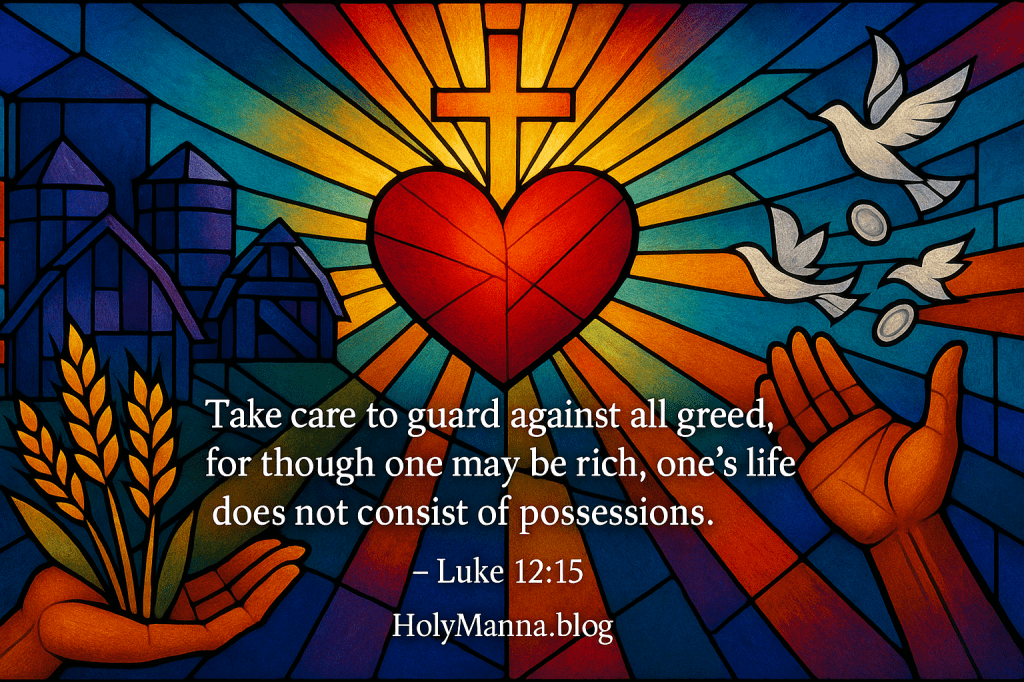
Verse 15 – “Then he said to the crowd, ‘Take care to guard against all greed, for though one may be rich, one’s life does not consist of possessions.’”
“Greed” translates a word for grasping more than one’s due. Jesus issues a vigilance command. Life is not reducible to inventory. This sets the interpretive key for the parable. The measure of a person is not net worth but worship, love, and faith.
Verse 16 – “Then he told them a parable. ‘There was a rich man whose land produced a bountiful harvest.’”
The abundance is explicitly from the land. The increase comes as gift. The man’s problem does not begin with wealth but with how he reads the gift. He treats surplus as solely his to manage, not as entrusted by God for the good of others.
Verse 17 – “He asked himself, ‘What shall I do, for I do not have space to store my harvest?’”
The monologue reveals isolation. He consults only himself. He speaks about barns, not neighbors. Lack of space becomes a spiritual test. Surplus asks for discernment, generosity, and stewardship.
Verse 18 – “And he said, ‘This is what I shall do: I shall tear down my barns and build larger ones. There I shall store all my grain and other goods’”
His solution is expansion without mission. He multiplies capacity but not charity. The repeated “I shall” signals a heart centered on self. He considers grain and goods, not God and the poor.
Verse 19 – “‘and I shall say to myself, “Now as for you, you have so many good things stored up for many years, rest, eat, drink, be merry!”’”
He preaches a false gospel to his soul. He mistakes security for serenity. The refrain of eating and merriment echoes worldly slogans. Without reference to God, pleasure becomes a fragile refuge.
Verse 20 – “But God said to him, ‘You fool, this night your life will be demanded of you; and the things you have prepared, to whom will they belong?’”
“Fool” in Scripture names one who lives without reference to God. The sudden summons reveals the truth. Life is a stewardship that can be asked back at any time. Preparations that ignore eternity collapse into a question mark. This is not divine cruelty. It is a merciful disclosure of reality.
Verse 21 – “Thus will it be for the one who stores up treasure for himself but is not rich in what matters to God.”
Jesus concludes with a contrast. The issue is not possessing goods but being possessed by them. To be “rich toward God” is to order possessions to love, mercy, and worship. It is to let faith direct wealth rather than let wealth direct faith.
Teachings
On covetousness, CCC 2536 teaches: “The tenth commandment forbids greed and the desire to amass earthly goods without limit. It forbids avarice arising from a passion for riches and their attendant power. It also forbids the desire to commit injustice by harming our neighbor in his temporal goods.” This clarifies why Jesus warns the crowd to guard against all greed.
On the form of Jesus’ teaching, CCC 546 states: “Jesus’ invitation to enter his kingdom comes in the form of parables, a characteristic feature of his teaching.” The parable of the rich fool is not an anecdote. It is an invitation to conversion and a judgment on false securities.
On temperance that frees the heart, CCC 1809 explains: “Temperance is the moral virtue that moderates the attraction of pleasures and provides balance in the use of created goods. It ensures the will’s mastery over instincts and keeps desires within the limits of what is honorable.” Temperance turns barns into blessings rather than prisons.
On charity toward the poor, CCC 2443 proclaims: “God blesses those who come to the aid of the poor and rebukes those who turn away from them.” Riches become richness toward God when they become mercy toward others.
On the seriousness of life’s brevity, CCC 1021 teaches: “Death puts an end to human life as the time open to either accepting or rejecting the divine grace manifested in Christ.” The sudden demand for the man’s life reveals the urgency of ordering goods toward God now.
Reflection
This Gospel asks for a reordering of desire. Begin by acknowledging that every harvest is gift. Thank God aloud for three concrete blessings and ask how each can serve His glory and someone else’s good. Choose a specific act of generosity today that costs you something, such as almsgiving, sharing time with someone in need, or forgiving a debt of resentment. Create a simple rule for surplus. For example, whenever you receive an unexpected bonus, set aside a meaningful portion for the poor and for the Church before any upgrades. Practice temperance by one small fast from a comfort that often governs you, and let that space become a short prayer. End the day by examining your heart with this question from Jesus. In what ways am I storing treasure for myself instead of becoming rich in what matters to God? If my life were required of me tonight, what story would my spending, saving, and sharing tell about my trust in the Father? What one decision can I make today that turns a barn into a blessing for someone else?
Gathered into One
Today’s Word draws a single line through all three readings. Abraham’s faith in Romans 4:20–25 shows that righteousness is received, not achieved, as Scripture declares, “It was credited to him as righteousness” (Romans 4:22). Zechariah’s song in Luke 1:69–75 reveals why God saves us, that “without fear we might worship him in holiness and righteousness all our days” (Luke 1:74–75). Jesus’ parable in Luke 12:13–21 then exposes the rival liturgy of greed and warns, “one’s life does not consist of possessions” (Luke 12:15), concluding with the call to be “rich in what matters to God” (Luke 12:21). Taken together, these readings teach that trusting God’s promise in Christ frees the heart for fearless worship and generous love. The wealth that endures is the life of faith, hope, and charity poured into us through justification, as taught in CCC 1814 and CCC 1991, and expressed in true adoration, as taught in CCC 2096.
Here is the invitation. Make a simple act of faith like Abraham, naming one concrete promise of God and entrusting one concrete worry to the Father who raised Jesus. Pray the Benedictus from Luke 1:69–75, and ask for a heart that serves God without fear. Examine your surplus with the Gospel’s light, then turn one barn of comfort into a blessing for someone in need through deliberate almsgiving or sacrificial service, since God’s gifts are entrusted for love. Practice temperance in one small way today so that your desires learn to rest in God. Where is the Lord inviting you to trust His promise more deeply this week? What step can you take today to become rich in what matters to God and to worship Him with a free and joyful heart?
Engage with Us!
Share your reflections in the comments below and join the conversation as we let God’s Word shape our hearts and our habits.
- First Reading: Romans 4:20–25 — Where is the Lord inviting you to trust His promise more concretely this week? What fear or control do you need to surrender so that you “gave glory to God” becomes the story of your choices? How does believing in the Father who raised Jesus change the way you face today’s challenges?
- Responsorial Psalm: Luke 1:69–75 — What fear is keeping you from worshiping God freely and joyfully? Where do you recognize God “remembering” His covenant mercy in your life right now? In what practical action will you serve Him “in holiness and righteousness” today?
- Holy Gospel: Luke 12:13–21 — What “barns” of security are you building, and why? If your life were asked of you tonight, what would your possessions say about your loves and priorities? What step can you take today to become “rich in what matters to God” through generosity, temperance, and prayer?
May the Holy Spirit strengthen you to live a life of faith, to worship without fear, and to do everything with the love and mercy that Jesus taught us.
Sacred Heart of Jesus, we trust in You!
Immaculate Heart of Mary, pray for us!
Saint Michael the Archangel, defend us in battle!
Follow us on Instagram and Facebook for more insights and reflections on living a faith-filled life.

 Holy Manna!
Leave a comment