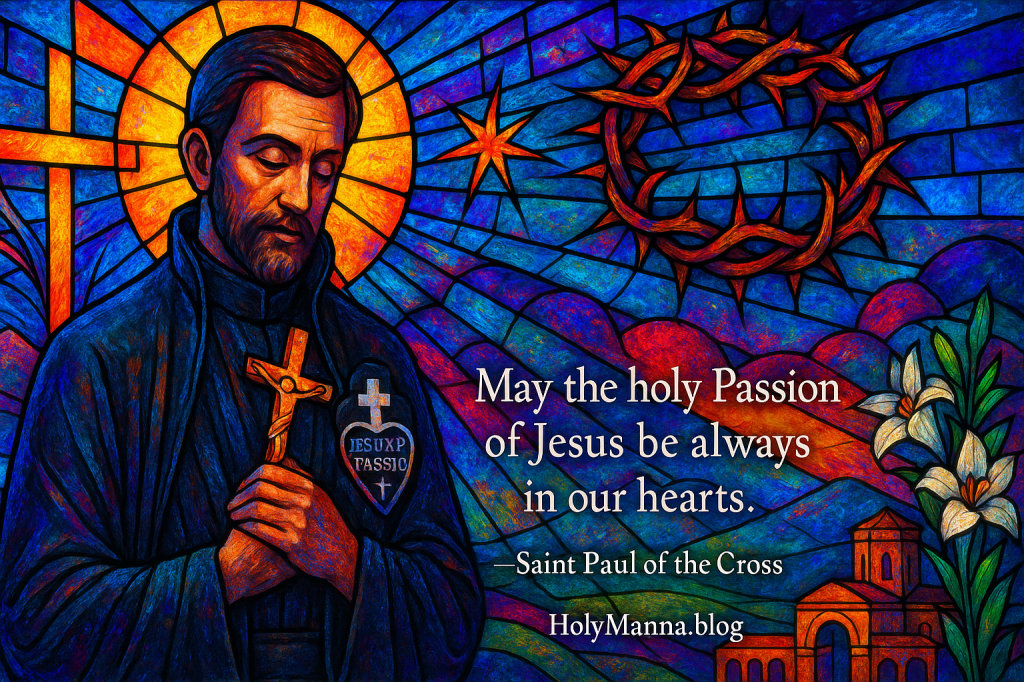
A Flame That Preached Christ Crucified
Saint Paul of the Cross, born Paolo Francesco Danei, set his heart on one mission that shaped his entire life and legacy: to keep alive in the Church the saving memory of the Passion of Jesus. He is the founder of the Passionists, a congregation dedicated to contemplative prayer, rigorous poverty, and powerful preaching that leads souls to conversion at the foot of the Cross. He is remembered as a mystic, spiritual father, and master of the interior life whose letters and missions reawakened countless people to God’s mercy. He died in Rome on October 18, 1775, after more than five decades of apostolic labor, and the Church later recognized his sanctity with beatification and canonization. His witness continues wherever Passionists serve and wherever Christians kneel before Christ Crucified to drink from the wellspring of divine love.
Roots, Awakening, and a Burning Call
Paul was born on January 3, 1694, in Ovada in the Republic of Genoa to Luca Danei and Anna Maria Massari, a devout couple who taught their children to center their days around the Eucharist and the Rosary. As a boy he showed a marked love for silence and prayer, yet he also experienced the ordinary trials of youth and commerce, helping his family and discerning what God wanted of him. In his twenties a sequence of grace-filled experiences during preaching and prayer deepened his conversion. He became convinced that God was summoning him to gather companions who would live for the glory of God by meditating on and preaching the Passion of Jesus. In 1720, encouraged by his bishop, he undertook a lengthy retreat in Castellazzo and wrote a Rule for a new community whose badge would bear a heart and the Holy Name of Jesus with a cross above it. From that point, the memory of Calvary became the central light of his life. Among the sayings preserved from his letters, one concise line expresses his conviction: “May the holy Passion of Jesus be always in our hearts.” Another line distills his spirituality with luminous simplicity: “The Passion of Jesus is the greatest and most stupendous work of God’s love.”
Building a School of the Cross
With the Church’s blessing, Paul and his brother John Baptist received priestly ordination in Rome in 1727. The brothers began to preach parish missions, call people to confession, and form disciples in a way of life marked by fasting, night prayer, and filial devotion to Our Lady. The first Passionist retreat rose on Monte Argentario, and more houses followed as vocations grew. The Passionist habit, black and austere, carried a heart-shaped emblem inscribed with “Jesu XPI Passio” that silently preached what Paul proclaimed with fire: everything begins and matures at the foot of the Cross. He preached in towns and villages, guided clergy and laity, and wrote thousands of letters that opened souls to God’s tenderness. He insisted that meditation on Christ’s Passion be practical and transformative, leading to reconciliation with God and neighbor. He urged his spiritual children to cling to Jesus in His wounds, because there God’s mercy is most visible: “Let us hide ourselves in the sacred wounds of Jesus, and we shall find an ocean of love.” His method was simple and evangelical. He invited people to contemplate the Passion, receive the sacraments, forgive injuries, and live charity with courage and joy.
Wonders of Mercy During His Lifetime
Everywhere he went, Paul found souls thirsting for hope, and many experienced striking graces through his prayer and counsel. Contemporary accounts describe hardened hearts moved to tears, long estranged families reconciled after hearing his missions, and the sick regaining strength in response to his intercession. Above all, the miracle he most desired was the conversion of sinners and the renewal of the Church from within. He taught that deep healing flows from union with the Crucified: “The remembrance of the Passion of Jesus Christ is the door to union with God.” He often reminded penitents that God’s mercy is stronger than their sins and that the Cross is the school where the virtues are learned in truth and humility. His sanctity was not a matter of public marvels alone. It was the steady, fruitful miracle of a priest who spent himself in confessionals, pulpits, and sickrooms, where grace quietly transformed lives.
Trials That Tempered a Saint
Paul’s path to founding and stabilizing the Passionists was strewn with difficulties. Approval of the Rule involved delays and revisions. Foundations were poor and precarious. He endured misunderstandings, periods of interior dryness, and bodily illness brought on by fasting, travel, and fatigue. Yet he interpreted every obstacle through the Cross he loved. He refused bitterness and embraced humility, trusting that God’s timing would prevail. He once counseled the discouraged with a line that bears repeating: “Do not be fearful or anxious; be patient, and let God act.” Paul was not a martyr by blood, but he lived a true martyrdom of charity and perseverance. The Catechism of the Catholic Church teaches that Christ invites us to participate in His Paschal Mystery by taking up our daily crosses in love (cf. Catechism, 618). Paul’s endurance shows how this teaching becomes a lived school of holiness where suffering is transformed into intercession and hope.
A Father’s Blessing Beyond the Grave
After his holy death on October 18, 1775, devotion to Paul of the Cross spread swiftly. Pilgrims prayed at his tomb, and reports of healings and favors multiplied. These graces supported the Church’s formal processes that eventually led to his beatification and canonization. Even more enduring than individual miracles is the living miracle of his spiritual family. Passionist missionaries carried his charism far beyond Italy, preaching missions, guiding retreats, and consoling the afflicted with the same burning love for Jesus Crucified. Through the Passionists and the contemplative Passionist Nuns inspired by his vision, the Church continues to receive a fatherly blessing from Paul’s intercession, especially wherever suffering people learn to read their lives in the light of the Cross.
Praying With the Church
Saint Paul of the Cross invites us to stand with Mary and John where the love of God is most tangible, at Calvary. The Catechism teaches that Christ’s sacrifice is the unique source of our salvation, offered out of love “to the end,” and that believers can unite their trials to His redemptive offering in the Eucharist and in daily fidelity (cf. Catechism, 571, 616, 618). Paul’s spirituality is not gloomy. It is radiant with the joy that flows from being loved by the Crucified and Risen Lord. If we contemplate Christ’s wounds with trust, our resentments lose power, our fears grow quiet, and our hearts are set free to forgive and to serve. Begin with a daily meditation on the Passion using a Gospel scene. Whisper his simple aspiration throughout the day: “May the holy Passion of Jesus be always in our hearts.” Let that prayer shape the way you listen, work, suffer, and rejoice. How is Christ inviting you to stand at the foot of the Cross today?
Engage with Us!
- Which moment in Saint Paul of the Cross’s story most challenges or inspires you, and why?
- How might you “keep alive the memory of the Passion” in your prayer this week?
- Where is Jesus asking you to unite a concrete suffering to His Cross for someone’s good?
- What would change in your family or parish if you prayed and served with Passionist simplicity and zeal?
Go forward encouraged. Fix your eyes on Jesus, let His Passion shape your love, and do everything with the mercy He has poured out for us.
Saint Paul of the Cross, pray for us!
Follow us on Instagram and Facebook for more insights and reflections on living a faith-filled life.

 Holy Manna!
Leave a comment