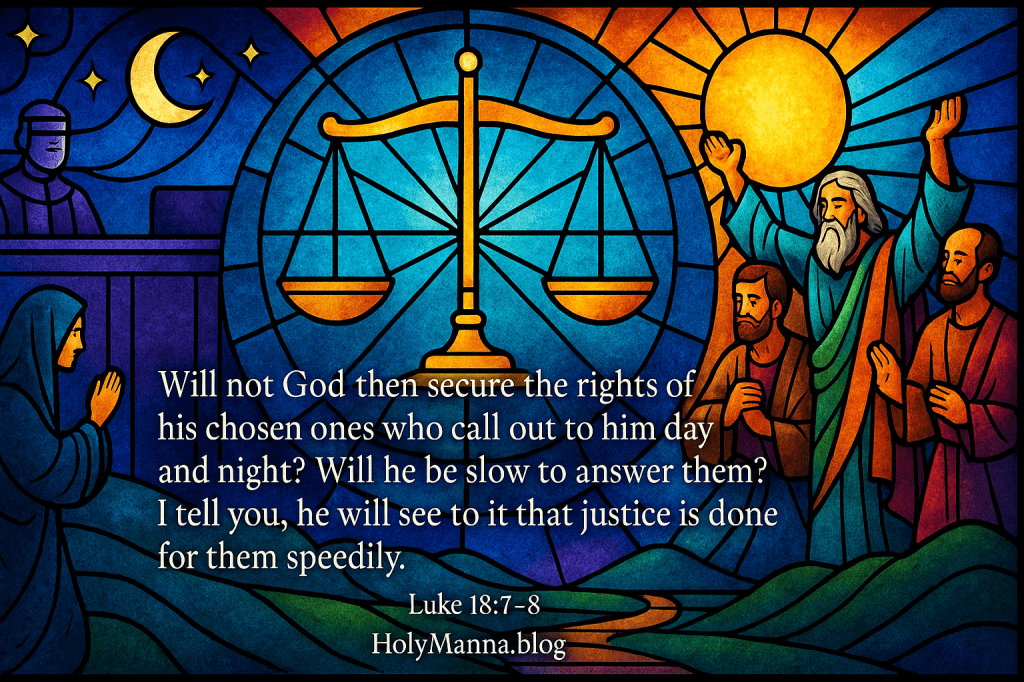
Twenty-ninth Sunday in Ordinary Time – Lectionary: 147
Lifted Hands, Living Word, Unwearied Hearts
If you have ever felt outmatched by life’s battles, today’s readings invite you to stand firm, lift your heart, and keep praying. The central theme is simple and demanding: persevering prayer, anchored in the Word of God and sustained by the communion of believers, draws down the Lord’s faithful help and justice. In Exodus 17:8–13, Israel’s victory over Amalek is not won by the sword alone. It comes as Moses prays with uplifted hands, an ancient orans posture of intercession. When he grows weary, Aaron and Hur steady his arms, and the people prevail. The scene teaches that persevering prayer is a communal labor before it is a solitary effort, and that God’s power works through our fidelity to intercede. Psalm 121 gives the pilgrim’s soundtrack for this struggle, a Song of Ascents for those climbing toward Jerusalem: “My help comes from the Lord, the maker of heaven and earth.” The Lord neither sleeps nor grows tired. He guards our going out and coming in, day and night. In 2 Timothy 3:14–4:2, Paul grounds this perseverance in the authority of the Scriptures and the mission of preaching. “All scripture is inspired by God and is useful for teaching, for refutation, for correction, and for training in righteousness.” Therefore Timothy must “proclaim the word; be persistent whether it is convenient or inconvenient.” The Lord who guards us also equips us through His God-breathed Word to endure and to act. Finally, in Luke 18:1–8, Jesus places the capstone on the call: “Pray always without becoming weary.” A vulnerable widow secures justice from a cynical judge by steadfast petition. If such persistence moves an unjust official, how much more will the Father bring justice to His chosen who cry to Him day and night. The Church echoes this summons in CCC 2613 and CCC 2742 on constant prayer, and in CCC 131–133 and CCC 2653 on the vital place of Scripture in the Christian life. Will you allow your prayer to be steadied by the Church, your courage to be fed by the Scriptures, and your hope to keep knocking until the Lord opens the way?
First Reading – Exodus 17:8–13
When weary hands are lifted, heaven fights for us
Israel meets Amalek at Rephidim soon after the miraculous water from the rock, which follows the exodus from Egypt and precedes the covenant at Sinai. The Amalekites were a nomadic people often associated in Israel’s memory with opportunistic aggression, and later Scripture will recall their attack as particularly treacherous in Deuteronomy 25:17–19. The scene unfolds in the wilderness, where Israel learns that victory does not rest in numbers or skill but in fidelity to God’s presence symbolized by “the staff of God.” Moses’ uplifted hands reflect the orans posture of intercession found throughout Israel’s worship, while Aaron and Hur’s support reveals that prayer is sustained by community, not by solitary heroics. Read within today’s theme, this passage teaches that persevering prayer, grounded in trust and supported by the People of God, draws down divine help and justice. It anticipates the Church’s understanding of intercession in The Catechism and foreshadows the outstretched arms of Christ who intercedes for us.
Exodus 17:8-13
New American Bible (Revised Edition)
Battle with Amalek. 8 Then Amalek came and waged war against Israel in Rephidim. 9 So Moses said to Joshua, “Choose some men for us, and tomorrow go out and engage Amalek in battle. I will be standing on top of the hill with the staff of God in my hand.” 10 Joshua did as Moses told him: he engaged Amalek in battle while Moses, Aaron, and Hur climbed to the top of the hill. 11 As long as Moses kept his hands raised up, Israel had the better of the fight, but when he let his hands rest, Amalek had the better of the fight. 12 Moses’ hands, however, grew tired; so they took a rock and put it under him and he sat on it. Meanwhile Aaron and Hur supported his hands, one on one side and one on the other, so that his hands remained steady until sunset. 13 And Joshua defeated Amalek and his people with the sword.
Detailed Exegesis
Verse 8 – “Then Amalek came and waged war against Israel in Rephidim.”
Amalek initiates the conflict, underscoring Israel’s vulnerability in the desert. Rephidim, a staging place before Sinai, becomes a classroom where God teaches reliance on Him rather than on military advantage. The enemy’s attack after the gift of water suggests that spiritual consolations are often followed by trials that test fidelity.
Verse 9 – “So Moses said to Joshua, ‘Choose some men for us, and tomorrow go out and engage Amalek in battle. I will be standing on top of the hill with the staff of God in my hand.’”
Leadership is shared. Joshua fights while Moses intercedes, signaling the unity of action and prayer. The “staff of God” recalls the signs in Egypt and the parting of the sea. It is a sacramental sign of God’s authority at work. The hill becomes a liturgical vantage point, teaching that the Church’s mission advances when contemplation and action are joined.
Verse 10 – “Joshua did as Moses told him: he engaged Amalek in battle while Moses, Aaron, and Hur climbed to the top of the hill.”
Obedience precedes victory. Moses is not alone. Aaron, the priest, and Hur, a lay elder by tradition, accompany him. This communion reveals a priestly, prophetic, and communal dimension of intercession. Israel’s struggle is not merely tactical. It is ecclesial and liturgical.
Verse 11 – “As long as Moses kept his hands raised up, Israel had the better of the fight, but when he let his hands rest, Amalek had the better of the fight.”
The outcome hinges on persevering intercession. The raised hands embody steadfast prayer and dependence. When prayer falters, the tide turns. This is not magic. It is pedagogy. God forms His people to understand that grace sustains their battle and that prayer must not grow weary.
Verse 12 – “Moses’ hands, however, grew tired; so they took a rock and put it under him and he sat on it. Meanwhile Aaron and Hur supported his hands, one on one side and one on the other, so that his hands remained steady until sunset.”
Even the greatest intercessor tires. God’s answer arrives through the charity of companions who “support his hands.” The rock evokes stability and may hint at God’s faithfulness. The steadying presence of Aaron and Hur images the Church, in which the weak are upheld by the strong so that prayer continues until the work is finished.
Verse 13 – “And Joshua defeated Amalek and his people with the sword.”
Victory is granted through a synergy of faithful action and persevering prayer. Joshua’s sword is effective because Moses’ prayer endures. The pattern will echo across salvation history and reaches fulfillment in Christ, whose Paschal victory empowers the Church’s mission.
Teachings
This passage illumines intercessory prayer as a work of communion. The Catechism explains the nature of intercession with striking clarity: “Intercession is a prayer of petition which leads us to pray as Jesus did. He is the one intercessor with the Father on behalf of all men, especially sinners. He is ‘able for all time to save those who draw near to God through him, since he always lives to make intercession for them.’ The Holy Spirit himself intercedes for us and intercedes in us.” (CCC 2634–2635, citing Heb 7:25 and Rom 8:26). The constancy required on the hill of Rephidim harmonizes with the Lord’s command to pray without ceasing: “‘Pray constantly’ … It is always possible to pray.” (CCC 2742). The Word of God also equips perseverance in trial, as Paul teaches: “All scripture is inspired by God and is useful for teaching, for refutation, for correction, and for training in righteousness.” (2 Timothy 3:16). The Fathers perceived in Moses’ uplifted arms a figure of Christ. As Christians contemplate the Crucified with arms outstretched, we recognize the definitive intercession that upholds the Church’s battle against sin and injustice. In salvation history, Israel’s memory of Amalek in Deuteronomy 25:17–19 and the later conflict in 1 Samuel 15 underscores how persistent opposition to God’s people calls for equally persistent fidelity, repentance, and obedience to God’s word.
Reflection
When the battle lengthens and your strength fades, remember that God often answers by sending you an Aaron and a Hur. Ask for help, and offer it to others. Establish a daily rhythm of prayer shaped by Scripture. Choose a simple orans posture for a few minutes each day to embody dependence on the Lord. Invite two trusted friends to “steady your hands” by praying with you weekly for specific intentions. Unite your work with intercession by pausing at midday to offer your efforts to God. Bring your parish needs and the suffering of the world to the Lord with persevering confidence. Where do you need to let others support your prayer so that you do not grow weary? How can you hold up the arms of someone else this week through concrete acts of intercession and encouragement? Will you let the Word of God equip you to persevere until sunset, trusting that the Lord guards your going out and coming in now and forever?
Responsorial Psalm – Psalm 121
Guarded on the climb, sustained in the fight
This pilgrim song, one of the Songs of Ascents, likely accompanied worshipers as they journeyed up to Jerusalem for the great feasts. The ascent was physical and spiritual. Travelers faced heat by day, cold by night, and ambush in rugged passes. Into this landscape the psalmist lifts his eyes and confesses that help does not come from hills or watchtowers but from the Lord who made those hills and the heavens themselves. Repetition of the Hebrew root for “guard” saturates the psalm and reveals God as vigilant keeper. Unlike the sleeping idols mocked elsewhere in Scripture, the Guardian of Israel never slumbers. Read with today’s theme, Psalm 121 teaches persevering prayer that rests on God’s tireless providence. It is the inner soundtrack of Moses’ uplifted hands, the Church’s confidence in the God-breathed Word, and the widow’s relentless plea for justice.
Psalm 121
New American Bible (Revised Edition)
The Lord My Guardian
1 A song of ascents.
I raise my eyes toward the mountains.
From whence shall come my help?
2 My help comes from the Lord,
the maker of heaven and earth.
3 He will not allow your foot to slip;
or your guardian to sleep.
4 Behold, the guardian of Israel
never slumbers nor sleeps.
5 [c]The Lord is your guardian;
the Lord is your shade
at your right hand.
6 By day the sun will not strike you,
nor the moon by night.
7 The Lord will guard you from all evil;
he will guard your soul.
8 The Lord will guard your coming and going
both now and forever.
Detailed Exegesis
Verse 1 – “I raise my eyes toward the mountains. From whence shall come my help?”
The question admits human limitation. The mountains frame both danger and destination. The pilgrim looks beyond created heights to the Creator. Persevering prayer begins with honest need and a lifted gaze.
Verse 2 – “My help comes from the Lord, the maker of heaven and earth.”
The confession is immediate and decisive. Because the Lord is Creator, His help is not limited by circumstance. This grounds the Church’s boldness to pray always and not lose heart.
Verse 3 – “He will not allow your foot to slip; or your guardian to sleep.”
The journey image continues. Slipping feet symbolize moral failure and physical harm. God’s vigilance protects the pilgrim’s steps. Prayer trusts that the Lord attends to each moment and guards the path.
Verse 4 – “Behold, the guardian of Israel never slumbers nor sleeps.”
The psalmist shifts from the individual to the people. God’s sleepless care is communal and covenantal. Intercession belongs to a people who know they are watched over together.
Verse 5 – “The Lord is your guardian; the Lord is your shade at your right hand.”
“Shade” evokes a protective presence that stands near. The right hand is the place of action and combat. God’s nearness covers our weakness and strengthens our work so that prayer and action move as one.
Verse 6 – “By day the sun will not strike you, nor the moon by night.”
The extremes of day and night express totality. Nothing in the cycle of time falls outside God’s care. Persevering prayer lives this truth at morning and evening, in labor and in rest.
Verse 7 – “The Lord will guard you from all evil; he will guard your soul.”
Protection deepens from external harm to the inner person. God’s custody touches the heart, where fear and discouragement breed. Prayer lets the Lord keep our soul steadfast.
Verse 8 – “The Lord will guard your coming and going both now and forever.”
The blessing embraces every departure and return, every today and all eternity. The pilgrim’s life is bracketed by divine fidelity. This is the confidence that fuels persistence in prayer until justice comes.
Teachings
The Catechism articulates the providence that Psalm 121 celebrates: “With creation God does not abandon his creatures to themselves. He not only gives them being and existence, but also, and at every moment, upholds and sustains them in being, enables them to act and brings them to their final end.” (CCC 301). The Church therefore urges unfailing prayer that rests on the Father’s care: “‘Pray constantly’ … It is always possible to pray.” (CCC 2742). In seasons of fear or fatigue, Christian hope anchors the heart: “By hope we desire, and with steadfast trust await from God, eternal life and the graces to merit it.” (CCC 1817). The psalm’s refrain of guarding and keeping resonates with the life of Jesus who reveals the Father’s attentive love: “Jesus asks for childlike abandonment to the providence of our heavenly Father who takes care of his children’s smallest needs.” (CCC 305). Because Scripture forms this trust, the Church insists that we live from the Word: “All scripture is inspired by God and is useful for teaching, for refutation, for correction, and for training in righteousness.” (2 Timothy 3:16). The saints echo the psalmist’s confidence. “God alone suffices.” writes Saint Teresa of Ávila, a succinct confession that mirrors “My help comes from the Lord.”
Reflection
Begin and end each day by praying Psalm 121 slowly, aloud if possible, and let its words shape your breathing. When you feel heat by day or chill by night, name the concrete pressure or fear and then answer it with “My help comes from the Lord.” Ask one friend to be a spiritual “shade at your right hand” by checking in weekly and praying with you for ten minutes. Place reminders at your doorway to entrust your “coming and going” to God. Carry a short verse in your pocket and return to it when distractions arise. Offer a simple act of trust before meetings and chores. Where are you tempted to look to the hills of self reliance or human approval instead of the Lord who made the hills? How can you make room for a daily rhythm of morning and evening prayer so that your soul is guarded in peace? Who might the Lord be asking you to guard through intercession today so that they do not grow weary on the climb?
Second Reading – 2 Timothy 3:14–4:2
God-breathed Scripture and unwearied proclamation
Composed as Paul’s final testament, 2 Timothy addresses a spiritual son who leads the church in Ephesus amid false teaching, cultural pressure, and the fatigue that follows long obedience. Paul roots Timothy’s endurance in two graces: the living tradition he received from trusted witnesses and the God-breathed Scriptures that shape wise disciples. The passage culminates in a solemn charge to preach the Word with patience and courage in every season. Within today’s theme, this reading shows that persevering prayer is nourished by persevering Scripture, and that the Church’s mission advances when Word and witness form unwearied hearts.
2 Timothy 3:14-4:2
New American Bible (Revised Edition)
3:14 But you, remain faithful to what you have learned and believed, because you know from whom you learned it, 15 and that from infancy you have known [the] sacred scriptures, which are capable of giving you wisdom for salvation through faith in Christ Jesus. 16 All scripture is inspired by God and is useful for teaching, for refutation, for correction, and for training in righteousness, 17 so that one who belongs to God may be competent, equipped for every good work.
Solemn Charge. 4:1 I charge you in the presence of God and of Christ Jesus, who will judge the living and the dead, and by his appearing and his kingly power: 2 proclaim the word; be persistent whether it is convenient or inconvenient; convince, reprimand, encourage through all patience and teaching.
Detailed Exegesis
Verse 3:14 – “But you, remain faithful to what you have learned and believed, because you know from whom you learned it.”
Paul contrasts Timothy with restless teachers by saying “but you.” Perseverance begins with fidelity to what has been handed on in the Church. The line “from whom you learned it” points to the personal transmission of the faith through Paul, through the apostolic community, and through Timothy’s family. Endurance is not innovation. It is faithfulness to trustworthy witnesses.
Verse 15 – “And that from infancy you have known the sacred scriptures, which are capable of giving you wisdom for salvation through faith in Christ Jesus.”
Timothy’s formation began in childhood with the Scriptures of Israel. Those Scriptures now unveil their goal in Christ. Scripture does not merely inform. It gives wisdom that leads to salvation. The phrase “through faith in Christ Jesus” safeguards the purpose of biblical study. The text leads to a Person, and prayerful faith receives what the text offers.
Verse 16 – “All scripture is inspired by God and is useful for teaching, for refutation, for correction, and for training in righteousness,”
“All scripture is inspired by God” renders the Greek theopneustos, “God breathed.” The same Spirit who breathed life into creation breathes divine authorship into the human words of Scripture. Because God authors it, Scripture is profitable in four ways. It teaches truth, refutes error, corrects moral deviation, and trains God’s people in a way of life. The usefulness is pastoral and practical, not merely academic.
Verse 17 – “So that one who belongs to God may be competent, equipped for every good work.”
The goal is a formed person. Scripture equips the disciple for action, furnishing the Church for concrete works of charity, justice, and evangelization. The wise read the Bible not to collect ideas but to become instruments of the Lord’s work.
Verse 4:1 – “I charge you in the presence of God and of Christ Jesus, who will judge the living and the dead, and by his appearing and his kingly power:”
Paul frames his commission in an eschatological courtroom. The ministry of the Word unfolds coram Deo, in the presence of God, with Christ as Judge and King. Preaching is not performance. It is stewardship under divine gaze, oriented to the Lord’s appearing.
Verse 2 – “Proclaim the word; be persistent whether it is convenient or inconvenient; convince, reprimand, encourage through all patience and teaching.”
Here is the heartbeat of apostolic ministry. Proclaim the Word in season and out of season. The verbs cover the full range of pastoral care. Convince the mind, correct the will, and encourage the heart. The manner is as important as the content. Patience and teaching sustain people through the long obedience of conversion. Persevering proclamation mirrors persevering prayer.
Teachings
The Catechism teaches the divine authorship of Scripture with luminous clarity: “God is the author of Sacred Scripture. ‘The divinely revealed realities, which are contained and presented in the text of Sacred Scripture, have been written down under the inspiration of the Holy Spirit.’” (CCC 105). In God’s book there is no deception: “The inspired books teach the truth. ‘Since therefore all that the inspired authors or sacred writers affirm should be regarded as affirmed by the Holy Spirit, we must acknowledge that the books of Scripture firmly, faithfully, and without error teach that truth which God, for the sake of our salvation, wished to see confided to the sacred Scriptures.’” (CCC 107). Because of this origin and reliability, the Church exhorts every disciple to live from the Word: “The Church ‘forcefully and specifically exhorts all the Christian faithful… to learn ‘the surpassing knowledge of Jesus Christ’ by frequent reading of the divine Scriptures. ‘Ignorance of the Scriptures is ignorance of Christ.’” (CCC 133, citing St. Jerome). Scripture is not only to be read but prayed, so the Spirit can equip us for every good work: “The Church forcefully and specifically exhorts all the Christian faithful to learn the ‘surpassing knowledge of Jesus Christ’ by frequent reading of the divine Scriptures… Let them remember, however, that prayer should accompany the reading of Sacred Scripture, so that a dialogue takes place between God and man.” (CCC 2653). Saint Augustine illuminates Paul’s “from whom you learned it” with his famous confession about the Church’s authority: “I would not believe the Gospel, had not the authority of the Catholic Church moved me.” This highlights that Scripture, Tradition, and the teaching Church stand together in forming persevering disciples who proclaim the Word with patience.
Reflection
Create a daily rule that marries Scripture and prayer. Begin with a short invocation to the Holy Spirit, then read a small portion of the Bible slowly, and let one verse become your prayer throughout the day. Keep a spiritual notebook where you write a single concrete good work that today’s Word equips you to do, such as a call to reconcile, a gift to the poor, or a word of encouragement to someone who is weary. Meet weekly with a friend to share how the Word is correcting, convincing, and encouraging you, and then pray for one another. When opportunities to witness feel inconvenient, whisper “Proclaim the word; be persistent whether it is convenient or inconvenient.” and step forward in humility. Where is the Lord inviting you to move from knowing Scripture to being equipped by it for a particular good work today? Who has been a trustworthy witness “from whom you learned it,” and how can you honor that gift by persevering in faith? What single commitment will help you read, pray, and proclaim the Word with patience in the season you are living right now?
Holy Gospel – Luke 18:1–8
Justice at the door of a tireless Father
Jesus speaks this parable in a first century setting where local judges mediated disputes and where widows, often without male advocates or financial leverage, were among the most vulnerable. In Israel’s law and prophets, care for widows was a measure of true justice, so the image would sting a conscience that had grown indifferent. The judge in Jesus’ story lacks the two pillars of righteousness in Scripture. He neither fears God nor respects people. Yet the widow’s persistent plea prevails. Within today’s theme, the parable teaches that persevering prayer is not a technique to twist God’s arm. It is a lived confession of God’s faithful character. If stubborn persistence can move a corrupt magistrate, then unwearied faith can trust the Father who loves justice to answer the cries of His chosen who call to Him day and night.
Luke 18:1-8
New American Bible (Revised Edition)
The Parable of the Persistent Widow. 1 Then he told them a parable about the necessity for them to pray always without becoming weary. He said, 2 “There was a judge in a certain town who neither feared God nor respected any human being. 3 And a widow in that town used to come to him and say, ‘Render a just decision for me against my adversary.’ 4 For a long time the judge was unwilling, but eventually he thought, ‘While it is true that I neither fear God nor respect any human being, 5 because this widow keeps bothering me I shall deliver a just decision for her lest she finally come and strike me.’” 6 The Lord said, “Pay attention to what the dishonest judge says. 7 Will not God then secure the rights of his chosen ones who call out to him day and night? Will he be slow to answer them? 8 I tell you, he will see to it that justice is done for them speedily. But when the Son of Man comes, will he find faith on earth?”
Detailed Exegesis
Verse 1 – “Then he told them a parable about the necessity for them to pray always without becoming weary. He said,”
Jesus states the purpose up front. Prayer is a necessity, not an optional devotion. The command “pray always” frames the entire scene as instruction in perseverance. The antidote to discouragement is not intensity for a moment but fidelity over time.
Verse 2 – “There was a judge in a certain town who neither feared God nor respected any human being.”
This judge violates the basic biblical norm of justice that begins with the fear of the Lord and love of neighbor. He represents systemic hardness. Jesus sets the bar low on the human side to raise our confidence in God’s goodness.
Verse 3 – “And a widow in that town used to come to him and say, ‘Render a just decision for me against my adversary.’”
The widow stands for those with no human leverage. Her repeated approach, “used to come,” signals a rhythm more than a single outburst. Her prayer has content. She asks for justice, not vengeance. Persevering prayer learns to be specific and righteous in its petitions.
Verse 4 – “For a long time the judge was unwilling, but eventually he thought, ‘While it is true that I neither fear God nor respect any human being,’”
Delay is part of the trial. The judge’s soliloquy exposes his cynicism. The obstacle is real, which makes the outcome all the more striking. Jesus validates the experience of waiting and the temptation to quit.
Verse 5 – “‘Because this widow keeps bothering me I shall deliver a just decision for her lest she finally come and strike me.’”
He yields for ignoble reasons, perhaps to avoid public shaming or trouble. The point is not to liken God to this judge but to contrast them. If persistence bends injustice, then steadfast prayer can trust the just Judge to act out of love.
Verse 6 – “The Lord said, ‘Pay attention to what the dishonest judge says.’”
Jesus highlights the logic of contrast. Disciples must draw the right inference. The parable is a training device to sharpen confidence in the Father, not a lesson in nagging.
Verse 7 – “Will not God then secure the rights of his chosen ones who call out to him day and night? Will he be slow to answer them?”
Here is the heart of divine assurance. God secures justice for His chosen who persevere in prayer. “Day and night” parallels the widow’s repeated coming and echoes the Church’s pattern of continual prayer. The question expects a firm no. God is not slow in the sense of indifference. He is patient in order to save.
Verse 8 – “I tell you, he will see to it that justice is done for them speedily. But when the Son of Man comes, will he find faith on earth?”
“Speedily” refers to the certainty and decisiveness of God’s action in His time and according to His plan. The searching question turns the promise into an examination of conscience. The issue is not whether God will be faithful. It is whether we will persevere in faith that prays without ceasing.
Teachings
The Catechism defines the posture that makes this parable fruitful: “Prayer is the raising of one’s mind and heart to God or the requesting of good things from God.” (CCC 2559). The intercession that the widow embodies is central to Christian charity: “Intercession is a prayer of petition which leads us to pray as Jesus did. He is the one intercessor with the Father on behalf of all men, especially sinners. He is ‘able for all time to save those who draw near to God through him, since he always lives to make intercession for them.’ The Holy Spirit himself intercedes for us and intercedes in us.” (CCC 2634–2635). The Church urges constancy that matches the widow’s rhythm: “‘Pray constantly.’” (CCC 2742). Saint Augustine explains how such perseverance works from within by turning desire into uninterrupted prayer: “Your desire is your prayer; and if your desire is without ceasing, your prayer will also be without ceasing.” (St. Augustine, Letter 130 to Proba). The parable’s promise that God will bring justice invites Christian hope to endure through apparent delay. In every age when the Church has faced opposition or cold tribunals, the saints have read this Gospel as a summons to steadfast petition joined to concrete works of mercy so that God’s justice breaks in through praying hands and serving hands together.
Reflection
Return daily to the simple practice of asking and not losing heart. Choose one just cause that mirrors the widow’s plea, such as the protection of the vulnerable, the healing of a broken relationship, or the conversion of a loved one, and bring it to God morning and night. Add a short aspiration to your day, repeating “Lord, let your justice come.” whenever anxiety rises. Pair your intercession with an act of mercy that aligns with your petition, since persevering prayer bears fruit in persevering love. Invite two friends to agree with you in prayer once a week, and record how God sustains you in the waiting. What specific justice are you asking God to bring about, and how will you pray for it without growing weary this week? Where do you sense the temptation to give up, and how can you turn that place into a daily meeting point with the Father? When the Son of Man comes, will He find in you the faith that keeps knocking, trusting that the door will be opened?
Lifted Hands, Open Scriptures, Persistent Hearts
Today the Word of God gathers our steps into one path. In Exodus 17:8–13 we see weary hands lifted and steadied, and a people who prevail because prayer does not quit. In Psalm 121 we hear the pilgrim’s confession, “My help comes from the Lord.” In 2 Timothy 3:14–4:2 we learn that the Scriptures are God breathed, shaping disciples who are equipped for every good work and ready to proclaim in season and out of season. In Luke 18:1–8 Jesus calls us to “pray always without becoming weary.” Together these readings teach one lesson with many faces. Persevering prayer draws on the Father’s faithful guardianship, drinks from the God breathed Scriptures, leans on the communion of believers, and keeps knocking until justice opens the door.
Let this be our call to action. Keep the Scriptures open each day and let one verse become your breath of prayer. Offer your work and your wounds to the Lord at midday and ask Him to guard your soul. Invite two companions to steady your prayer when you tire and to share how the Word is training you in righteousness. Join your petitions to concrete mercy so that your love persists as your prayer persists. End the day with gratitude for every quiet way the Guardian of Israel has kept your coming and your going. Where is the Lord asking you to lift your hands again in prayer and to let others hold them up? What single commitment to Scripture, intercession, and mercy will you begin today so that your faith remains steadfast when the Son of Man comes?
Engage with Us!
We would love to hear from you in the comments below. Share what the Lord is stirring in your heart and how you plan to respond this week.
- In the First Reading, Exodus 17:8–13, where do you need companions to steady your prayer when you grow weary, and how can you become that steady support for someone this week?
- In the Responsorial Psalm, Psalm 121, what practical step will help you lift your eyes to the Lord when anxiety rises, and where do you most need to trust that He is guarding your coming and your going?
- In the Second Reading, 2 Timothy 3:14–4:2, what is one concrete good work the God breathed Scripture is equipping you to do today, and who formed your faith “from whom you learned it,” prompting you to persevere with gratitude?
- In the Holy Gospel, Luke 18:1–8, what just cause will you bring to prayer morning and night without losing heart, and how will your faith take visible action as you keep asking, seeking, and knocking this week?
May the Lord strengthen you to live a life of faith, to pray without growing weary, and to do everything with the love and mercy that Jesus taught us.
Sacred Heart of Jesus, we trust in You!
Immaculate Heart of Mary, pray for us!
Saint Michael the Archangel, defend us in battle!
Follow us on Instagram and Facebook for more insights and reflections on living a faith-filled life.

 Holy Manna!
Leave a comment