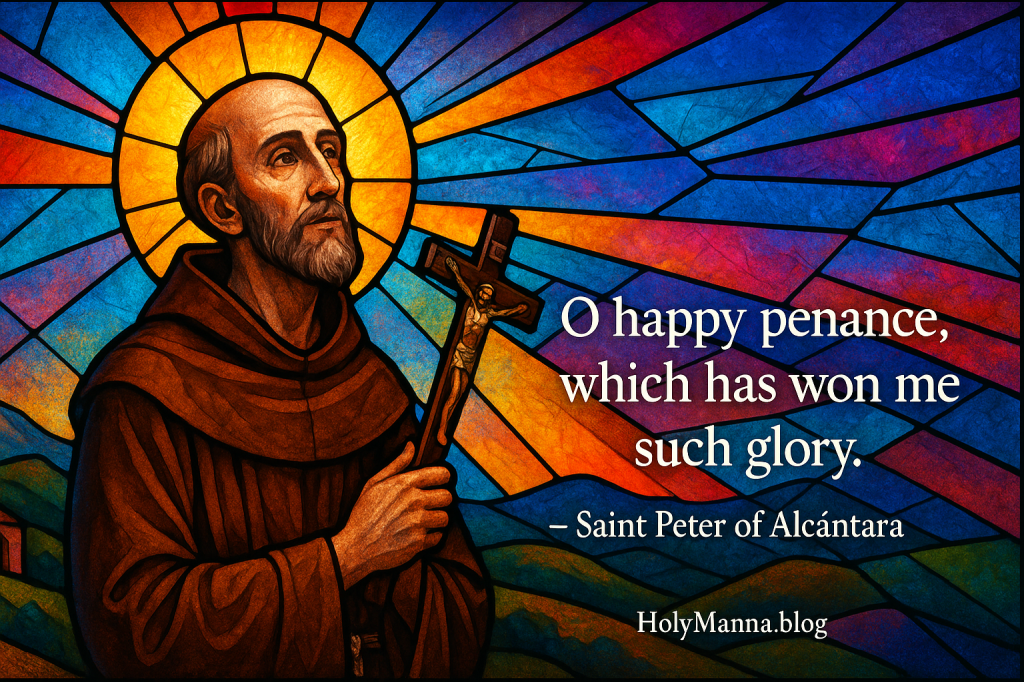
A Flame of Penance and Friendship with God
Saint Peter of Alcántara was a sixteenth-century Spanish Franciscan reformer whose radical simplicity, luminous prayer, and brotherly friendship with Saint Teresa of Jesus helped rekindle Catholic life in Spain. He became renowned as a spiritual father to founders and ordinary believers alike, guiding many through his small but mighty classic, Treatise on Prayer and Meditation. He is honored for restoring the original Franciscan ardor of poverty and contemplation, founding humble houses like El Palancar, and modeling a life where joy and penance meet in love.
Extremadura Beginnings and a Heart Set on the Lord
Peter was born in 1499 in the border town of Alcántara in Extremadura, Spain, to a family of modest standing that valued education and faith. Drawn early to solitude and prayer, he entered the Observant Franciscans as a youth and was ordained a priest in 1524. Over the years he served as guardian and provincial, but even as an administrator he kept the heart of a hermit. His conversion was not from unbelief to faith but from ordinary devotion to a wholehearted surrender to Christ, a deepening that matured through silence, fasting, and ceaseless meditation. He became best known as a reformer of Franciscan life, a director of souls, and the author of a practical manual that taught beginners how to begin and veterans how to persevere in mental prayer.
The Gospel Lived Out
Peter’s daily life preached before his words ever did. He wore a simple habit, went barefoot, and kept to a sparse diet that freed his heart for God. He founded and visited small hermitages, insisting on fraternal charity and cheerful austerity rather than gloomy rigor. His counsel was sought by nobles and peasants, by founders and by the poor, because his authority came from prayer. In his Treatise on Prayer and Meditation, he insists that prayer is the ordinary path to transformed living and steady virtue. He writes, “One of the most efficacious means for overcoming this dullness of heart is devotion.” He adds that true devotion does not come by accident but has a clear path: “If you ask me by what means devotion is attained, I answer that it is by meditation and contemplation of divine things.” These teachings shaped a generation of Spanish saints, none more famous than Saint Teresa of Jesus, whom he encouraged in 1562 as she prepared to open the first monastery of the Carmelite reform at Ávila.
Wonders that Accompanied His Steps
Those who knew Peter reported favors and miracles that followed his preaching and prayer. He was often in extasy while praying or in contemplation, and his blessing brought consolation and healing to the sick and poor who asked his intercession. The point of these wonders was never spectacle but conversion. When he visited communities, disputes softened, vocations deepened, and the lukewarm found fresh desire for God. His sanctity made him a trusted confessor and spiritual father, especially for Saint Teresa, who praised his holiness and credited his guidance at decisive moments of her reform.
Cross and Consolation
Reform is rarely welcomed, and Peter encountered resistance within his own family of friars as he proposed stricter observance of poverty and prayer. His frail health, worn by fasting and night vigils, meant frequent fatigue and illness. Yet he answered opposition with gentleness and humor, and he embraced bodily hardship as a free and loving participation in Christ’s Passion. The Church reminds us that “the way of perfection passes by way of the Cross; there is no holiness without renunciation and spiritual battle.” Peter’s life is a living commentary on that teaching. He was not a martyr, and he died peacefully on October 18, 1562, but he carried the daily martyrdom of self-gift with joy.
Afterglow of a Holy Life
After his death, devotion to Peter spread swiftly. Many testified to favors received through his intercession, from healings of the sick to reconciled families and renewed vocations. Pilgrims found inspiration in the little hermitage of El Palancar in Extremadura and in churches associated with his final years, returning home resolved to live more simply and pray more faithfully. Christian memory also preserves a short cry of triumph traditionally placed on his lips at the hour of death, a line that captures his whole spirituality: “O happy penance, which has won me such glory.” The Church confirmed his cult by beatifying him in 1622 and canonizing him in 1669, proposing him to all the faithful as a guide into the school of prayer.
Learning the Art of Mental Prayer
Saint Peter’s gift to the Church is the conviction that friendship with Jesus ripens in quiet, steady, mental prayer. The Church, echoing Saint Teresa of Jesus, describes contemplative prayer as “nothing else than a close sharing between friends; it means taking time frequently to be alone with Him who we know loves us.” Peter shows us the on-ramp: take a short Gospel scene, consider it slowly, speak to the Lord heart to heart, and then carry a simple resolution into the day. He also reminds us that penance is not a punishment but a medicine that frees love. “The seasons and days of penance” invite us to fast, give alms, and practice works of mercy, not to prove our strength but to create room for grace. Finally, he urges us to seek help from heaven. “Being more closely united to Christ, those who dwell in heaven do not cease to intercede with the Father for us.” Ask Saint Peter of Alcántara to obtain for you a love of prayer, a taste for simplicity, and courage to carry your cross with joy.
Start Small, Stay Faithful, Love Much
If his austerities feel distant from modern life, remember that the heart of his message is not extraordinary feats but ordinary fidelity. Choose ten quiet minutes each day to rest with the Lord in mental prayer. Practice small acts of penance that increase your freedom and tenderness, such as moderating screens, simplifying meals, or giving hidden alms. Let your schedule, your spending, and your attention serve what matters most. What is the one step you can take today that would make friendship with Jesus the first priority of your life? If you persevere there, Peter promises that devotion will awaken and grow.
Engage with Us!
Share your thoughts and experiences in the comments. How is the Lord inviting you to a deeper friendship through prayer right now?
- What small, consistent act of penance could help you love God and neighbor with greater freedom this week?
- When have you experienced the saints’ intercession in a concrete way, and how did it strengthen your faith?
- How might you simplify your schedule, your spending, or your screens so that prayer becomes the unmissable appointment of your day?
- Which line from Peter’s Treatise on Prayer and Meditation speaks to you most, and why?
Let us go forward together, keeping our eyes on Jesus. May Saint Peter of Alcántara teach us to pray faithfully, love simply, and do everything with the love and mercy that Jesus taught us.
Saint Peter of Alcántara, pray for us!
Follow us on Instagram and Facebook for more insights and reflections on living a faith-filled life.

 Holy Manna!
Leave a comment