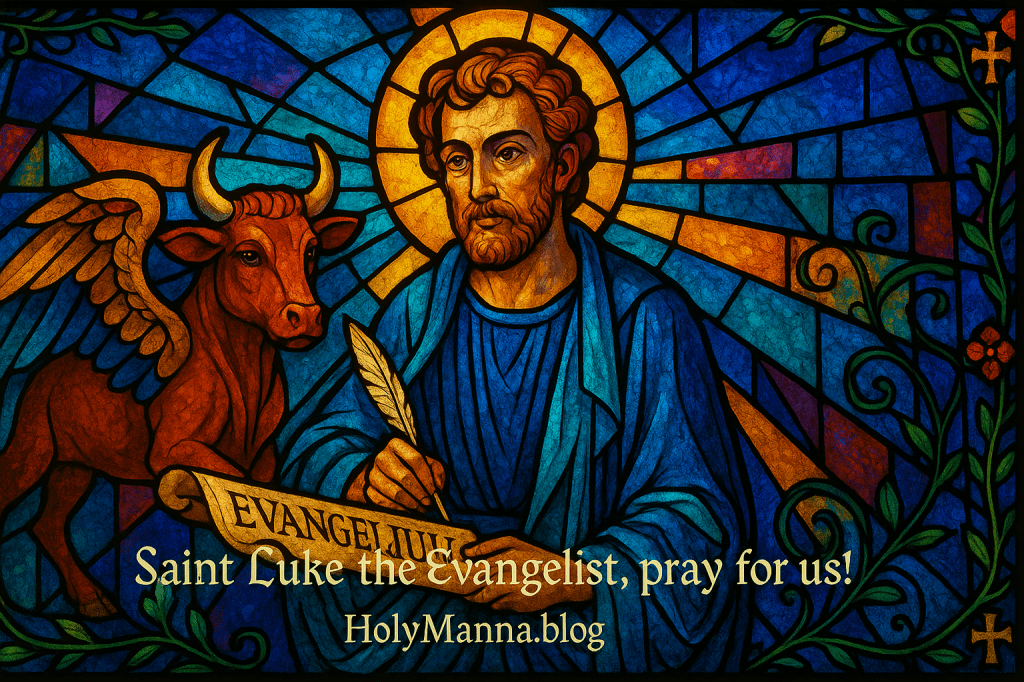
Physician of Mercy and Historian of the Spirit
Saint Luke the Evangelist shines as the Spirit-inspired author of the Gospel according to Luke and Acts of the Apostles, the trusted companion of Saint Paul, and the Church’s great narrator of divine mercy. Scripture remembers him as “the beloved physician” who stayed faithful beside Paul in trials, a witness whose careful research and pastoral heart serve the healing mission of Christ. The Church receives his writings with profound reverence because “God is the author of Sacred Scripture” and “the Gospels are the heart of all the Scriptures”. Luke’s two-volume work draws us into the joy of salvation, the tenderness of Jesus toward the poor and the sick, the dignity of women and the marginalized, and the fire of the Holy Spirit that launches the Church’s mission. As The Catechism of the Catholic Church urges, “In Sacred Scripture the Church constantly finds her nourishment and her strength.”
Antioch Beginnings and a Heart Converted to Christ
Ancient tradition traces Luke’s origins to Antioch of Syria. He is remembered as a Greek-speaking Gentile who practiced medicine before his conversion. In the bustling, cosmopolitan setting of Antioch, Luke encountered the Gospel that had begun to reach the nations. The New Testament situates him firmly in the apostolic era, appearing as Paul’s collaborator and later as the careful historian who addresses his writings to a certain Theophilus. Luke himself discloses his method and motivation in his elegant prologue: “It seemed good to me also, having followed all things closely for some time past, to write an orderly account for you, most excellent Theophilus, that you may know the truth concerning the things of which you have been informed.” His conversion flowers into a lifelong service of truth, charity, and mission, as he joins the apostolic journeys and preserves the Church’s earliest memories with physician-like precision.
An Orderly Account That Heals and Sends
Luke is best known for composing the third Gospel and Acts of the Apostles, which together make up a large portion of the New Testament. He writes with an eye for the human heart and for the saving nearness of God. Only his Gospel gives us the Annunciation to Mary and the tender infancy narratives with the Magnificat, Benedictus, and Nunc Dimittis. Only Luke tells the parables of the Good Samaritan and the Prodigal Son, where mercy meets misery and transforms it. He marks the path of discipleship with prayer, table fellowship, and joy. His account of the Risen Lord’s walk with the disciples to Emmaus reveals the pattern of Christian life as Scripture opened, hearts burning, and Christ known in the breaking of the bread. In Acts, Luke traces the story from Jerusalem to Rome as the Spirit empowers the Church through Pentecost, apostolic preaching, sacramental life, and missionary courage. We should remember and emulate Luke because he weds sound history to evangelical compassion, teaching us to love truth with tenderness and to practice the works of mercy his pages proclaim. As The Catechism teaches of inspiration, “God inspired the human authors of the sacred books”, so Luke’s careful research becomes a channel of God’s living word.
Medicine for Souls
No specific miracle worked by Luke himself is recorded in Scripture or the earliest traditions. Yet his vocation as a physician and evangelist becomes a sign of Christ’s own healing mercy. Through Luke’s pen we encounter the miracles of Jesus with luminous detail and the mighty deeds of the apostles in Acts. In his writings the blind receive sight, the lame walk, and sinners find forgiveness and peace. His narrative artistry becomes pastoral medicine, since he preserves for all generations the saving encounters that heal wounded consciences and reconcile divided communities. Luke’s own words in the opening of Acts summarize his purpose with humility and focus: “In the first book, O Theophilus, I have dealt with all that Jesus began to do and teach.” The work of Jesus continues through the Church, and Luke’s witness keeps that work before our eyes and within our reach.
Companionship in Hardship
Luke knew the rigors of apostolic mission. He sailed, walked, and suffered alongside Paul, and tradition sees his presence in the “we” passages of Acts, a quiet signature of fidelity. Paul’s letters preserve moving lines that suggest Luke’s steadfastness when others fell away, including the stark testimony, “Only Luke is with me.” The manner of Luke’s death is not certain. While some traditions hold that he died peacefully in Boeotia at an advanced age, most remember him as a martyr. What is clear is his perseverance under trial and his love for the Gospel until the end. His life teaches us to remain near to suffering apostles, to stand firm in seasons of abandonment, and to spend our gifts in service of the word of God.
A Legacy Venerated and Favors Sought
After his death, devotion to Saint Luke spread widely, and the Church honored his relics in several places over the centuries. Pilgrims have long sought his intercession for healing of body and soul, fitting for the beloved physician who made Christ’s mercy known. Christian memory also cherishes the ancient tradition that Luke painted an image of the Blessed Virgin Mary, a sign that evangelization can travel through beauty as well as through words. Whether contemplating his relics or venerating icons that tradition links to him, the faithful have asked for healing, courage, and clarity of faith. Luke’s legacy remains a living source of consolation because his writings and his witness continue to lead us to the Divine Physician.
That You May Know the Truth
Saint Luke invites us to discipleship that listens carefully, investigates humbly, and loves boldly. He shows us a Church that prays before acting, welcomes the poor, honors the dignity of women, and brings the Gospel to the margins. He urges us to give a reason for the hope within us by sharing an “orderly account” of God’s work in our lives. Let his prologue become our own mission statement and let the Emmaus pattern shape our days. Read Scripture daily. Let your heart burn as you listen to the word. Recognize Jesus in the Eucharist. Go share mercy with those who most need it. The Catechism assures us that Scripture is nourishment for holiness, so receive Luke’s pages as a living medicine and then become instruments of that same healing in your families, parishes, and neighborhoods.
Engage with Us!
Share your thoughts and testimonies in the comments below. We would love to pray with you and learn how Saint Luke’s witness is shaping your walk with Jesus.
- Where in Luke’s Gospel have you most clearly encountered the mercy of Jesus this week, and how did it move you to act?
- How does Luke’s example as “beloved physician” challenge the way you view your profession, studies, or daily responsibilities?
- Which scene in Acts of the Apostles inspires you to persevere when evangelization feels hard?
- How can your parish or small group embody Luke’s attention to the poor, the sick, and the marginalized?
- What “orderly account” of God’s work in your life could you write to encourage a friend who is seeking Christ?
Take courage. Walk with the Divine Physician. Tell the story of Jesus with accuracy and with love. Do everything with the mercy He taught us, and may Saint Luke intercede for us as we bring healing, truth, and hope to our world.
Saint Luke, pray for us!
Follow us on Instagram and Facebook for more insights and reflections on living a faith-filled life.

 Holy Manna!
Leave a comment