Little In Stature, Mighty In Obedience
Saint John the Dwarf, also called John the Little and John Kolobos, stands among the great Desert Fathers who shaped Christian monasticism in fourth and fifth century Egypt. He is remembered for luminous humility, cheerful austerity, and an obedience so complete that it became a living catechesis for the whole desert. Tradition honors him as a spiritual father of Scetis whose counsel formed generations of monks and whose life embodied what the Church calls the obedience of faith. In the West his memorial is commonly kept on October 17, while Eastern calendars often commemorate him in early November, and the Coptic Church remembers him in the month of Paopi.
Roots In The Desert, Heart Set On God
Ancient traditions place John’s origins in Upper Egypt. From youth he desired the hidden life with God, and as a young man he journeyed with his brother Daniel into the wilderness of Scetis to be formed by a holy elder, often identified as Abba Pambo. His nickname, “the Dwarf,” speaks to his small physical stature, but in the eyes of the fathers he became a giant in the interior life. Under his elder’s guidance he learned the path of the cell, the sweet labor of manual work, and the custody of the heart through unceasing prayer. He wove palm-leaf baskets, fed on little bread and water, guarded silence, and welcomed visitors who sought a word of life. What John is most known for is the fearless simplicity with which he surrendered his judgment in obedience so that Christ alone might rule his thoughts and desires.
The Tree That Bore The Fruit Of Obedience
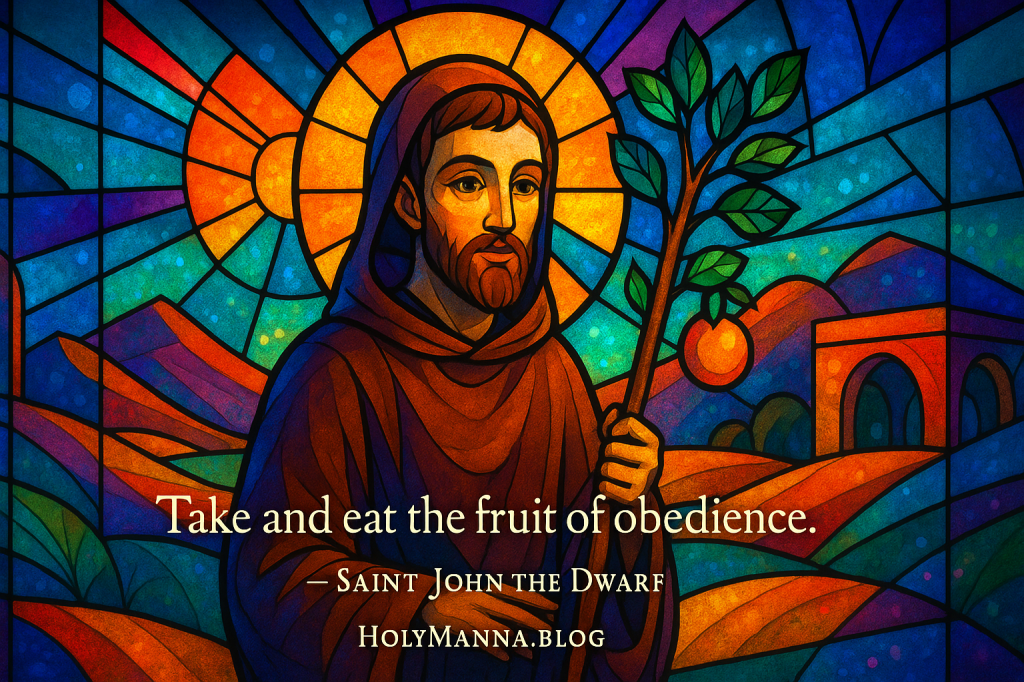
The most famous episode from John’s life began with an impossible command. His elder gave him a dead staff, told him to plant it in the sand, and instructed him to fetch water each day from a distant spring to irrigate it. John walked the long road daily for years, refusing to measure the command by his own reasoning. In time the lifeless wood sprouted, then leafed out, and finally produced edible fruit. The elder gathered the brethren and said, “Take and eat the fruit of obedience.” Monastic travelers later testified that the tree continued to grow in the courtyard as a sign for all who came to learn the way of Christ. This miracle is not a clever fable. It is a portrait of grace: when a disciple entrusts everything to God, the desert blooms and the impossible becomes nourishment for many.
John’s sayings also nourish the Church. One of his best known counsels uses the image of a siege to teach ascetic wisdom: “If a king wants to take a city, he cuts off its water and food; so the passions are overcome by hunger and thirst.” He did not glorify harshness for its own sake. He taught that fasting, watchfulness, and prayer are simply the tools that create space for the Holy Spirit to reorder the heart. Another treasured story tells of a woman named Paesia whose life had become enslaved to sin. John sought her out, spoke to her with fatherly mercy, and led her to repentance. Accounts relate that her conversion was sealed by a grace so swift and tender that it left John himself in awe of God’s compassion.
White Martyrdom In A World On Fire
The peace of the desert was often shattered by raiding parties that swept through the monastic settlements. During one such wave of violence, John and many brethren left Scetis and withdrew toward the Red Sea, near the mountain hallowed by Saint Anthony. Exile did not end his mission. He rebuilt the rhythm of prayer and work, counseled the young, and persevered in spiritual combat until his repose in the early fifth century. John did not die by the sword. His martyrdom was the daily laying down of his life in a thousand hidden choices to prefer God over self, serenity over resentment, humble perseverance over discouragement. This white martyrdom is why the Church remembers him with such affection. He shows that victory is found where one clings to Christ in trials and keeps going.
Light That Keeps Shining After Sunset
After John’s death, the memory of his sanctity spread wherever desert spirituality took root. Monks treasured the stories of his obedience and copied his sayings to guide their own inner warfare. Communities associated with Scetis preserved his relics with love, and pilgrims sought his intercession, reporting help in temptations, strength to endure dryness in prayer, and reconciliations that seemed humanly impossible. His icon often depicts a small, radiant elder holding a blossoming staff, a visual homily that invites every generation to trust that God can bring fruit from our barren places when we obey him with a childlike heart.
Why He Still Matters
Saint John the Dwarf teaches that holiness begins with small, steady acts of fidelity. The Catechism of the Catholic Church describes the Christian path as the obedience of faith, and it explains that to obey is to submit freely to the word we have heard because its truth is guaranteed by God. John’s staff became a tree because he entrusted his reason, his schedule, and his comfort to the wisdom of his elder for love of Christ. Today that same grace is available to us in the ordinary obedience of our vocation, our promises, and our daily duties. He also shows that ascetic practices are never about spiritual heroics. They are about love. Fasting, simplicity, and silence make room for mercy to reorder our desires. John’s life confirms that when we persevere in prayer, even when we are dry and tired, the Lord quietly changes us from within until charity becomes our second nature.
Plant Your Dry Staff
Begin where you are and choose one concrete act of obedience to the Gospel. Pray a brief Scripture each morning and carry it like a lamp through your day. Unite your work to God by offering it before you begin and thanking him when you finish. If you find yourself discouraged by weakness or failure, remember John’s lesson from the desert. Growth does not mean the absence of struggle. It means turning to God in the struggle, asking for mercy, and taking the next small step with trust. When your heart feels like dry wood, plant it in the soil of the Church’s prayer, water it with perseverance, and ask Saint John to help you bear the fruit of obedience.
Engage with Us!
I would love to hear your thoughts and graces. Share in the comments below how Saint John’s witness meets you today.
- Where is God inviting you to a small but steady “watering” of obedience this week?
- What helps you keep “composure of heart” when distractions and temptations crowd in?
- Who is a trustworthy elder or mentor you can learn from in the Lord, and what is one step you can take to seek their counsel?
- How might you unite ordinary work with short prayers so your day becomes a living liturgy?
May the example and prayers of Saint John the Dwarf strengthen you to live a life of faith, hope, and love, doing everything with the mercy Jesus taught us.
Saint John the Dwarf, pray for us!
Follow us on Instagram and Facebook for more insights and reflections on living a faith-filled life.

 Holy Manna!
Leave a comment