Thursday of the Twenty-eighth Week in Ordinary Time – Lectionary: 470
The Key of Mercy
Step inside today’s Word with a heart ready to be found. The readings move like a pilgrimage from the cry of the sinner to the doorway of the Kingdom, where the true key is not status or pedigree but the gift of divine mercy received in faith. In Romans 3:21-30, Saint Paul announces that the saving righteousness of God has appeared in Jesus Christ and is offered to all, Jew and Gentile alike, apart from the works of the law. This is not a downgrade of the law but its fulfillment, long foretold by the prophets, and now poured into human history as grace that justifies the one who believes. The Catechism teaches that justification is the gracious action of God that detaches us from sin and renews the interior person through the power of Christ’s Paschal mystery (CCC 1991–1992). The proper posture before this gift is not boasting but dependence, the humble recognition that “all have sinned” and that salvation is received, not achieved.
That interior posture finds its voice in Psalm 130, one of Israel’s great penitential songs, prayed by pilgrims ascending to worship in Jerusalem. From the bottom of the human heart the psalmist pleads, “Out of the depths I call to you, Lord”, trusting the God who does not sift through our failures to condemn but forgives in order to awaken reverence and hope. This is the Church’s perennial school of prayer, where contrition and confidence stand together. As The Catechism teaches, the acknowledgment of sins is already the beginning of the Spirit’s work in us, and the bold confession of God’s mercy opens us to conversion and life (CCC 1847–1848).
Against that backdrop, Luke 11:47-54 exposes a tragic temptation. Jesus confronts religious leaders who honor the tombs of the prophets yet resist the living God who speaks in their midst. They possess the Scriptures, but they do not enter the truth they proclaim, and they hinder others by misusing authority. The Lord warns that to reject God’s messengers is to stand accountable for a history of bloodshed reaching from Abel to Zechariah. The issue is not scholarship but surrender. Faith is a personal adherence to God who reveals, and obedience of faith is the free submission of the whole person to the God of truth (CCC 144).
Put together, these texts reveal a single path. God’s righteousness has drawn near in Christ, opening the door of mercy to every soul. The key that fits that door is faith working through repentance and love. The pilgrim’s cry of Psalm 130 becomes the believer’s confidence in Romans, and it stands as a judgment against any piety that refuses to be converted in Luke. Will I cling to my credentials, or will I receive the gift and step through the doorway Jesus opens today?
First Reading – Romans 3:21-30
Grace that Silences Boasting
Saint Paul writes to a mixed community of Jews and Gentiles in Rome in the late first century, where questions about the Mosaic law, circumcision, and access to covenant blessings were pressing. Into that tension, Paul announces that God’s saving righteousness has appeared in Jesus Christ and is offered to every person by faith. This is not a rejection of the law but its fulfillment, long foretold by the prophets and now revealed in history. The vocabulary of “expiation” recalls the mercy seat in the Temple, where blood was sprinkled on the Day of Atonement, now fulfilled in Christ. By setting the ground of salvation in God’s initiative rather than in human achievement, the passage dismantles ethnic pride and religious self-reliance and invites the humble cry of Psalm 130 into the obedience of faith. In today’s theme, grace opens the door and humility walks through it, while the Gospel warns that scholarship without surrender can still miss the key of knowledge.
Romans 3:21-30
New American Bible (Revised Edition)
21 But now the righteousness of God has been manifested apart from the law, though testified to by the law and the prophets, 22 the righteousness of God through faith in Jesus Christ for all who believe. For there is no distinction; 23 all have sinned and are deprived of the glory of God. 24 They are justified freely by his grace through the redemption in Christ Jesus, 25 whom God set forth as an expiation, through faith, by his blood, to prove his righteousness because of the forgiveness of sins previously committed, 26 through the forbearance of God—to prove his righteousness in the present time, that he might be righteous and justify the one who has faith in Jesus.
27 What occasion is there then for boasting? It is ruled out. On what principle, that of works? No, rather on the principle of faith. 28 For we consider that a person is justified by faith apart from works of the law. 29 Does God belong to Jews alone? Does he not belong to Gentiles, too? Yes, also to Gentiles, 30 for God is one and will justify the circumcised on the basis of faith and the uncircumcised through faith.
Detailed Exegesis
Verse 21 – “But now the righteousness of God has been manifested apart from the law, though testified to by the law and the prophets.”
Paul marks a decisive moment in salvation history. “But now” signals the Christ event. God’s covenant faithfulness, promised throughout the Law and the Prophets, is revealed in a way that does not depend on performing works of the Mosaic code. The continuity remains, since the whole Old Testament bears witness to this unveiling in Christ.
Verse 22 – “The righteousness of God through faith in Jesus Christ for all who believe. For there is no distinction.”
The gift is universal in scope and personal in reception. Faith is the open hand that receives Christ. There is no ethnic or ritual barrier. This levels the ground at the foot of the Cross and anticipates Paul’s later argument about Abraham as father of all who believe.
Verse 23 – “All have sinned and are deprived of the glory of God.”
A universal diagnosis requires a universal remedy. Humanity stands in need not of minor repair but of restoration to divine glory. The Church reads this as the backdrop for justification and sanctification, the healing and elevation of the human person by grace.
Verse 24 – “They are justified freely by his grace through the redemption in Christ Jesus.”
Justification is a gift, not a wage. “Freely” excludes boasting and puts all emphasis on God’s initiative. “Redemption” evokes the buying back of slaves and Israel’s exodus. Christ’s Paschal mystery is the price of our freedom.
Verse 25 – “Whom God set forth as an expiation, through faith, by his blood, to prove his righteousness because of the forgiveness of sins previously committed.”
“Expiation” translates the term that can mean mercy seat, the place of atonement. Jesus is both priest and place, the one in whom God meets sinners with mercy. His blood is covenantal life poured out for forgiveness. The Cross displays God’s justice and mercy together.
Verse 26 – “Through the forbearance of God, to prove his righteousness in the present time, that he might be righteous and justify the one who has faith in Jesus.”
God’s patience did not negate justice. In Christ, God shows himself just and the justifier. The scandal of deferred judgment finds its answer in the Cross where mercy and justice kiss, and faith becomes the door to share in that verdict.
Verse 27 – “What occasion is there then for boasting? It is ruled out. On what principle, that of works? No, rather on the principle of faith.”
Since salvation is gift, pride has no place. Faith shifts trust from self to God. Works of the law cannot be grounds for boasting, though works of love will flow from faith as its fruit.
Verse 28 – “For we consider that a person is justified by faith apart from works of the law.”
Paul states his thesis clearly. He is not rejecting the moral life. He is relocating its foundation. We live morally because we are justified by grace through faith, not in order to make ourselves just.
Verse 29 – “Does God belong to Jews alone? Does he not belong to Gentiles, too? Yes, also to Gentiles.”
There is one God and therefore one plan of salvation. The covenant was always destined to widen to the nations. The Church, born from Christ’s side, gathers all peoples into one family.
Verse 30 – “For God is one and will justify the circumcised on the basis of faith and the uncircumcised through faith.”
Paul echoes the Shema, Israel’s confession of the one God. Because God is one, the way is one. The circumcised and the uncircumcised share the same door, which is faith in Jesus Christ.
Teachings
In the light of this passage, the Church teaches the primacy of God’s initiative in justification and the real transformation it brings about in the believer. The Catechism summarizes the Tridentine doctrine with these words: “The first work of the grace of the Holy Spirit is conversion, effecting justification in accordance with Jesus’ proclamation at the beginning of the Gospel: ‘Repent, for the kingdom of heaven is at hand.’ Moved by grace, man turns toward God and away from sin, thus accepting forgiveness and righteousness from on high. ‘Justification is not only the remission of sins, but also the sanctification and renewal of the interior man.’” (CCC 1989).
Regarding the source and growth of Christian merit, The Catechism teaches: “Since the initiative belongs to God in the order of grace, no one can merit the initial grace of forgiveness and justification, at the beginning of conversion. Moved by the Holy Spirit and by charity, we can then merit for ourselves and for others the graces needed for our sanctification, for the increase of grace and charity, and for the attainment of eternal life.” (CCC 2010).
On our cooperation with grace, the Church reminds us with the words of Saint Augustine as cited by The Catechism: “God created us without us: but he did not will to save us without us.” (CCC 1847).
Historically, Paul’s claim that Christ is “expiation” evokes the Day of Atonement in Leviticus 16, when the high priest sprinkled blood on the mercy seat. In Christ, the symbol becomes reality. He is both the priest who offers and the place where God’s mercy is poured out. The Council of Trent affirmed this same mystery against both presumption and despair, insisting that the justified live by faith that works through love, with all true merit flowing first from grace.
Reflection
God’s righteousness has come near in Jesus and has silenced every boast. This frees you to stop performing for love and to start living from love. Begin your day by acknowledging your need before God and thanking him that justification is a gift, not a paycheck. Return to that truth when you fail and when you succeed. When you fail, run to confession and receive the mercy that restores you. When you succeed, give glory to God and ask for the grace to serve others without pride. Seek reconciliation in places where you have drawn lines, since God has opened one door for all. Practice a concrete act of humble love today that costs you something, and let it be your Amen to the grace that found you. Where do I still rely on my own effort to feel worthy of God’s love? Whom have I quietly excluded in my heart, and how is God inviting me to widen the circle? Will I allow the Cross to be my only boast, and will I live from that gift with joy today?
Responsorial Psalm – Psalm 130:1-6
From the Deepest Valley to the Dawn of Mercy
Known in the Church as the De profundis, Psalm 130 is one of the seven traditional penitential psalms and a “song of ascents” likely prayed by pilgrims journeying up to Jerusalem. Its language of depths, forgiveness, and waiting echoes the ancient rhythm of Israel’s worship, where confession and hope were woven into the Temple liturgy. The Psalm’s watchman imagery evokes sentinels scanning the horizon for first light after a long night on the city walls. In today’s theme, this prayer gives voice to the heart that refuses to boast and instead cries for mercy. It prepares us to receive the gift described in Romans 3:21-30 and warns us, with Luke 11:47-54, not to honor God with our lips while withholding our hearts. The psalm situates us where every Christian life begins and begins again, at the place where grace opens the door and humility walks through it.
Psalm 130:1-6
New American Bible (Revised Edition)
Prayer for Pardon and Mercy
1 A song of ascents.
Out of the depths I call to you, Lord;
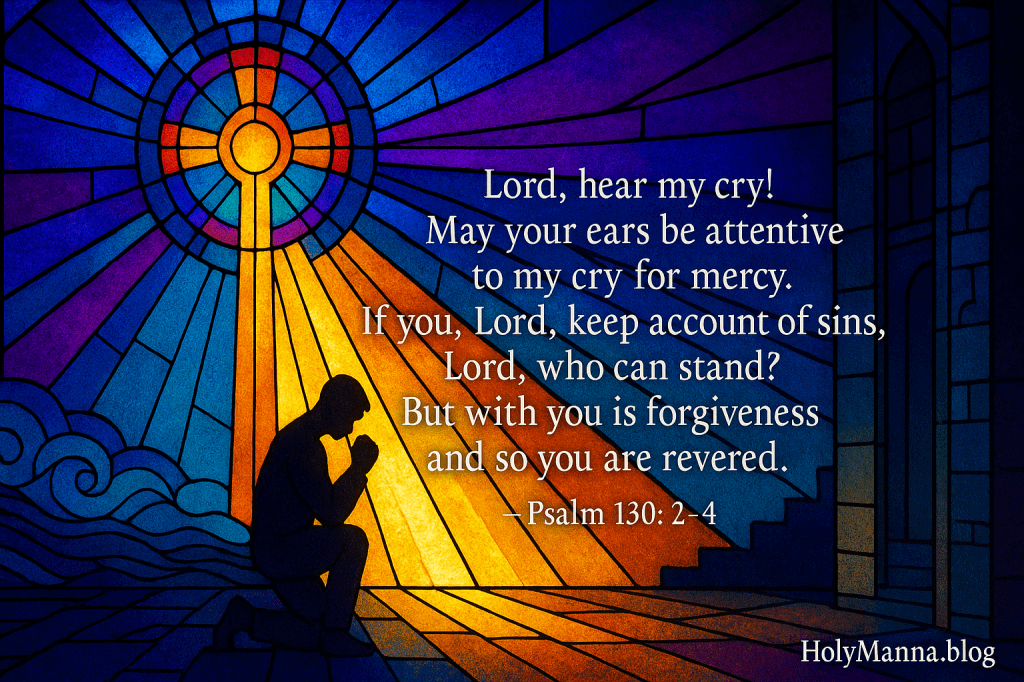
2 Lord, hear my cry!
May your ears be attentive
to my cry for mercy.
3 If you, Lord, keep account of sins,
Lord, who can stand?
4 But with you is forgiveness
and so you are revered.
5 I wait for the Lord,
my soul waits
and I hope for his word.
6 My soul looks for the Lord
more than sentinels for daybreak.
More than sentinels for daybreak,
Detailed Exegesis
Verse 1 – “Out of the depths I call to you, Lord;”
The prayer starts at the bottom. “Depths” in biblical language suggests chaos, danger, and the felt distance of exile. True conversion begins by telling the truth about our condition before God. The psalm refuses denial and models the honest cry that grace can meet.
Verse 2 – “Lord, hear my cry! May your ears be attentive to my cry for mercy.”
The repeated appeal emphasizes urgency and dependence. Mercy is not owed. It is asked for. Petition is an act of faith that God is Father and that he hears. This verse shapes a posture that prepares us for the justification that is received by faith, not earned by works.
Verse 3 – “If you, Lord, keep account of sins, Lord, who can stand?”
The psalmist confesses universal guilt. No one can remain standing when measured against divine holiness. This anticipates the apostolic claim that all have sinned and are deprived of God’s glory. The point is not despair but the leveling of pride so that all might receive the same mercy.
Verse 4 – “But with you is forgiveness and so you are revered.”
Forgiveness generates holy fear, not presumption. Awe is born in the experience of mercy. God’s pardon does not reduce his majesty. It reveals it. The right response to absolution is worship and a life reordered in gratitude.
Verse 5 – “I wait for the Lord, my soul waits and I hope for his word.”
Waiting is not passivity. It is trustful perseverance that leans on God’s promise. Hope is tethered to his word, not to self-improvement projects. This is the daily school of discipleship where Scripture sustains desire and guards it from discouragement.
Verse 6 – “My soul looks for the Lord more than sentinels for daybreak. More than sentinels for daybreak,”
Ancient watchmen peered into the darkness for the first sign of dawn. The repetition heightens longing. In the night of guilt or grief the believer looks for God with greater intensity than a guard looks for light. The image invites us to cultivate a vigilant hope that expects mercy’s sunrise.
Teachings
The Church names the interior movement of this psalm “contrition.” The Catechism of the Catholic Church defines it with precision: “Contrition is sorrow of the soul and detestation for the sin committed, together with the resolution not to sin again.” (CCC 1451). It also explains the kind of sorrow that most perfectly matches the psalmist’s hope: “When it arises from a love by which God is loved above all else, contrition is called ‘perfect’ contrition. Such contrition remits venial sins; it also obtains forgiveness of mortal sins if it includes the firm resolution to have recourse to sacramental confession as soon as possible.” (CCC 1452). The same teaching clarifies why verse 3 humbles every boast: “Sin is an offense against God. It is a failure in genuine love for God and neighbor caused by a perverse attachment to certain goods.” (CCC 1849).
In the life of prayer the psalm’s cry forms the Church to ask first for mercy. The Catechism highlights this primacy of humble petition: “The first movement of the prayer of petition is asking forgiveness, like the tax collector in the parable: ‘God, be merciful to me a sinner!’ It is a prerequisite for righteous and pure prayer.” (CCC 2631). Historically, Psalm 130 has been prayed for the dead and for the living. It shapes the Office of the Dead and has accompanied countless Christians in moments of repentance and mourning. In the monastic tradition it became a daily ladder of ascent where the heart learns to wait for God like a sentinel waits for dawn. The psalm therefore stands at the crossroads of conversion, liturgy, and hope, teaching the Church to breathe with confession and confidence at once.
Reflection
Begin by praying Psalm 130 slowly, letting the words become your own. Tell God the truth about your “depths,” name them without excuse, and ask for mercy with confidence. Seek the Sacrament of Reconciliation as an act of hope and reverence, trusting that forgiveness awakens holy fear and love. Carry a verse from this psalm in your heart today and return to it whenever pride rises or shame whispers. Watch for small dawns of grace in your life and thank God for every hint of light. Where do I feel stuck in the depths and how can I bring that place into the light of prayer today? What concrete step of repentance can I take this week to match my request for mercy with the resolve to change? Am I waiting on the Lord with the vigilance of a sentinel, or have I settled for a lesser hope that cannot sustain me through the night?
Holy Gospel – Luke 11:47-54
The Key of Knowledge and the Courage to Enter
In first century Judea, the scribes and Pharisees were honored as guardians of Scripture and tradition. They commemorated the prophets with tombs and memorials, yet Jesus exposes a tragic pattern. The fathers killed the prophets, and their descendants decorate the graves while repeating the same resistance to God’s living word. When Jesus speaks of the “key of knowledge,” he names the authority that should open the door of God’s Kingdom. Instead, it is misused to bar entry for self and others. Against the backdrop of Romans 3:21-30, where grace justifies the humble who believe, and Psalm 130, where the penitent soul waits for mercy, the Gospel confronts religious pride that honors revelation in theory but refuses conversion in practice. The Lord insists that true reverence is not building monuments but receiving God’s messengers and stepping through the door that grace has opened.
Luke 11:47-54
New American Bible (Revised Edition)
47 Woe to you! You build the memorials of the prophets whom your ancestors killed. 48 Consequently, you bear witness and give consent to the deeds of your ancestors, for they killed them and you do the building. 49 Therefore, the wisdom of God said, ‘I will send to them prophets and apostles; some of them they will kill and persecute’ 50 in order that this generation might be charged with the blood of all the prophets shed since the foundation of the world, 51 from the blood of Abel to the blood of Zechariah who died between the altar and the temple building. Yes, I tell you, this generation will be charged with their blood! 52 Woe to you, scholars of the law! You have taken away the key of knowledge. You yourselves did not enter and you stopped those trying to enter.” 53 When he left, the scribes and Pharisees began to act with hostility toward him and to interrogate him about many things, 54 for they were plotting to catch him at something he might say.
Detailed Exegesis
Verse 47 – “Woe to you! You build the memorials of the prophets whom your ancestors killed.”
Jesus indicts a piety that beautifies the past but betrays the present. The “woe” is not mere anger. It is a prophetic lament over a community that confuses honoring graves with heeding God. The memorials become cover for avoiding the prophetic call to repentance.
Verse 48 – “Consequently, you bear witness and give consent to the deeds of your ancestors, for they killed them and you do the building.”
By adorning the tombs while rejecting the living Word, they certify the old crime. Consent is shown not by words but by repeating the fathers’ pattern of resistance. The contrast prepares the Church to examine whether our external honors match an interior obedience of faith.
Verse 49 – “Therefore, the wisdom of God said, ‘I will send to them prophets and apostles; some of them they will kill and persecute’”
“Wisdom of God” aligns Jesus’ mission with God’s long plan of sending messengers. The addition of “apostles” widens the horizon to the Church’s witnesses. Persecution is not a surprise but a confirmation that God’s Word confronts hardened hearts and calls for decision.
Verse 50 – “In order that this generation might be charged with the blood of all the prophets shed since the foundation of the world,”
“Generation” means the present cohort that persists in the ancestral pattern. Responsibility accumulates when revelation is rejected. The line underscores that history is moral. To refuse God’s Word places us inside a story that we do not get to rewrite.
Verse 51 – “From the blood of Abel to the blood of Zechariah who died between the altar and the temple building. Yes, I tell you, this generation will be charged with their blood!”
From Abel in Genesis to Zechariah in 2 Chronicles, which closed the Hebrew canon, Jesus spans the whole scriptural story. The martyrdom “between the altar and the temple” highlights sacrilege in the very place of worship. The indictment warns that piety without conversion can become violent toward truth.
Verse 52 – “Woe to you, scholars of the law! You have taken away the key of knowledge. You yourselves did not enter and you stopped those trying to enter.”
The “key” is the rightful authority to interpret God’s Word and to open access to the Kingdom. Misused authority neither receives the Messiah nor allows others to approach him. The Lord exposes a scandal that can still occur when leaders make knowledge a barrier instead of a door.
Verse 53 – “When he left, the scribes and Pharisees began to act with hostility toward him and to interrogate him about many things,”
Hostility replaces humility. Interrogation becomes a strategy to trap rather than a search for truth. The narrative shows how hard hearts relate to Jesus. They question not to understand but to accuse.
Verse 54 – “For they were plotting to catch him at something he might say.”
The intent is entrapment. This anticipates the Passion, where the rejection of the Word culminates in violence. The Gospel invites us to the opposite posture, the obedience of faith that listens, repents, and enters.
Teachings
The Catechism describes the heart of the Gospel’s call: “To obey (from the Latin ob-audire, to ‘hear or to listen to’) in faith is to submit freely to the word that has been heard, because its truth is guaranteed by God, who is Truth itself.” (CCC 144).
Regarding revelation’s climax in Christ, The Catechism teaches: “In many and various ways God spoke of old to our fathers by the prophets, but in these last days he has spoken to us by a Son.” and “Christ, the Son of God made man, is the Father’s one, perfect, and unsurpassable Word.” (CCC 65).
On the Church’s service to the Word, The Catechism states: “The task of giving an authentic interpretation of the Word of God, whether in its written form or in the form of Tradition, has been entrusted to the living, teaching office of the Church alone.” (CCC 85).
On the danger of externalism without conversion, The Catechism insists: “Jesus’ call to conversion and penance, like that of the prophets before him, does not aim first at outward works, ‘sackcloth and ashes,’ fasting and mortification, but at the conversion of the heart, interior conversion.” (CCC 1430).
The Fathers echo this summons. Saint Jerome’s maxim remains a perennial test for stewardship of the “key of knowledge.” “Ignorance of Scripture is ignorance of Christ.” The Gospel therefore forms both pastors and people to hear, to enter, and to help others enter.
Reflection
Receive Jesus as the living Word who fulfills the prophets and sends apostles to you today. Ask the Holy Spirit to show where you have admired truth at a distance but resisted its claim up close. Pray for your pastors and teachers to use the key of knowledge to open, not to bar, and resolve to support them through intercession and obedience in faith. Practice one concrete act of entering, such as reconciling with someone you have wronged, studying the day’s Gospel with a teachable heart, or sharing a word of witness that invites another to come closer to Christ. Where am I building memorials while avoiding conversion in the present moment? How can I move from interrogating Jesus to listening and obeying him in a specific area of my life? Whom might I be hindering by my example, and how can I become a door that opens to the Lord today?
Open the Door and Enter
Today’s Word drew a single line of grace across Romans 3:21-30, Psalm 130:1-6, and Luke 11:47-54. In Romans, God’s righteousness is revealed as gift, not wage, so that “all have sinned” yet are “justified freely by his grace through the redemption in Christ Jesus”. In Psalm 130, the Church gives this truth a voice that rises “out of the depths” with contrite confidence and watchful hope. In Luke, Jesus warns that honoring truth without surrender keeps the key of knowledge in our pocket and leaves the door shut. The path is clear. Grace opens the door. Humility walks through it. Faith receives, adores, and obeys.
Let your response be simple and wholehearted. Confess the depths without fear. Ask for the mercy that awakens holy reverence. Choose concrete obedience where the Lord is speaking today. Pray Psalm 130 as your morning and evening breath, then live from Romans by letting Christ’s gift, not your performance, be your boast. Refuse the temptation to admire Jesus at a safe distance. Enter by listening, repenting, and doing the next loving thing he places before you. Where is the Lord inviting me to trade self-reliance for trust today? Whom can I encourage to approach Jesus by opening a door with my words and my witness? May the Holy Spirit grant us the courage to step through the doorway of mercy and to lead others into the same light until the daybreak of Christ fills the whole horizon.
Engage with Us!
We would love to hear your heart. Share your reflections in the comments below and tell us how the Lord spoke to you through today’s readings.
- First Reading – Romans 3:21-30: Where do I still try to earn God’s love instead of receiving it as gift? What would it look like today to let faith silence my boasting and widen my welcome to others?
- Responsorial Psalm – Psalm 130:1-6: What are the “depths” I need to name before God right now? How can I wait for the Lord like a sentinel for daybreak through concrete practices of prayer and confession?
- Holy Gospel – Luke 11:47-54: How might I be honoring truth outwardly while resisting conversion inwardly? In what practical way can I use the “key of knowledge” to help someone else enter more deeply into Jesus today?
May the Holy Spirit strengthen you to live a life of faith, hope, and charity, and to do everything with the love and mercy Jesus taught us.
Sacred Heart of Jesus, we trust in You!
Immaculate Heart of Mary, pray for us!
Saint Michael the Archangel, defend us in battle!
Follow us on Instagram and Facebook for more insights and reflections on living a faith-filled life.

 Holy Manna!
Leave a comment