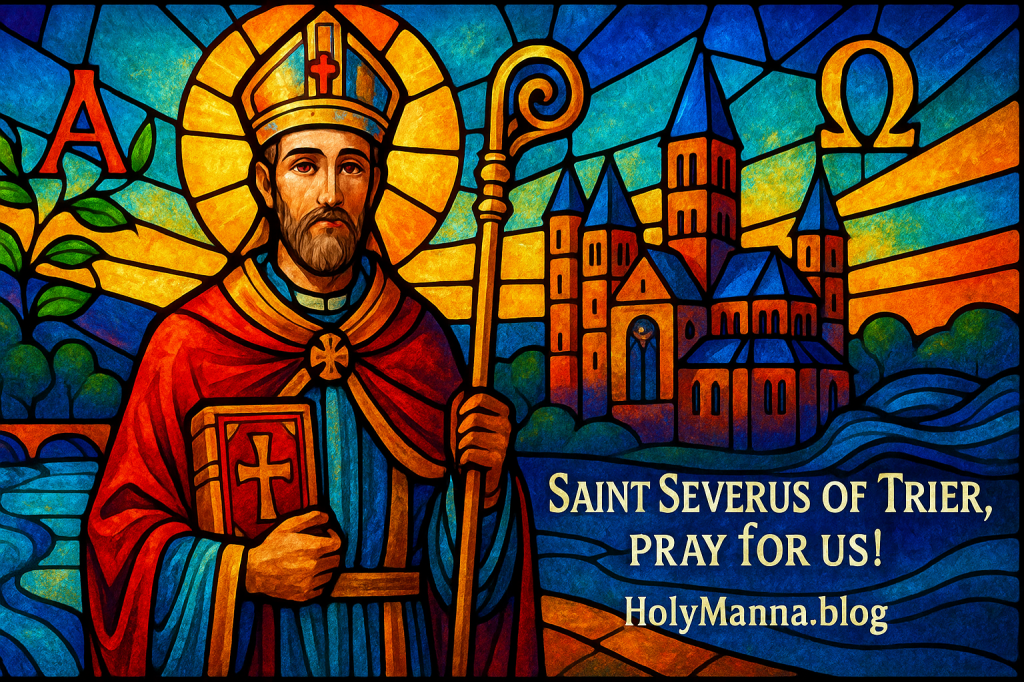
A Shepherd on the Edge of Empires
Saint Severus of Trier stands at the crossroads of the late Roman world and the dawn of early medieval Europe. As bishop of Trier in the mid fifth century, he strengthened an ancient Christian community that had once lived in the orbit of imperial power and now found itself on a shifting frontier. He is remembered as a confessor of the faith who guarded sound doctrine, preached Christ with clarity, and worked for the conversion of peoples along the lower Moselle and Middle Rhine. His memory endures in the local Church on October 15, where he is honored for pastoral courage and steadfast hope. The heart of his witness mirrors the Church’s teaching about bishops: “Bishops, with priests as co workers, have as their first task to preach the Gospel of God to all men. They are authentic teachers of the apostolic faith endowed with the authority of Christ.” (Catechism of the Catholic Church, 888).
Formed for Mission in a Time of Upheaval
Very little is recorded about Severus’s family background or birthplace, which is not unusual for his era. What emerges from reliable traditions is the shape of his formation. He is closely linked to the circle of holy pastors in Gaul, especially Saint Lupus of Troyes and Saint Germanus of Auxerre. Around 445 or 446 he succeeded Leontius as bishop of Trier, one of the most venerable sees in the West. Trier had been an imperial residence in the previous century. By Severus’s time it had become a border city that needed strong, patient shepherding. His reputation for preaching carried beyond the city and into the countryside, where many communities were in the early stages of embracing the Gospel. Some late traditions report that Severus secured an early papal privilege for the Church of Trier. While the precise details of that claim are debated, the tradition captures how the faithful remembered him as a bishop who strengthened communion with the wider Church.
Fellow Laborer for the Gospel
Severus’s name is intertwined with the missionary efforts of his friend Saint Germanus of Auxerre. Tradition holds that Severus assisted Germanus on his second journey to Britain, around 447, to confront the Pelagian crisis. Pelagianism denied the necessity of grace and undermined the Church’s proclamation of salvation in Christ. The British mission is remembered for preaching, catechesis, and a renewal of Christian life among clergy and laity. Whether Severus’s personal role on that journey is described in every source with the same precision, the larger portrait is consistent. He was a bishop who taught sound doctrine, supported evangelization, and fostered stable Christian communities at the edges of the former Empire. In the Rhineland and Moselle regions he promoted the conversion of local and newly arrived Germanic peoples through patient instruction, pastoral visitation, and the celebration of the sacraments. His style of leadership embodied the missionary heart of the Church and the grace filled rhythm of teaching, sanctifying, and governing in service to Christ’s flock.
The Humble Silence of History
Unlike the lives of some saints, no specific, well attested miracles worked personally by Severus have come down to us in detail. The narratives that describe healings and dramatic interventions during the British missions attribute those signs primarily to Saint Germanus. Rather than fill the silence with inventions, we take the record as it stands and give thanks for what God accomplished through the communion of holy pastors laboring together. The Church helps us understand how such witnesses strengthen us even when particulars are sparse: “They do not cease to intercede with the Father for us, as they proffer the merits which they acquired on earth through the one mediator between God and men, Christ Jesus. So by their fraternal concern is our weakness greatly helped.” (Catechism of the Catholic Church, 956). In Severus we see the quiet miracle of persevering fidelity that bears fruit across generations.
Confessor in the Storm
Severus served during years marked by political turbulence, migrations, and theological confusion. Bishops in northern Gaul faced pressures from within and without. They guarded orthodoxy against distortions of the faith, encouraged clergy, reconciled the lapsed, and mediated with civil powers for the protection of their people. Severus is venerated as a confessor rather than a martyr. He did not shed blood for the faith, yet he gave his life to the daily martyrdom of pastoral charity. He endured the trials of his office with courage and patience, holding fast to the truth and guiding his flock through uncertainty. In him we learn that heroic sanctity often looks like steadfast service in ordinary time.
The Pilgrim Church of Trier
The Church of Trier keeps his memory with devotion. His feast is celebrated on October 15, and a local tradition in Trier commemorates the translation of his relics on November 18. Pilgrims in Trier still find a living expression of the faith in the ancient cathedral, where the bishops’ crypt speaks quietly of continuity, sacrifice, and prayer across the centuries. There are no widely circulated medieval miracle tales tied solely to Saint Severus’s shrine, yet the very fact of his veneration shows how the faithful experienced his intercession. Generations have asked his prayers for steadfastness in trial and for unity in the truth. The Church teaches why this matters for us today: “By canonizing some of the faithful, the Church recognizes the power of the Spirit of holiness within her and sustains the hope of believers by proposing the saints to them as models and intercessors.” (Catechism of the Catholic Church, 828).
What Saint Severus Teaches Our Hearts
Saint Severus of Trier reminds us that holiness often grows in the hidden places of fidelity. He teaches bishops, priests, deacons, catechists, and parents to persevere in handing on the faith without compromise and without harshness. He invites us to make space for the Holy Spirit in our neighborhoods, workplaces, and parishes through reverent worship, sacramental life, and patient teaching. If you serve in ministry, let his example encourage you to preach Christ clearly and to accompany souls gently. If you carry family responsibilities, ask his intercession for the courage to form your home in the faith through daily prayer, Sunday Mass, and works of mercy. Do not be discouraged by the lack of spectacular signs. Lean into the ordinary graces that build the Church one person at a time. There are no surviving writings or verified quotations from Saint Severus himself. That silence can free us to listen more intently to the Gospel he preached and to the teaching office he served with humility.
Engage with Us!
- Where is God asking you to defend the truth in love this week, especially through patient teaching rather than argument?
- How can you support your parish’s preaching and catechesis so the Gospel reaches those at the “frontiers” of your community?
- What concrete step will you take today to deepen your devotion to the communion of saints and ask their intercession for your family?
Be encouraged. Live the Gospel with courage, tenderness, and fidelity, and do everything with the love and mercy Jesus taught us.
Saint Severus of Trier, pray for us!
Follow us on Instagram and Facebook for more insights and reflections on living a faith-filled life.

 Holy Manna!
Leave a comment