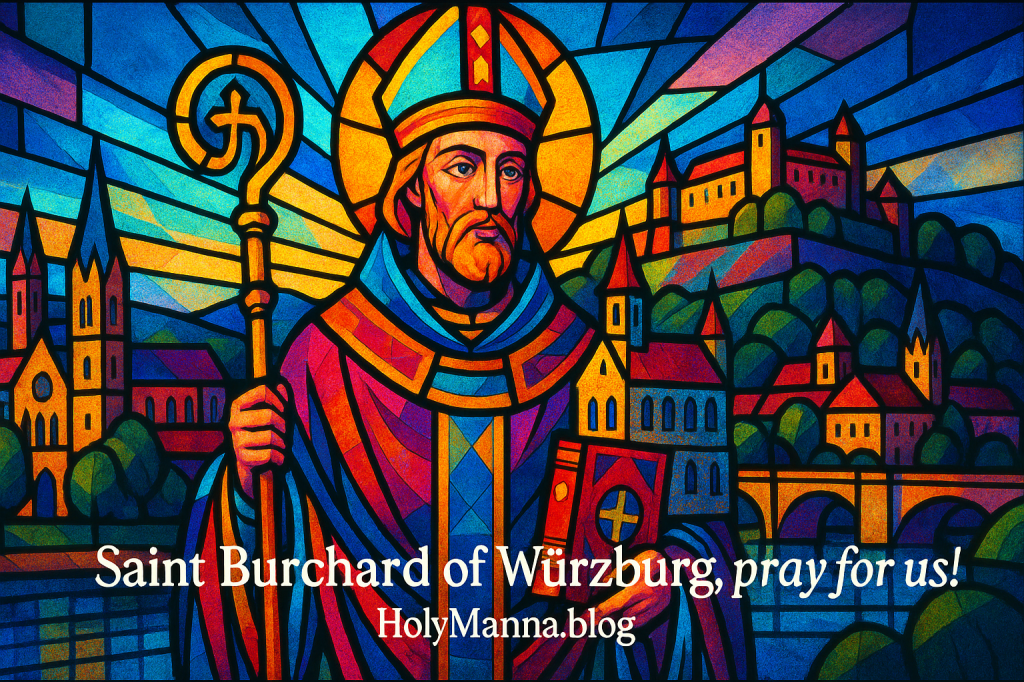
A Pastor Who Built a Church
Saint Burchard of Würzburg stands at the headwaters of Catholic life in Franconia as its first bishop and one of Saint Boniface’s most trusted collaborators. An English monk formed by Benedictine spirituality, he crossed the sea to serve the Gospel on missionary frontiers and was consecrated bishop around the early 740s. As bishop he organized parishes and deaneries, fostered monastic houses as centers of prayer and learning, and shaped the Christian identity of the region by solemnly enshrining the relics of Saint Kilian and his companions. His feast is kept on October 14. Burchard is revered for steady, fatherly governance that married zeal for souls with careful institution building. The Church teaches of bishops that “with priests as co-workers, their first task is to preach the Gospel of God to all men… They are authentic teachers of the apostolic faith endowed with the authority of Christ.” (Catechism of the Catholic Church). Burchard lived that mandate with clarity and courage.
From Island Roots to a Continental Mission
Burchard’s early life unfolded in England, where he embraced the Benedictine path of ora et labora, prayer and work, in a culture that had already produced saints who evangelized Europe. After the death of his parents he answered the call of mission and joined Saint Boniface’s circle on the continent. He labored in Thuringia and the Main valley, where the Church was young and the task immense. Recognized for prudence and holiness, he was entrusted with the newly formed see of Würzburg and confirmed by Rome. He founded and nurtured monasteries, notably at Neustadt am Main, to be wells of prayer, catechesis, and priestly formation for a generation. His name became synonymous with pastoral order, reliable counsel to the emerging Carolingian rulers, and filial loyalty to the Apostolic See. If you ask what he is most known for, it is the wise planting of the Church so that the sacraments, sacred teaching, and shepherding care would endure long after he was gone.
Ordering the Vineyard
Burchard’s daily life as bishop shows why he matters and why his memory is worth imitating. He convened clergy, taught sound doctrine, corrected abuses, set norms for the celebration of the sacraments, and visited his flock. He supported synodal life in the Frankish realms so that evangelization would be shared rather than solitary. He promoted the cult of local martyrs, especially Saint Kilian, not as ornament but as a living catechesis that rooted a missionary people in the communion of saints. Contemporary records do not preserve spectacular miracle tales from his lifetime. Instead, the most evident marvel is the durable fruit of his labor: a diocese that outlived emperors and invasions, clergy formed in prayer and discipline, and a people schooled in the faith. The Catechism reminds us that “The Church is missionary by her very nature.” Burchard’s miracle is the ordinary holiness that makes a missionary Church take lasting shape.
Trials and the Grace of Perseverance
The frontier Church did not lack trials. Burchard faced lingering pagan customs, syncretism, and resistance to moral conversion. He navigated political transitions with fidelity to the Gospel, maintaining communion with Rome while serving the common good. Travel was arduous, roads were unsafe, and communication slow, yet he sought counsel when needed and offered it when asked. In time he laid down his episcopal office, retired to monastic quiet at Homburg on the Main, and died in peace in the mid-eighth century. He was a confessor, whose steadfastness under pressure offers a pattern for shepherds and laity alike. The Catechism teaches that “The bishop is the steward of the grace of the supreme priesthood.” In Burchard we see a steward who poured himself out for the flock with patient courage.
Light After Sunset
After his death the people he had formed continued to honor him. His remains were reverently kept and later translated to a church in Würzburg that now bears his name, St. Burkard, where the faithful ask his intercession to this day. The city’s devotion to Saint Kilian grew in tandem with gratitude for the bishop who had enshrined the martyrs and taught the people to venerate them with right understanding. Pilgrims came to Würzburg to pray at the tombs, to seek healing of soul and body, and to renew their baptismal promises at the altars he helped to establish. The Catechism calls this web of love “the communion of saints” and teaches that “the religious sense of the Christian people finds expression in the veneration of relics,” which extend the Church’s liturgical life without replacing it. The enduring cult of Saint Burchard is a quiet testimony that God loves to continue his work through the humble servants he has made holy.
Building With Patience, Praying With the Church
Saint Burchard’s life invites us to see evangelization not only as charismatic preaching but as patient daily faithfulness. He shows that to build the Church is to love her worship, form her ministers, teach her doctrines, and anchor her people in the saints who point to Christ. In a noisy age, his witness suggests that order, obedience, and consistency are not dull but fruitful. Pray for your bishop and priests, offer your gifts for parish formation, and let devotion to the saints deepen your love for the sacraments. As the Catechism beautifully puts it, “These expressions of piety extend the liturgical life of the Church, but do not replace it.” If no authenticated sayings survive from Saint Burchard’s own lips, his deeds preach with clarity. Let his pastoral heart inspire us to love Jesus in the Eucharist, to revere the martyrs, and to plant something that will outlast us.
Engage with Us!
- Where do you see God inviting you to help “build” the Church in your parish or city, as Burchard did in Würzburg?
- How can you support your bishop and priests this month in their mission to teach, sanctify, and govern?
- What sacramentals or devotions draw you closer to the Eucharist without replacing the liturgy in your life?
- When have you experienced the communion of saints through the intercession of a patron saint or local shrine?
- Which concrete step will you take this week to evangelize with patience and fidelity?
May Saint Burchard’s intercession help us live the faith with wisdom, courage, and love. May we do everything with the love and mercy Jesus taught us.
Saint Burchard of Würzburg, pray for us!
Follow us on Instagram and Facebook for more insights and reflections on living a faith-filled life.

 Holy Manna!
Leave a comment