Tuesday of the Twenty-eighth Week in Ordinary Time – Lectionary: 468
Worshiping the Creator
Take a breath and let creation’s silent hymn draw you in, because “The heavens declare the glory of God” (Psalm 19:2). Today’s readings move from the sky’s wordless proclamation to the soul’s deepest motives, calling us to reject every idol and let mercy cleanse our hearts. Saint Paul announces the saving power that does not depend on status or pedigree. “I am not ashamed of the gospel. It is the power of God for the salvation of everyone who believes” (Romans 1:16). Yet he also warns that humanity often trades the living God for lesser loves, “exchanging the truth of God for a lie” and worshiping what is made rather than the Maker (Romans 1:25). The Catechism teaches that we can know God through creation itself (CCC 31–34), and it names idolatry for what it is. It is the divinizing of what is not God (CCC 2112–2114). The firmament’s beauty leaves us without excuse, but it also invites us back to true worship.
Against that backdrop, Luke 11:37–41 brings us to a dinner table in a Pharisee’s home, where purity customs were part of daily piety in Second Temple Judaism. Ritual washings were meant to express reverence and separation for God’s service. Jesus does not discard reverence. He goes deeper. He reveals the divine logic of the Law that aims at the heart. “Although you cleanse the outside of the cup and the dish, inside you are filled with plunder and evil” (Luke 11:39). The remedy he gives is not a new technique but a renewed heart that overflows in mercy. “As to what is within, give alms, and behold, everything will be clean for you” (Luke 11:41). In the Jewish tradition, almsgiving, or tzedakah, was not mere philanthropy. It was a concrete act of justice and covenant love. The Catechism names almsgiving as a work of mercy that expresses interior conversion (CCC 1434, CCC 2447).
Rome’s culture prized wisdom, power, and the gods of the empire. Paul writes into that world and into ours. He insists that righteousness comes from faith and leads to a life that honors the Creator. The psalmist reminds us that creation’s beauty is revelation, not a replacement for God. Jesus then exposes the perennial temptation to settle for external correctness while the heart remains unconverted. Together the readings form a single invitation. Recognize the Creator in the splendor of the works of his hands. Renounce idols that cannot save. Let faith in Christ purify the inner person and bear fruit in mercy toward the poor.
Where does creation’s quiet witness stir your heart to give thanks today? What act of concrete mercy could express your desire for a clean heart before God?
First Reading – Romans 1:16–25
Power, Glory, and the Peril of Trading Truth for Idols
Paul writes into the heart of the Roman world where civic religion, the imperial cult, and a marketplace of gods shaped daily life. In that setting he announces that the Gospel is God’s power that saves all who believe, both Jew and Greek, and unveils the righteousness of God. This message confronts a second reality that spans every age. Humanity tends to exchange the living God for lesser objects of worship. The created world shines like a cathedral that silently proclaims its Maker. Yet hearts turn inward and downward when thanksgiving is withheld. Within today’s theme of true worship and interior conversion, this reading exposes idolatry as a refusal to glorify and thank the Creator, and it points to faith as the doorway into a rightly ordered life that gives God his due.
Romans 1:16-25
New American Bible (Revised Edition)
16 For I am not ashamed of the gospel. It is the power of God for the salvation of everyone who believes: for Jew first, and then Greek. 17 For in it is revealed the righteousness of God from faith to faith; as it is written, “The one who is righteous by faith will live.”
Punishment of Idolaters. 18 The wrath of God is indeed being revealed from heaven against every impiety and wickedness of those who suppress the truth by their wickedness. 19 For what can be known about God is evident to them, because God made it evident to them. 20 Ever since the creation of the world, his invisible attributes of eternal power and divinity have been able to be understood and perceived in what he has made. As a result, they have no excuse; 21 for although they knew God they did not accord him glory as God or give him thanks. Instead, they became vain in their reasoning, and their senseless minds were darkened. 22 While claiming to be wise, they became fools 23 and exchanged the glory of the immortal God for the likeness of an image of mortal man or of birds or of four-legged animals or of snakes.
24 Therefore, God handed them over to impurity through the lusts of their hearts for the mutual degradation of their bodies. 25 They exchanged the truth of God for a lie and revered and worshiped the creature rather than the creator, who is blessed forever. Amen.
Detailed Exegesis
Verse 16 – “For I am not ashamed of the gospel. It is the power of God for the salvation of everyone who believes: for Jew first, and then Greek.”
Paul rejects cultural embarrassment and declares that the Gospel does not merely inform but transforms. Salvation comes through faith, which levels distinctions of privilege and precedence. The phrase “Jew first, and then Greek” honors salvation history while revealing the Gospel’s universality.
Verse 17 – “For in it is revealed the righteousness of God from faith to faith; as it is written, ‘The one who is righteous by faith will live.’”
God’s righteousness is his faithful covenant action that sets things right. It is revealed in the Gospel and received by faith. The citation echoes Habakkuk 2:4 and frames Christian life as a continual movement of faith that begins, grows, and perseveres by trusting God.
Verse 18 – “The wrath of God is indeed being revealed from heaven against every impiety and wickedness of those who suppress the truth by their wickedness.”
Divine wrath is not capricious rage. It is God’s holy opposition to sin and the consequential unveiling of disorder when truth is resisted. Suppressing the truth is moral, not merely intellectual. Sin silences the witness of reality and chokes gratitude.
Verse 19 – “For what can be known about God is evident to them, because God made it evident to them.”
Knowledge of God’s existence and some attributes is accessible because God himself makes it so. Revelation begins with creation’s givenness. The problem is not absence of light but refusal to receive it.
Verse 20 – “Ever since the creation of the world, his invisible attributes of eternal power and divinity have been able to be understood and perceived in what he has made. As a result, they have no excuse;”
Creation functions as a universal pedagogy. The visible world bears traces of the invisible God. Paul concludes that culpable ignorance is inexcusable when one refuses the testimony of the works of God.
Verse 21 – “for although they knew God they did not accord him glory as God or give him thanks. Instead, they became vain in their reasoning, and their senseless minds were darkened.”
Failure to glorify and thank God triggers a downward spiral. When worship and gratitude cease, reason becomes futile and the interior light dims. In biblical logic, thanksgiving is not a courtesy. It is the safeguard of sanctified reason.
Verse 22 – “While claiming to be wise, they became fools”
Detached from worship, self-styled wisdom collapses into folly. Pride masquerades as insight while the heart drifts from reality’s source.
Verse 23 – “and exchanged the glory of the immortal God for the likeness of an image of mortal man or of birds or of four-legged animals or of snakes.”
The exchange is the essence of idolatry. Images are not evil in themselves, but absolutizing creatures in place of the Creator distorts both worship and human dignity. What we adore we resemble.
Verse 24 – “Therefore, God handed them over to impurity through the lusts of their hearts for the mutual degradation of their bodies.”
“Handed over” signals a judicial permission where God allows sin’s consequences to manifest. Disordered worship yields disordered desire. Bodies and relationships suffer when the heart’s altar is misdirected.
Verse 25 – “They exchanged the truth of God for a lie and revered and worshiped the creature rather than the creator, who is blessed forever. Amen.”
Paul returns to the tragic exchange. The creature is good, but not God. Right worship blesses the Creator and heals the worshiper. False worship enthrones a lie and fractures the person from within.
Teachings
Paul’s diagnosis aligns with the Catechism on idolatry and the knowledge of God through creation. “Idolatry not only refers to false pagan worship. It remains a constant temptation. Idolatry consists in divinizing what is not God.” (CCC 2113). The first commandment’s claim is absolute. “The first commandment condemns polytheism.” (CCC 2112). Creation itself is a pathway to God, not a rival to him. “From the order and beauty of the world, one can come to a knowledge of God as the origin and end of the universe.” (CCC 32). The moral fallout Paul describes flows from worship dislocated from truth. Works of mercy embody renewed worship. “The works of mercy are charitable actions by which we come to the aid of our neighbor in his spiritual and bodily necessities.” (CCC 2447). The saints echo Paul’s call to re-center worship. Saint Augustine confesses the heart’s true horizon: “You have made us for yourself, O Lord, and our heart is restless until it rests in you.” (Confessions I, 1). In a culture that prizes self-made wisdom, Paul reminds us that genuine wisdom begins in adoration and thanksgiving that honor the Creator.
Reflection
Give God glory today with your mind, your words, and your choices. Begin with thanksgiving. Name the gifts of creation that point you to the Giver. Renounce the subtle idols of productivity, pleasure, and image that promise meaning but cannot save. Reorder desire by choosing an act of mercy that costs you something and blesses someone in need. Let your worship become visible in your generosity. Where have you exchanged truth for a convenient half truth in order to fit in or feel in control? What would it look like to restore thanksgiving as the first movement of your day? How might a concrete work of mercy today become your act of true worship before the Creator who is blessed forever?
Responsorial Psalm – Psalm 19:2–5
Creation’s Silent Symphony and the Call to True Worship
Composed as a hymn of praise, Psalm 19 unites Israel’s worship with the cosmic witness of the heavens. In ancient Israel, the sky and the firmament were not objects to be adored but signs that pointed beyond themselves to the Lord, the Maker of heaven and earth. Within Second Temple piety, daily prayer oriented the heart to God at sunrise and sunset, echoing how creation’s cycles mark time for worship. Today’s selection, drawn from the first movement of the psalm, listens to creation’s wordless proclamation that leaves humanity without excuse, which complements Romans 1:16–25. The same heavens that “declare the glory of God” invite interior conversion. They summon us to reject idols and to offer God thanks and praise that become concrete in works of mercy.
Psalm 19:2-5
New American Bible (Revised Edition)
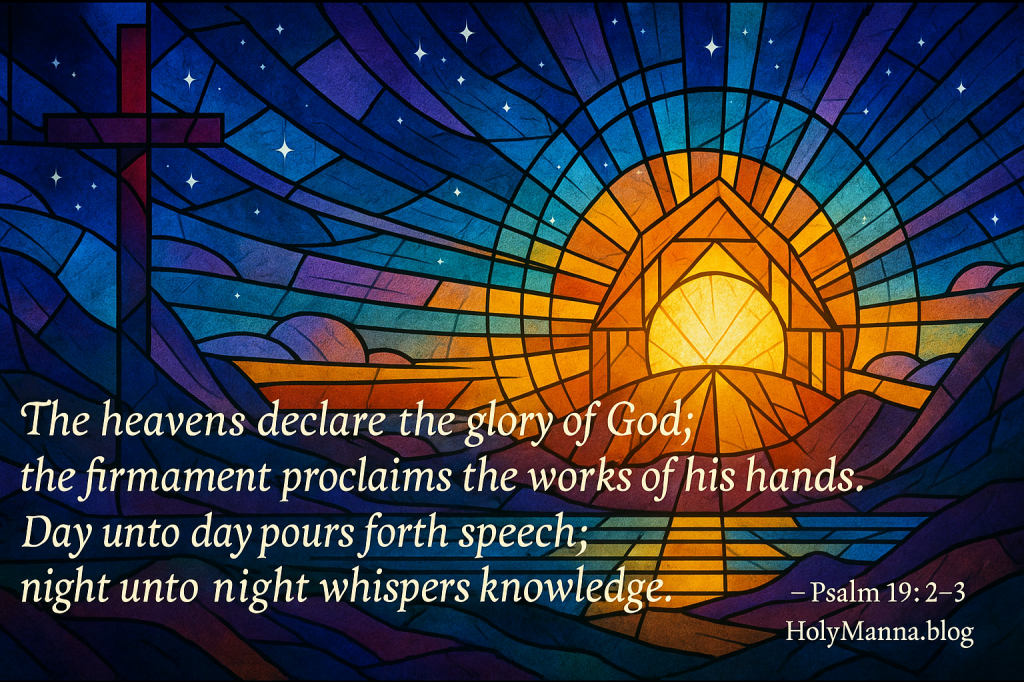
2 The heavens declare the glory of God;
the firmament proclaims the works of his hands.
3 Day unto day pours forth speech;
night unto night whispers knowledge.
4 There is no speech, no words;
their voice is not heard;
5 A report goes forth through all the earth,
their messages, to the ends of the world.
He has pitched in them a tent for the sun;
Detailed Exegesis
Verse 2 – “The heavens declare the glory of God; the firmament proclaims the works of his hands.”
The psalmist presents creation as a temple choir. The heavens do not compete with God. They testify to his glory. In biblical thought, “glory” signifies God’s manifested presence and weight. The firmament, a poetic image for the sky, is a visible sign that points to an invisible Creator.
Verse 3 – “Day unto day pours forth speech; night unto night whispers knowledge.”
Time itself becomes a catechist. Each day hands on the testimony it received. Each night quietly communicates understanding. This is an unending liturgy of witness. Creation’s continuity reveals God’s fidelity and invites a human response of thanksgiving and obedience.
Verse 4 – “There is no speech, no words; their voice is not heard;”
The paradox is deliberate. Creation’s sermon is wordless yet intelligible. It reaches the mind and heart through beauty, order, and harmony. The absence of audible words does not diminish the clarity of the message. It intensifies responsibility to perceive and to praise.
Verse 5 – “A report goes forth through all the earth, their messages, to the ends of the world. He has pitched in them a tent for the sun;”
The scope is universal. No land is beyond this revelation. The poetic image of a “tent for the sun” evokes God’s sovereign ordering of creation. The sun has its place and purpose, which underscores that even the greatest creature serves the Creator’s design and does not deserve worship.
Teachings
The Church hears in Psalm 19 the sacramental logic of creation. “God speaks to man through the visible creation. The material cosmos is so presented to man’s intelligence that he can read there traces of its Creator.” (CCC 1147). Beauty and truth converge in this witness. “Truth is beautiful in itself. Truth carries with it the joy and splendor of spiritual beauty.” (CCC 2500). The psalm’s universal reach aligns with the conviction that the Creator’s signs are offered to all peoples. This guards against idolatry and directs praise to God alone, in harmony with Romans 1:20–25. The saints echo this vision. Saint Augustine exclaims, “Late have I loved you, Beauty ever ancient, ever new, late have I loved you.” (Confessions X, 27). He recounts creation’s testimony drawing him to the Creator. In Christian worship, the Church gathers each day under the same heavens, receiving time as a gift and returning it as praise, so that what creation proclaims with silent splendor we proclaim with believing hearts.
Reflection
Let creation catechize you today. Step outside, look up, and let gratitude be your first prayer. Name aloud the works of God’s hands that you see, and then bless someone concretely with a word of encouragement or an act of mercy. Train your heart to hear the silent hymn that never stops. What is the Spirit teaching you through the beauty and order you encounter today? Where might you be tempted to admire the gift without blessing the Giver? How will you turn the world’s wordless praise into your own words of thanksgiving before the Creator?
Holy Gospel – Luke 11:37–41
Cleansed Within
In the setting of a Pharisee’s home during the period of Second Temple Judaism, ritual washings were practiced as signs of devotion and separation for God’s service. Jesus accepts the invitation to dine, not to dismiss piety, but to reveal the heart of the Law. He exposes the danger of focusing on external observances while ignoring interior conversion. Today’s theme has already shown us how creation proclaims the Creator and how idolatry begins when gratitude fails. In the Gospel, Jesus completes the picture by teaching that authentic worship flows from a clean heart that expresses itself in concrete mercy. Almsgiving becomes a decisive sign that the interior has been purified by love.
Luke 11:37-41
New American Bible (Revised Edition)
37 After he had spoken, a Pharisee invited him to dine at his home. He entered and reclined at table to eat. 38 The Pharisee was amazed to see that he did not observe the prescribed washing before the meal. 39 The Lord said to him, “Oh you Pharisees! Although you cleanse the outside of the cup and the dish, inside you are filled with plunder and evil. 40 You fools! Did not the maker of the outside also make the inside? 41 But as to what is within, give alms, and behold, everything will be clean for you.
Detailed Exegesis
Verse 37 – “After he had spoken, a Pharisee invited him to dine at his home. He entered and reclined at table to eat.”
Jesus freely shares table fellowship with a Pharisee, signaling openness to dialogue and reform. Reclining at table reflects customary dining posture and highlights that this is an ordinary setting where extraordinary revelation will occur. Holiness is not confined to the Temple. It reaches the dinner table.
Verse 38 – “The Pharisee was amazed to see that he did not observe the prescribed washing before the meal.”
The host’s amazement reflects a concern for ritual purity. Such washings were part of devout practice intended to honor God. Jesus’ omission is pedagogical. He provokes a question about the relationship between outward signs and inward disposition.
Verse 39 – “The Lord said to him, ‘Oh you Pharisees! Although you cleanse the outside of the cup and the dish, inside you are filled with plunder and evil.’”
Jesus contrasts exterior cleanliness with interior corruption. The image of cup and dish is a parable of the person. When the heart is filled with greed or injustice, external conformity cannot make one truly clean. True purity is an interior reality that produces justice and mercy.
Verse 40 – “You fools! Did not the maker of the outside also make the inside?”
This is a theological correction. God, who created both body and soul, cares about the whole person. The divine Maker’s concern reaches the inner life, motives, and desires. Focusing on appearances while neglecting the heart fractures the unity of the person and forgets the Creator’s design.
Verse 41 – “But as to what is within, give alms, and behold, everything will be clean for you.”
Jesus offers the remedy. Almsgiving is not a superficial gesture. It is the outward overflow of an interior conversion that dethrones self and enthrones love. When mercy becomes concrete, the heart is purified. The movement is from within to without. The clean heart gives, and the giving further cleanses the heart.
Teachings
Jesus’ teaching accords with the Church’s perennial call to interior conversion. “Jesus’ call to conversion and penance, like that of the prophets before him, does not aim first at outward works, ‘sackcloth and ashes’, fasting and mortification, but at the conversion of the heart, interior conversion. Without this, such penances remain sterile and false; however, interior conversion urges expression in visible signs, gestures and works of penance.” (CCC 1430). This interior change necessarily takes visible form in traditional practices. “The interior penance of the Christian can be expressed in many and various ways. Scripture and the Fathers insist above all on three forms, fasting, prayer, and almsgiving, which express conversion in relation to oneself, to God, and to others.” (CCC 1434). The Church names the works of mercy as the habitual path where love becomes concrete. “The works of mercy are charitable actions by which we come to the aid of our neighbor in his spiritual and bodily necessities. Instructing, advising, consoling, comforting are spiritual works of mercy, as are forgiving and bearing wrongs patiently. The corporal works of mercy consist especially in feeding the hungry, sheltering the homeless, clothing the naked, visiting the sick and imprisoned, and burying the dead.” (CCC 2447). Within that tradition, almsgiving holds a privileged place. “Giving alms to the poor is one of the chief witnesses to fraternal charity: it is also a work of justice pleasing to God.” (CCC 2462). Scripture reinforces this purifying dimension of mercy. “For almsgiving delivers from death, and it will purge away every sin.” (Tobit 12:9). In the light of the Gospel, external observances find their purpose only when they flow from a heart made new by grace and directed to love of God and neighbor.
Reflection
Invite Jesus to cleanse the inside today. Examine your motives before you act. Choose one concrete act of almsgiving or mercy that costs you something in time, attention, or resources. Let it come from a heart that desires to love God more than image or approval. Pray for a clean heart and a generous spirit. Where am I tempted to look holy without surrendering my motives to the Lord? What specific act of mercy will I offer today so that what is within may be given to God and to my neighbor? How can I let my daily routines become places where interior conversion overflows into compassionate action?
Let the Creator Be Your First Love
Today’s Word draws one golden thread through every passage. The Creator reveals his glory and love, calls us to reject idols, and invites us to a clean heart that overflows in mercy. In Romans 1:16–25, Paul proclaims the Gospel as saving power for all who believe and warns that darkness begins when we trade worship for lesser loves, “exchanging the truth of God for a lie” (Romans 1:25). Psalm 19 lifts our eyes to a world that preaches without words, “The heavens declare the glory of God” (Psalm 19:2), so that gratitude may awaken and idolatry may lose its grip. In Luke 11:37–41, Jesus brings the message home to the heart, commanding a purity that is proven in compassion. “As to what is within, give alms, and behold, everything will be clean for you.” (Luke 11:41).
Here is the way forward. Receive the Gospel with faith. Let creation’s beauty become prayer. Renounce the subtle idols of control, comfort, or image. Choose a concrete act of mercy that costs you something and blesses someone else. Ask for the grace of interior conversion taught in The Catechism (CCC 1430–1434), and let thanksgiving be the first word on your lips and the motive beneath your actions.
Open your eyes to the silent sermon of the skies. Open your heart to the cleansing gift of mercy. Open your hands to the poor. The Creator who fashioned the outside and the inside desires to make you whole. What will you thank God for today with your voice and your life? Which idol will you topple by an act of love? How will you let the beauty you see lead you to the Beauty who saves?
Engage with Us!
Share your reflections in the comments below. We would love to hear how the Lord is speaking to you through today’s Scriptures.
- First Reading – Romans 1:16–25: Where might you be tempted to “exchange the truth of God for a lie,” and how will you choose faith and thanksgiving instead today? What concrete step can you take to glorify God as Creator in a decision, a conversation, or a habit?
- Responsorial Psalm – Psalm 19:2–5: What part of creation lifted your heart to praise today, and how did you respond in gratitude to the Giver? How can you let the “silent speech” of the heavens become a simple prayer you repeat throughout the day?
- Holy Gospel – Luke 11:37–41: What is within that Jesus is asking you to surrender so that your heart may be clean? What act of almsgiving or mercy will you choose today so that love within becomes love in action?
Go forward in faith. Let your worship become thanksgiving and mercy. Do everything with the love and the compassion Jesus taught us, so that your life gives glory to the Creator who made both the outside and the inside.
Sacred Heart of Jesus, we trust in You!
Immaculate Heart of Mary, pray for us!
Saint Michael the Archangel, defend us in battle!
Follow us on Instagram and Facebook for more insights and reflections on living a faith-filled life.

 Holy Manna!
Leave a comment