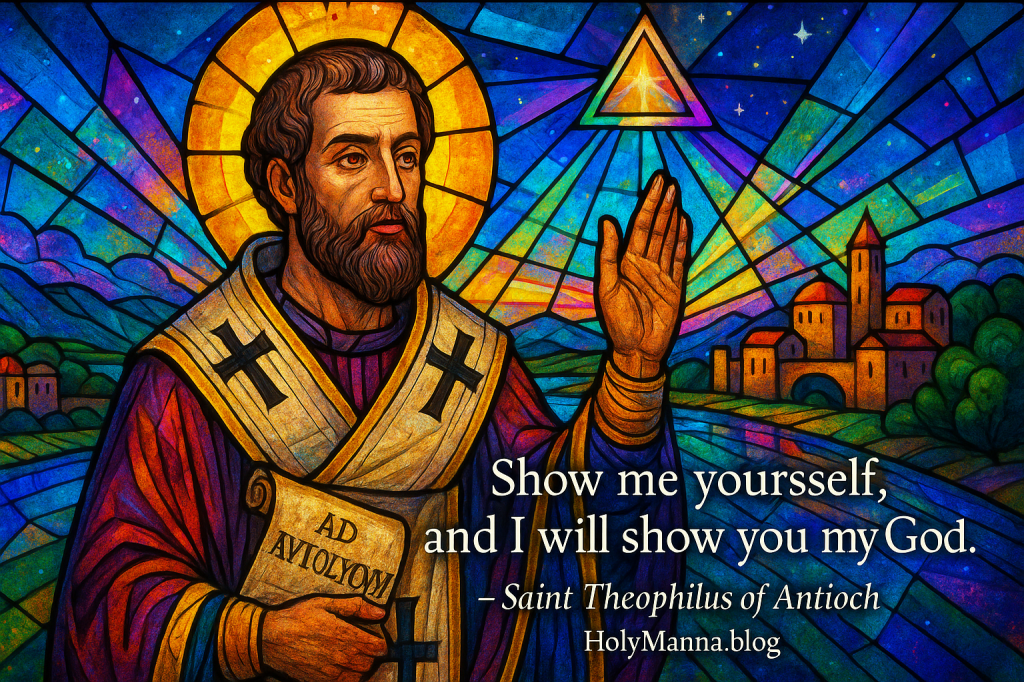
A Bishop Who Taught the World to See God
Theophilus of Antioch stands out among the second century Fathers as a steady and incisive teacher who helped the Church speak clearly to a pagan world. As bishop of the apostolic see of Antioch, he guided a community founded by Saint Peter and known from the Acts of the Apostles as the first place where believers were called Christians. His surviving work, Ad Autolycum (To Autolycus), is a three-book apology that defends the God of Israel as Creator, unmasks the emptiness of idols, and urges moral conversion so that the soul can truly perceive God. In those pages he articulates creation out of nothing, reveres the Word and Wisdom of God, and offers one of the earliest explicit Christian uses of the term Trinity as a theological key for reading Genesis. He is venerated for guarding the deposit of faith through teaching that is both biblical and pastorally aimed at conversion.
From Pagan Seeker to Shepherd of Antioch
Ancient tradition remembers Theophilus as a convert from paganism who was drawn to Christ by reading the sacred writings. He likely came from the region of the Tigris and Euphrates and lived in the latter half of the second century. He succeeded Bishop Eros and was followed by Bishop Maximus on the Antiochene throne, which places his episcopate roughly around the reigns of Antoninus Pius and Marcus Aurelius. The path from educated pagan to Christian bishop shaped his style. He wrote to cultured friends who mocked the faith, answered their questions patiently, and invited them to let Scripture interpret the world rather than the world interpret Scripture. In Ad Autolycum he famously insists that conversion is the doorway to knowledge of God, writing, “If you say, ‘Show me your God,’ I would reply, ‘Show me yourself, and I will show you my God.’” He adds that God is not grasped by curious eyes but by a purified heart: “God is seen by those who are enabled to see Him when they have the eyes of their soul opened.” This steady insistence that moral renewal and illumination belong together is part of why the Church treasures his witness.
A Pen That Pierced Idols
Theophilus’s chief arena was the page rather than the public square, yet his words read like courageous witness. He urges Autolycus to leave lifeless idols for the living God who made heaven and earth. He stresses that the world is not eternal and that God brought all things into being freely. Summarizing the Scriptures, he teaches that God made the universe “out of what was not,” which later theology calls creation ex nihilo. He also reflects on Genesis 1 and sees in the first three days a foreshadowing of the Triune mystery, “types of the Trinity, of God, and His Word, and His Wisdom.” Because he writes as a pastor, his theology is never abstract. He treats topics like marriage, chastity, the formation of conscience, the resurrection of the body, and the right use of reason. He even pauses to explain why believers bear the name Christian, “We are called Christians because we are anointed with the oil of God.” In every case his approach is the same. He lays Scripture before the reader, exposes the false promises of the age, and calls for a change of life so the eyes of the soul can see.
Trials Without Spectacle
Theophilus lived in a turbulent period marked by sporadic local persecutions of Christians and by the spread of corrosive false teachings. He wrote against the errors of Hermogenes, who taught the eternity of matter, and against Marcion, who set the God of the Old Testament against the Father of Jesus Christ. Those refutations have not survived, but the fact that he wrote them shows a shepherd attentive to threats that could devour his flock. There is no reliable ancient testimony that he worked public miracles or died a martyr. Instead, his trial was the slow, faithful labor of clarifying doctrine, strengthening Christian identity, and defending the unity of the Old and New Testaments in an intellectual climate that often ridiculed both.
Afterglow of a Teacher
After his death Theophilus’s legacy endured not through a flourishing cult of relics but through the steady circulation of his writings. Christians continued to read Ad Autolycum for its robust defense of creation, its Scriptural catechesis, and its luminous moral appeal. Later generations cherished his language about the Trinity and his insight that only a converted heart beholds God. If Antioch did not become a pilgrimage center because of him, the faithful nevertheless made a kind of pilgrimage through his pages. There they found a bishop who could meet a skeptical friend where he stood and lead him step by step toward the living God.
Learning to See God in a Noisy Age
Theophilus teaches us that knowledge of God is not a spectator sport. It requires repentance, discipline, and the humble reading of Scripture. Begin with a concrete act of conversion this week. Go to Confession, forgive a rival, or renounce a hidden compromise. Read a chapter of the Gospels each day and ask the Lord to open the eyes of your soul. Pray with Genesis 1 and let the light of the Trinity illuminate your work, your rest, and your relationships. Let Theophilus’s voice remind you that the intellect blooms when the heart is pure. How will you open the eyes of your soul to see God today?
Engage with Us!
I would love to hear your thoughts and prayer insights in the comments below.
- What part of Theophilus’s invitation, “Show me yourself, and I will show you my God,” challenges you most right now?
- Where do you sense the Holy Spirit asking you to “clean the mirror” of the soul so that you can see God more clearly this week?
- How does Theophilus’s reading of Genesis as a type of the Trinity deepen your awe at creation and your worship of the Father, the Son, and the Holy Spirit?
- What concrete practice will you adopt to let Scripture be your daily teacher, in line with the Church’s teaching on God’s Word?
Go in peace with fresh courage. Live your faith out loud, and do everything with the love and mercy Jesus taught us.
Saint Theophilus of Antioch, pray for us!
Follow us on Instagram and Facebook for more insights and reflections on living a faith-filled life.

 Holy Manna!
Leave a comment