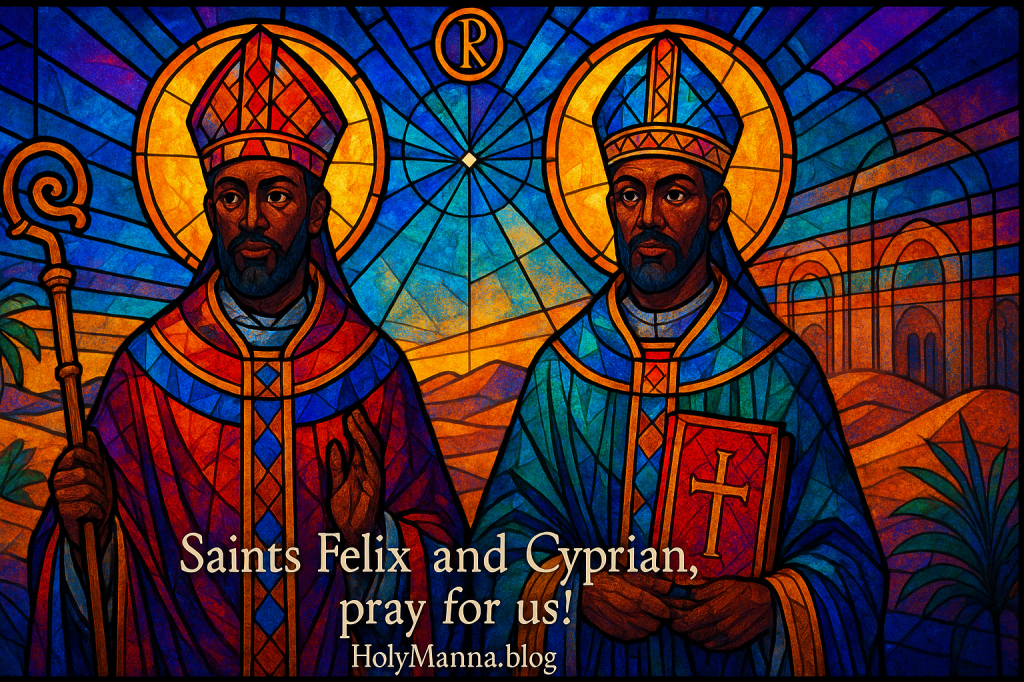
Desert Lanterns of Fidelity
Saints Felix and Cyprian shine as steadfast North African bishops who guarded the flock of Christ during the Vandal persecutions in the fifth century. Their fidelity in the face of state pressure to abandon the Nicene faith made them living icons of pastoral courage and charity. They are revered as witnesses who chose communion with Christ and his Church over safety and convenience. Their cult endures because their story distills a perennial truth of discipleship. “Martyrdom is the supreme witness given to the truth of the faith.” (Catechism of the Catholic Church, 2473). Their memory encourages every Christian leader and lay disciple to keep the faith whole and entire, even when that fidelity is costly.
Roots Hidden, Witness Resplendent
The early biographical details of Felix and Cyprian have not come down to us in a continuous narrative. What the Church remembers with clarity is their office as bishops in Roman Africa and the testing of that office under Arian rulers. They were formed in a thriving Christian culture that had produced giants such as Saint Cyprian of Carthage and Saint Augustine of Hippo. In that same soil of doctrine, sacrament, and pastoral zeal, Felix and Cyprian learned to teach, to celebrate the Eucharist, and to protect the unity of the Church. When their sees came under Vandal domination and imperial favor turned hostile, their faith did not shrink. Their conversion, understood as a deepening configuration to Christ, became visible in the way they shepherded their people with hope. “Fortitude ensures firmness in difficulties and constancy in the pursuit of the good.” (Catechism of the Catholic Church, 1808).
Shepherds on the Sand
Felix and Cyprian are most known for their episcopal constancy during the Arian crisis in North Africa. They defended the full divinity of the Son and the integrity of baptismal faith. They strengthened the faithful when churches were confiscated, when clergy were harassed, and when public gatherings were policed. Their ministry likely included clandestine celebration of the sacraments, consolation of the bereaved, and the organization of care for those displaced by exile. Their leadership was not ideological. It was sacramental and paternal. “The Eucharist is the source and summit of the Christian life.” (Catechism of the Catholic Church, 1324). By safeguarding the Eucharist and teaching the Creed, they preserved the lifeblood of Christian identity for their people. We remember and emulate them because they demonstrate how truth and charity belong together and how the bishop’s office is ordered to the unity and holiness of the Church.
Signs of Grace During Their Lives
No authenticated collection of sayings or specific miracle stories from the lifetimes of Felix and Cyprian has been preserved. The tradition venerates them first as confessors and martyrs whose holiness was displayed in heroic endurance and pastoral charity. Their most luminous sign is the supernatural courage with which they faced coercion. The fruits of their ministry, including reconciled sinners, steadfast families, and communities that kept the Creed under pressure, are spiritual miracles of grace. “By his Passion and death on the cross Christ has given a new meaning to suffering.” (Catechism of the Catholic Church, 1505). That transformed meaning radiated through their ministry, turning desolation into witness and fear into fidelity.
Trial by Fire
The Vandal authorities demanded that Catholic bishops accept Arian teaching or lose their positions and their freedom. Many bishops, clergy, monks, and laypeople were driven into the Libyan desert, where harsh climate, hunger, and forced labor took a heavy toll. Felix and Cyprian chose to stand with their people and bear the consequences of fidelity. They suffered exile and, according to the Church’s memory, won the crown of martyrdom. Contemporary accounts from the period speak of brutal punishments, including the cutting out of tongues of confessors who nonetheless continued to speak by God’s power, a sign that divine truth cannot be silenced. Without assigning that particular wonder to Felix and Cyprian themselves, the Church places them among those whose endurance was sealed with death for Christ. Their martyrdom matters because it confirms the apostolic teaching they guarded. “The blood of martyrs is the seed of Christians.” (Tertullian, received in the Church’s tradition and consonant with Catechism of the Catholic Church, 2473).
After the Storm
After their deaths the Church continued to honor Felix and Cyprian in liturgical remembrance and local devotion. Their names appear in martyrologies that keep alive the memory of North Africa’s confessors. Over the centuries, relics associated with the Vandal martyrs have been cherished in various churches, a sign of the Church’s belief that the bodies of the saints, destined for resurrection, are vessels of holy memory. Pilgrims have invoked their aid when seeking courage in persecution and unity amid doctrinal confusion. “Being more closely united to Christ, those who dwell in heaven fix the whole Church more firmly in holiness.” (Catechism of the Catholic Church, 956). Through their intercession many have found the grace to persevere and to love the Church more ardently.
Walking With the Martyrs
Felix and Cyprian teach us to love truth with humility and to love people with patience. They did not abandon the flock entrusted to them. They did not trade communion for comfort. Their witness invites us to fortify our conscience through prayer, to remain faithful to Sunday Mass, to seek frequent confession, and to cultivate solidarity with suffering Christians. It also challenges us to guard our speech, to refuse bitterness, and to resist the temptation to fracture communion when trials come. How is the Lord asking you to stand with someone who suffers because of their faith today? Where is he calling you to deeper unity with the Church and greater charity for her members? What comforts or fears keep you from bearing witness to Christ with the steadiness of a desert lantern? Let their memory inspire practical steps, such as visiting the sick, supporting ministries to the persecuted, and studying the Creed with renewed attention. “Hope is the theological virtue by which we desire the kingdom of heaven and eternal life as our happiness.” (Catechism of the Catholic Church, 1817). Rooted in hope, we can endure trials with love.
Engage with Us!
We would love to hear how the courage of Saints Felix and Cyprian speaks to you. Share a grace, a challenge, or a prayer in the comments below so that our community can grow together in hope.
- What word or phrase from the story of Felix and Cyprian most challenges you to live your faith more openly this week, and why?
- When have you felt tempted to compromise the truth for comfort, and how can the martyrs’ example help you choose Christ instead?
- How can you practice concrete solidarity with a suffering member of the Church in your parish or community this month?
Go in peace, and let us do everything with the love and mercy that Jesus taught us, trusting that the God who sustained his martyrs in the desert will strengthen us in every desert we face.
Saints Felix and Cyprian, pray for us!
Follow us on Instagram and Facebook for more insights and reflections on living a faith-filled life.

 Holy Manna!
Leave a comment