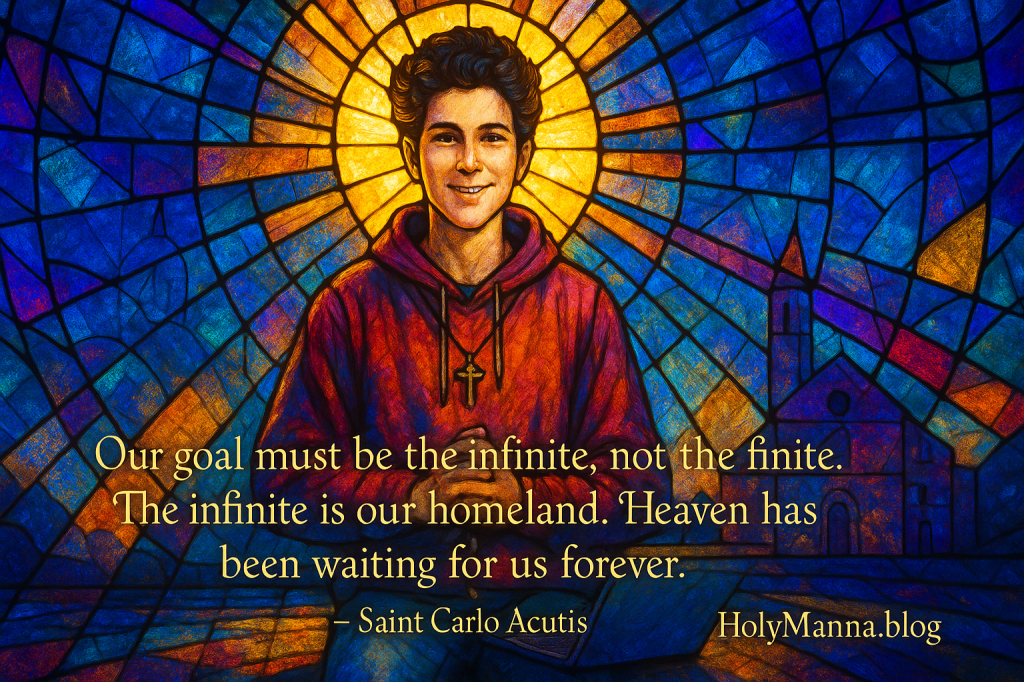
Bright Pixels, Burning Love
Saint Carlo Acutis stands as a luminous sign that holiness is possible right now. He is widely remembered as a “cyber apostle of the Eucharist,” a teenager who placed Jesus in the Eucharist at the center of everything and let his creativity, intelligence, and love for people serve that center. He combined a tender devotion to Our Lady with a practical love for the poor, and he treated the internet not as a playground for ego but as a pulpit for truth. His life echoes the Catechism of the Catholic Church on the Eucharist as the source and summit of the Christian life (CCC 1324) and on Eucharistic adoration as love responding to Love (CCC 1418). He loved to say, “The Eucharist is the highway to heaven.” He also challenged peers with the electric line, “All people are born as originals, but many die as photocopies.” For Carlo, originality meant friendship with Jesus that blossoms into concrete charity and courageous witness.
A London Cradle and an Assisi Dream
Carlo was born in London on May 3, 1991 to Italian parents, Andrea Acutis and Antonia Salzano, and soon moved to Milan where he grew up. From early childhood he showed a spontaneous attraction to prayer and churches, an attentiveness that surprised even his own family and slowly drew them deeper into the practice of the faith. He received First Holy Communion at seven, with special permission, and from that day he sought daily Mass, frequent confession, the Rosary, and time before the tabernacle. He cultivated a simple plan of life: “To always be close to Jesus, that is my life plan.” He attended the Jesuit school Istituto Leone XIII in Milan, where he paired a strong mind with a gentle heart, defending classmates who were bullied and offering help without fanfare. Gifted with computers, he taught himself coding and design so that he could spread the Gospel. He loved animals, sports, and humor, yet he practiced a deliberate modesty in media use, limiting video games and entertainment so that his heart stayed free for God and for people. He desired Assisi as his spiritual home, drawn by the poverty and joy of Saint Francis, and he often visited the city to pray.
Coding for the King and Serving the Poor
Carlo’s best known work was a multimedia exhibition on Eucharistic miracles around the world. What began as a personal project became a global apostolate, traveling from parishes to schools and prisons and stirring countless people to Eucharistic adoration and confession. He used ordinary means with extraordinary love, building parish websites, tutoring classmates, and spending his pocket money on sleeping bags and food for the homeless he met on his way to church. He cherished the Sacred Heart and would slip into a nearby church for a brief visit before and after school. He once explained the transforming power of adoration with a joyful image: “When we face the sun we become tan, but when we place ourselves before Jesus in the Eucharist we become saints.” There are no authenticated physical miracles recorded during Carlo’s lifetime, and he never sought signs or wonders. His “miracles” were conversions and reconciliations brought about by his humble witness, his kindness, and the magnetic peace he radiated. He loved to remind friends that heaven is our destination and that everything else must serve that goal: “Our goal must be the infinite, not the finite. The infinite is our homeland. Heaven has been waiting for us forever.”
A Cross Embraced and a Crown Awaited
At fifteen, Carlo was diagnosed with acute promyelocytic leukemia. The news came swiftly and his condition deteriorated quickly. He offered his sufferings for the Pope and for the Church with a serenity that astonished doctors and nurses. He asked that his burial be in Assisi, near Saint Francis, because he had found there a home for his heart. He died on October 12, 2006. Carlo was not a martyr in the technical sense, yet his final days showed the white martyrdom of a life offered in love. He prepared for death without fear, telling his mother with a smile, “I am happy to die because I have lived my life without wasting a minute on those things which do not please God.” His tomb in Assisi became a place of quiet hope where many discovered that holiness can look like a hoodie, jeans, a laptop, and a rosary, all placed at the feet of Jesus.
Signs That Follow Believers
After his death, numerous favors were reported through Carlo’s intercession, but two stand out for their ecclesial significance. The first was the healing of a Brazilian boy born with a congenital pancreatic condition. After prayers seeking Carlo’s intercession, the child was cured in a way that doctors could not explain, a grace later recognized for his beatification. The second involved a young Costa Rican university student who suffered severe head trauma in a bicycle accident while studying in Florence. Her mother went to Carlo’s tomb in Assisi to beg for his intercession. The daughter’s rapid and complete recovery surprised her medical team and deepened the stream of pilgrims to the Sanctuary of the Renunciation, where Carlo’s body rests. These miracles are not celebrity fireworks but signs that God delights to work through the faith of His friends. Carlo once said, “Not I, but God.” Those words now echo in the lives healed and the hearts rekindled through his prayer.
Living the Catechism with a Laptop and a Rosary
Carlo’s holiness is disarmingly simple. He kept Jesus in the Eucharist at the center, as the Catechism teaches: the Eucharist is the source and summit of the Christian life (CCC 1324). He adored Christ present in the tabernacle and monstrance because, in the words of the Catechism, Christ Himself is present and adored (CCC 1418). He approached confession regularly, not out of scruple but out of love for mercy and a desire to grow, trusting the sacrament’s healing power that remits sins and restores friendship with God (cf. CCC 1468). If you want to imitate him, begin with a concrete, doable plan. Set a day for weekly or biweekly confession. Choose one weekly Holy Hour and keep it as you would the most important meeting of your week. Prepare for Mass the night before, arrive a few minutes early, and remain a few minutes after to give thanks. Practice digital asceticism by setting limits, curating your feeds for truth and beauty, and creating content that points to Christ. Make charity practical by carrying a small “mercy budget” in your bag for simple acts of love. Above all, ask for Carlo’s intercession and dare to live his audacious simplicity: “To always be close to Jesus, that is my life plan.”
Engage with Us!
We would love to hear how Saint Carlo has touched your life. Share your thoughts and graces in the comments below.
- How does Saint Carlo’s love for the Eucharist challenge the way you plan your week and set your priorities?
- What one habit in your digital life could you change today to make it a tool for holiness rather than distraction?
- When will you next go to Confession, and how can you invite a friend to come with you?
- Which person in need around you could encounter Christ through a concrete act of mercy from you this week?
Keep your eyes on Jesus. Live a Eucharistic life. Do everything with the love and mercy that Jesus taught us, and let Him make you an original masterpiece of grace.
Saint Carlo Acutis, pray for us!
Follow us on Instagram and Facebook for more insights and reflections on living a faith-filled life.

 Holy Manna!
Leave a comment