Twenty-eighth Sunday in Ordinary Time – Lectionary: 144
Washed, Healed, and Thankful: Faith That Obeys and Sings
Where has God already met you with mercy, and how will you respond today? Today’s readings move in a clear arc from cleansing to communion. In 2 Kings 5:14–17, Naaman the Aramean obeys the prophet and plunges into the Jordan. His skin becomes like that of a child, and his heart turns to exclusive worship of Israel’s God. He even asks for earth to take home, a glimpse into the ancient belief that deities were tied to lands, yet he now desires to adore the Lord alone. Psalm 98:1–4 answers this personal miracle with a cosmic chorus, urging the whole earth to “sing a new song to the Lord” for His visible victory. In 2 Timothy 2:8–13, Paul writes from chains, yet he proclaims that “the word of God is not chained”, and he hands on what many scholars hear as an early Christian hymn that promises life and reigning with Christ to those who die and persevere with Him. Finally, in Luke 17:11–19, ten lepers are cleansed on the way to the priests in keeping with Leviticus 14, but only one returns to worship. He is a Samaritan, an outsider, and Jesus declares, “your faith has saved you.”
Together these passages reveal a single path of grace. God initiates mercy that reaches beyond borders, whether Aramean or Samaritan, and He invites a response of obedient trust, persevering fidelity, and grateful praise. The background matters. Leprosy in antiquity meant social death and liturgical distance, which explains the command to show oneself to the priest in Leviticus 14. Samaritans were regarded with suspicion by many Jews, which sharpens the surprise that the lone worshiper is the “foreigner.” Paul’s imprisonment highlights that the Gospel advances through suffering servants who cling to Christ. The Church calls this living response faith, not mere assent but obedience steeped in love, as taught in CCC 1814. Christ’s healings are signs that the Kingdom has drawn near, as noted in CCC 1509, and grace remains God’s free initiative that seeks our free “yes,” as taught in CCC 1996. When faith recognizes the gift, it blossoms into thanksgiving, which is the very meaning of the Eucharist, as CCC 2637 to 2638 teaches. As we enter the readings, watch how divine mercy makes worshipers out of former outcasts, and how healed bodies become voices in the great song of salvation. Will your healing lead you to obedient steps, persevering love, and a life of thanksgiving today?
First Reading – 2 Kings 5:14–17
From washing to worship
Naaman is an Aramean commander who seeks healing in Israel during a tense period between Aram and the Northern Kingdom. His journey into Israelite territory places him at the crossroads of ancient power, prophetic authority, and the living God of Israel. The Jordan River carries covenant memory for Israel, recalling crossings into the Promised Land and the God who saves. Seven immersions evoke fullness and divine action. Elisha’s refusal of payment proclaims that God’s saving work is not a magical commodity but a gratuitous gift. Naaman’s request for Israel’s soil reflects an ancient belief that deities were tied to lands, yet his act signals a decisive allegiance. He now adores the Lord alone. This reading fits today’s theme by revealing a pattern of grace. God initiates cleansing, obedient trust receives it, and gratitude flowers into exclusive worship, which aligns with the Samaritan’s thankful return in Luke 17:11–19 and the Church’s call to persevere with Christ in 2 Timothy 2:8–13.
2 Kings 5:14-17
New American Bible (Revised Edition)
14 So Naaman went down and plunged into the Jordan seven times, according to the word of the man of God. His flesh became again like the flesh of a little child, and he was clean.
15 He returned with his whole retinue to the man of God. On his arrival he stood before him and said, “Now I know that there is no God in all the earth, except in Israel. Please accept a gift from your servant.” 16 Elisha replied, “As the Lord lives whom I serve, I will not take it.” And despite Naaman’s urging, he still refused. 17 Naaman said: “If you will not accept, please let me, your servant, have two mule-loads of earth, for your servant will no longer make burnt offerings or sacrifices to any other god except the Lord.
Detailed Exegesis
Verse 14 – “So Naaman went down and plunged into the Jordan seven times, according to the word of the man of God. His flesh became again like the flesh of a little child, and he was clean.”
Naaman’s descent into the Jordan is an act of obedient trust. The sevenfold immersion signals completeness and divine initiative. The restoration “like a little child” hints at new birth and purity that God alone grants. This anticipates Christian baptism, where cleansing and new creation come by grace. Obedience to the prophetic word is the human response that opens the door to God’s healing.
Verse 15 – “He returned with his whole retinue to the man of God. On his arrival he stood before him and said, ‘Now I know that there is no God in all the earth, except in Israel. Please accept a gift from your servant.’”
Naaman moves from petition to profession. His confession is theological and missionary. He recognizes the Lord’s unique sovereignty in all the earth. His offer of a gift reflects ancient Near Eastern protocols of honoring benefactors. Yet true knowledge of God will be completed not by payment but by worship and fidelity.
Verse 16 – “Elisha replied, ‘As the Lord lives whom I serve, I will not take it.’ And despite Naaman’s urging, he still refused.”
Elisha safeguards the gratuity of grace. He refuses compensation to prevent any confusion between divine mercy and transactional magic. Prophetic integrity preserves God’s glory. Salvation is not for sale, which prepares the way for a faith that gives thanks rather than attempts to buy favor.
Verse 17 – “Naaman said: ‘If you will not accept, please let me, your servant, have two mule-loads of earth, for your servant will no longer make burnt offerings or sacrifices to any other god except the Lord.’”
Naaman desires to bring Israel’s soil home, reflecting the period’s sense of territorial sanctity, yet his purpose is profound. He pledges exclusive sacrifice to the Lord. This is conversion in action. The healed man becomes a worshiper. The movement from cleansing to communion completes the arc of grace and anticipates the thankful Samaritan who returns to Jesus in Luke 17.
Teachings
Naaman’s story depicts faith as obedient assent that blossoms into exclusive worship and thanksgiving. The Church names this virtue and describes it with precision in CCC 1814: “Faith is the theological virtue by which we believe in God and believe all that he has said and revealed to us, and that Holy Church proposes for our belief, because he is truth itself.” Naaman believes the prophetic word and acts on it. His healing is not earned. It is the gift of God’s grace, as taught in CCC 1996: “Our justification comes from the grace of God. Grace is favor, the free and undeserved help that God gives us to respond to his call to become children of God, adoptive sons, partakers of the divine nature and of eternal life.” Elisha’s refusal of gifts underscores this undeserved favor.
The end of the reading highlights adoration and exclusive worship, the heart of the first commandment. CCC 2097 teaches: “To adore God is to acknowledge, in respect and absolute submission, the ‘nothingness of the creature’ who would not exist but for God. To adore God is to praise and exalt him and to humble oneself, as Mary did in the Magnificat, confessing with gratitude that he has done great things and holy is his name.” Naaman’s resolution to sacrifice to no other god exemplifies this adoration in practice.
Graced healing should culminate in thanksgiving, which is the soul of Christian worship. CCC 2637 states: “Thanksgiving characterizes the prayer of the Church which, in celebrating the Eucharist, reveals and becomes more fully what she is.” Naaman’s confession and intent to worship foreshadow the new song of Psalm 98 and the Eucharistic life of the Church. As a patristic echo, the line commonly attributed to Saint Augustine captures this movement from heart to hymn: “He who sings prays twice.” Gratitude becomes song. Song becomes sacrificial love.
Historically, Naaman’s request for earth makes sense within ancient conceptions of sacred space and divine presence. Theologically, it signals a break from idolatry toward covenant fidelity. Spiritually, it models the pattern seen throughout salvation history. God acts. We trust. We worship.
Reflection
God’s mercy seeks you first, but it calls for your response of obedient trust and grateful worship. Take a concrete step of obedience today in an area where God has already spoken to your heart. Replace a transactional approach to God with a posture of thanksgiving. Name aloud three specific mercies and offer them to the Lord in prayer. Let your gratitude flow into faithful practice. Attend Mass with intention, offer your day as sacrifice, and make space for humble adoration before the Blessed Sacrament. Where is the Lord inviting you to be washed again in trust so that your life becomes worship? How will you turn a received grace into a concrete act of thanksgiving today? What rival loyalties is God asking you to leave behind so that you may offer sacrifice to Him alone?
Responsorial Psalm – Psalm 98:1–4
Sing the new song of saved hearts
The psalm places us in the temple courts of ancient Israel, where God’s people proclaim His kingship with music and joyful shouts. Psalm 98 belongs to a cluster of royal hymns that celebrate the Lord’s victorious reign. The imagery of God’s “right hand” and “holy arm” reflects ancient Near Eastern language for a king’s power, yet here all glory belongs to the Lord who saves not by human might but by divine mercy and fidelity. The psalm widens the circle from Israel’s sanctuary to the ends of the earth, inviting every nation into praise. Within today’s theme, this is the sound of healed lives becoming worship. Naaman’s cleansing in 2 Kings 5 and the Samaritan’s grateful return in Luke 17 both flower into thanksgiving, and 2 Timothy 2 urges perseverance that ends in glory. The “new song” is the voice of those who have been washed, healed, and made faithful by grace.
Psalm 98:1-4
New American Bible (Revised Edition)
The Coming of God
1 A psalm.
Sing a new song to the Lord,
for he has done marvelous deeds.
His right hand and holy arm
have won the victory.
2 The Lord has made his victory known;
has revealed his triumph in the sight of the nations,
3 He has remembered his mercy and faithfulness
toward the house of Israel.
All the ends of the earth have seen
the victory of our God.
4 Shout with joy to the Lord, all the earth;
break into song; sing praise.
Detailed Exegesis
Verse 1 – “Sing a new song to the Lord, for he has done marvelous deeds. His right hand and holy arm have won the victory.”
The command to sing “a new song” signals a fresh act of salvation that demands a fresh response. The “right hand” and “holy arm” are sacred ways of saying that victory belongs to God alone. The Church hears in this a pattern fulfilled in Christ, whose Paschal victory creates a new creation. Our healed gratitude does not recycle old routines. It becomes a new song that matches new mercy.
Verse 2 – “The Lord has made his victory known; has revealed his triumph in the sight of the nations.”
Salvation is public. God reveals His work before the nations so that all peoples may see and believe. This verse harmonizes with Naaman’s confession that there is no God but the Lord and anticipates the Gospel’s universal call. When God acts, He intends the witness of His people to be visible, audible, and invitational.
Verse 3 – “He has remembered his mercy and faithfulness toward the house of Israel. All the ends of the earth have seen the victory of our God.”
“Mercy” and “faithfulness” echo covenant terms that carry the weight of God’s steadfast love. Israel’s story becomes a lamp for the world. The psalm stretches from Israel’s memory to global mission. The healed Samaritan in Luke 17 becomes a living sign of this wideness, as grace overflows ancestral boundaries and draws outsiders into the circle of praise.
Verse 4 – “Shout with joy to the Lord, all the earth; break into song; sing praise.”
The crescendo is universal liturgy. Joy is not an accessory. It is the fitting form of a heart that has been rescued. Praise is not mere emotion. It is obedience, since God commands the earth to sing. The Eucharistic life of the Church answers this call with thanksgiving made flesh in Christ.
Teachings
The psalms form the Church’s perennial school of prayer and song. CCC 1156 teaches: “The musical tradition of the universal Church is a treasure of inestimable value, greater even than that of any other art.” In this treasure, the psalms hold pride of place as the inspired hymnal that trains our hearts to answer God’s deeds with fitting praise. Thanksgiving is the Church’s native language. CCC 2637 proclaims: “Thanksgiving characterizes the prayer of the Church which, in celebrating the Eucharist, reveals and becomes more fully what she is.” Praise is likewise essential. CCC 2639 teaches: “Praise is the form of prayer which recognizes most immediately that God is God. It lauds God for his own sake and gives him glory, quite beyond what he does, but simply because he is.” The psalm’s “new song” is therefore more than a melody. It is the life of a people renewed by God’s victory and gathered into Eucharistic thanksgiving. In this light, the oft-attributed Augustinian insight rings true for Christian worship: “He who sings prays twice.” The song of the redeemed becomes prayer intensified, joining Israel’s memory to the Church’s sacrament.
Historically, Psalm 98 likely accompanied festal worship that proclaimed the Lord’s kingship. Culturally, it contrasts Israel’s God with the claims of surrounding nations by attributing victory to the Lord’s holy arm rather than to human weapons. Religiously, it envisions a missionary horizon where the nations behold and join the praise. This aligns with Naaman’s conversion and the Samaritan’s thanksgiving as living commentaries on the psalm.
Reflection
Let your life become the new song that God deserves. Begin and end your day with a brief act of thanksgiving, naming aloud the concrete mercies you have received. Bring this gratitude to Mass and let the Responsorial Psalm shape your voice into praise. Share one witness this week about God’s goodness so that His victory becomes visible through you. What “new song” is God inviting you to sing because of a mercy you have recently received? Where can you make God’s victory known in the sight of others through simple, joyful testimony? How will you let thanksgiving reshape your habits so that praise becomes the steady rhythm of your spiritual life?
Second Reading – 2 Timothy 2:8–13
Unchained Word, unwavering fidelity
Paul writes from imprisonment in Rome and hands Timothy a compact creed that the early Church likely sang or recited. The letter stands near the culmination of Paul’s mission and reflects a church learning to endure hostility with hope. By invoking Jesus as risen and as son of David, Paul ties the Gospel to Israel’s promises and to the universal hope announced in Christ’s Paschal victory. The “trustworthy saying” that follows sounds like an early baptismal or liturgical hymn. It weaves together death and life with Christ, perseverance under trial, the sober warning against denial, and the rock-solid faithfulness of God. Within today’s theme, these verses show how healed people become steadfast worshipers. Grace cleanses, gratitude sings, and perseverance carries the song through chains, since “the word of God is not chained.”
2 Timothy 2:8-13
New American Bible (Revised Edition)
8 Remember Jesus Christ, raised from the dead, a descendant of David: such is my gospel, 9 for which I am suffering, even to the point of chains, like a criminal. But the word of God is not chained. 10 Therefore, I bear with everything for the sake of those who are chosen, so that they too may obtain the salvation that is in Christ Jesus, together with eternal glory. 11 This saying is trustworthy:
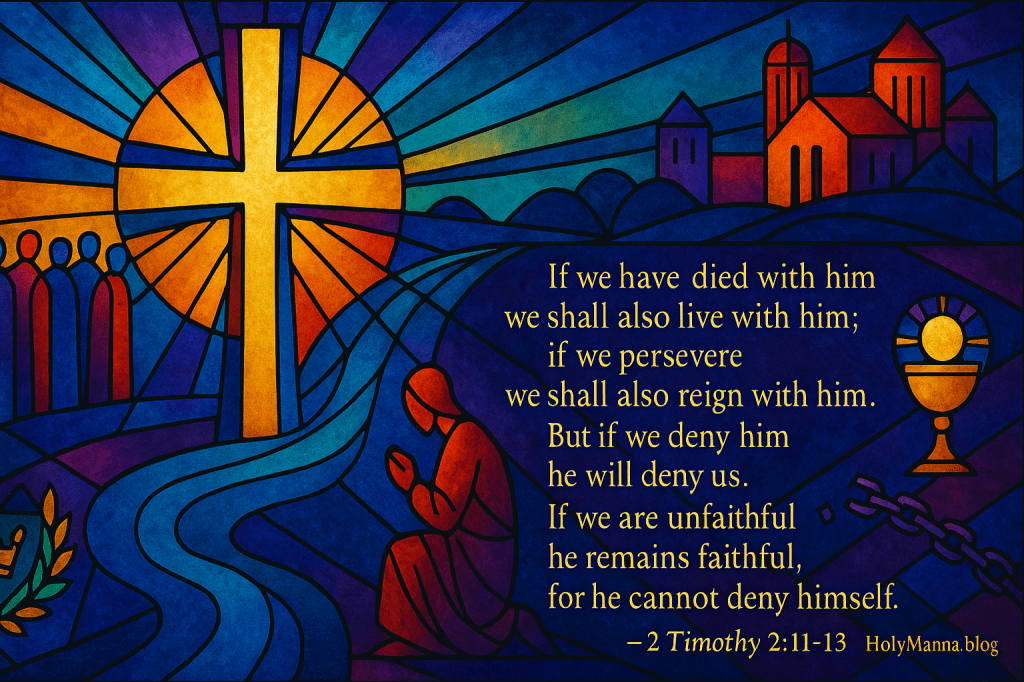
If we have died with him
we shall also live with him;
12 if we persevere
we shall also reign with him.
But if we deny him
he will deny us.
13 If we are unfaithful
he remains faithful,
for he cannot deny himself.
Detailed Exegesis
Verse 8 – “Remember Jesus Christ, raised from the dead, a descendant of David: such is my gospel.”
Paul commands a continual remembrance. Memory here is not mere recall. It is a liturgical and moral focus that shapes life. “Raised from the dead” proclaims Easter as the decisive event that validates every promise of God. “Descendant of David” anchors Jesus in Israel’s messianic hope, showing that the Gospel fulfills covenant history. This short creed keeps Timothy centered when trials come.
Verse 9 – “For which I am suffering, even to the point of chains, like a criminal. But the word of God is not chained.”
Paul’s body is bound, yet the Gospel advances. Suffering for the Gospel is not failure. It is participation in Christ’s own witness. The contrast between Paul’s chains and the freedom of God’s word teaches the Church to measure success by fidelity rather than ease.
Verse 10 – “Therefore, I bear with everything for the sake of those who are chosen, so that they too may obtain the salvation that is in Christ Jesus, together with eternal glory.”
Apostolic suffering is pastoral and missionary. Paul endures “for the sake” of the elect so that others may share salvation and glory. This verse reveals the communion of the Body. One member’s perseverance strengthens many. Suffering offered in love becomes seed for others’ salvation.
Verse 11 – “This saying is trustworthy: If we have died with him we shall also live with him.”
The hymn begins with baptismal logic. To die with Christ in baptism is to share His risen life, both now in sanctifying grace and finally in the resurrection. The line also dignifies martyrdom and daily self-denial as real participation in Christ’s Paschal Mystery.
Verse 12 – “If we persevere we shall also reign with him. But if we deny him he will deny us.”
Perseverance is the path to royal communion with the King. To reign with Christ is to share His victorious love. The warning is bracing. Public denial severs us from the confession that saves. Fidelity has consequences, and so does infidelity.
Verse 13 – “If we are unfaithful he remains faithful, for he cannot deny himself.”
The hymn ends on God’s nature. Our lapses do not change who He is. Divine fidelity is not permission to sin. It is the ground of our hope and the call to repentance. Christ’s faithfulness to His covenant identity is the anchor that invites us back when we have fallen.
Teachings
The Resurrection stands at the heart of Paul’s command to “remember.” CCC 651 teaches: “The Resurrection above all constitutes the confirmation of all Christ’s works and teachings. All truths, even those most inaccessible to human reason, find their justification if Christ by his Resurrection has given the definitive proof of his divine authority, which he had promised.” Memory of the Risen One steadies disciples under pressure.
Union with Christ in death and life is given sacramentally. CCC 1227 teaches: “According to the Apostle Paul, the believer enters through Baptism into communion with Christ’s death, is buried with him, and rises with him: ‘Do you not know that all of us who have been baptized into Christ Jesus were baptized into his death? We were buried therefore with him by baptism into death, so that as Christ was raised from the dead by the glory of the Father, we too might walk in newness of life.’ The baptized have ‘put on Christ.’ Through the Holy Spirit, Baptism is a bath that purifies, justifies, and sanctifies.” The hymn’s first line voices this baptismal identity.
Faith is necessary and must endure. CCC 161 teaches: “Believing in Jesus Christ and in the One who sent him for our salvation is necessary for obtaining that salvation. Since ‘without faith it is impossible to please God’ and to attain to the fellowship of his sons, therefore without faith no one has ever attained justification, nor will anyone obtain eternal life ‘but he who endures to the end.’” The hymn’s promise and warning make sense only within this call to persevering faith.
Because faith can be lost, it must be nourished. CCC 162 teaches: “Faith is an entirely free gift that God makes to man. We can lose this priceless gift, as St. Paul indicated to St. Timothy: ‘Wage the good warfare, holding faith and a good conscience. By rejecting conscience, certain persons have made shipwreck of their faith’ (1 Tim 1:18-19). To live, grow, and persevere in the faith until the end we must nourish it with the word of God; we must beg the Lord to increase our faith; it must be ‘working through charity,’ abounding in hope, and rooted in the faith of the Church.”
Perseverance follows the cruciform road. CCC 2015 teaches: “The way of perfection passes by way of the Cross. There is no holiness without renunciation and spiritual battle.” Paul’s chains are not a detour. They are a disciple’s path. All of this rests on grace. CCC 1996 teaches: “Our justification comes from the grace of God. Grace is favor, the free and undeserved help that God gives us to respond to his call to become children of God, adoptive sons, partakers of the divine nature and of eternal life.” God’s unwavering fidelity in verse 13 is the fountain of the very perseverance He commands.
Reflection
Remember Jesus Christ in every circumstance and let that remembrance shape your choices. Begin each day by slowly praying Paul’s creed from 2 Timothy 2:8–13. Embrace one concrete act of perseverance today, such as fidelity to prayer when tired, charity when annoyed, or honesty when it costs you. Offer any trial for the salvation of others, and ask for the grace to endure with love. If you have denied Christ in word or deed, return through repentance and trust His faithful heart. Where is the Lord inviting you to endure with Him so that you may live and reign with Him? What practice will help you “remember Jesus Christ” when you feel chained by fear or discouragement? How can your suffering today become a seed for someone else’s salvation and joy?
Holy Gospel – Luke 17:11–19
Gratitude that saves
Jesus travels toward Jerusalem where His Paschal victory will be revealed, and He passes along the borderland between Samaria and Galilee. This is liminal territory, a fitting stage for a revelation that God’s mercy crosses boundaries. In the world of Leviticus 13–14, those with skin disease lived at a distance for the protection of the community and could be restored to worship only after priestly verification. The ten lepers cry out for mercy, and Jesus sends them to the priests before any visible cure. As they go, they are cleansed. Only one returns to glorify God and to thank Jesus. He is a Samaritan, a figure many Jews regarded with suspicion, yet he becomes the exemplary worshiper. The Greek verb for “thank” in this passage shares the root of the word “Eucharist,” which means thanksgiving. This Gospel seals today’s theme. God’s merciful cleansing aims at communion. True faith obeys, perseveres, and blossoms into thanksgiving that becomes worship.
Luke 17:11-19
New American Bible (Revised Edition)
11 As he continued his journey to Jerusalem, he traveled through Samaria and Galilee. 12 As he was entering a village, ten lepers met [him]. They stood at a distance from him 13 and raised their voice, saying, “Jesus, Master! Have pity on us!” 14 And when he saw them, he said, “Go show yourselves to the priests. As they were going they were cleansed. 15 And one of them, realizing he had been healed, returned, glorifying God in a loud voice; 16 and he fell at the feet of Jesus and thanked him. He was a Samaritan. 17 Jesus said in reply, “Ten were cleansed, were they not? Where are the other nine? 18 Has none but this foreigner returned to give thanks to God?” 19 Then he said to him, “Stand up and go; your faith has saved you.”
Detailed Exegesis
Verse 11 – “As he continued his journey to Jerusalem, he traveled through Samaria and Galilee.”
Luke’s travel note situates the scene within Jesus’ ascent to Jerusalem, the place of His passion, death, and resurrection. The border setting anticipates the inclusion of outsiders in the saving work of God. Salvation history is moving toward its climax, and mercy is already spilling over conventional lines.
Verse 12 – “As he was entering a village, ten lepers met him. They stood at a distance from him.”
Distance is required by the law for those with leprosy-like conditions, signifying ritual exclusion and social loss, as outlined in Leviticus 13. The ten approach as far as they may. Their communal suffering unites them beyond ethnic divisions, preparing for a communal mercy.
Verse 13 – “And raised their voice, saying, ‘Jesus, Master! Have pity on us!’”
Their prayer is pure supplication. They acknowledge Jesus’ authority by calling Him “Master.” The Church recognizes this cry as the essence of petition. CCC 2629 teaches: “The vocabulary of supplication in the New Testament is rich: ask, beseech, plead, invoke, entreat, cry out, and even ‘struggle in prayer.’” Their cry is the door through which mercy enters.
Verse 14 – “And when he saw them, he said, ‘Go show yourselves to the priests.’ As they were going they were cleansed.”
Jesus sees and commands. He honors the Torah by sending them to the priests who alone can declare them clean and readmit them to worship, as Leviticus 14 prescribes. The healing happens in the very act of obedience. Faith takes the first step, and grace meets it on the way.
Verse 15 – “And one of them, realizing he had been healed, returned, glorifying God in a loud voice.”
Perception leads to praise. He recognizes the gift and immediately becomes a herald, fulfilling Psalm 98’s summons to a new song. His loud doxology reverses the earlier loud plea. Petition matures into proclamation.
Verse 16 – “And he fell at the feet of Jesus and thanked him. He was a Samaritan.”
Posture reveals faith. Prostration and thanksgiving form an act of worship. The verb for “thanked” shares the root of “Eucharist,” signaling that gratitude is the heart of Christian worship. The identification “Samaritan” intensifies the surprise. The outsider becomes the model disciple who recognizes God’s visitation.
Verse 17 – “Jesus said in reply, ‘Ten were cleansed, were they not? Where are the other nine?’”
Jesus’ questions expose the gap between received mercy and returned worship. All ten obeyed and were cleansed, yet only one completes the arc from gift to glory. Grace invites gratitude. Silence after mercy is a missed vocation.
Verse 18 – “‘Has none but this foreigner returned to give thanks to God?’”
Jesus names him “foreigner,” echoing language once associated with the outer courts of the temple. Ironically, the one presumed far off lives the temple’s true purpose by glorifying God through thanksgiving.
Verse 19 – “Then he said to him, ‘Stand up and go; your faith has saved you.’”
The healing language shifts to salvation. The Greek verb can mean “saved” as well as “healed.” His faith is not merely assent. It is obedient trust that returns to worship and thanksgiving. The healed man becomes a companion of Jesus on the way, commissioned to live out what he has received.
Teachings
Christ’s healings are signs of the Kingdom’s nearness and the fullness of salvation He brings. CCC 1503 teaches: “Christ’s compassion toward the sick and his many healings of every kind of infirmity are a resplendent sign that ‘God has visited his people’ and that the Kingdom of God is close at hand.” The cleansing of the ten is thus more than a medical event. It proclaims God’s reign.
The Church continues Christ’s healing mission. CCC 1509 teaches: “‘Heal the sick.’ The Church has received this charge from the Lord and strives to carry it out by taking care of the sick as well as by accompanying them with her prayer of intercession. She believes in the life-giving presence of Christ, the physician of souls and bodies.” Christian service to the sick participates in the same mercy revealed on the road through Samaria and Galilee.
Faith responds in obedience and worship. CCC 1814 teaches: “Faith is the theological virtue by which we believe in God and believe all that he has said and revealed to us, and that Holy Church proposes for our belief, because he is truth itself.” The ten obey Christ’s word; the Samaritan completes faith’s trajectory by returning to glorify God.
Thanksgiving is the Church’s native posture, culminating in the Eucharist. CCC 2637 proclaims: “Thanksgiving characterizes the prayer of the Church which, in celebrating the Eucharist, reveals and becomes more fully what she is.” And CCC 2638 adds: “As in the prayer of petition, every event and need can become an offering of thanksgiving.” The Samaritan’s return is a living homily on Eucharistic life.
Conversion is grace at work in the heart, turning us from distance to communion. CCC 1432 teaches: “The human heart is heavy and hardened. God must give man a new heart. Conversion is first of all a work of the grace of God who makes our hearts return to him.” The Samaritan’s turn back to Jesus dramatizes this interior return.
Adoration is the fitting response to God alone. CCC 2097 teaches: “To adore God is to acknowledge, in respect and absolute submission, the ‘nothingness of the creature’ who would not exist but for God. To adore God is to praise and exalt him and to humble oneself, as Mary did in the Magnificat, confessing with gratitude that he has done great things and holy is his name.” Falling at Jesus’ feet expresses precisely this adoration.
Historically, the priestly inspection restored one to the worshiping community and to social life. Culturally, naming the Samaritan exposes long-standing animosities rooted in rival sanctuaries and mixed ancestry after the Assyrian conquest. Religiously, Jesus shows that covenant mercy is meant for all and that true worship is measured not by lineage but by grateful faith.
Reflection
Let your healing become worship. Begin each day by voicing a simple prayer of petition and end it with a concrete act of thanksgiving. When God answers a prayer, return to Him in adoration, perhaps with a visit to the Blessed Sacrament, and tell someone the good He has done for you so that His victory is known. Make a habit this week of naming out loud the mercies you notice and offering them back to the Lord. Where might the Lord be asking you to obey first and see the healing as you go? What grace have you received that still awaits your thankful return to Jesus? How can your gratitude today become Eucharistic, shaping not only your words but your worship and your works of mercy?
From Cleansing to Communion
Grace finds us, cleanses us, and draws us into worship. In 2 Kings 5:14–17, Naaman obeys the prophetic word, is washed, and pledges exclusive adoration. In Psalm 98:1–4, the Church answers God’s victory with the universal chorus to “sing a new song to the Lord”. In 2 Timothy 2:8–13, Paul reminds us that “the word of God is not chained” and that those who die and persevere with Christ will live and reign with Him. In Luke 17:11–19, the Samaritan returns to Jesus, glorifies God, and hears “your faith has saved you”. Today’s message is simple and demanding. Mercy received must become obedience, perseverance, and thanksgiving. The Lord heals to make worshipers, and He saves to make saints.
Let your gratitude become a way of life. Remember Jesus Christ each morning, obey His word in the duties of your state in life, and return to Him in thanksgiving throughout the day. Offer your trials for the salvation of others and allow your joy to witness publicly to God’s victory. Make room for adoration, confession, and Eucharist so that thanksgiving shapes your habits and your heart, as CCC 1814, CCC 1996, and CCC 2637–2638 teach. Where do you need to take the first obedient step so that grace can meet you on the way? What mercy have you received that you can turn into praise today? How will you persevere with Christ so that your life becomes His new song for the world?
Engage with Us!
We would love to hear how the Holy Spirit is speaking to you through these readings; please share your reflections in the comments below.
- First Reading — 2 Kings 5:14–17: Where is the Lord inviting you to take a humble step of obedience like Naaman so that grace can meet you on the way? How will you turn a received mercy into exclusive worship of the Lord in your daily life?
- Responsorial Psalm — Psalm 98:1–4: What new song of thanksgiving can you sing for a concrete mercy God has done for you this week? Where can your praise be seen and heard so that others recognize the victory of our God?
- Second Reading — 2 Timothy 2:8–13: What daily habit will help you remember Jesus Christ and keep your heart steady when trials arise? Where is God asking you to persevere so that you may live and reign with Him?
- Holy Gospel — Luke 17:11–19: Where have you noticed healing as you obeyed the Lord’s word, even before you saw results? How will you return to Jesus in thanksgiving today and let that gratitude shape your worship and works of mercy?
May the Lord strengthen you to live a life of faith, to persevere in hope, and to do everything with the love and mercy that Jesus taught us.
Sacred Heart of Jesus, we trust in You!
Immaculate Heart of Mary, pray for us!
Saint Michael the Archangel, defend us in battle!
Follow us on Instagram and Facebook for more insights and reflections on living a faith-filled life.

 Holy Manna!
Leave a comment