A Heart That Kept Vigil
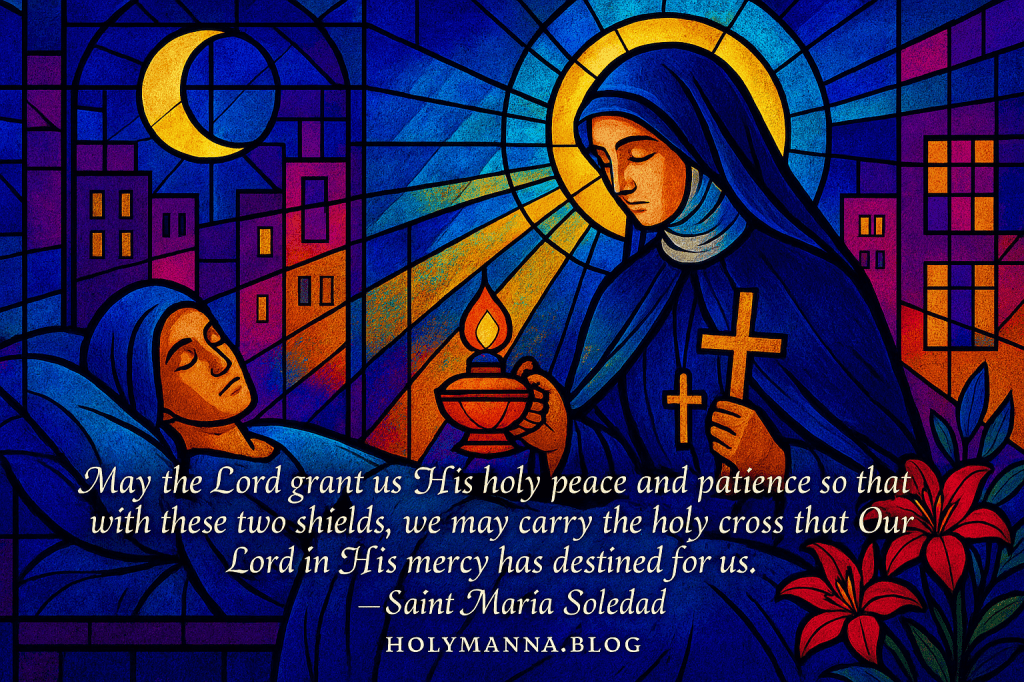
Saint María Soledad Torres Acosta, born in 1826 and called home to God on October 11, 1887, founded the Servants of Mary, Ministers to the Sick, whose distinctive charism was free, in-home night care for the poor and the infirm. She formed women who would carry lamps through dark streets, enter crowded apartments and humble dwellings, and keep prayerful watch beside bedsides until dawn. Rooted in Eucharistic adoration and a tender love for Our Lady, she taught that the sick are living images of Christ and that nursing, offered in faith, becomes a liturgy of charity. Her witness anticipated modern home health care while remaining thoroughly evangelical. In her letters she exhorted her Sisters with the humble confidence of a mother who trusted Providence, writing, “May the Lord grant us His holy peace and patience so that with these two shields, we may carry the holy cross that Our Lord in His mercy has destined for us.”
From Manuela to María Soledad
Baptized Antonia Bibiana Manuela in Madrid, she grew up in a modest home where faith, work, and neighborly kindness shaped her imagination. From girlhood she visited the sick with local charitable groups and learned to recognize Christ in the most vulnerable. Drawn first to contemplative life, she discerned that God was asking for something different and more immediately responsive to the sufferings of her city. When the parish priest of Chamberí, Fr. Miguel Martínez Sanz, gathered a small group of women in 1851 to serve the sick in their own homes, Manuela answered at once. She received the habit on August 15 and took the name María Soledad. This name, invoking Our Lady of Sorrows, foreshadowed a vocation of standing at the foot of many crosses. Under her steady guidance the Servants of Mary embraced a rhythm of prayer, work, and night vigils. They went wherever they were called, regardless of a patient’s background, because charity is universal and the image of God shines in every person.
Night Angels of Mercy
Mother Soledad insisted that every Sister begin with the tabernacle and return to it after service, so that Christ in the Eucharist would be the source and summit of Christ in the suffering neighbor. During outbreaks of contagious disease in Madrid, including cholera in the 1860s, the Sisters became known for courage that did not shrink from risk. The congregation’s records describe countless scenes in which a Sister’s calm presence stabilized a frantic household, a whispered prayer reconciled a patient to God, or a night of careful nursing turned a corner in illness when doctors could do little more. While sensational claims do not define her life, the daily “miracles” of patience, cleanliness, nutrition, and prayer changed outcomes for the poor. She formed her daughters to move quietly, speak gently, and let their hands reveal the tenderness of Christ. She often repeated that peace and patience are the shields of the cross, and she taught her Sisters to keep those shields always at the ready.
Trial by Fire
The early years were marked by uncertainty and contradiction. When Fr. Martínez left for the missions in Africa, the fledgling institute faced leadership struggles, misunderstandings, and calumny. At one point María Soledad was removed from office and the very survival of the congregation was questioned. She responded with prayer, silence, obedience, and charity, trusting that truth would emerge in God’s time. After an ecclesial review she was reinstated and confirmed as the rightful superior. Political turbulence also tested the Servants of Mary. In the climate of anticlerical suspicion surrounding the Revolution of 1868, religious houses faced scrutiny and closures. Mother Soledad navigated these storms with prudence and courage, safeguarding the Sisters, consolidating their foundations, and insisting that no external pressure should extinguish the interior fire of charity. Her trials matured the institute and purified its mission. She showed that sanctity is not a path of ease but of fidelity.
A Charism That Spread Like Light
The charism of night service for the sick drew generous hearts. New houses opened across Spain, and then overseas as requests arrived from far-flung communities that lacked medical care for the poor. By the mid 1870s the Servants of Mary were present in the Caribbean and continued to grow. Formation included catechesis, basic nursing, and a spirituality centered on the Eucharist, the Rosary, and hidden service. Mother Soledad remained a simple, practical superior who prioritized holiness over human success, yet God blessed the work abundantly. She died in Madrid on October 11, 1887, after ensuring that her Sisters would remain faithful to the original grace: to enter homes as messengers of mercy, to care through the night, and to leave before sunrise without fanfare. Her tomb quickly became a place of prayer for the sick and those who care for them.
Signs from Heaven
After her death, reports of favors through her intercession multiplied, especially healings that medical science could not explain. The Church examined several of these cures with rigor during the causes for her beatification and canonization. Testimonies spoke of serious illnesses resolved suddenly and completely after prayers to Mother Soledad, including conditions of the lungs and ear disease, as well as dramatic recoveries of infants whose lives hung in the balance. These graces were recognized as signs that God wished to confirm her life of humble love. She was beatified in 1950 and canonized in 1970. Her liturgical memorial on October 11 invites the whole Church to rediscover the Gospel power of visiting the sick, comforting families, and serving quietly where suffering is greatest.
Why She Matters Now
Saint María Soledad is a luminous commentary on The Catechism of the Catholic Church. The Catechism teaches, “The works of mercy are charitable actions by which we come to the aid of our neighbor in his spiritual and bodily necessities.” This is precisely the road she walked and taught others to walk. The mystery of Christ’s compassion for the sick remains alive in the Church, and God raises up saints to show each generation what that compassion looks like in practice. Canonization proposes the saints as models and intercessors so that our hope may be strengthened and our charity refined. To imitate her is to let the Eucharist send us outward, to make room in our schedules and homes for those who are ill or alone, and to transform ordinary care into a sacrament of God’s tenderness for the world.
Keeping Vigil With Christ
Her legacy challenges us to love in the off hours, when it is least convenient and most needed. Begin with prayer before the Blessed Sacrament, ask Our Lady to lend you her steadfast heart, and then offer practical help to someone who is suffering. Call the relative you have postponed calling. Sit with a friend who is navigating treatment. Support a parish ministry that visits the homebound. Invite Saint María Soledad’s intercession when patience runs thin. She will teach you to carry the shields of peace and patience and to discover that Christ is already waiting for you in the person who needs your presence.
Engage with Us!
We would love to hear how Saint María Soledad inspires you. Share your thoughts and prayer intentions in the comments below.
- Where is Christ inviting you to “keep vigil” with someone who is suffering right now?
- How can you bring Eucharistic love into your caregiving, your work, or your neighborhood this week?
- Which work of mercy is hardest for you at the moment, and how might Saint María Soledad help you practice it with joy?
- What small act of hidden service can you offer today for someone who cannot repay you?
Go forth encouraged. Live a life of faith, and do everything with the love and mercy Jesus taught us.
Saint María Soledad, pray for us!
Follow us on Instagram and Facebook for more insights and reflections on living a faith-filled life.

 Holy Manna!
Leave a comment