A Crown Won on Montmartre
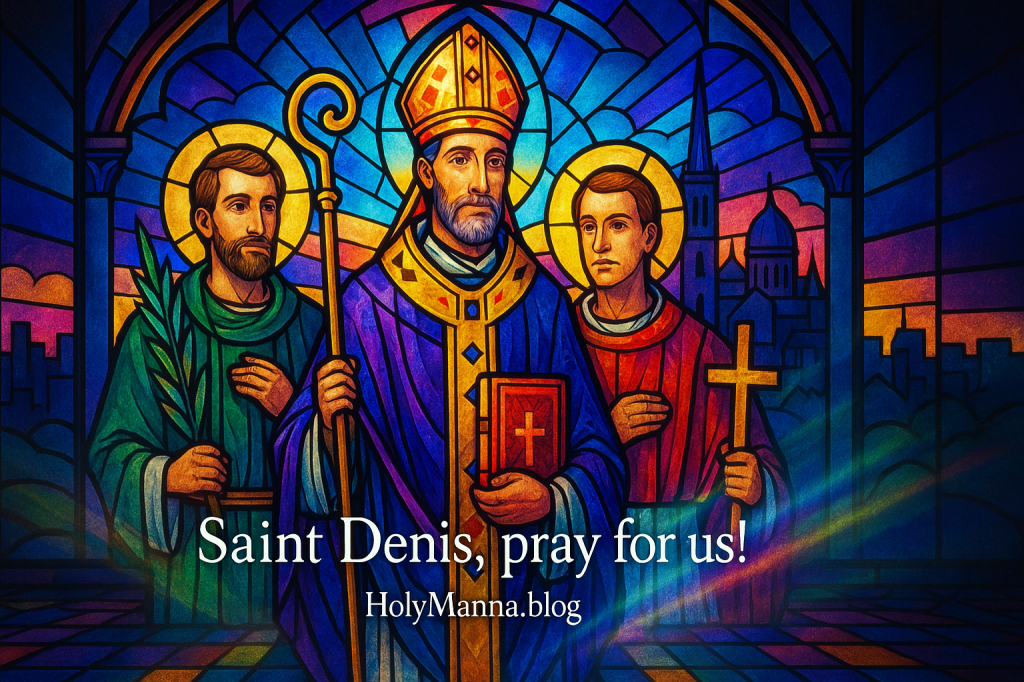
Saint Denis of Paris, together with his companions Rusticus the priest and Eleutherius the deacon, is remembered as one of the great missionary founders of the Church in Roman Gaul. As the first bishop of Paris, Denis preached Christ openly in the bustling river city of Lutetia and gathered a community around the Eucharist that would become the heart of Christian Paris. He is venerated as patron of Paris and honored across the Church for an unwavering apostolic courage that culminated in martyrdom. The Church teaches that the martyr’s witness is the highest proof of love for Christ. “Martyrdom is the supreme witness given to the truth of the faith.” (Catechism of the Catholic Church 2473). His tomb gave rise to the famed Basilica of Saint-Denis, a place where faith, art, and history met in luminous praise of God.
Sent to the Parisii
Very little can be said with certainty about Denis before his mission. Early Christian memory places his origins in the Latin West and remembers him as a bishop appointed to shepherd and evangelize the Parisii sometime in the mid third century. He did not arrive alone. With him came Rusticus, a priest, and Eleutherius, a deacon, who shared his daily labor of preaching, teaching, and serving the poor. The mission likely formed part of a broader effort by the Church to strengthen the faith in Gaul during years marked by both growth and persecution. What we can say confidently is that Denis and his companions established stable Christian worship on the Île de la Cité and nearby quarters, celebrated the sacraments, instructed catechumens, and modeled that apostolic pattern that still shapes parish life today. To avoid confusion that arose in the Middle Ages, it is important to note that Saint Denis of Paris is not the same person as Dionysius the Areopagite from Acts of the Apostles 17. There are no verified, direct quotations from Saint Denis or from Rusticus and Eleutherius that survive to us.
Planting the Gospel in Lutetia
Denis’ legacy rests above all in faithful evangelization. He preached Christ crucified and risen in a city devoted to many gods and won converts through patient instruction and sacramental grace. The community that formed around him learned to live a new way in Christ, gathering for the breaking of the bread and for the works of mercy that marked early Christian life. Tradition remembers conversions that followed his preaching and healings that accompanied prayer in Christ’s name. While details are sparse in early records, the picture is clear. Denis taught the truth with charity, governed the community as a father, and sanctified the flock through the liturgy. That is why his memory endures. The saints matter because they show us how discipleship actually looks. The Church reminds us that their example strengthens our hope. “By their example they stimulate us and by their fraternal concern they help us.” (Catechism of the Catholic Church 956).
Witness on the Hill of the Martyrs
Opposition grew as the Christian faith spread. Denis, Rusticus, and Eleutherius were arrested and endured interrogation and abuse. The exact imperial edict and civil authority responsible are debated by historians, but the Church’s memory firmly locates their execution in the middle years of the third century. They were condemned to death by beheading. Tradition places the martyrdom on the heights north of the city that later came to be called Montmartre, the hill of the martyrs. Their death was not a defeat but a consummation of their preaching, since they sealed their words with their blood. The Beatitudes illuminate what happened. “Blessed are those who are persecuted for righteousness’ sake, for theirs is the kingdom of heaven.” (Mt 5:10). A medieval legend later embroidered the scene by saying that Denis, after decapitation, rose, took his head in his hands, and continued praising God as he walked to the place where he wished to be buried. The Church distinguishes legend from verifiable history, yet recognizes how such stories reflect the depth of devotion that surrounded the martyrs.
A Shrine of Light and a River of Favors
Veneration began immediately at the martyrs’ burial site. Christians gathered there to pray and to ask the intercession of Denis and his companions. Over time a memorial chapel rose, then an abbey, and eventually the great Abbey and Basilica of Saint-Denis. Pilgrims traveled from near and far to pray at the tombs, and many spoke of healings and spiritual consolations received through the martyrs’ prayers. As centuries passed, the basilica became the burial place for the kings and queens of France, which only increased the flow of pilgrims and the renown of the shrine. The luminous architecture that crowned the site signaled a theological truth. The saints are windows of grace through whom the light of Christ shines into history. The Catechism captures this conviction beautifully. “Because the saints are closely united to Christ, they do not cease to intercede for us.” (Catechism of the Catholic Church 956). The faithful continue to honor Denis, Rusticus, and Eleutherius on October 9, asking their help to confess Christ with clarity and courage.
How Saint Denis Shapes Our Discipleship
Saint Denis and his companions exemplify missionary friendship with Jesus. They prayed, preached, suffered, and loved together. Their story teaches three simple lessons for us. First, keep the Eucharist at the center. Denis built the Church in Paris by forming a community around Word and Sacrament. Make Sunday Mass the anchor of your week and let the grace of the altar overflow into your home and work. Second, witness publicly with humility. The martyrs did not hide their faith when it cost them. Ask for the gift of holy boldness and speak of Christ with reverent confidence. Third, live communion. Denis did not evangelize alone. He shared the mission with Rusticus and Eleutherius. Find companions, perhaps in your parish or small group, with whom you can pray, serve, and persevere. The Church’s teaching on martyrdom gives the horizon. “Martyrdom is a gift from God, an expression of love to the end.” (Catechism of the Catholic Church 2473–2474). Trust that God will give you the grace to be faithful in the ordinary trials of each day, which are the training ground for extraordinary love.
Engage with Us!
I would love to hear your reflections in the comments. Your story helps others find courage.
- Where is God asking you to witness to Christ with greater courage this week, and what is one concrete step you will take?
- How can you make your home or parish more missionary in spirit, inspired by Saint Denis and his companions?
- Which beatitude challenges you most right now, and how can the martyrs’ example help you live it?
- What pilgrimage or shrine has strengthened your faith, and why?
Go forward strengthened by the martyrs’ example. Live a life of faith, and do everything with the love and mercy Jesus taught us.
Saint Denis, pray for us!
Follow us on Instagram and Facebook for more insights and reflections on living a faith-filled life.

 Holy Manna!
Leave a comment