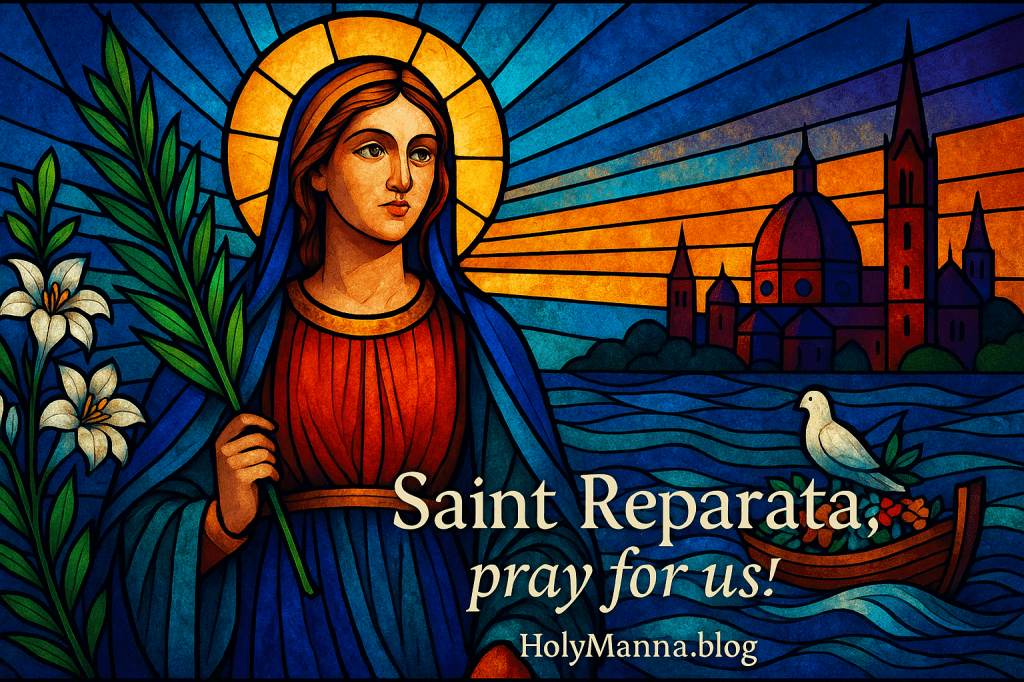
A Radiant Patroness of Courage
Saint Reparata shines in Christian memory as a youthful virgin martyr from Caesarea Maritima in the Roman Empire whose steadfast love for Jesus inspired perennial devotion across the Mediterranean. She is especially honored in Florence and in Nice, where her name and intercession became woven into civic gratitude and Christian identity. Her feast is celebrated on October 8. The Church venerates her for purity of heart, fearless confession of Christ, and the mysterious way God magnified her hidden life. The very meaning of her name, drawn from Latin, evokes “restoration,” a fitting image for a martyr through whom God restored courage to the fearful and hope to entire cities. The Catechism of the Catholic Church reminds us that the saints’ holiness is a sign of Christ’s presence in his Church and a call to all the faithful to pursue charity without compromise (CCC 828).
From Caesarea’s Shores to the Heart of the Church
While precise biographical data are scarce, ancient tradition situates Reparata in Caesarea Maritima during the mid third century, the era marked by the Decian persecution. Accounts preserved in later passiones describe her as a young Christian who confessed Jesus publicly when summoned before Roman authorities. The early Church treasured such testimonies not as folklore but as living catechesis for the baptized. In Reparata’s case, the Church remembers a girl of humble station whose fidelity outweighed the coercive weight of empire. There are no authenticated sayings from Saint Reparata that survive, which is not unusual for early martyrs. The silence of her own recorded voice invites us to listen instead to the eloquence of her actions, what the Catechism calls “the supreme witness given to the truth of the faith.” (CCC 2473)
Preserved Through Fire
Traditional narratives recount that Reparata’s refusal to deny Christ led to a sequence of torments. She was cast into a blazing furnace yet was not consumed. She was forced to drink boiling pitch and was preserved from mortal harm. These dramatic scenes were not retold to dazzle but to manifest what the Church confesses about divine providence and the power of grace in the weakest vessels. The miracles attributed to her during life show a pattern familiar in early martyr acts: God vindicates the humble, confounds cruelty, and sustains his servant until the hour appointed. The point is not spectacle but sanctity. Reparata’s courage teaches us to prize the friendship of Christ above comfort, reputation, or safety, and to trust that the Lord is near in trial as truly as in triumph.
The Crown of Witness
Eventually the authorities executed for her unyielding confession of Jesus. The tradition holds that she was beheaded, offering her life in union with the Lamb. The Church understands martyrdom as a grace that configures a disciple to the Paschal Mystery. “Martyrdom is the supreme witness given to the truth of the faith: it means bearing witness even unto death.” (CCC 2473) In this the young saint becomes a teacher of fortitude. She shows that fidelity does not rage against persecutors but rests in the Lord, choosing love of God over fear. Her martyrdom is not a defeat but a liturgy of victory, a confession that Jesus is Lord of history and of every human heart.
A Saint Who Sheltered Cities
The memory of Reparata’s help flowered after her death in ways that shaped Christian Europe. Florence long thanked Saint Reparata for heavenly aid during a perilous invasion in late antiquity and dedicated its ancient cathedral to her, a basilica whose archeological remains still lie beneath the floor of today’s Santa Maria del Fiore. For centuries the city marked her feast with solemn liturgy and civic thanksgiving, acknowledging that God often protects communities through the intercession of the saints. In Nice, a venerable tradition tells how her body, placed in a small boat adorned with flowers and guided by a dove, reached the shore where the faithful received her as their heavenly patroness. The Cathedral of Saint Reparata in the old city became a focus of pilgrimage and prayer, and healings have been reported through her intercession. The Catechism explains that the saints “do not cease to intercede with the Father for us” and that popular piety, including pilgrimages and the veneration of relics, is a fruitful expression of the Church’s life in the Spirit (CCC 956; 1674–1676).
Lessons for Today
Reparata’s life teaches several lessons that are strikingly contemporary. First, Christian purity is not a negation but a wholehearted yes to the Lord who alone satisfies the heart. Second, youthful courage can evangelize entire cultures when it is rooted in prayer and the sacraments. Third, obscure fidelity matters. God delights to work through the hidden and the small. The communion of saints means we are never alone in this school of charity. Ask Saint Reparata to obtain for you a bright love of Jesus, a quiet strength in trials, and a cheerful readiness to be counted as his disciple. How does her youthful steadfastness challenge the compromises you may be tempted to make? The Catechism invites us to live this communion daily through prayer, sacramental life, and works of mercy (CCC 946–957, 2044–2046).
Engage with Us!
- Where is Christ inviting you to bear a clearer witness to the truth this week, even if it costs you comfort or reputation?
- What concrete practice of purity or simplicity can you adopt in honor of Saint Reparata’s virginity and single-hearted love for Jesus?
- How might you bring your city, parish, or family under the protection of the saints through intercession and pilgrimage this month?
Be encouraged to live your faith boldly, love generously, and entrust everything to Jesus, whose mercy makes saints and turns small acts of fidelity into light for the world.
Saint Reparata, pray for us!
Follow us on Instagram and Facebook for more insights and reflections on living a faith-filled life.

 Holy Manna!
Leave a comment