Wednesday of the Twenty-seventh Week in Ordinary Time – Lectionary: 463
The Wide Mercy of the Father
Enter today with open hands and a willing heart, ready to let the Father teach you how to love as He loves. The readings move from a prophet’s clenched fists to the Son’s open-handed prayer. In Jonah 4, the reluctant prophet fumes when God spares Nineveh, the storied Assyrian capital known for its power and violence. Jonah had preached judgment and then waited for fire, but God reveals a heart that is “gracious and merciful, slow to anger, abounding in kindness.” Jonah grieves a withered plant more than a city of souls, and the Lord exposes this narrowness to invite him into divine compassion. Psalm 86 answers that invitation with worship: “Lord, you are good and forgiving” and “All the nations you have made shall come to bow before you”, a vision of universal praise that stretches far beyond the borders of Israel. In Luke 11:1–4, Jesus gives the pattern that forms such a heart. The Our Father is not simply words to recite. It is the school of the Father’s mind. We ask that His name be hallowed and His Kingdom come, which aligns our desires with His saving will for every person. We ask for daily bread, confessing our dependence on His providence, a thread that runs from Israel’s manna in the wilderness to our need today. We beg for forgiveness while binding ourselves to the same mercy for others: “for we ourselves forgive everyone in debt to us”. The Church teaches that God “desires all men to be saved,” and that His Kingdom is realized when our hearts surrender to that will (CCC 2822). She also insists that God’s mercy cannot flood our lives unless we choose to forgive from the heart (CCC 2840). Taken together, these texts show that prayer is not an escape from the world. It is the place where the Father reshapes our vision, widens our compassion, and equips us to love even Nineveh. Where is the Father inviting you today to forgive, to trust His daily care, and to pray until your heart looks like His?
First Reading – Jonah 4
A Prophet Schooled by Mercy
Jonah’s final chapter takes us to the edge of Nineveh, the capital of Assyria, a people infamous in the ancient Near East for conquest and cruelty. Israel feared Assyria, and Jonah reflects that national memory. Yet God sends him to preach repentance, and Nineveh responds. Jonah wants justice as he imagines it, but God reveals a justice suffused with mercy. In this scene of a hut, a plant, a worm, and a hot wind, the Lord trains Jonah’s heart. He exposes how easily we prize our comforts while overlooking souls. This reading sits at the heart of today’s theme because it dramatizes the Father’s universal compassion and calls our prayer to align with it. As we will pray in Luke 11:1–4, the Kingdom comes when our hearts learn to forgive and to desire each person’s salvation. Will you let the Father teach you to love even your Nineveh today?
Jonah 4
New American Bible (Revised Edition)
Jonah’s Anger and God’s Reproof. 1 But this greatly displeased Jonah, and he became angry. 2 He prayed to the Lord, “O Lord, is this not what I said while I was still in my own country? This is why I fled at first toward Tarshish. I knew that you are a gracious and merciful God, slow to anger, abounding in kindness, repenting of punishment. 3 So now, Lord, please take my life from me; for it is better for me to die than to live.” 4 But the Lord asked, “Are you right to be angry?”
5 Jonah then left the city for a place to the east of it, where he built himself a hut and waited under it in the shade, to see what would happen to the city. 6 Then the Lord God provided a gourd plant. And when it grew up over Jonah’s head, giving shade that relieved him of any discomfort, Jonah was greatly delighted with the plant. 7 But the next morning at dawn God provided a worm that attacked the plant, so that it withered. 8 And when the sun arose, God provided a scorching east wind; and the sun beat upon Jonah’s head till he became faint. Then he wished for death, saying, “It is better for me to die than to live.”
9 But God said to Jonah, “Do you have a right to be angry over the gourd plant?” Jonah answered, “I have a right to be angry—angry enough to die.” 10 Then the Lord said, “You are concerned over the gourd plant which cost you no effort and which you did not grow; it came up in one night and in one night it perished. 11 And should I not be concerned over the great city of Nineveh, in which there are more than a hundred and twenty thousand persons who cannot know their right hand from their left, not to mention all the animals?”
Detailed Exegesis
Verse 1 – “But this greatly displeased Jonah, and he became angry.”
Jonah is scandalized by divine mercy. His anger reveals a heart that confuses zeal for righteousness with resentment toward sinners. The prophet’s reaction invites us to examine the gap between our preferences and God’s saving will.
Verse 2 – “He prayed to the Lord, ‘O Lord, is this not what I said while I was still in my own country? This is why I fled at first toward Tarshish. I knew that you are a gracious and merciful God, slow to anger, abounding in kindness, repenting of punishment.’”
Jonah quotes the classic creed of Israel from Exodus 34:6. He knows God’s character, yet he resists its implications for Nineveh. The verse lays bare a spiritual paradox: we rely on God’s mercy for ourselves while balking at its breadth for others.
Verse 3 – “So now, Lord, please take my life from me; for it is better for me to die than to live.”
This despair shows how pride narrows vision. Jonah would rather die than see his enemies live. The plea exposes how disordered loves can eclipse the divine perspective.
Verse 4 – “But the Lord asked, ‘Are you right to be angry?’”
God’s question is pastoral and probing. He does not crush Jonah. He invites him into examination, the first step of conversion. The Father educates the conscience with gentle truth.
Verse 5 – “Jonah then left the city for a place to the east of it, where he built himself a hut and waited under it in the shade, to see what would happen to the city.”
Jonah remains a spectator of judgment rather than a participant in mercy. The eastward vigil symbolizes a heart still oriented away from God’s purposes, clinging to the hope of retribution.
Verse 6 – “Then the Lord God provided a gourd plant. And when it grew up over Jonah’s head, giving shade that relieved him of any discomfort, Jonah was greatly delighted with the plant.”
God “provides” a living parable. The plant is a gratuitous gift that shelters Jonah. His joy over shade contrasts with his lack of joy over repentant souls. The verse exposes our tendency to prize created comforts more than the Creator’s loving plan.
Verse 7 – “But the next morning at dawn God provided a worm that attacked the plant, so that it withered.”
The same God who gives can remove, not to harm but to heal. The withering plant unmasks Jonah’s attachments. Divine pedagogy sometimes permits losses that reveal what we love most.
Verse 8 – “And when the sun arose, God provided a scorching east wind; and the sun beat upon Jonah’s head till he became faint. Then he wished for death, saying, ‘It is better for me to die than to live.’”
The “scorching east wind” intensifies the lesson. Jonah’s repeated death wish shows how unhealed anger can spiral into despair. Suffering without surrender hardens the heart.
Verse 9 – “But God said to Jonah, ‘Do you have a right to be angry over the gourd plant?’ Jonah answered, ‘I have a right to be angry, angry enough to die.’”
God focuses Jonah’s outrage on a small good to reveal the disproportion. Jonah confesses his absolutized grievance. The verse prepares the final divine argument from the lesser to the greater.
Verse 10 – “Then the Lord said, ‘You are concerned over the gourd plant which cost you no effort and which you did not grow; it came up in one night and in one night it perished.’”
God highlights the plant’s fragility and Jonah’s lack of investment. If Jonah can care for a fleeting comfort, how much more should God care for immortal souls.
Verse 11 – “And should I not be concerned over the great city of Nineveh, in which there are more than a hundred and twenty thousand persons who cannot know their right hand from their left, not to mention all the animals?”
The book ends with God’s unanswered question. Divine concern extends to the morally ignorant, to every person, and even to animals. God reveals the breadth of His providence and leaves the prophet, and us, to decide whether our hearts will widen to match His.
Teachings
Jonah 4 reveals the Father’s universal salvific will and His merciful pedagogy. The Church articulates this will in the Our Father’s petition that God’s will be done. “Our Father ‘desires all men to be saved and to come to the knowledge of the truth’ (1 Tim 2:3–4). He ‘is forbearing toward you, not wishing that any should perish’ (2 Pet 3:9). His commandment is ‘that you love one another; even as I have loved you, that you also love one another’ (Jn 13:34).” CCC 2822. Jonah’s resistance also exposes why mercy must transform us from within. “Now, and this is daunting, this outpouring of mercy cannot penetrate our hearts as long as we have not forgiven those who have offended us. Love, like the Body of Christ, is indivisible. We cannot love the God we cannot see if we do not love the brother or sister we do see. In refusing to forgive our brothers and sisters, our hearts are closed and their hardness makes them impervious to the Father’s merciful love. But in confessing our sins, our heart is opened to his grace.” CCC 2840. At the same time the Church professes the seriousness of rejecting grace. “God predestines no one to go to hell. For this, a willful turning away from God is necessary, and persistence in it until the end.” CCC 1037. Jonah’s lesson is therefore not sentimental. Mercy seeks conversion and life, not the denial of justice. In the schooling of the plant and the worm, we glimpse how God corrects His friends so that they may become co workers in His universal mission.
Reflection
God ends Jonah with a question rather than a period. That question now rests on us. Let the Father train your heart in three ways. First, pray the Our Father slowly and ask that His Kingdom come in the life of someone you struggle to love. Speak their name before God and ask for their good. Second, practice concrete mercy by forgiving a real debt today. Write down the offense, release it before the Lord, and if prudent, reconcile with the person. Third, hold your comforts lightly. Thank God for the “plants” that shade you, and bless Him if some are removed, trusting that He is forming a freer love in you. Who is your Nineveh today, and will you intercede rather than accuse? Where have you cared more for shade than for souls? How is the Father inviting you to forgive as you have been forgiven and to desire salvation for those you would rather avoid?
Responsorial Psalm – Psalm 86:3-6, 9-10
From Personal Plea to Universal Praise
This psalm, traditionally attributed to David, appears within Book Three of the Psalter as a humble “prayer” that gathers phrases and theology from Israel’s living memory. Its language echoes Exodus 34 and the liturgical confession that the Lord is gracious and merciful. Culturally, such a prayer would have been voiced by an individual who stands within the worshiping community, modeling how personal lament becomes communal trust and, finally, a vision of the nations streaming to adore the one true God. Religiously, the psalm moves from petition to praise, preparing our hearts to pray the words of Jesus in Luke 11:1–4 and to accept God’s universal mercy that stretches even to Nineveh in Jonah 4. In today’s theme, this psalm teaches us to call on the Lord without ceasing, to receive His forgiveness, and to anticipate the day when all nations bow before His name.
Psalm 86:3-6, 9-10
New American Bible (Revised Edition)
3 be gracious to me, Lord;
to you I call all the day.
4 Gladden the soul of your servant;
to you, Lord, I lift up my soul.
5 Lord, you are good and forgiving,
most merciful to all who call on you.
6 Lord, hear my prayer;
listen to my cry for help.
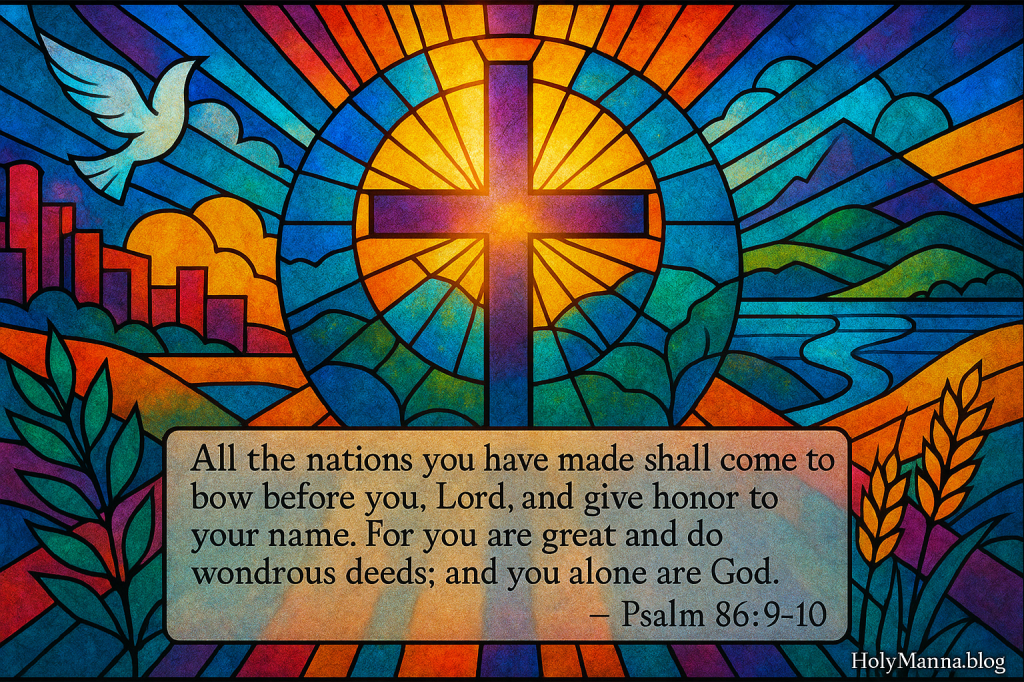
9 All the nations you have made shall come
to bow before you, Lord,
and give honor to your name.
10 For you are great and do wondrous deeds;
and you alone are God.
Detailed Exegesis
Verse 3 – “be gracious to me, Lord; to you I call all the day.”
The psalmist begins with continual petition. “All the day” signals perseverance, not panic. True prayer is steady trust that refuses despair. The request for grace acknowledges divine initiative. We do not manipulate God. We receive from Him.
Verse 4 – “Gladden the soul of your servant; to you, Lord, I lift up my soul.”
Joy is asked as a gift, not manufactured as a mood. “Lift up my soul” is worship language, placing the whole person before God. The servant’s identity is found in relation to the Lord, which is the foundation of all authentic prayer.
Verse 5 – “Lord, you are good and forgiving, most merciful to all who call on you.”
This confesses God’s character revealed to Moses and celebrated across Israel’s liturgy. The phrase “to all who call” widens the horizon. Mercy is not tribal property. It is the Father’s generosity offered to every supplicant who turns to Him.
Verse 6 – “Lord, hear my prayer; listen to my cry for help.”
The repetition “hear” and “listen” intensifies urgency while remaining filial. Petition is not a bargaining session. It is the child’s cry to the Father who cares. Honest need is not a lack of faith. It is faith expressing dependence.
Verse 9 – “All the nations you have made shall come to bow before you, Lord, and give honor to your name.”
Personal prayer opens into mission. The worship of Israel flowers into a universal procession. The Creator’s claim over “all the nations” grounds a hope that transcends politics and history. This line harmonizes with God’s question to Jonah about Nineveh and anticipates the Our Father’s “your kingdom come.”
Verse 10 – “For you are great and do wondrous deeds; and you alone are God.”
Praise culminates in doxology and confession of monotheism. Wonders recall the Exodus and every saving act. “You alone are God” purifies our attachments and exposes idols. Prayer ends not with our need but with His glory.
Teachings
The psalm’s movement from petition to praise mirrors the Church’s teaching on prayer. The Catechism, citing Saint John Damascene, defines prayer with luminous simplicity: “Prayer is the raising of one’s mind and heart to God or the requesting of good things from God.” CCC 2559. Praise is the most immediate recognition of who God is: “Praise is the form of prayer which recognizes most immediately that God is God.” CCC 2639. Adoration grounds this praise in humble truth: “To adore God is to acknowledge, in respect and absolute submission, the ‘nothingness of the creature’ who would not exist but for God.” CCC 2097. The horizon of verse 9 aligns with the divine will the Church professes in the Our Father, that all peoples be gathered into worship and salvation, as Scripture declares in 1 Timothy 2:4: “[God] desires all men to be saved and to come to the knowledge of the truth.” Saint Augustine gives voice to the heart that learns this posture before God: “You have made us for yourself, O Lord, and our heart is restless until it rests in you.” Confessions I, 1, 1. Together these teachings show why the psalmist’s cry is not self centered. Personal prayer is the doorway into universal praise and the Father’s merciful plan for every nation.
Reflection
Pray this psalm as a daily rhythm. Begin by naming your need before the Father and ask, “be gracious to me” with childlike confidence. Then “lift up your soul” by adoring God for who He is, not only for what He gives. Finally, widen your intercession beyond yourself to include someone you avoid, a rival you resent, or a people you fear. Ask that they join the procession of verse 9. Offer a concrete act today that matches your prayer, such as a hidden kindness or a word of forgiveness that costs you something. Let your doxology cleanse your priorities. If a worry rises, answer it with the confession, “you alone are God.” What would change if you called on the Lord “all the day” rather than only in emergencies? Whom is the Father inviting you to include in your prayer so that your personal plea becomes universal praise? Where might an act of adoration uproot an idol and make room for joy?
Holy Gospel – Luke 11:1-4
The School of the Father’s Heart
In the world of Second Temple Judaism, rabbis gathered disciples into distinct communities of prayer and practice. Each teacher formed followers not only in doctrine but in a way of praying that expressed a shared identity before God. When the disciple asks Jesus, “teach us to pray just as John taught his disciples,” he is asking to be shaped by the Son’s relationship with the Father. The response is the Church’s foundational prayer. It sets our priorities, purifies our desires, and widens our hearts to the scope of divine mercy revealed in Jonah 4 and celebrated in Psalm 86. The petitions move us from adoration to trust, from forgiveness received to forgiveness given, and from fear of trial to filial confidence. In today’s theme, the Our Father is the pattern that aligns us with the Father’s universal compassion and trains us to forgive as we have been forgiven.
Luke 11:1-4
New American Bible (Revised Edition)
The Lord’s Prayer. 1 He was praying in a certain place, and when he had finished, one of his disciples said to him, “Lord, teach us to pray just as John taught his disciples.” 2 He said to them, “When you pray, say:
Father, hallowed be your name,
your kingdom come.
3 Give us each day our daily bread
4 and forgive us our sins
for we ourselves forgive everyone in debt to us,
and do not subject us to the final test.”
Detailed Exegesis
Verse 1 – “He was praying in a certain place, and when he had finished, one of his disciples said to him, ‘Lord, teach us to pray just as John taught his disciples.’”
Jesus is found at prayer before He teaches prayer. The disciple does not request a technique but access to the Son’s filial intimacy. The comparison to John the Baptist reflects a Jewish pattern in which a master gives his followers a distinctive prayer, a sign of belonging and mission.
Verse 2 – “He said to them, ‘When you pray, say: Father, hallowed be your name, your kingdom come.’”
“Father” places us in Jesus’ own address to God. Sanctifying the name recognizes God’s holiness and asks that our lives mirror His glory. “Your kingdom come” aligns us with the saving will celebrated in Psalm 86 and defended by God in Jonah 4. It is a missionary petition that extends beyond the self to every soul.
Verse 3 – “Give us each day our daily bread.”
This acknowledges continual dependence. “Each day” teaches a rhythm of trust, not hoarding. The petition embraces both what sustains earthly life and, in the Church’s living tradition, points to the Bread of Life who makes us live by God. It forms hearts that receive rather than grasp.
Verse 4a – “and forgive us our sins for we ourselves forgive everyone in debt to us,”
Mercy received and mercy offered are inseparable. The “for” binds divine forgiveness to our willingness to forgive others. This is not a bargain but a transformation. God intends to reproduce His own merciful heart in His children.
Verse 4b – “and do not subject us to the final test.”
We ask not to be abandoned to temptation’s power. The prayer faces trial with humility and vigilance, confessing that perseverance is a gift. It orients us to discernment and to the grace that delivers from evil’s snares.
Teachings
The Church presents the Our Father as the heart of Christian prayer. “The Lord’s Prayer is truly the summary of the whole Gospel.” CCC 2759. Jesus invites living communion, not mere repetition. “But Jesus does not give us a formula to repeat mechanically.” CCC 2766. The petition for bread reaches to every need and, in the Church’s understanding, to the Eucharist itself. “The Greek word epiousios occurs nowhere else in the New Testament.” CCC 2837. The petition of forgiveness exposes why mercy must reshape us from within. “This outpouring of mercy cannot penetrate our hearts as long as we have not forgiven those who have offended us.” CCC 2840. The final petition cultivates realism about spiritual warfare. “This petition goes to the root of the preceding one, for our sins result from our consenting to temptation.” CCC 2846. Saint Thomas Aquinas marvels at the perfection of this prayer: “The Lord’s Prayer is the most perfect of prayers; for in it we ask not only for all the things we can rightly desire, but also in the order in which they should be desired.” ST II II, q.83, a.9. These teachings show how the Gospel today is not only an instruction but an initiation into the Son’s own filial posture before the Father, which overflows in universal mercy for all.
Reflection
Pray the Our Father slowly today as a training in love. Begin by pausing on “Father,” and ask for a child’s trust in every circumstance you face. Hallow His name by choosing one concrete act that honors God when no one is watching. Ask for daily bread by naming a specific need and by preparing to receive the Eucharist with renewed hunger if you are able to attend Mass. Then forgive a real debt. Speak a blessing over the person who has hurt you and ask for the grace to do one practical good for them if the moment is right. Finally, entrust your trials to the Father. Ask for discernment to avoid occasions of sin and for strength to endure unavoidable testing with fidelity. Where is the Spirit inviting you to exchange self reliance for filial trust? Whom must you forgive so that the Father’s mercy can find room in you? What daily bread do you need to ask for with confidence today, and from what temptation do you need to flee by His grace?
Hearts Wide Like the Father’s
Today God invites us into the school of His mercy. In Jonah 4 He asks the piercing question “Are you right to be angry?” and reveals a love that cares for every soul, even those we call enemies. In Psalm 86:3–6, 9–10 the Church learns to lift up her voice with confidence, confessing “Lord, you are good and forgiving, most merciful to all who call on you.” In Luke 11:1–4 Jesus hands us the pattern of a transformed life in the Our Father, where we seek the sanctifying of God’s name, the coming of His Kingdom, the bread we need each day, the mercy that we both receive and extend, and deliverance in trial. The Catechism gathers these threads when it teaches that God “desires all men to be saved” and that the Father’s mercy cannot flood our hearts unless we forgive from the heart (CCC 2822, CCC 2840).
Let this word become life. Pray the Our Father slowly and let each petition shape your next faithful step. Ask the Spirit to show you one person who has become your Nineveh and speak a blessing over them. Entrust your needs to the Father without fear and choose one concrete act that hallows His name in secret. If resentment surfaces, answer it with forgiveness and the confession that He alone is God. Whom is the Father asking you to forgive today so that His mercy can move freely in you? Where do you need to trust Him for daily bread rather than grasping for control? How will you pray until your heart learns to love as He loves?
Engage with Us!
We would love to hear from you in the comments below. Share how the Lord spoke to your heart through today’s Word and how you plan to respond.
- First Reading – Jonah 4: Where is the Father inviting you to release anger and choose mercy toward someone you struggle to love? How might the Lord be using a recent disappointment to teach your heart compassion for souls rather than comfort for yourself? What practical step will you take today to intercede for your own Nineveh?
- Responsorial Psalm – Psalm 86:3-6, 9-10: How can you build a simple rhythm of calling on the Lord throughout the day with trust and perseverance? Whom will you intentionally include in your prayer so that it widens into praise for all nations? What act of adoration can you offer that places God first in a concrete way?
- Holy Gospel – Luke 11:1-4: Which petition of the Our Father is the Spirit highlighting for you right now? Whom do you need to forgive so that the Father’s mercy can move freely in your heart? What daily bread do you need to entrust to Him today, and from what temptation do you need His deliverance?
Go forward with courage. Live a life of faith that hallows the Father’s name, seeks His Kingdom, receives and gives mercy, and faces every trial with trust. Do everything with the love and mercy Jesus taught us.
Sacred Heart of Jesus, we trust in You!
Immaculate Heart of Mary, pray for us!
Saint Michael the Archangel, defend us in battle!
Follow us on Instagram and Facebook for more insights and reflections on living a faith-filled life.

 Holy Manna!
Leave a comment