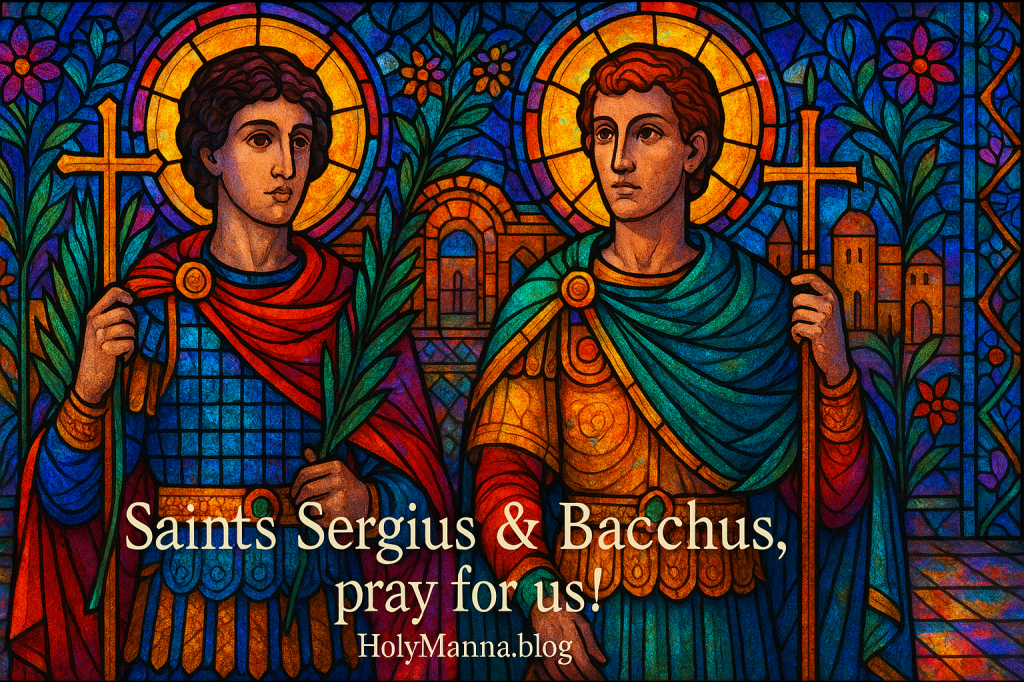
Brothers in Arms for Christ
Sergius and Bacchus are revered as fourth century Roman military martyrs whose steadfast friendship and fearless confession of Jesus Christ turned humiliation into glory. They are honored across the Christian world as patrons of soldiers and defenders of the faith, and their cult spread quickly from Syria throughout the Byzantine East and into Rome. Their story presents a radiant picture of loyal friends who kept faith in a hostile environment, showing that courage, fidelity, and charity can flourish even within the ranks of an imperial army. Their feast is kept on October 7 in the Roman Martyrology and throughout many Eastern churches, and they remain enduring signs of Christian friendship ordered to Christ.
From the Legion to the Lord
The earliest accounts do not preserve the saints’ birthplaces or family backgrounds, yet they agree that Sergius and Bacchus were high ranking officers who served near the imperial court in the East during the years surrounding the Diocletianic persecutions and the reign of Galerius. They were admired for competence and integrity, but their deepest identity was hidden. They were followers of Jesus who refused to burn incense to the emperor’s gods, a refusal that exposed them to charges of impiety and disloyalty. Tradition remembers that their refusal came to light when they would not participate in a state ceremony honoring Jupiter. Their superiors responded with calculated public shame, dressing them in women’s garments to mock them before the ranks, chaining them, and marching them through the streets. Even then they confessed Christ with calm resolve. What they are most known for is not battlefield heroism but the quiet heroism of disciples who obeyed God rather than men and who accepted disgrace for the sake of the Gospel. No personal writings of Sergius or Bacchus survive, and no verified personal sayings are preserved. What remains is the luminous record of their deeds and the Church’s memory of their witness.
A Holy Friendship Tested by Fire
The life of these saints matters because it shows how grace transfigures duty, honor, and friendship. In an environment shaped by ambition and fear, Sergius and Bacchus treated their comrades with justice, prayed in secret, and strengthened one another to remain faithful. Their companionship was not merely affectionate. It was a school of courage that prepared them to stand firm when the cost of discipleship became public. Although no historically secure miracles are recorded during their earthly life, the tradition highlights how God sustained them interiorly. Their endurance, their serenity in the face of humiliation, and their refusal to retaliate became a sign that the Holy Spirit was at work in them. Their example calls us to cultivate friendships that make holiness possible, to practice daily fidelity in small things so that we can be faithful in great trials, and to let our baptismal allegiance to Christ govern every lesser loyalty.
Humiliation, Iron Shoes, and the Crown
The persecution intensified quickly. Bacchus was scourged so savagely that he died from the blows. Sergius was forced to put on iron shoes that had their soles studded with nails and was driven under guard along the Syrian roads to the city of Resafa. There he was beheaded for refusing to deny Christ. The ancient Passion recounts that after Bacchus’s death he appeared to Sergius in a vision that strengthened him to endure his final trial. Whether in the courtroom, on the road, or at the place of execution, the saints bore witness to the same truth that shaped the early Church. For to me to live is Christ and to die is gain. Philippians 1:21. The Church summarizes this witness with clarity in the Catechism of the Catholic Church: “Martyrdom is the supreme witness given to the truth of the faith: it means bearing witness even unto death.” CCC 2473. The Catechism notes that the Church has preserved the Acts of the Martyrs so that the faithful may remember and imitate their constancy. “The Church has painstakingly collected the records of those who persevered to the end in witnessing to their faith.” CCC 2474.
Sergiopolis and the River of Miracles
After their deaths, devotion to Sergius and Bacchus blossomed throughout Syria and beyond. Resafa, the site of Sergius’s martyrdom, became known as Sergiopolis, a great pilgrimage center where the faithful sought healing and protection through the saints’ intercession. Pilgrims reported cures of illness and freedom from afflictions, and soldiers and travelers invoked the martyrs for safety on the road and courage in danger. The Byzantine emperor Justinian honored their memory on an imperial scale. He fortified Sergiopolis to safeguard its shrine and he dedicated in Constantinople the renowned Church of Saints Sergius and Bacchus, a jewel of early Byzantine architecture known today as the Little Hagia Sophia. Across the centuries churches and chapels bearing their names rose from the Levant to Rome, and the saints’ relics were venerated as tangible signs of their nearness. The Catechism explains why such veneration matters. “Being more closely united to Christ, those who dwell in heaven fix the whole Church more firmly in holiness.” It adds that the saints “do not cease to intercede with the Father for us.” CCC 956. Their cult thus expresses the communion of saints, in which the triumph of the martyrs strengthens the perseverance of the faithful.
Marching Orders for the Modern Disciple
Sergius and Bacchus teach that discipleship is public, courageous, and sustained by grace given through the communion of saints. Their friendship shows how God uses loyal companions to make us steadfast when the world mocks our convictions. Their refusal to offer even a pinch of incense to false gods challenges us to renounce modern idols that demand quiet compromise. Their serenity under shame calls us to patience when our fidelity to Christ costs reputation, comfort, or advancement. The Catechism reminds us that holiness is the Church’s true beauty. “By canonizing some of the faithful, the Church recognizes the power of the Spirit of holiness within her.” CCC 828. It also reminds us that friendship belongs at the heart of Christian life. “The virtue of chastity blossoms in friendship.” It teaches the disciple to imitate the Lord who “has chosen us as his friends.” CCC 2347. Ask Saints Sergius and Bacchus to shape your friendships into schools of virtue, to steady your steps when ridicule stings, and to obtain for you a soldier’s courage and a saint’s joy.
Engage with Us!
Share your thoughts and prayer intentions in the comments below.
- Where do you feel pressured to “fit in” rather than to live as a disciple of Jesus, and how can the courage of Sergius and Bacchus help you today?
- What friendships in your life call you to holiness, and how can you strengthen them through prayer and sacrifice this week?
- How does the Church’s teaching on martyrdom in CCC 2473–2474 challenge or encourage your daily witness to Christ?
Go forth encouraged. Live your faith with mercy and strength, let your friendship be a school of holiness, and let everything you do be done in the love and compassion Jesus taught us.
Saints Sergius & Bacchus, pray for us!
Follow us on Instagram and Facebook for more insights and reflections on living a faith-filled life.

 Holy Manna!
Leave a comment